The hidden cost of running your community across too many tools
TL;DR
- Tool sprawl starts as a series of reasonable choices, then turns into hidden costs across subscriptions, time, retention, and brand trust.
- Consolidation pays off most when community, courses, events, email, payments, and member data run from one source of truth.
- The switch is usually less painful than the fear of it, especially when a migration keeps members and payments intact.
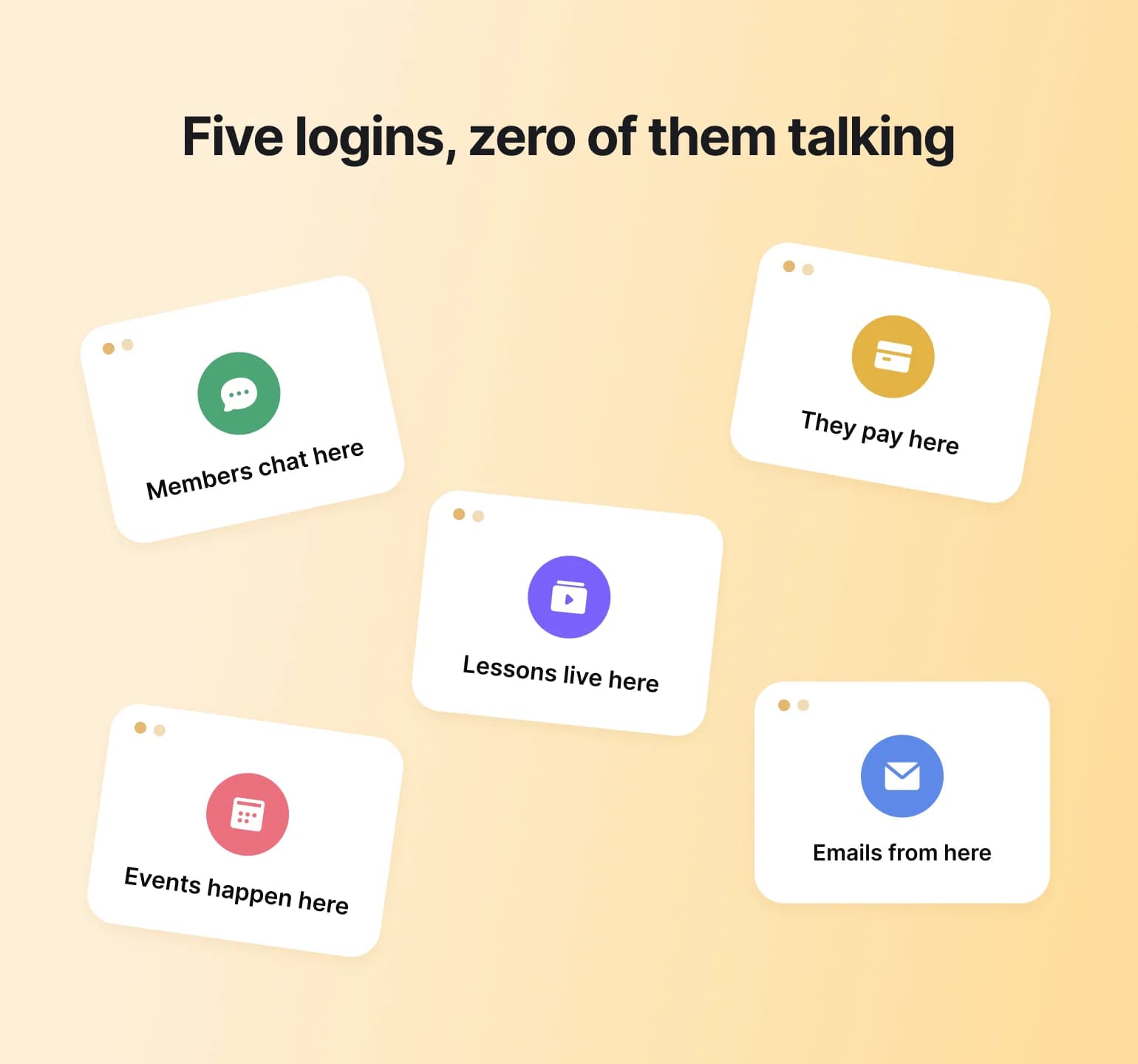
"I just want them on one platform, and I can see what they're all doing at one time." That's how one operator described her community on a sales call, and if you run a paid community, you know the feeling exactly. Members chat in one app. They pay through a second. Lessons live in a third, events in a fourth, and your emails go out from a fifth. Five logins, five dashboards, and no single screen that shows what any of them are actually doing.
Nobody decides to run a business this way. It happens one reasonable yes at a time, and by the time you notice, the patchwork is charging you in four ways: in subscriptions, in time, in the members who quietly leave, and in a brand that stops feeling like one business. Here's what each of those costs actually looks like, and what changes when one platform does the job of all of them.
The stack that felt free
Every tool in your stack was a reasonable yes at the time. You needed a chat app, then an email tool, then a course platform, and each purchase solved a real problem the day you bought it.
A creator business can stretch across social, websites, emails, payments, community, courses, events, and automation, and you end up duplicating work across separate systems. Nobody chooses sprawl. You just keep saying yes, and one day you look up and you've built an ugly-ish business, held together with duct-tape and hope.
The subscriptions you stopped noticing
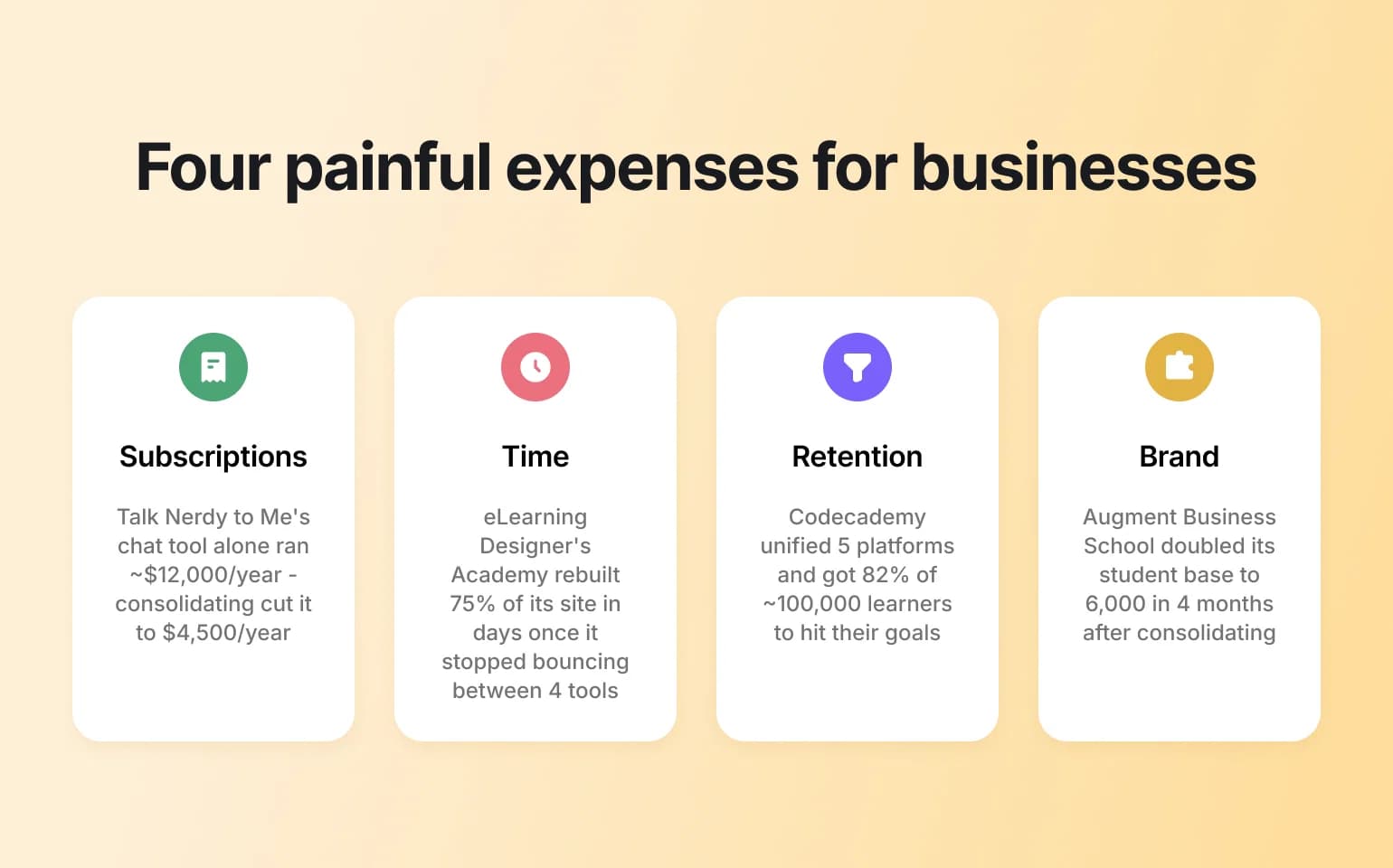
Start with the cost hiding on your credit-card statement. Stacked line items quietly add up to more than one platform would cost, and no single bill is big enough to make you flinch, so they all keep running. That was the story at Talk Nerdy to Me, an accounting-education community whose chat-tool bill climbed to roughly $12,000 a year, with one month spiking to $3,000. By consolidating onto one platform and replacing his course tool, community tool, site, and webinar tool, Seth David cut his total to just over $4,500 a year, a third of what the chat tool alone had been costing him.
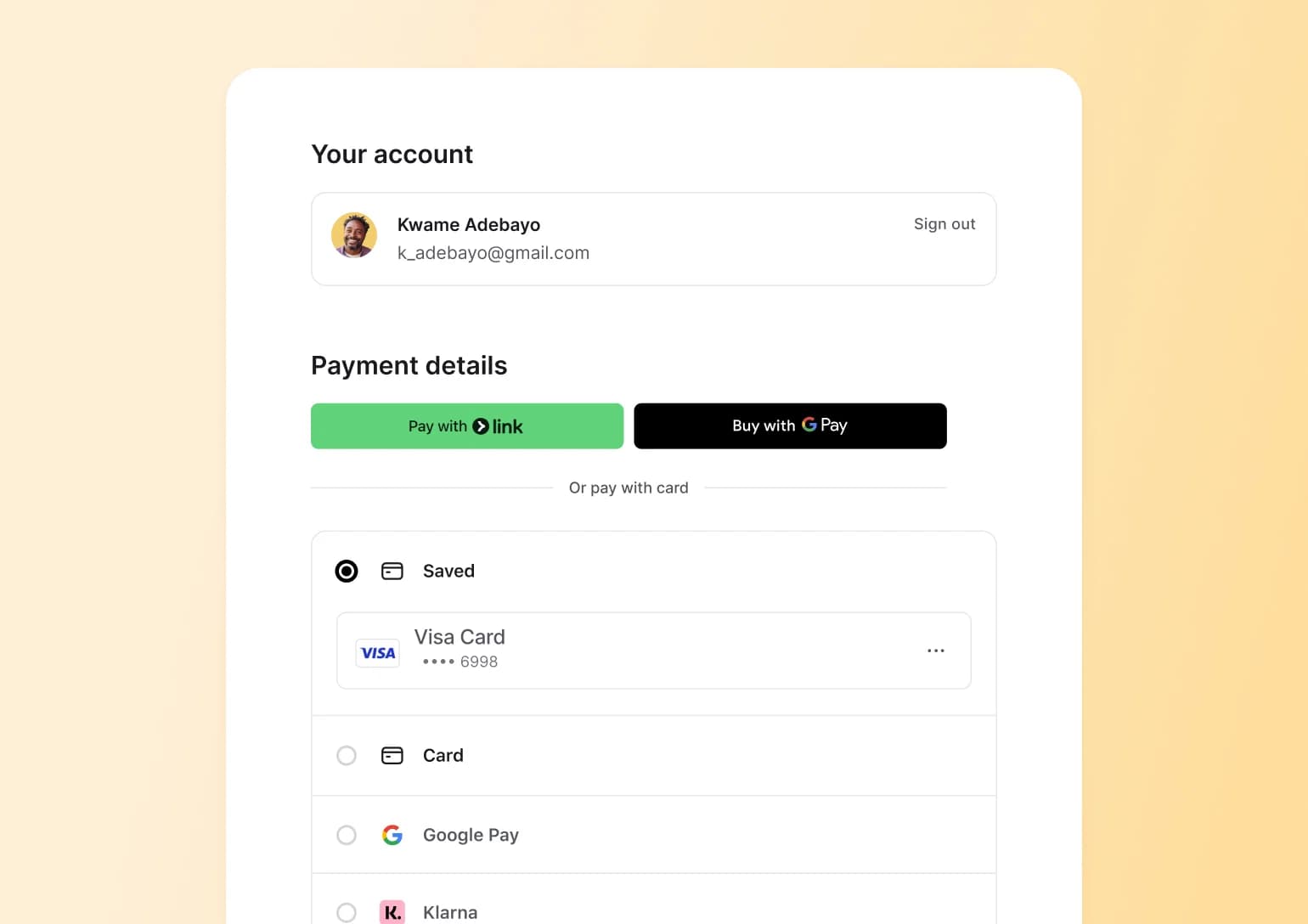
Seth's math points at the mechanic behind it: per-user and per-activity pricing punishes growth, while flat-rate platforms don't. Keeping payments in the same system as your members also closes the offboarding leak, where a canceled member keeps access because nobody cross-referenced five tools. Circle's Payments ties access to payment status and runs a branded checkout inside your community, so access and subscription never drift apart. Retain those members month after month and it compounds into recurring revenue.

One bill instead of five.
The hours the stack quietly eats
Subscriptions are the cost you can see on a bill, but lost hours spent cobbling things together never show up on your calendar. Manual syncing and brittle automation chains cost you hours you never bill for, and time is what community builders can least spare. Every tool switch forces you to stop, reorient, and rebuild context instead of staying in the work.
Third-party automation chains like Zapier promise to fix this, and sometimes they do, but they also break, and every broken connection is unbilled repair work. When automation lives natively, most of that repair work disappears. Circle's Workflows can handle onboarding, event follow-ups, reminders, access updates, and nurture sequences from the same member data, and its AI Agents run inside your community, trained on your own content, so repetitive member questions stop pulling you away from the work your members actually pay for.
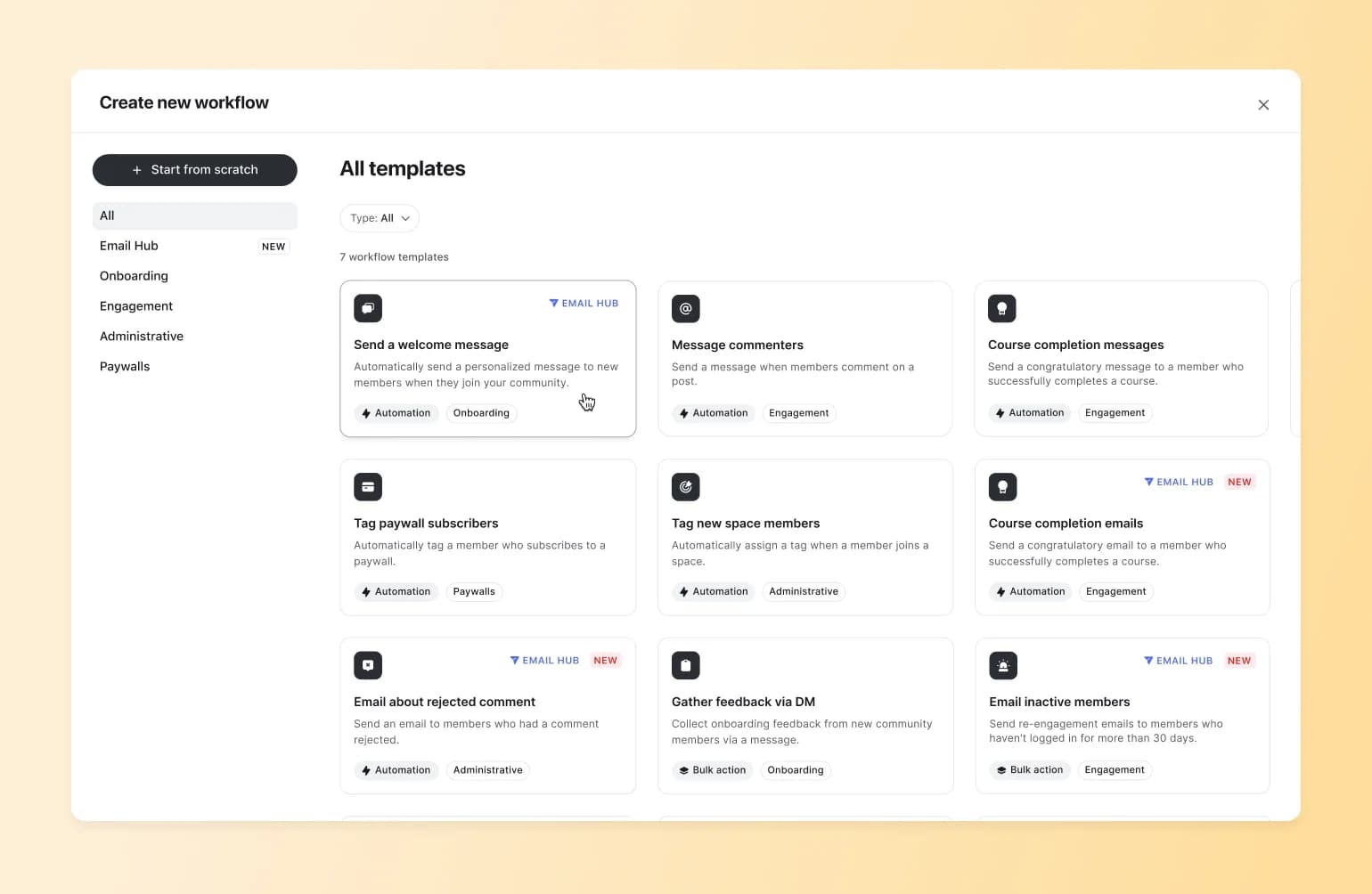
And where a Zapier chain needs you to wire and babysit it, Circle AI builds and runs the automation from inside the platform, so setup and upkeep stop landing on you. You describe what you want in plain language and it builds the workflow for you, then runs it on live member data instead of a synced copy. The same assistant can build out a space, set up a course, or answer a plain-language question about your community's numbers, so routine setup and reporting stop eating your week.
Tim Slade, founder of The eLearning Designer's Academy, felt the time tax in one specific place: his website. What began as a single course in 2020 now serves more than 11,000 instructional designers, and along the way he'd been juggling a course platform, a chat tool, a video-call app, and a separate website builder, where every new landing page meant looping in a contractor and waiting weeks for something that never quite matched the rest of his community. After moving courses, workshops, gated content, and discussions onto Circle, Tim Slade rebuilt 75% of his old site himself in days with Website Builder, saving thousands in contractor costs and reclaiming the calendar time that used to vanish into vendor threads.
The members who slip through the gaps
Time is the cost you don't see on a bill, and retention is the money you never see at all... until you're looking back at your yearly finances. Every handoff between tools drops members, and you rarely catch it happening. When someone has to cross a seam just to reach the next thing they paid for, some never make it. In courses, the gap is even clearer: lessons paired with active community discussion tend to keep learners more engaged than lessons delivered in isolation, and every extra step between the course and the community nudges people away from the thing that helps them finish.
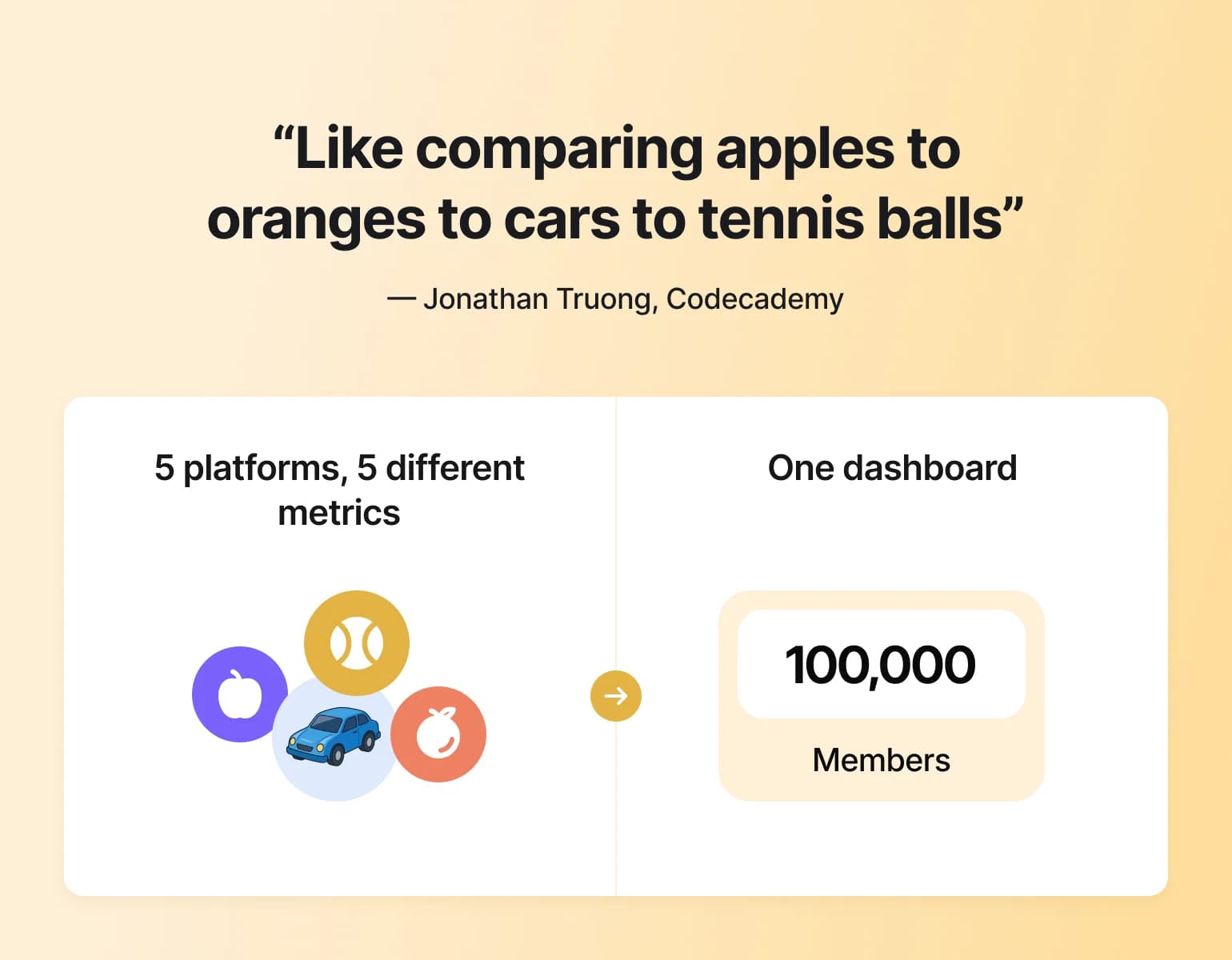
Fragmentation hides its own damage, which is why this cost stays invisible. Codecademy learned that at scale. Its community had sprawled across five platforms over a decade: forums, a social group, a chat server, a separate events tool, and a discussion tool, with more than a million members and no shared data layer connecting any of it.
Head of Community, Jonathan Truong, couldn't even measure the loss; the metrics on each platform, he said, were "like comparing apples to oranges to cars to tennis balls." When you can't see across your tools, you can't see who's slipping through the seams, so you can't fix it. After unifying its members in 2024 to Circle, Codecademy saw 82% of learners hit their goals. With roughly 100,000 members together in one place, the team had a number they could finally track and report on.
The brand that reads as stitched together
The last cost is the one members feel before they can name it. Five different-looking touchpoints reads as amateur, and people notice when the checkout, the community, and the course player all feel like they came from different businesses. Each seam is a quiet signal that the operation is held together rather than built intentionally.
For a premium community charging premium prices, that inconsistency is the gap between a member who upgrades and one who hesitates and drifts. Your relationship with your audience matters here too: it should live on ground you control rather than on borrowed social platforms, where one algorithm change can bury your reach and impact overnight. For how a native builder ties the public front door to the members-only interior, see why community-first builders matter.
A Paris-based "MBA for Entrepreneurs" with courses taught by the founders of YouTube, Wikipedia, Shazam, and Waze hit this head-on. For two years its courses lived on one platform and its community on another, and the split created exactly the friction you'd expect at the premium end: students toggling between two platforms, a mobile app on the old course platform that "was just not working well," and a fragmented stack that quietly undercut a brand positioning itself as the alternative to a traditional MBA. After consolidating everything (courses, community, and a fully branded iOS and Android app) onto Circle in early 2025, Augment Business School doubled its student base to 6,000 within four months, hit 61% monthly active users, and is on track for 70x revenue growth over its first three years.
| Cost | What it looks like | Real example |
|---|---|---|
| Subscriptions | Per-user and per-activity pricing on top of a stack of separate tools quietly adds up to more than one platform would cost | Talk Nerdy to Me's chat tool alone ran ~$12,000/year, with one month spiking to $3,000. Consolidating cut total costs to just over $4,500/year |
| Time | Manual syncing and brittle automation chains eat hours nobody bills for, plus the reorientation cost every time you switch tools | eLearning Designer's Academy juggled a course platform, chat tool, video app, and separate site builder. After moving to Circle, Tim Slade rebuilt 75% of his site himself in days |
| Retention | Every handoff between tools drops some members, and fragmentation hides the damage since each platform's metrics can't be compared to the others | Codecademy's community sprawled across 5 platforms with no shared data layer. After unifying in 2024, 82% of ~100,000 learners hit their goals, a number the team could finally track |
| Brand | Five different-looking touchpoints (checkout, community, course player) read as stitched-together, which costs the most at premium price points | Augment Business School ran courses and community on separate platforms for two years. After consolidating in 2025, it doubled its student base to 6,000 in 4 months and is on track for 70x revenue growth |
What one home actually changes
Four quiet (and not so quiet) costs, one root cause. Once you see them stacked together, the fix is obviously structural. Community, courses, events, email marketing, and payments tend to work better in one branded system with one data layer, because segmentation and automation can act on a full picture of each member instead of a partial copy synced from somewhere else.
Circle gives you that single home: community, courses, events, email marketing, and payments running from one member record instead of five separate tools.
That leaves one last objection: the move itself. Fear of migration keeps people paying for sprawl indefinitely. As one operator put it, they never wanted to migrate again; they wanted "a one and done type of a situation." Income School had run a seven-figure, course-based membership on a patchwork of website plugins for years, and moving everything, especially member payments, was one of its biggest reasons never to switch. When they finally committed, Income School migrated to Circle in 30 days with zero customers churned.
It turned out that their fear of the migration was bigger than the move itself.
One home, zero churn.
Running your community on one platform FAQ
How many tools does the average community builder actually use?
There's no single verified average, but the pattern is consistent: separate tools for chat, courses, events, email, payments, websites, and automation add up to a system nobody deliberately set out to build.
Is an all-in-one platform really cheaper than stacking separate tools?
It can be, though it depends on your stack and size. One platform can cost less than the stacked bills when you consolidate community, courses, a site, and webinar tools, because per-user and per-activity pricing tends to punish growth while flat-rate platforms don't.
What's the biggest hidden cost of tool sprawl?
Two costs compete for the title. App switching and tool upkeep pull attention away from members, and the members you quietly lose in the gaps between logins are the hardest to see, because no tool reports that loss.
Will I lose members or revenue if I migrate to one platform?
Not necessarily. Migration is often smoother than teams expect: in Income School's case, the move took 30 days start to finish, with zero customers churned. The move is usually far less painful than the fear that delays it.
Does consolidating tools help me prove my community's value?
Yes, because a unified data layer is what makes impact measurable. When engagement and completion live in one system instead of scattered across platforms, you can track outcomes and show the numbers that earn leadership buy-in.
Community Content Marketer
Arina is Circle’s community content marketer, sharing insights on community growth, GTM strategy, and storytelling for solopreneurs.