How to start a coaching business in 2026
TL;DR
- Validate paid demand before you build a website, a funnel, or a curriculum.
- Package the method you already run into a named offer priced to the outcome, not the hour.
- Set up the operational spine—automation, onboarding, a coaching bot—so admin doesn't drown you by month three.
Most first-time coaches launch the hard way. Three months picking a logo, another three on a funnel. Tabs open for a course tool, a booking tool, and a payment processor at 11pm. By the time everything's stitched together, more has been spent than earned. Meanwhile, the two prospects who'd expressed interest have gone quiet. The craft isn't the problem. The build is.
There's a better way, and it's faster than most first-time coaches think. Validated offer, warm room, one platform running checkout and community, first paying client inside a fortnight. In 2026, most of the setup that used to take those months runs on triggers: checkout, onboarding, session notes, follow-ups. That leaves a clean split between the parts that run themselves and the parts only you can do. This is how to launch around that split, from validated offer to first paying clients to the operational spine that keeps you sane at client ten.
If you're already past launch and scaling is the next problem, the business coaching guide covers pricing tiers, group programs, and getting past the 1:1 ceiling; this article is about getting the practice off the ground in the first place.
Start with the part AI can't do
AI can now handle a surprising amount of the day-to-day support layer around coaching—drafting first-pass answers, sending reminders, generating session summaries, running onboarding. What it can't do is the emotionally charged, high-stakes, values-based conversation that made a client hire a coach in the first place.Trust, contextual judgment, and accountability sit on the human side of the line.
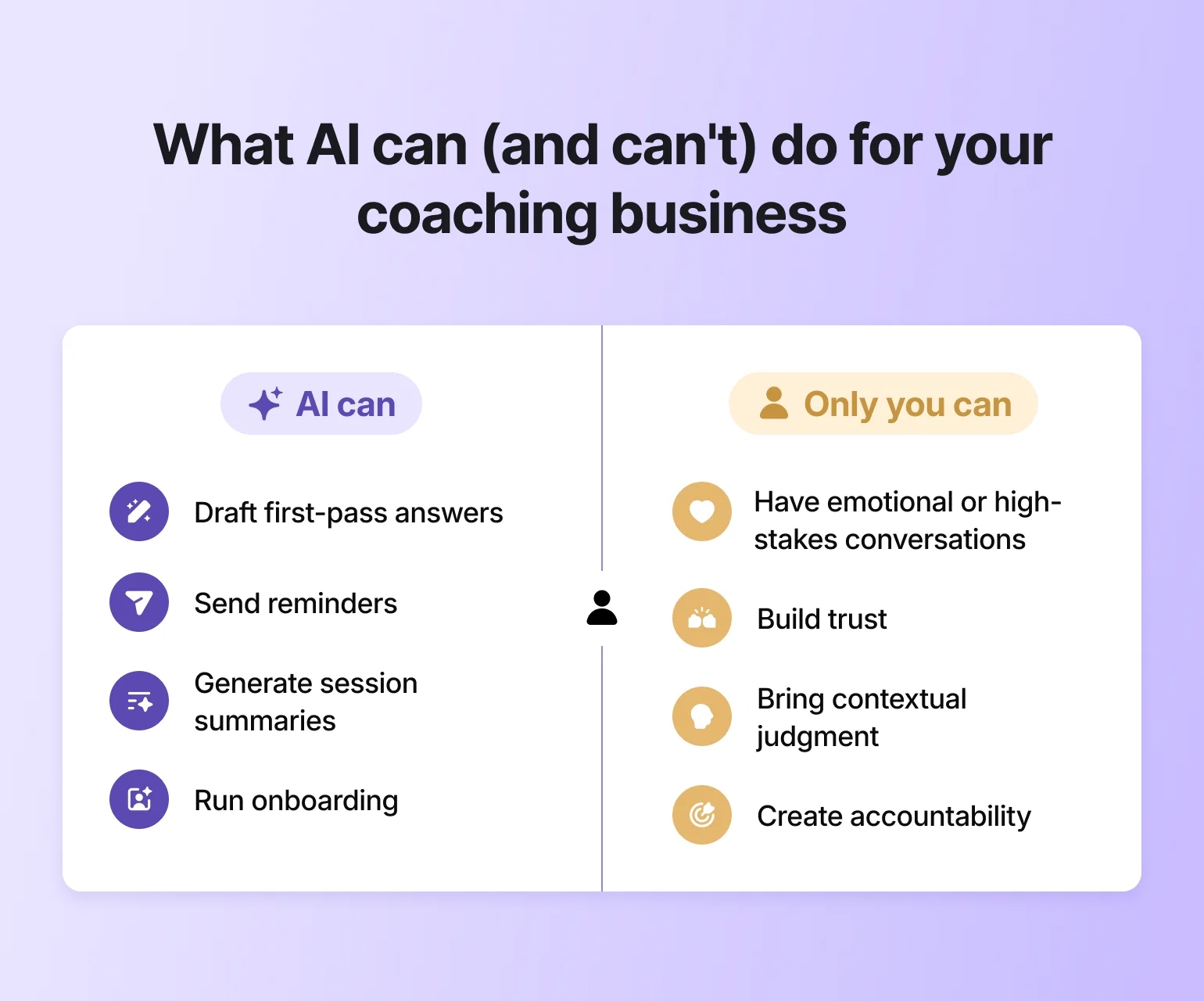
That split is the whole business model. Knowing which is which tells you what to automate, what to protect, and which clients will pay for your time.
Pick a market that's already in pain
Before you pick your niche, pick your market. A good market passes four tests. The demand is urgent. The buyers have budget to solve the problem. You can reach them through associations and groups that already exist. And there's enough room that you're not fighting for the last seat.
Specificity is what lets you charge for judgment. Position yourself so premium buyers can read one sentence and think that's me. A useful clarity test: one line that names the person, the recurring struggle, and the transformation you can reliably guide them toward. Compare the shape of these:
- ❌ "Executive coaching for high performers" — a compliment, not a niche; nobody hires this.
- ❌ "Helping ambitious founders unlock their next level" — the reader has no idea what you actually do.
- ✅ "I help sourdough bakers who sell at farmers' markets turn one Saturday stall into a $10K/month wholesale account."
- ✅ "I coach dungeon masters running paid D&D campaigns on how to price a session so they clear $2K a table without burning out."
Each one names the person, the recurring struggle, and the outcome. Each one also shrinks the room, which is the point—one qualified prospect who reads themselves in that sentence is worth a hundred who don't.
Turn your method into an offer
Before you can price or sell anything, you need a method: the repeatable path you take a client from where they start to the result they came for. Maybe you already run a version of it, maybe you're building it from scratch. Either way, the job is to make it explicit enough that a prospect can see exactly what they're buying.
Here's what that looks like across four different coaching practices:
| Coach | Method | Breakdown |
|---|---|---|
| Fitness coach for post-partum runners | Return to Miles protocol | Session 1: gait scan + pelvic floor screen. Sessions 2–3: eight-week rebuild block (walk-run intervals, glute activation, breath work). Sessions 4–5: return to 5K with weekly mileage cap. Session 6: race plan. |
| Sales coach for SaaS AEs | Pipeline Post-Mortem | Week 1: audit last 20 lost deals, tag by stage. Week 2: rebuild discovery script around the three questions the tape shows they never ask. Week 3: multi-thread every open opportunity above $30K. Week 4: renegotiate quota commit with manager. |
| Pricing coach for wedding photographers | True Price method | Call 1: cost-of-delivery audit (hours per wedding, edit time, second shooter, gear amortisation). Call 2: rebuild three packages using good/better/best. Call 3: rewrite the inquiry email so price appears in the second reply, not the fifth. Call 4: raise the middle tier 40% and watch the mix. |
| Parenting coach for parents of newly-diagnosed autistic kids | First 90 Days framework | Month 1: two 90-minute sessions demystifying the report, mapping supports. Month 2: weekly 45-minute check-ins while they navigate the school IEP. Month 3: tapering to fortnightly, with a private space for questions between calls. |
Notice the pattern. Every one of them has a specific starting diagnostic, a fixed number of sessions, named phases, and one memorable name. That's what a prospect buys. It's also what an AI agent trains on, what a group program packages, and what a junior coach could eventually deliver on your behalf.
Write down four things about your own version. First, the experience you bring—the years, the client count, the specific results you can point to. Second, the transformation you can reliably produce. Third, how you diagnose the problem in the first session, because the diagnostic is often the most valuable thing you do. Fourth, the phases the client moves through, with a set number of sessions and a name for each phase.
What coaches actually charge in 2026
ICF's 2025 global study puts the average coaching session at about $234 an hour worldwide, yet the average coach earns just under $50K a year from coaching. The gap is the model, not the rate. Most coaches try to close it with more clients and more sessions, but hours are the one thing you can't add more of, and AI is busy making generic advice cheap. What keeps its price is a specific problem solved for a specific person, so set your number from the specificity of the problem, the depth of support, and the value of the result, not from an hourly rate times a figure that feels brave. The business coaching guide covers outcome-based pricing and tier structures in detail.
💡 Circle tip: However you price it, the checkout has to work on day one. Circle's built-in branded checkout keeps payment and client access under one login, so a client who pays at 10pm is inside your community by 10:01, with no hand-off to a separate tool in between.
Get your first paying clients before you build anything
Treat payment as validation. Surveys and interest lists collect "great idea" responses; a credit card collects proof. So start with a stripped-down sprint: one or two calls and a single focused outcome, run with two clients before you build anything bigger. Price it low enough to be an easy yes, but high enough that the buyer is serious.
If a beta cohort is the goal, pre-sell it. A one-page sales page (the problem, the outcome, the format, a founding-member price) is enough to bring in revenue before the program is built. Early access and a say in the curriculum are part of the pitch, not an apology. And if you coach for free at the start, keep it to pre-defined work in exchange for a documented result. Open-ended free coaching mostly attracts people who were never going to pay.
Infrastructure can come last. Your first client might come from speaking in a group the prospect already trusts, or from a warm DM to someone who's read your work. A clear offer and a warm room are enough; no website required. But the day a client pays, move them somewhere you own. A DM thread sits in an inbox you don't control. Your own list, community, data, and brand are where the relationship should live, so you can reach your members without an algorithm deciding whether they see you.
The 7 systems that run your business while you coach
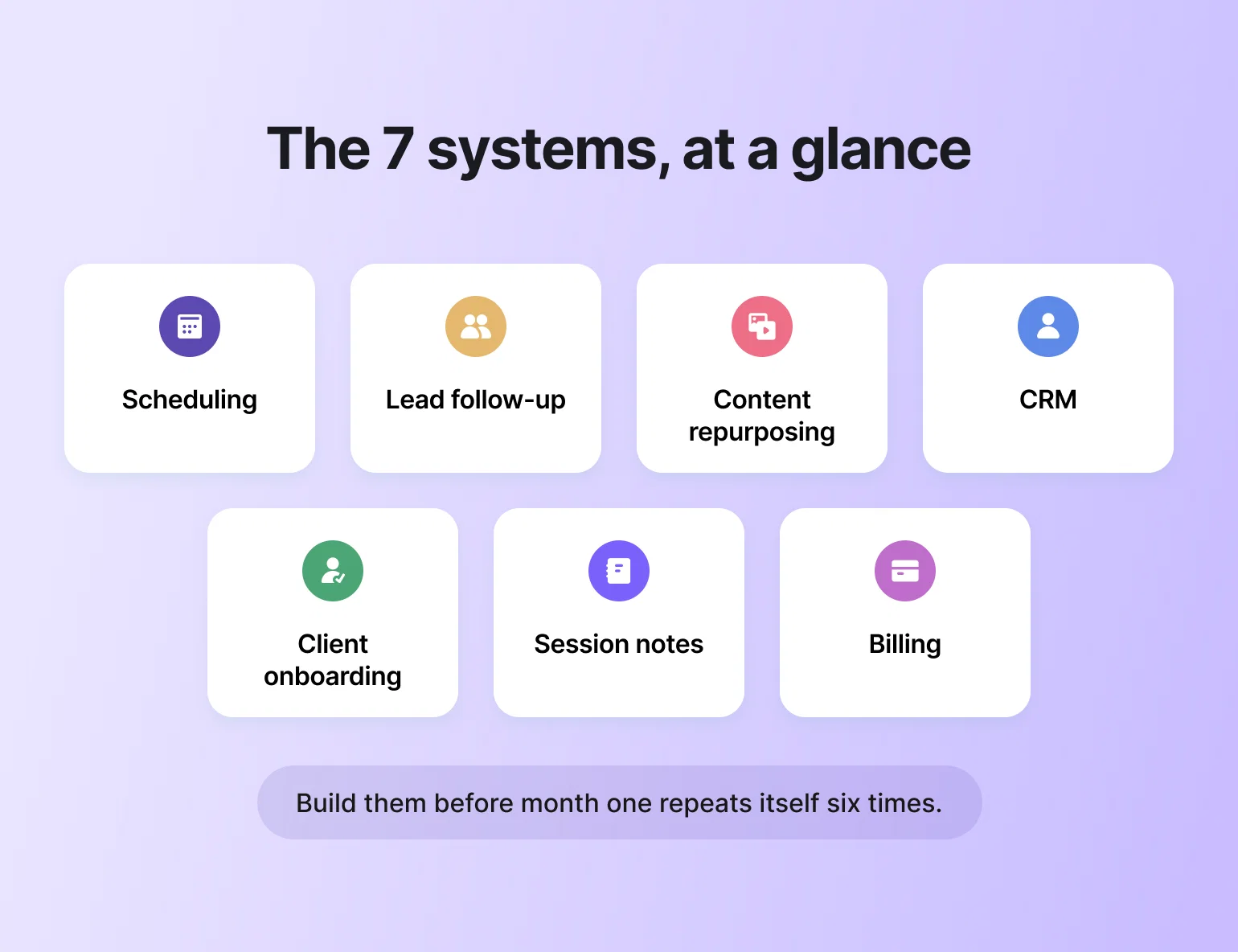
Every new client adds the same admin: scheduling, reminders, follow-ups, invoicing, onboarding. By hand, that work grows with your client list until it's eating the hours you should spend coaching. Automated once, it runs in the background. Here are the seven worth automating.
- Scheduling. A single booking link with automated reminders and a pre-call intake form removes the back-and-forth that eats an hour a week and cuts no-shows before they happen.
- Lead follow-up. A nurture sequence that fires the moment someone downloads a resource or enquires gets them a response right away, instead of leaving them to wait days while their interest cools.
- Content repurposing. Turning one call recording into posts, an email, and clips from the same source is the difference between a marketing engine and another thing on your to-do list.
- CRM. Pipeline tracking and profile data that update themselves mean you always know where every prospect and client sits without maintaining a spreadsheet at midnight.
- Client onboarding. The moment a client pays, the contract, welcome note, intake form, and booking link all go out automatically, so their first experience with you feels organised instead of a scramble of manual sends.
- Session notes. AI-generated transcripts and summaries free up the time you'd otherwise spend writing notes at 9pm, and give the client a searchable recap before they've had time to forget the meeting.
- Billing. Recurring payment collection on a schedule means revenue doesn't wait on you remembering to send an invoice, and lapsed cards get chased without a human doing it.
Circle runs all seven of these natively: native events handle scheduling and reminders, Email Hub covers lead follow-up, Circle AI handles content repurposing, the built-in CRM tracks every prospect and client, AI Workflows fire the onboarding sequence on the purchase event, automated transcriptions cover session notes, and native payments handle billing.
Start with whichever one is currently costing you the most evenings. You don't have to build them all in month one; you have to build them before month one repeats itself six times.

Your ops, on autopilot.
Build a coaching bot trained on your method
Your documented signature framework isn't just an offer. It's training data. Start with the framework document itself, then core course transcripts, your FAQ, your onboarding materials, and a few examples of your written voice. A focused collection of clean documents beats uploading everything you've ever written. Most of that material already sits in your files.
A bot grounded in your method gives clients a first-pass answer at 11pm on a Sunday, in your voice, using your framework—so the next call starts from a further-along place instead of covering ground you've covered a hundred times.
On Circle Plus, AI Agents train on your own material, and you can tier them by membership level so free members can't surface premium answers.
John Meese at SOLD OUT Coach Club trained an agent called SmartBuddy on his three published books, years of coaching-call transcripts, and a private "SmartBuddy Training" space where he adds in-progress material from his next book—material that hasn't been published anywhere yet. When his Member Success Coach left, SmartBuddy covered roughly 80% of what that $2,000/month contractor was doing. Members use it to pressure-test business strategies and refine messaging on their own schedule, not John's. He also built a dedicated "SmartBuddy Prompts" space with example questions, because an agent members don't know how to talk to is just a feature that exists.
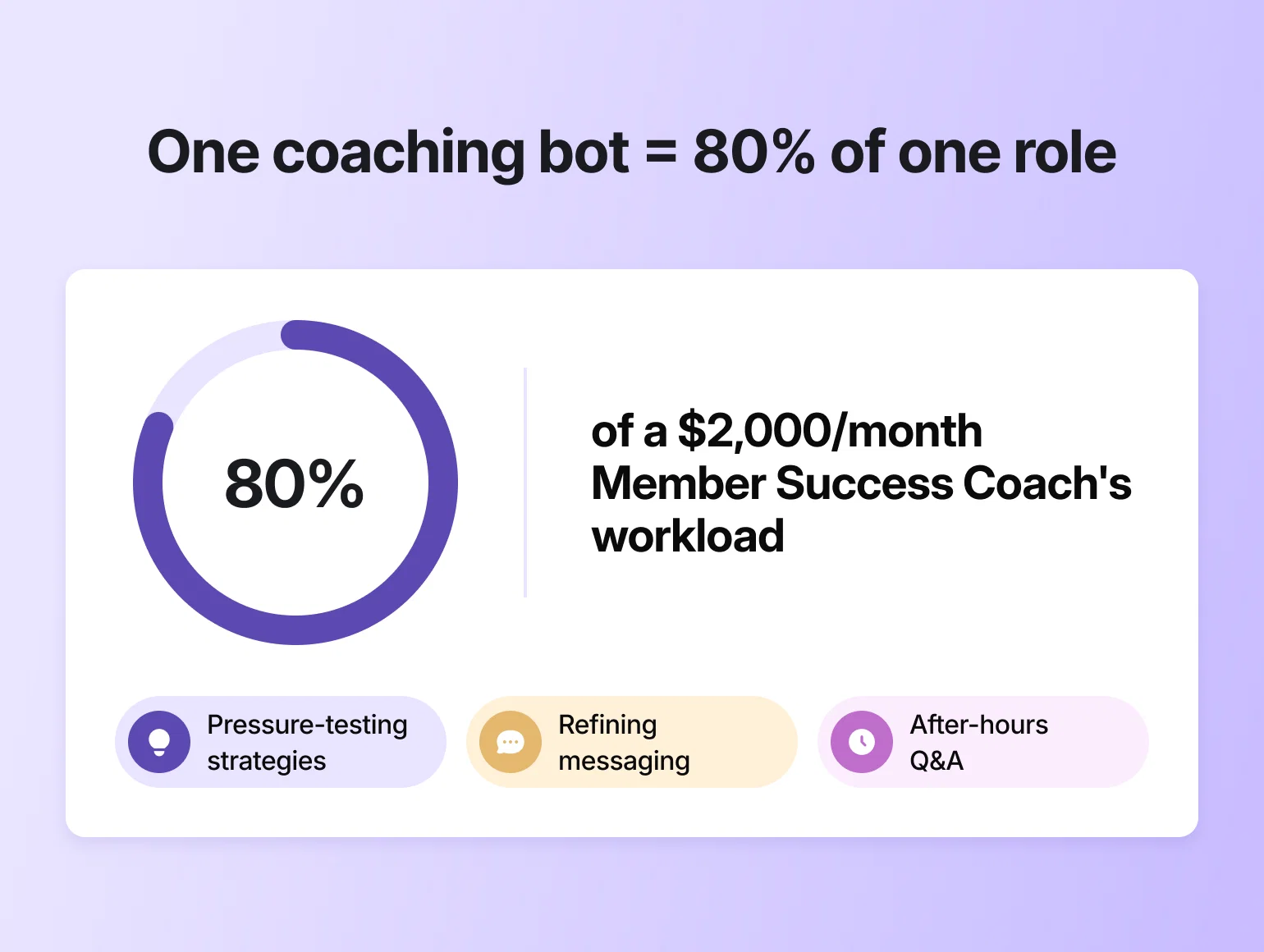
That's the point worth holding onto. SmartBuddy doesn't coach for John; it takes the repetitive load off him, the same handful of questions asked over and over, the after-hours pings, the first-pass feedback. What's left is the coaching only John can do, and now he has the hours for it.
Set the bot's boundaries before you launch
Do not rely on an AI agent to recognise when a client needs therapy, medical care, or legal advice instead of coaching. That judgment call has to be built in as a hard stop, not left for the model to make in the moment.
Jim Nelson runs Tripawds, a support community for pet amputation recovery. The moment a member's message hits a medical keyword, his agent pauses, alerts an admin, and directs the member to their vet. The boundary wasn't added later; it was the first thing he designed. For a coaching practice, the equivalent list is short and worth writing before you flip the switch: mental health crises, medical questions, regulated financial or legal advice, anything that requires a licensed professional. Configure the keywords that pause the agent and route the conversation to your inbox. You take it from there.
Start coaching before you finish building
Every piece of this comes from the coaching itself. Coach one client well and you have a result. A few results give you a method worth documenting. The method trains the bot. The paying clients pay for the systems. Not one of them has to exist the day you take your first client, which is why you can start now instead of six months from now.
That's also why the build shouldn't be the thing that holds you up. With Circle, your community, courses, checkout, and workflows live in one place, and you don't have to wire the spine up by hand: describe the coaching practice you want and Circle AI proposes the spaces, access, and paywalls, then builds the structure once you approve it. Setup runs in an afternoon, so your first ninety days go into sessions, not tools.
Skip the build, not the craft.
Starting a coaching business FAQ
How long does it take to launch a coaching business?
Faster than most first-time coaches assume. A validated offer plus a warm room can produce a first paying client inside two weeks—Will deShazo built a full website and community in that window and closed $15K in his first two months. The parts that take longer (a polished website, a course library, a big audience) are the parts you don't need on day one.
What's the minimum tech stack I need on day one?
Payment processing, a place for clients to work with you, and a way to schedule calls. Everything else is optional until you have paying clients telling you what they need. A single platform that handles checkout, client Spaces, and scheduling avoids the fragmentation tax before it starts.
How do I get testimonials before I have any paying clients?
Run a paid sprint at a founding-member price with two to five clients, in exchange for a documented result and a written testimonial as part of the deal. That's a validated offer with proof attached, not free coaching. Open-ended free work in exchange for "a testimonial someday" mostly produces neither.
Do I need a certification to start a coaching business?
Certification and legal permission to practice are separate questions. Credentials can strengthen trust and often matter more for corporate buyers, but requirements vary by location, specialty, and the services you provide. Check the rules in your jurisdiction, and avoid presenting coaching as licensed therapy, medical care, legal advice, or another regulated service unless you hold the qualifications.
Do I need a website before getting my first clients?
No. First clients come from warm outreach, referrals, and pre-sold beta offers; paid demand validates more than any landing page. Build the website and platform after you have a proven offer and know what it needs to say.
Community Content Marketer
Arina is Circle’s community content marketer, sharing insights on community growth, GTM strategy, and storytelling for solopreneurs.