What is business coaching? A beginner’s guide
TL;DR
- Business coaches help owners get unstuck on pricing, sales, hiring, or growth by asking the questions they haven't thought to ask themselves.
- Unlike a consultant — who hands you a strategy — a coach helps you find your own path forward, which is why the results tend to stick.
- The business model starts with a sharp niche and 1:1 clients. It scales when you stop selling time and start selling outcomes—and eventually, access to a group.
A business coach helps owners find the answer to whatever's slowing them down—and then holds them to it. The work tends to cluster around the same problems: pricing that doesn't match the value delivered, sales conversations that stall before they close, hires that keep getting pushed back, and a calendar so full there's no room to actually grow the business. The approach stays the same—the coach asks, the client thinks, the answer lands.
This guide covers what business coaches actually do, how they charge, what to look for if you're hiring one, and how coaches build and scale the business themselves.
What is business coaching?
Business coaching helps a business owner or operator find their own answers to whatever they're stuck on.
In practice, that work clusters around a handful of problems owners hit again and again:
- Revenue and pricing: raising rates, fixing a leaky funnel, or moving off trading hours for dollars
- Sales and closing: turning more conversations into clients without the high-pressure tactics buyers now resist
- Hiring and team: making the first hires, delegating, and getting out of every decision
- Leadership and decision-making: the founder-level questions about focus, priorities, and what to stop doing
- Growth and scale: breaking past the ceiling where the business depends entirely on the owner's hours
The stuck point changes from client to client. The coach's job stays the same: ask the questions that get the client to their own answer, rather than handing them yours.
Business coaching vs. business consulting: what's the difference?
The terms get used interchangeably, but they're not the same — and hiring the wrong one is one of the most common mistakes founders and creators make.
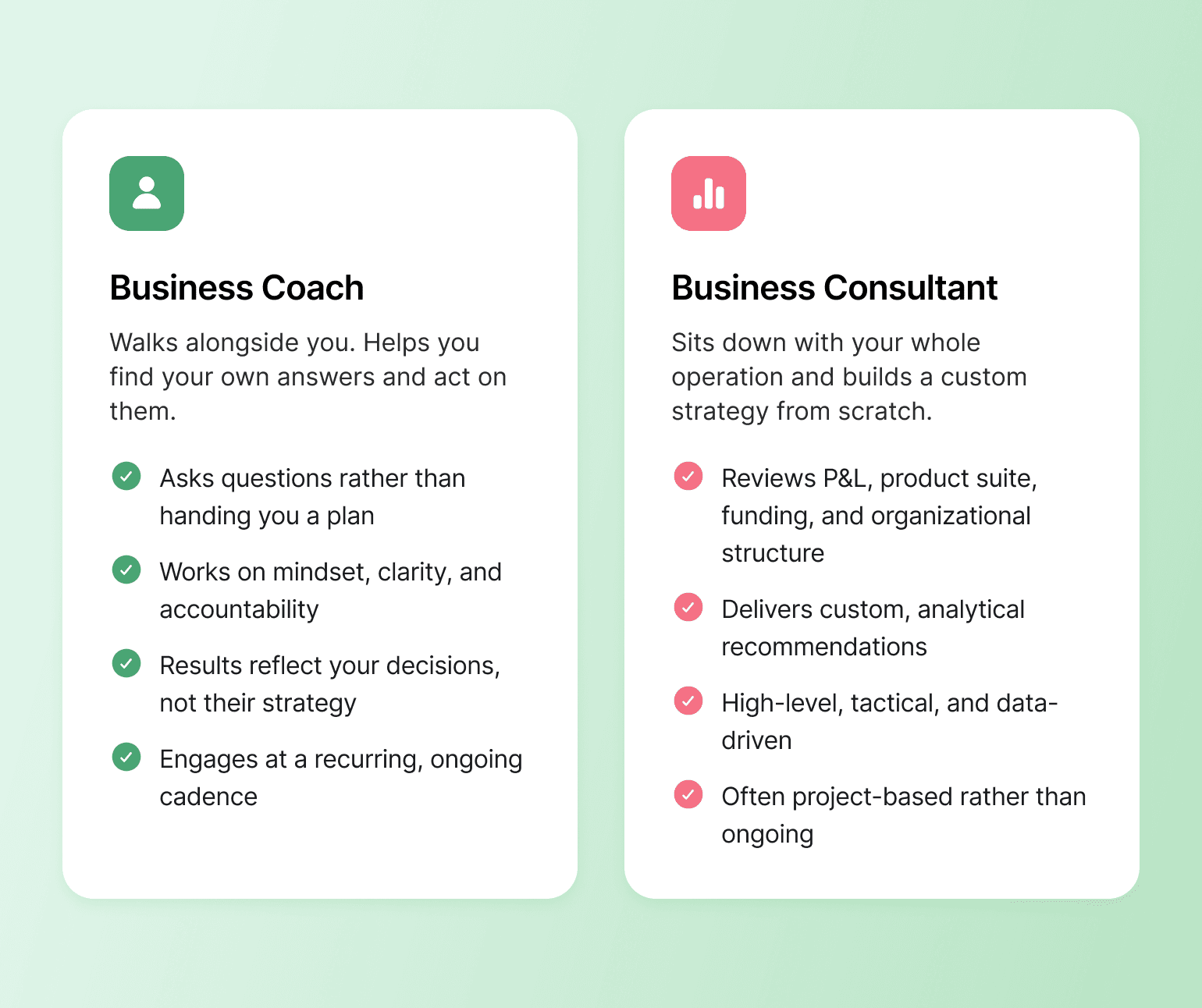
A business coach walks alongside you. Think of a soccer coach: they see your potential, help you push through limiting beliefs, give you the halftime pep talk that determines how the second half goes. They're not redesigning the play system from scratch — they're helping you perform within it.
Gabriella Borrero, founder of No Plan B Consulting and the Next Generation Network, puts it this way: a coach "meets you where you're at" and helps you overcome the obstacles between who you are and who you can become.
A business consultant sits down with your whole operation — the P&L, the product suite, the funding, the org structure — and builds custom strategy from the ground up. Nothing templated, nothing copy-pasted. According to Gabriella, who holds a master's in accounting and has done both, the consultant lens means going "very high level, very analytical," pulling year-over-year numbers and asking hard questions about where the business actually needs to change.
The problem, she says, is that a lot of business coaches get hired to do consulting work they weren't trained for — and clients don't always know the difference until something doesn't land.
What you need to start
To get started with business coaching, you need a niche sharp enough that the right clients recognize themselves, and a method you can repeat instead of reinventing for every client.
You need proof, not just a plan
The coaching industry has a credibility problem. Anyone can call themselves a business coach. What separates the ones who build lasting practices from the ones who burn out in year two isn't a certification or a course — it's the ability to point to something real.
For Gabriella Borrero, that proof was ten years of building her husband's music studio from the ground up. She set the pricing, built the systems, ran the fundraising, and managed the team. By the time she launched No Plan B Consulting, she wasn't guessing at what small business owners needed, because she had already done it.
"I coupled what I already knew about small business with my college degrees, and then hearing from other small business owners to understand what they needed," she says. Her master's in accounting didn't hurt either.
Your proof doesn't have to look like hers. It could be twenty years in corporate HR before you start coaching executives on people management. It could be scaling your own e-commerce brand before you coach other product founders. It could be a decade of sales before you coach on revenue. What it can't be is nothing — or worse, advice borrowed wholesale from your own coach without ever testing it with real clients.
"The number one mistake new coaches make," Borrero says, "is copy and pasting. Their coach tells them exactly what to offer and exactly what to price it — and they never actually talk to their ideal client to find out if any of it makes sense." The result is an offer built for someone else's audience, priced for someone else's market, sold by someone who hasn't yet earned the right to charge it.
Your proof is your positioning. Before you pick your niche, write down what you have genuinely done, seen, fixed, or built that someone would pay to learn from. That's where your coaching practice starts.
Niche down until you're findable
"Business coach" competes with everyone on the internet. "[Specific outcome] for [specific operator]" makes it easier to reach the right audience and convince them to pay for your services. When a prospect reads your offer and instantly recognizes themselves and the result they want, price stops being the conversation.
Here's what a sharp niche looks like across potential audiences:
- Course creators: "Help course creators go from $5K launches to $50K launches without growing their audience"
- Gym owners: "Help independent gym owners fill their private training program in 60 days"
- SaaS founders: "Help SaaS founders book 10 qualified demos a week from cold outbound"
- Newsletter writers: "Help newsletter writers turn 5,000 free subscribers into a paid tier that covers their rent"
- Podcasters: "Help podcasters with 1,000+ downloads per episode land their first $5K sponsor"
- Real estate agents: "Help agents close 24 deals a year working three days a week"
- Life coaches: "Help new life coaches sign their first five paying clients in 90 days"
Notice what every one of those has in common: a specific person, a specific outcome. Often a specific number. That's what makes a niche chargeable. Now pick one. Even if you can help with twenty things, only market one.
Borrero didn't find her niche through a positioning exercise — she found it by watching people fail. When her husband's music industry solopreneur friends kept struggling despite having real talent, she noticed they all had the same gap: no business strategy, no one navigating the back-end work she'd been doing for her husband for years. "Why don't I work with minority entrepreneurs?" she thought. Today, all of her clients are millennial women — about 80% of them immigrant or first generation. That specificity isn't limiting. It's what makes her referrable, credible, and easy for the right client to find.
A strong niche combines your real-world experience with your coaching skills and points the whole thing at a problem people already know they have and are already trying to solve. "Get more clients" is one of the most obviously chargeable niches inside business coaching, and you can cut it sharper by channel (SEO, podcasting, cold email) or by business type (gyms, SaaS, e-commerce, agencies). If you don’t know where else to start, work through this finding your niche framework before you build anything else.
What do business coaches charge in 2026?
Business coaching pricing varies widely by niche, buyer, experience, and delivery model. A coach selling to an early-stage founder won't price like one selling to a C-suite executive or a sales team.
Build an offer ladder
An offer ladder might look like this:
- An entry-level diagnostic or strategy session
- A defined 1:1 coaching package
- A group coaching program built around one repeatable outcome
- A premium advisory or implementation package
- A recurring community or membership that supports clients after the core program ends
Every rung of that ladder works better when it lives in one place. House the whole thing in a community—the sessions, the group program, the recordings, and the membership—so clients move up the ladder without ever leaving your branded community.

We've watched hundreds of coaches make this exact jump.
Price the outcome
Stop selling call time as the product: hourly billing punishes you for being good.
A client pays you $300 an hour. Instead of solving their problem in ten calls, you solve it in three because you’ve solved it a hundred times before. But, now you just earned $900 instead of $3,000 for being faster and more effective. That's what we call a broken model.
Price the outcome instead. "Triple your demo-to-close rate in 90 days — $9,000." Now the deliverable is the result, not the hours. Solve it in three calls and the client is thrilled and your margin is intact. Solve it in ten and you still get paid what the transformation is worth. Coaches who package what they've already done, with a named outcome a buyer can already picture themselves getting, can charge five figures because the price is anchored to the result, not the meeting length.
Gabriella learned this the hard way. She started at $50 a month for two sessions. Now a typical package runs $1,100/month for three months of focused work. The shift came when she stopped pricing for her own comfort and started doing a SWOT analysis against what others in her market were charging and what clients could actually pay.
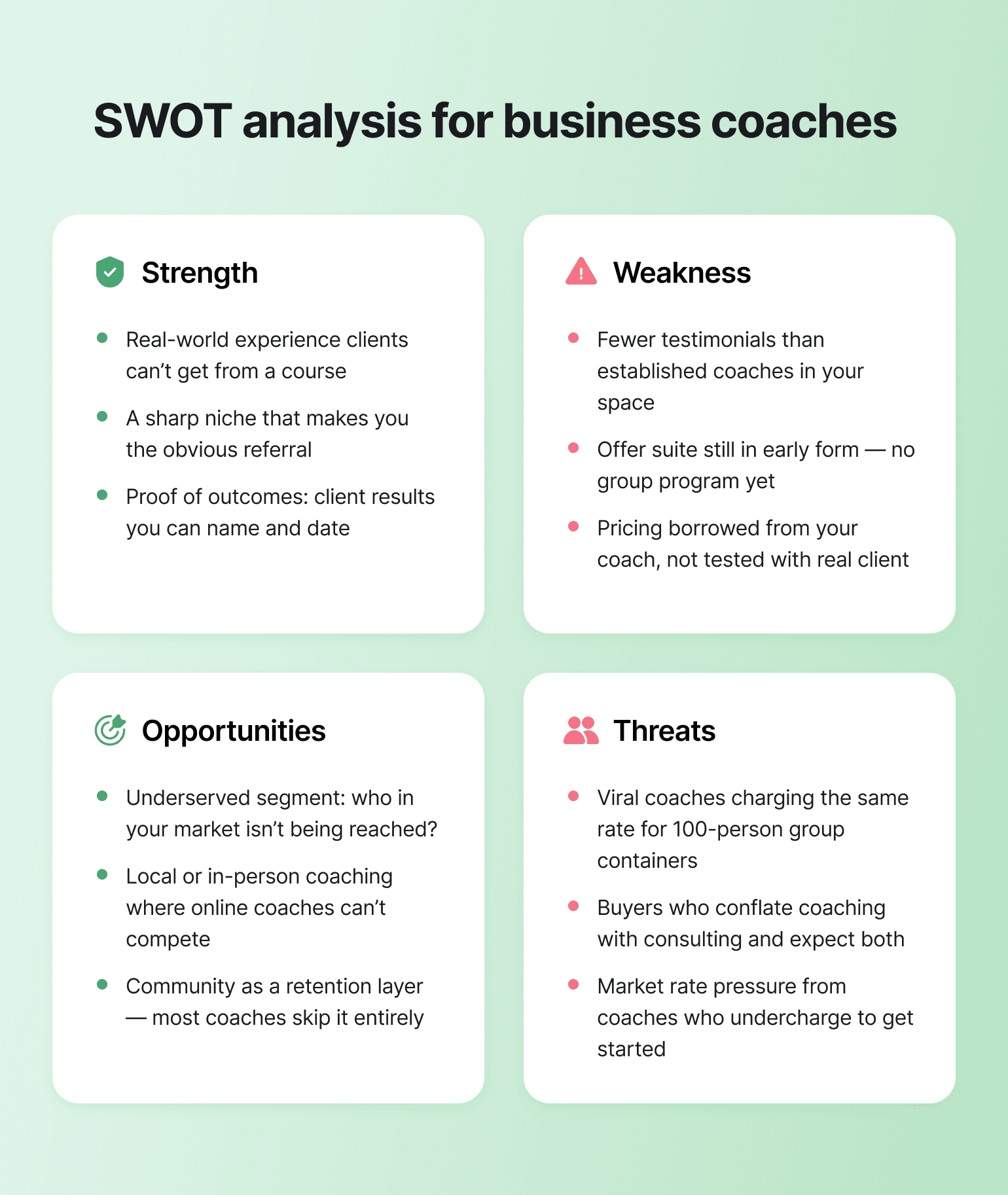
What’s a SWOT analysis? SWOT stands for strengths, weaknesses, opportunities, and threats. It's a framework businesses use to assess where they stand relative to their market — and it works just as well for positioning yourself as a coach. Strengths: What do you bring that others in your space don't? Credentials, lived experience, a specific methodology, a network, a niche? Weaknesses: Where are you still building? Fewer testimonials, less visibility, a narrower offer suite? Opportunities: What's underserved in your market? Who isn't being reached by the coaches already out there? Threats: Who else is competing for your ideal client's attention and budget — and how are they positioned?
Run this on yourself before you set a single price. As Borrero puts it: "You're a business operating within a market. You need to price yourself based on what's the go-to in your market" — and you can't know that until you've honestly assessed where you fit inside it.
Use Good, Better, Best pricing
Once you've anchored to outcome-based pricing, the next step is structuring your offers so clients can choose their level of access — not just whether to buy.
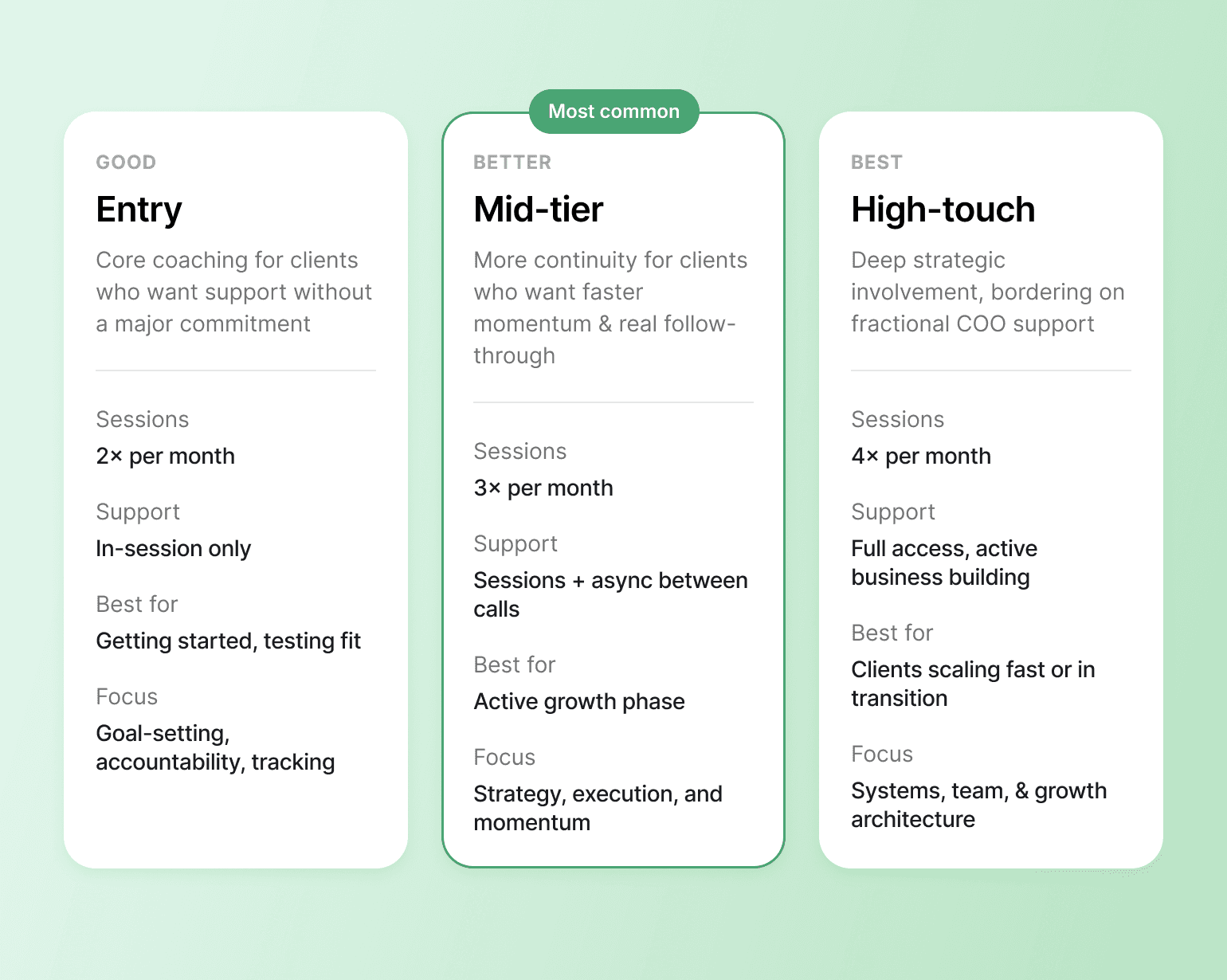
The framework comes from Paul Klein, host of the Pricing Is Positioning podcast: build three tiers, each delivering what the client asked for, with each step up adding more contact, more support, and more of you. The psychological logic is real — most buyers avoid both extremes and land in the middle tier, which is usually where you want them.
For a business coach, the tiers typically map to session frequency and involvement:
- Good — Two sessions per month. Core coaching, accountability check-ins, goal tracking. The entry point for clients who want support without a major commitment.
- Better — Three sessions per month plus async support between calls. For clients who want faster momentum and more continuity.
- Best — Four sessions per month with deeper strategic involvement. High-touch, potentially bordering on fractional support — and priced to reflect it.
Gabriella used this framework to inspire her offer ladder. Her typical mid-tier engagement runs $1,100/month for three months. Her highest-level work — where she's actively building the business alongside the client — crosses into fractional COO territory. "The higher you go, the highest amount of support, the highest amount of one-on-one," she says.
The other shift worth making: price for lifetime value, not the first contract. A client who starts at the entry tier and stays for twelve months is worth more than one who signs a big package and churns after 90 days. "I focus more on lifetime value than on a one-off contract," Gabriella says. "I don't mind where you're starting out as long as we start out together."
That's the pricing foundation. But pricing alone doesn't solve the core constraint of a 1:1 coaching business: your calendar.
How the best coaches scale
There's a ceiling even outcome-based pricing can't clear on its own: your calendar. Every paid hour drags unpaid ones behind it—prep, follow-up, notes, admin, sales calls—so the "fully booked" 1:1 coach is usually working nights and weekends with no room to take on more. The way past it isn't working harder; it's changing what one coached hour can serve. Run that hour 1:1 and you serve one client. Run it as a group and the same hour serves a room, with peer accountability layered on top of your time.
Group coaching
Group programs do two things at once. They multiply what you earn from a single coached hour, and they tend to get better client results, because peers see different angles on the same problem and hold each other accountable in ways you can't from a 1:1 chair. The catch is that a great group is designed, not assembled. Random clients on a Zoom call isn't a program. This group coaching guide covers the mechanics.
Gwyn Wansbrough's Breakthrough Facilitation is a clear example. When March 2020 made her decade of in-person facilitation work unviable overnight, she packaged her method into a live cohort course on Circle—onboarding, content, session recordings, and peer practice in one place—so students learned the skills by using each other as the practice room. Five cohorts and 178+ members later, she's trained more than 1,350 students on the same packaged method, none of it possible at 1:1 scale. The method is the asset; once it's named, sequenced, and repeatable, the group becomes the delivery layer that scales it without scaling you into the ground.
Community after the cohort
A great cohort ends. The client's business doesn't. That's the gap a community fills: a place where clients keep applying the method, keep getting feedback, and keep paying you long after the program is over.
Gabriella Borrero has run her Next Generation Network on Circle for five years. The community — virtual bi-weekly networking, summits, and a tight-knit conversion-focused membership at $75/month — takes about five hours a month to run. That's the compounding value of a community built on a repeatable structure: the upfront design investment pays recurring dividends long after you've stopped reinventing it.
This is also where the math of a coaching business changes. Retention becomes the growth lever, because churn quietly eats new signups for breakfast. A community that keeps members applying the method—through recurring payments, live coaching, and onboarding that runs on its own—turns a finished cohort program into income you can count on before the month begins. If you're weighing where to build, this rundown of online coaching platforms compares your options.
The path from expertise to a business that scales
The coaches who build something lasting are the ones who diversify. Once your method runs as a group program and lives in a community clients renew into, the business keeps moving on the days you don't—and that's the moment a coaching practice turns into a coaching business.
Pat Flynn's Smart Passive Income is what that looks like in practice. By 2020, SPI was generating over $1M annually from individual course sales — but the business had become what Flynn calls a "Frankenstein" system: courses on Teachable, community on Facebook Groups, events on Zoom, with members constantly lost navigating between platforms. Every month required a new launch to sustain revenue. Flynn moved everything onto Circle — courses, conversations, coaching, and live events under one login — and shifted from one-off course sales to a tiered community membership. The result: $700K+ in membership revenue in 2024, 40% year-over-year revenue growth, and course completion rates 2.5 to 3x higher than before. Community now accounts for 58% of SPI's total revenue.
That arc—sharp niche, outcome-based pricing, a method packaged into group programs, and a community that keeps clients past the cohort—is the path every scaled coaching business in this guide followed. Circle brings it into one place: instead of a course platform here, a community tool there, and a payment processor that doesn't talk to either, everything your clients touch lives in a single system under your own brand, so you scale your reach without scaling yourself out of every client relationship.
Thousands of coaches build here.
Business coaching FAQ
Do I need a certification to be a business coach?
A certification can help with credibility, especially in markets where buyers expect formal credentials, but many coaches start by proving client results first and formalize credentials later.
How much can a business coach realistically make?
It depends on niche, buyer, pricing, delivery model, and whether the coach sells only 1:1 time or packages a repeatable outcome. The jump usually comes from moving past 1:1 into group and community models.
Is business coaching different from consulting?
Yes. Coaching asks questions so clients find their own answers; consulting tells clients what to do. Many practitioners blend both, especially when they bring direct business experience to a specific client problem.
How many 1:1 clients can one coach handle?
It depends on call frequency and support load, but every 1:1 model eventually runs into the same limit: the coach's available hours. That ceiling is exactly why coaches move to group programs and communities.
What's the fastest way to scale a coaching business?
Package your method into a group program, then build a community that retains members past the cohort. Group sessions multiply revenue per hour, and community turns one-time clients into recurring members.
Community Content Marketer
Arina is Circle’s community content marketer, sharing insights on community growth, GTM strategy, and storytelling for solopreneurs.