11 Best online coaching platforms in 2026 (A comparison guide)
Choosing a coaching platform is like finding the perfect pair of running shoes—it needs to support your goals, fit your style, and help you go the distance without unnecessary friction. No one wants a blister. Choose wrong, and you’re stuck with a tool (or shoes) that creates more problems than it solves.
The online coaching market continues to grow, with projections estimating it’ll reach $17.33 billion by 2035. As more platforms enter the space, decision fatigue grows with it. Many coaches still juggle scheduling in one app, payments in another, Zoom for calls, and a separate tool for courses or community.
The scattered setup, first of all, gives you a headache and, frankly, wastes your time. Worse? It fragments the client experience. And as your coaching business grows (we know for sure it will! 🚀), patchwork systems just aren’t the way to go. If that sounds like something you’d rather avoid, we’ve rounded up the top 11 online coaching platforms to help you find the perfect solution to elevate your coaching business. For each one, we’ll look at:
- Who it’s best for
- Standout features
- Pros and cons
- Pricing
What is an online coaching platform?
An online coaching platform is a centralized digital tool that helps you manage, deliver, and grow your coaching business from one place. It typically includes tools for scheduling sessions, processing payments, hosting video calls, delivering courses or resources, tracking client progress, and managing communication.
How to choose the best coaching platform for your business
The best coaching platform isn’t the one with the most features (though that can be the case as well!). It’s the one that supports how you coach today—and how you plan to grow.
Before you compare features, pricing, and integrations, start with your business model.
❓Ask yourself:
- Am I a 1:1 coach who needs a simple, streamlined system for scheduling, payments, and client tracking?
- Do I run a**** group coaching program where community engagement and accountability are key–and I need to be able to scale personalization, manage cohorts, and group communication?
- Am I creating a course + coaching hybrid that requires both structured content delivery and live interactions, and can I measure the impact of both?
It’s much easier to choose the right platform once you’re clear on what you actually need. When you’re ready to dive into the tools, here are a few key pointers to keep in mind as you compare your options:👇🏼
Core needs every coaching platform should cover
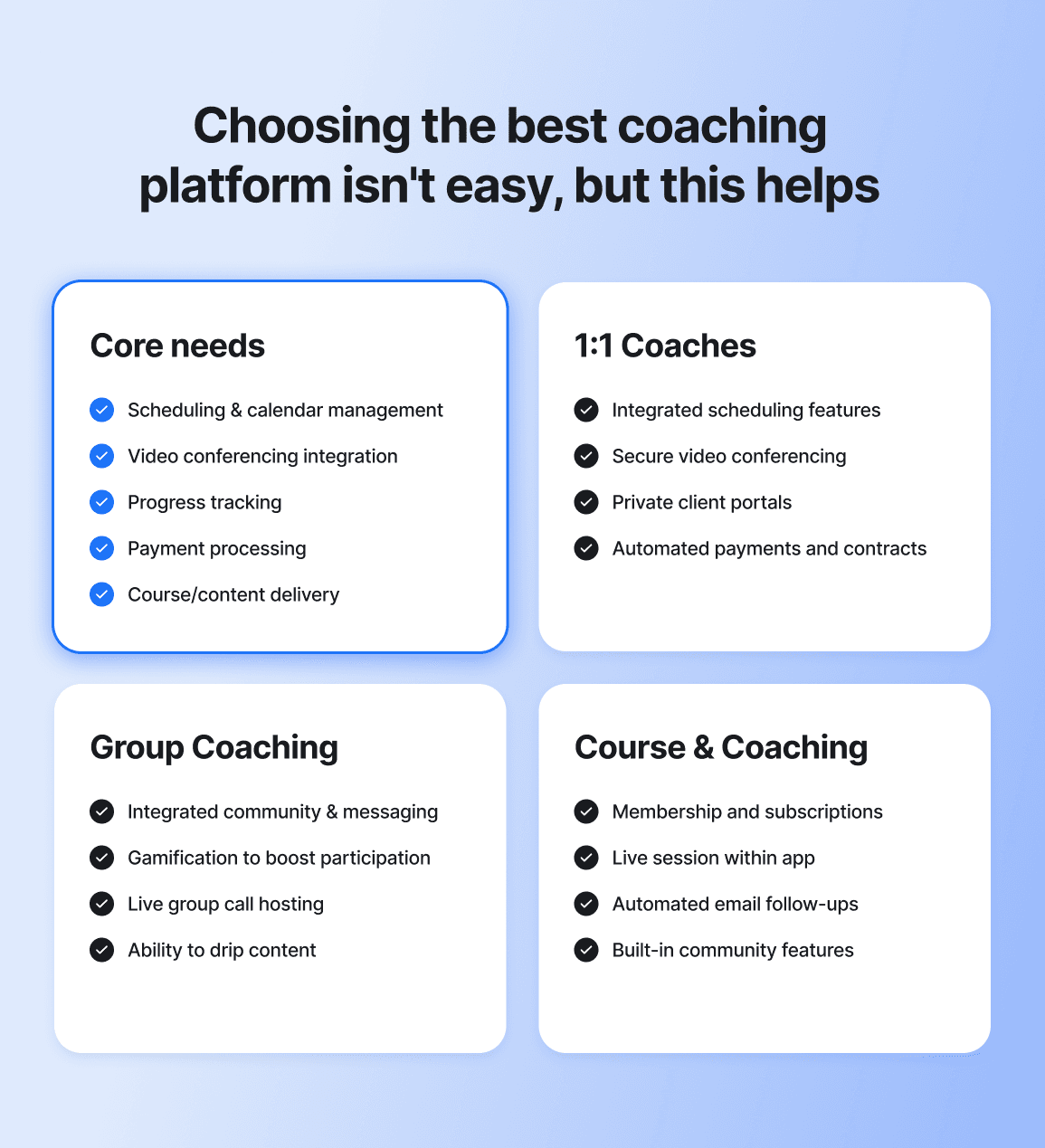
Let’s call these the non-negotiables. These are typically the features that automate the admin side of your coaching business, like scheduling calls, sending video conferencing links, and helping you track clients’ progress.
At a bare minimum, your platform should offer:
✅ Scheduling & calendar management: Clients need to be able to book without a headache.
✅ Video conferencing integration: Does it have Zoom, Google Meet, or another built-in video feature?
✅ Progress tracking: It’s super empowering for clients (and yourself) to see the growth happening.
✅ Payment processing: Make sure there are ways to help ensure you’re getting paid. Do you need features for subscriptions, one-time fees, or pay-as-you-go?
✅ Course/content delivery: If content distribution is part of your business, look for features that allow for streamlined creation and delivery.
1:1 coaches: Prioritize personalization
If you’re a one-on-one coach, you should look for a platform that supports highly personalized experiences. That means your tools should make it easy to track personal goals, document session notes, customize next steps, and maintain a secure, distraction-free space for each client.
At 1:1 coaching, scale matters less. What matters is depth, continuity, and a system that supports one-to-one transformation. According to our 2026 Community Trends Report, 69% of community builders prioritize member transformation as their #1 growth strategy.
Here are the top things you should look for:
- Integrated scheduling features (no more back-and-forth emails)
- Secure video conferencing
- Private client portals for notes and progress tracking
- Automated payments and contracts
Group coaching: Prioritize community
Group coaching thrives on connection and accountability. The right platform should bring your clients together, not scatter them across a dozen different tools. If you want to build an engaged, supportive community where members interact, learn from each other, and stay motivated, you need features that make participation easy (and fun!).
Here are the top things you should look for:
- Built-in community and communication
- Gamification to boost participation
- Live group call hosting and event scheduling features
- Drip content abilities that guide clients step by step
Course + coaching hybrid: Prioritize connection
Balancing structured learning with live coaching requires a platform that can do both well. You need a system that delivers your course content smoothly while also allowing for real-time interaction with clients. Whether you're running a self-paced program with optional coaching sessions or a fully guided cohort experience, your platform should support both education and engagement without friction.
Here are the top things you should look for:
- Course hosting (video, text, quizzes)
- Ability to expense memberships and subscriptions
- Live session integration within the app
- Automated email follow-ups
- Built-in community features
The 11 best coaching platforms in 2026: At a glance
Before we break down each platform in detail, here’s a quick side-by-side overview comparing the top 11 coaching platforms across core features, business model fit, and entry-level pricing.
| Tool | Best for | Core features | Starting price |
|---|---|---|---|
| Circle | Coaches who want community + courses + live coaching in one platform | - community spaces - course delivery - live group calls - 24/7 AI agents to support and coach clients - AI-powered community activity scores - gamification features to reward and motivate members - payments | $89/month |
| Thinkific | Course creators who need structured learning experiences | - course builder - quizzes - certificates | $36/month |
| Teachable | Coaches focused primarily on selling online courses | - course hosting - landing pages - affiliate tools | $29/month |
| Kajabi | Coaches who rely on marketing funnels | - course builder - email marketing - landing pages | $143/month |
| Mighty Networks | Community-first group coaching programs | - community building tools - forums - events | $79/month |
| Practice Better | Health, wellness & fitness coaches | - integration with health apps - personalized wellness plans | $25/month |
| Satori | 1:1 coaches who want a straightforward client management system | - automated scheduling - payments - session notes | $33/month |
| Paperbell | Coaches who want a simple, social-friendly website to sell sessions | - scheduling - payments - package management | $57/month |
| Coach Accountable | Coaches who need detailed client progress tracking and accountability tools | - goal tracking - reminders - client dashboards | $20/month |
| upcoach | Coaches running structured programs | - coaching program builder - course creation and drip scheduling - habit tracking and task assignments | $49/month |
| ABC Trainerize | Fitness coaches delivering training and nutrition programs | - habit coaching tools - client engagement tools - badges and engagement features | $0/month |
1. Circle — best overall platform to sell and run group coaching programs
Circle is the modern platform for coaching businesses. Win clients with a website, public webinars and forms for applications, sell programs with installments at a branded checkout, deliver through live calls, cohorts and courses, keep clients accountable in a community, and manage it all from one client record with Circle AI, workflows and AI Agents (Scale plan). Start with 1:1 coaching and grow into groups, memberships and an academy without changing platforms.
Key features:
- Deliver the program live: coaching calls, workshops and Q&As with native video, AI transcripts and summaries.
- Teach it in structure: a course builder with cohort-based delivery, drip content and multimedia lessons for the curriculum between calls.
- Keep clients accountable between sessions: discussion spaces, group chat, DMs, and gamification with points, levels, badges and leaderboards.
- Support them around the clock: AI Agents trained on your content answer questions, so you are not the first line of support.
- Sell every offer: one-time payments, subscriptions and installments at branded checkout, with paywalls, member-only discounts, bundles and promotion codes.
- Screen before you sell: take applications with Forms so you only onboard the right clients.
- Fill the funnel: open a public webinar to anyone, capture every guest as a lead, and follow up with your offer.
- Grow revenue per client: a post-checkout upsell moves a new client into your next program.
- Build the program from a prompt: describe it to Circle AI and it proposes the structure, then builds it with your approval.
- Own the brand: your own domain, a fully branded iOS and Android app on Circle Plus, and analytics from first website visit to paying client.
Pricing:
Plans start at $89/month, and all core plans offer a 14-day free trial. All plans include unlimited members.
Ideal for:
Coaches running 1:1, group or cohort programs who want to coach well, keep clients accountable between sessions, and fill the next cohort — without burning out.
| Pros | Cons |
|---|---|
| User-friendly, intuitive interface. | Pricing can be high for coaches with just a few clients. |
| AI-powered Agents trained on your content that provide personalized, always-on coaching support. | Feature depth can feel overwhelming for brand-new coaches. |
| Custom branding options, including white-label and branded mobile apps. | |
| Helpful support and continuous product improvements driven by user feedback. | |
| All plans include unlimited members, which isn’t always the case with other platforms. |
💬 Users say:
👍🏼 "Circle.so excels in providing an intuitive and user-friendly interface that simplifies community building and management. Its comprehensive suite of features—including discussion forums, event management, and seamless integrations—empowers us to create a vibrant and engaging community space. The platform's customization options allow us to align our community's appearance with our brand identity, enhancing the overall member experience. Additionally, Circle.so's responsive and knowledgeable customer support team ensures that any questions or issues are promptly addressed, contributing to a smooth and efficient user experience." - Verified review from G2
🤔 “It generally serves our needs well. There are opportunities for deeper analytics or improvement of certain analytics. For example, we use Circle's tracking links to determine which events prompt folks to sign up and we learned it tracks clicks on links, not actual sign ups." - Verified review from G2
👉 See how (and why) Josh Hall, a web design business coach, course creator, YouTuber, podcast host, and web agency founder, uses Circle to run his $240K web design community.

Rated #1 for a reason.
2. Thinkific — best for coaches turning expertise into a structured education business
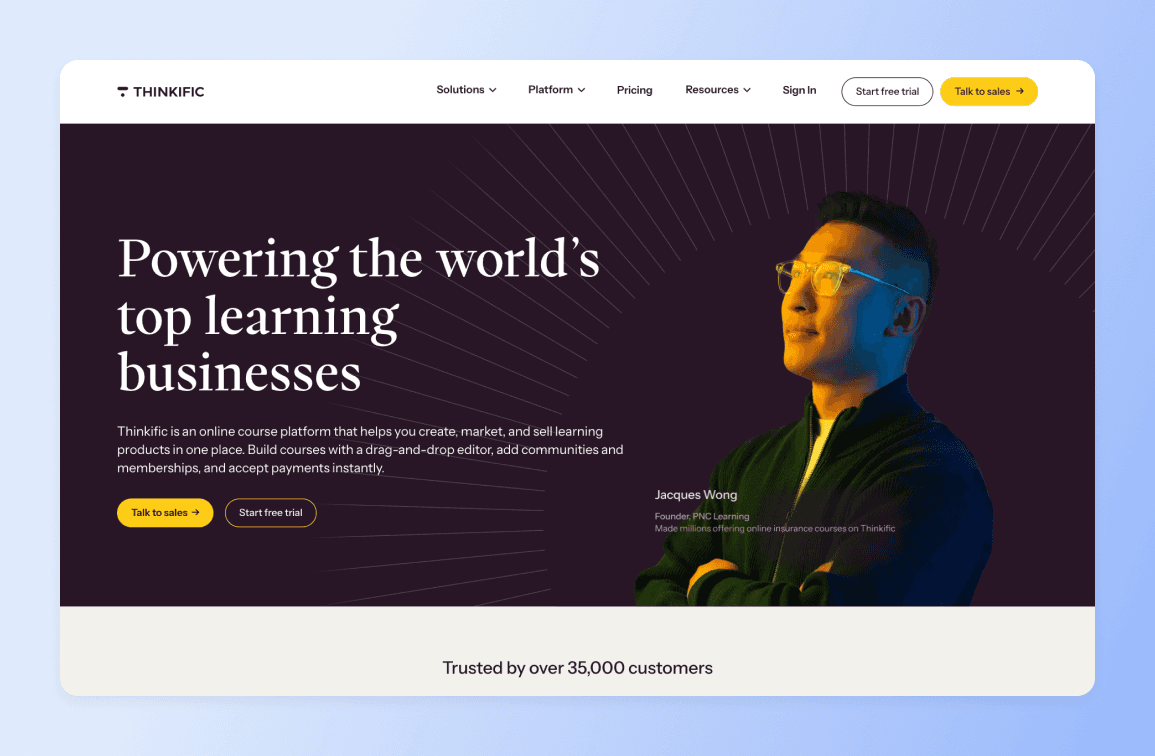
Thinkific is a top choice for coaches with courses who need a platform focused on delivering high-quality online education. The platform’s flexibility in course design makes it easy to create both structured and self-paced learning experiences.
Key features:
- Custom course pricing (free, one-time, subscriptions, bundles).
- Integrated quizzes, certificates, and student tracking.
- Live sessions through Zoom integration.
- Drip content and automated student progression.
Pricing:
Plans start at $36/month with a 30-day free trial available.
Ideal for:
Coaches who sell structured courses with optional coaching add-ons.
| Pros | Cons |
|---|---|
| Supports both 1:1 and group coaching formats. | Advanced capabilities require higher tiers. |
| Flexible monetization options. | |
| Advanced analytics with custom dashboards, engagement tracking, and revenue reporting. |
💬 Users say:
👍🏼 “Great interface, support is available to talk to." - Verified review from G2
🤔 “Website layout has few options to customise. So many extra add ons to pay for, the membership plans kept increasing in price and rather invest in upgrading the platform, they seem to push paid plugins instead. Our website was not very easily found in Google search so we left, the customer service team were not experienced to help and instead said not to worry." - Verified review from G2
Thinkific vs. Circle: See how Thinkific stacks up.
3. Teachable — best for course-focused coaches
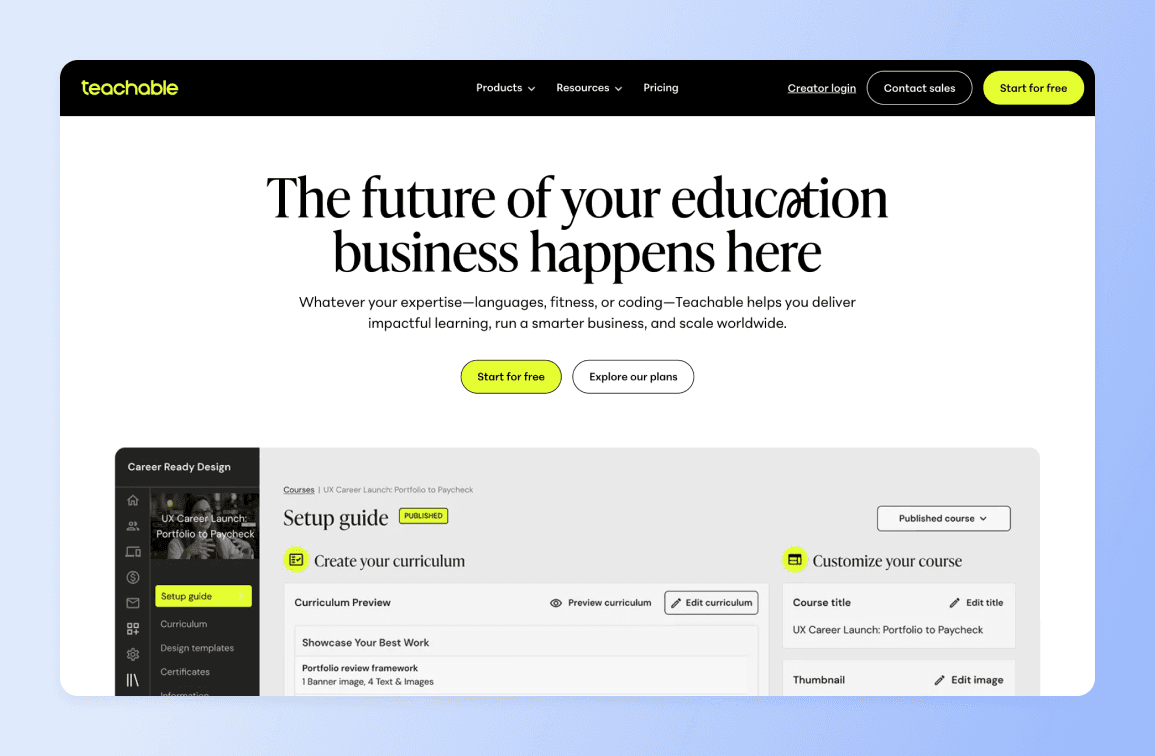
Teachable is perfect for coaches who want to create and sell online courses without the complexity. The platform is intuitive and easy to use, allowing coaches to focus on delivering their courses while Teachable handles the logistics.
Key features:
- Easy-to-use course creation tools.
- Customizable landing pages for marketing your course.
- Drip content and student progress tracking.
Pricing:
Plans start at $29/month with a 7-day free trial available.
Ideal for:
Coaches focused on creating and selling online courses.
| Pros | Cons |
|---|---|
| Very easy to launch. | Lacks community engagement tools. |
| Affiliate marketing options for increased course sales. | Fewer automation features than competitors. |
| Integration with email marketing tools like MailChimp and ConvertKit. |
💬 Users say:
👍🏼 “Teachable is intuitive to use. No fuss type of platform for course hosting. That is what I like the most about it "no fuss type of platform." - Verified review from G2
🤔 "Connection with your students. It was difficult to engage with them." - Verified review from G2
Teachable vs. Circle: See how Teachable stacks up.
4. Kajabi — best for coaches who rely on funnels and email marketing
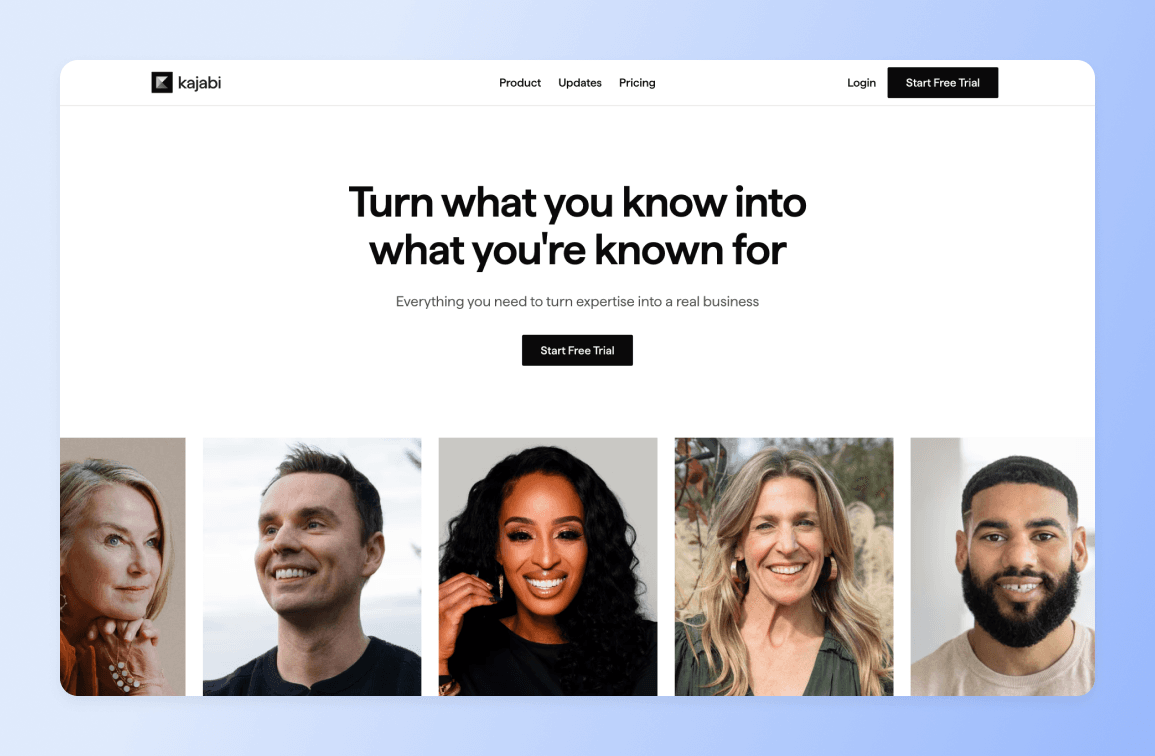
Kajabi is best for coaches who need an all-in-one platform that combines course creation, marketing, and sales funnels. It’s a powerful platform for coaches who want to sell, market, and deliver their courses all in one place.
Key features:
- Fully integrated course creation tools.
- Customizable landing pages for sales and marketing.
- Membership site management.
- Analytics features for tracking course sales.
Pricing:
Plans start at $143/month with a 14-day free trial available.
Ideal for:
Coaches who need an all-in-one platform for courses, marketing, and sales funnels.
| Pros | Cons |
|---|---|
| All-in-one platform with courses, marketing, and sales tools. | Higher starting price compared to competitors. |
| Built-in email marketing and sales funnel automation. | Can be overwhelming due to its many features. |
| Global checkout support—accept payments in 140+ currencies. |
💬 Users say:
👍🏼 "It is a very comprehensive platform, with access to metrics, funnel creation, email marketing, and easy landing page creation." - Verified review from G2
🤔 "Kajabi doesn't have a good community feature for members and students. Many people from our audience have to use different community platforms to meet their demands." - Verified review from G2
💡 Kajabi vs. Circle: See how Kajabi stacks up.
5. Mighty Networks — best for coaches building a membership-driven community
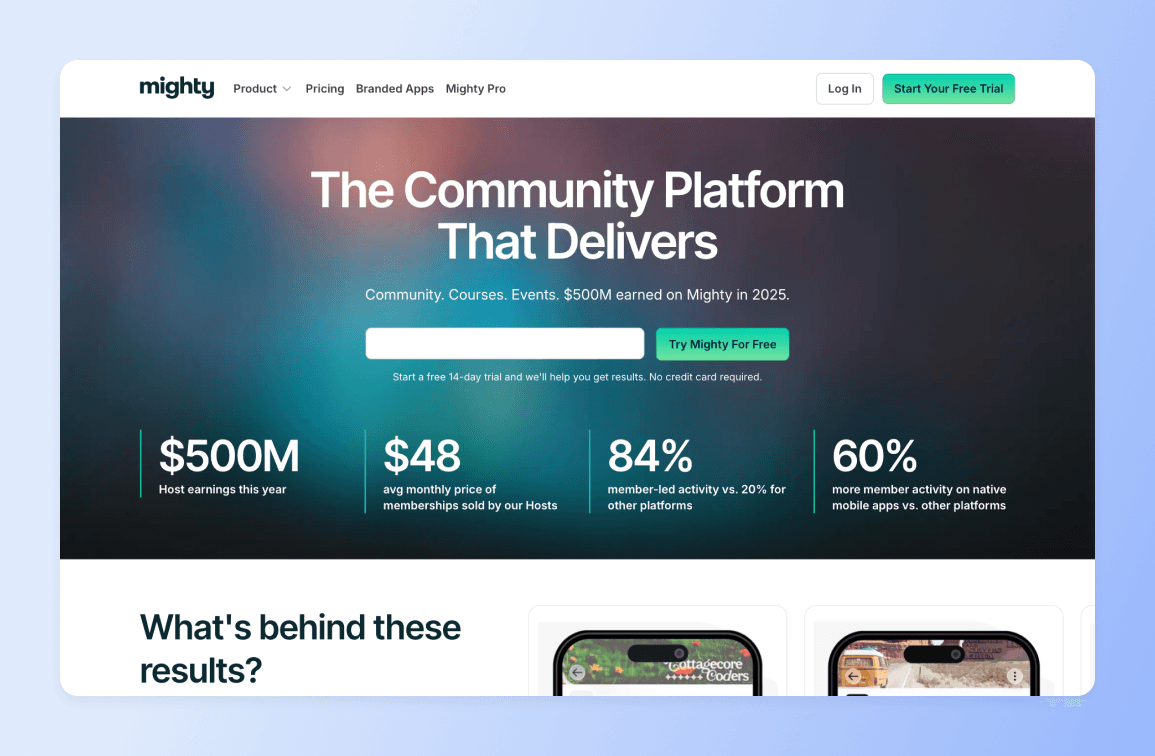
If your coaching business revolves around paid memberships, recurring engagement, and strong peer-to-peer interaction, Mighty Networks is built for that model.
Mighty isn’t primarily a coaching management tool. It’s more of a community engine designed to help you build interactive memberships with high member-led activity.
Key features:
- Community-building features (posts, polls, feeds, and discussions).
- One-time or recurring live and virtual events.
- Membership and subscription options for monetization.
Pricing:
Plans start at $79/month with a 14-day free trial available.
Ideal for:
Coaches who want to build a recurring membership business.
| Pros | Cons |
|---|---|
| Livestreams with live chat & reactions. | Lighter on the analytics side compared to other similar platforms. |
| Strong mobile experience. | |
| Good for recurring membership models. |
💬 Users say:
👍🏼 "Mighty Networks has a lot of great tools if you are looking for a smaller community. It is a great way for us to connect with our end users in our own controlled environment. The courses is what we use the most!" - Verified review from G2
🤔 "It's a very incomplete solution. It's mainly an online community, but it has very little customization available, the interaction with participants is choppy and flat, and the live class integration is terrible. But the biggest flaw is their inability to accommodate other software platforms that are utilized in your business. A community should be a part of a larger plan and unfortunately, Mighty Networks was built as a stand alone partial solution. Even if you purchase their top tier." - Verified review from G2
💡 Circle vs. Mighty Networks: Which platform is better for your coaching style?
While both platforms offer course, event, and community tools for coaches, Mighty Networks is not like us when it comes to ease of use, automation, or engagement features. While they’re great at creating a social-network-like experience, Circle is better for coaches because we’re able to host events within the platform (natively), send email flows automatically, and create workflows that keep clients engaged and retained.
6. Practice Better — best for health and wellness coaches who need client management tools
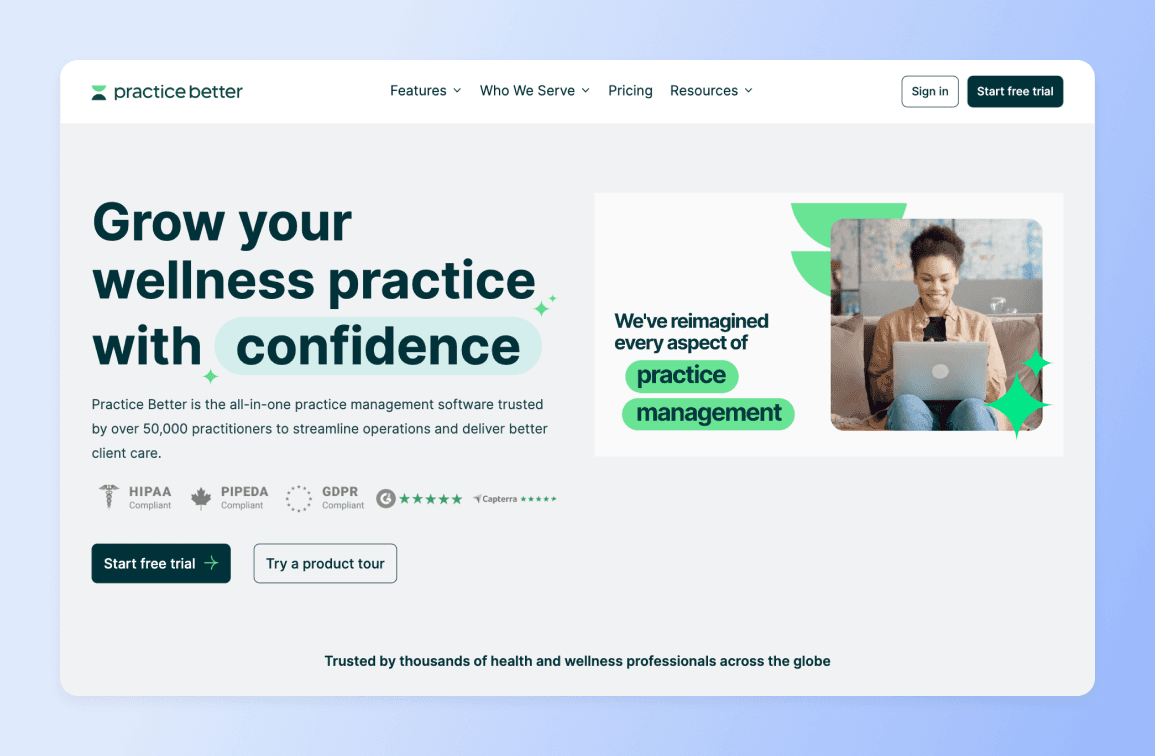
Practice Better is designed specifically for health and wellness coaches who need tools to manage client appointments, track progress, and deliver personalized plans. It’s perfect for coaches in the wellness space looking for a specialized platform.
Key features:
- Appointment scheduling and reminders.
- Client progress tracking and health integrations (fitness trackers).
- Personalized wellness plans and progress reports.
- Integration with popular health apps.
Pricing:
Plans start at $25/month. You can also try the tool for free for 14 days.
Ideal for:
Health, wellness, and fitness coaches needing appointment scheduling and client tracking.
| Pros | Cons |
|---|---|
| Strong client management infrastructure, including notes, forms, and protocols. | Not suited for community-driven businesses. |
| Group session scheduling with attendee controls. | Limited marketing and funnel automation. |
| Integrated billing workflows. |
💬 Users say:
👍🏼 "Practice better is easy to use and very user friendly. It has most of the features I need without too much fluff, extras or complexity. The ability to create notes, protocols, schedule appointments, have clients fill forms, and secure communication satisfies most of my needs." - Verified review from G2
🤔 “I don't love the program feature. There's not really a community aspect, and I use a separate platform for that. When creating programs in Practice Better, there's a chat feature for clients, but it's not very functional in the way I would like it to be. Also, the initial setup of Practice Better was a lot of work and took many hours, but once it's done, it's done.” - Verified review from G2
7. Satori — best for coaches who want to streamline 1:1 client operations

If you’re a life coach who primarily works with 1:1 clients and you don’t want to splurge on a complex, all-in-one platform, Satori is a great option to consider.
It isn’t trying to be a community platform or a marketing funnel builder. Instead, it focuses on what many solo coaches actually need: converting discovery calls, onboarding clients smoothly, and delivering structured multi-session coaching packages with ease.
Key features:
- Client management (progress tracking, session notes).
- Scheduling and calendar management.
- Payment processing and invoicing.
- Integrated video calls for seamless 1:1 sessions.
Pricing:
Plans start at $33/month with a 15-day free trial available.
Ideal for:
Coaches who want a simple, budget-friendly solution for 1:1 coaching.
| Pros | Cons |
|---|---|
| Simple and budget-friendly. | Not built for community-driven models. |
| Customizable coaching packages and pricing. | |
| Automated reminders and follow-ups for clients. |
💬 Users say:
👍🏼 "Satori is very helpful! It was easy to use, has lots of features, and the support is awesome." - Verified review from G2
🤔 “Even though there are options to integrate with others tool, there are some limitations of not integrating some well known coaching tools.” - Verified review from G2
8. Paperbell — best for coaches who want a simple, social-friendly website to sell sessions
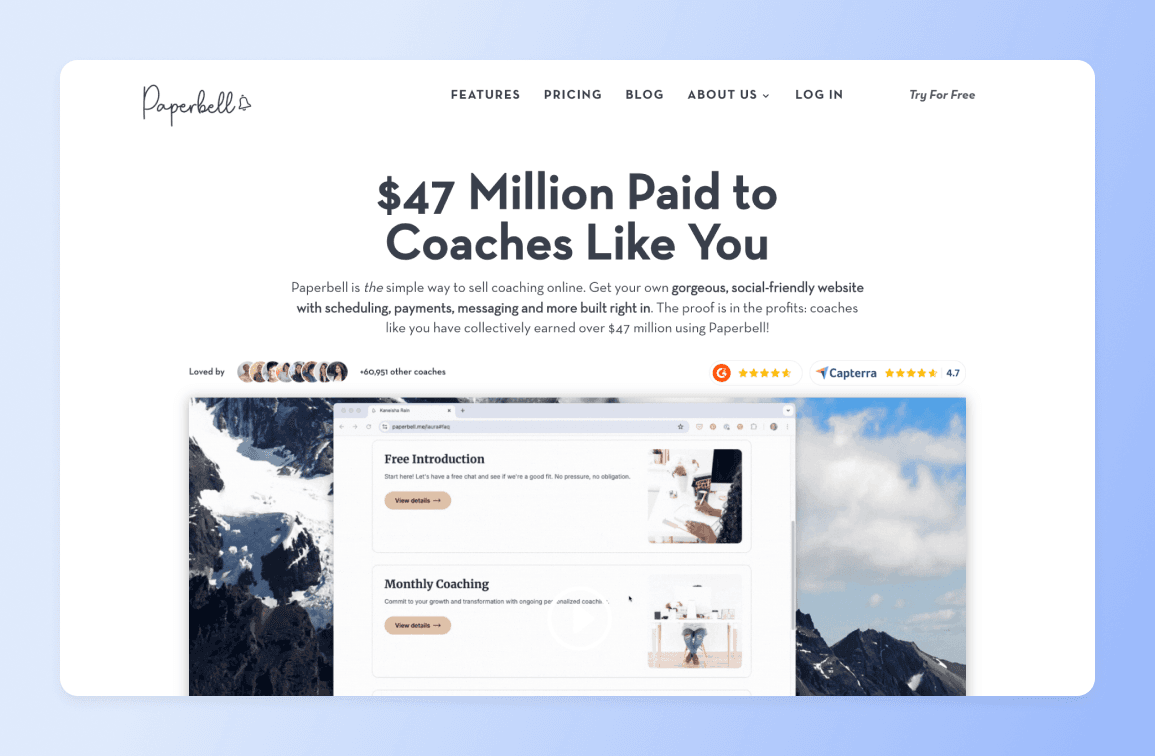
Paperbell is a perfect solution for solopreneurs who need an easy way to manage their coaching business. It includes tools for scheduling, payments, and session management, all in a simple, streamlined platform.
Key features:
- Scheduling and client management.
- Payment processing and invoicing.
- Client communication tools (messages and session notes).
- Simple client portal for easy access to materials.
Pricing:
Plans start at $57/month and include a 7-day free trial.
Ideal for:
Solopreneurs who need scheduling, client management, and payment tools.
| Pros | Cons |
|---|---|
| Simple and intuitive platform for solo coaches. | Lack of marketing automation tools. |
| Built-in contract signing feature. | |
| Client intake forms. |
💬 Users say:
👍🏼 "Paperbell aligns with how I run my business. I am able to offer coaching packages with a certain number of sessions at either a one time price (with a discount if desired) or a monthly fee. Of all the coaching platforms I've checked out, it has the greatest flexibility to do what I need." - Verified review from G2
🤔 "Paperbell doesn't include any big marketing features to help you find clients. You have to find clients and then send them to Paperbell to purchase your packages." - Verified review from G2
9. Coach Accountable — best for coaches who need detailed client progress tracking
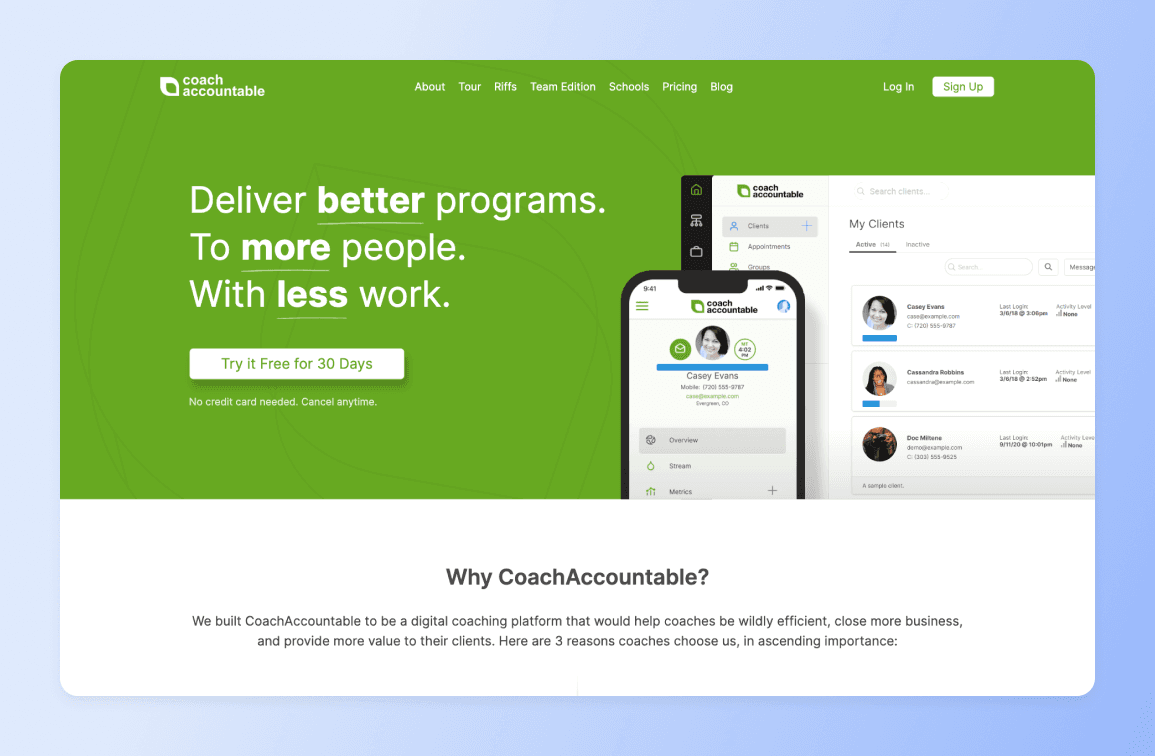
Coach Accountable is built for coaches who prioritize accountability and tracking. With robust features for goal-setting, activity tracking, and client monitoring, it’s ideal for coaches who need detailed insights into their clients' progress.
Key features:
- Action plans and assignments between sessions.
- Goal tracking and progress metrics.
- Automated reminders and nudges.
- Session notes and shared records.
Pricing:
Plans start at $20/month with a 30-day free trial available.
Ideal for:
Coaches who focus on accountability and tracking client progress.
| Pros | Cons |
|---|---|
| Client dashboards with engagement summaries. | The interface feels more functional than modern. |
| Strong accountability framework that encourages real follow-through. | Limited marketing and sales tools. |
| Good option for structured coaching programs. |
💬 Users say:
👍🏼 "It’s a comprehensive solution for coaches that are just starting out, who might not have the money for a client portal that hosts all their amazing content and fuels the client through their methodology." - Verified review from G2
🤔 "It isn’t an all in one system. It won’t do your accounting or automate your entire operational process from sales to fulfillment." - Verified review from G2
10. upcoach — best for coaches running structured programs
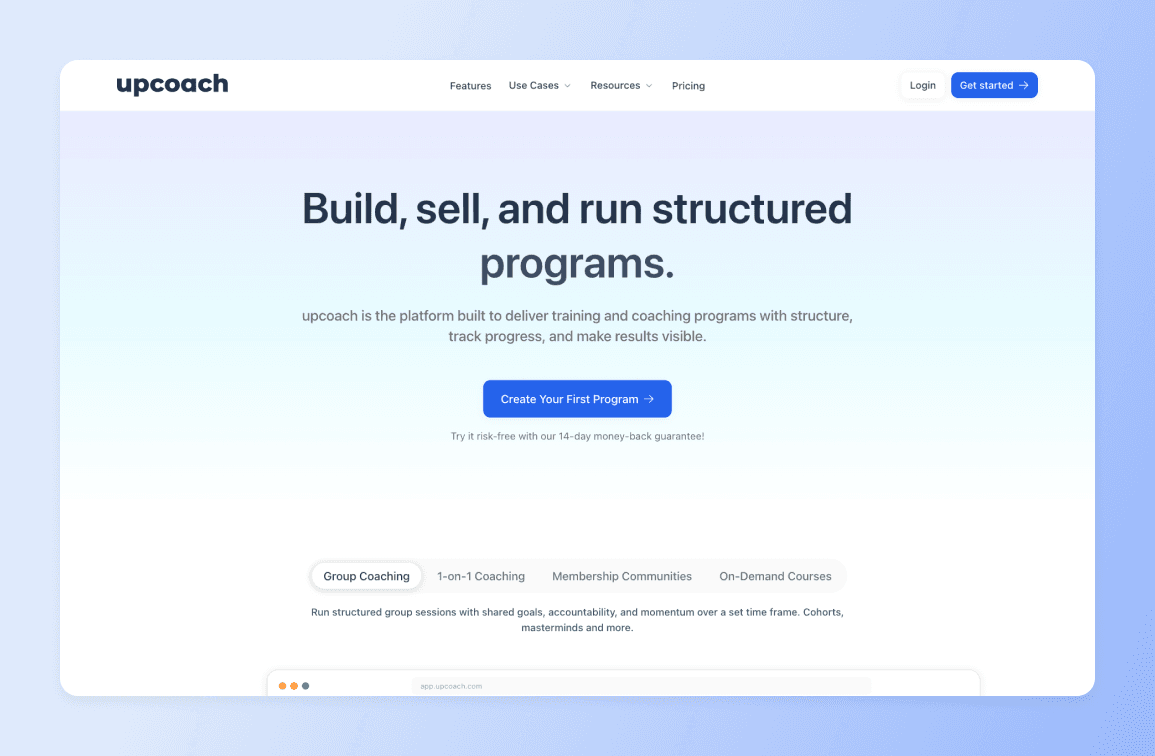
If your coaching business runs on structured programs with clear milestones, exercises, and repeatable frameworks, upcoach could be a great option for you. It brings your 1:1 coaching, group programs, courses, payments, and client communication into one organized system.
For coaches growing from solo practice into structured programs or small teams, upcoach offers a practical middle ground between simplicity and scale.
Key features:
- Coaching program builder (1:1 and group).
- Course creation and drip scheduling.
- Habit tracking and task assignments.
- Built-in CRM.
Pricing:
Plans start at $49/month. There’s no free trial, but they offer a 14-day money-back guarantee.
Ideal for:
Structured program-based coaches and small coaching teams.
| Pros | Cons |
|---|---|
| Strong program structure tools (tasks, habits, smart documents). | Client limits on lower plans. |
| Works well if you mix 1:1, group coaching, and light course delivery in the same offer. | Not currently GDPR- or HIPAA-compliant. |
| The ability to clone programs and reuse workflows. |
💬 Users say:
👍🏼 “I have had Upcoach for quite a while now and am just starting to properly use it again (since the Uteach debacle, really). It does have a bit of a learning curve, but once you do understand it, you realize it was made by a coach (or coaches) for coaches!” – Verified review from AppZumo
🤔 “No GDPR compliance.” – Verified review from AppZumo
11. ABC Trainerize — best for fitness coaches delivering training and nutrition programs
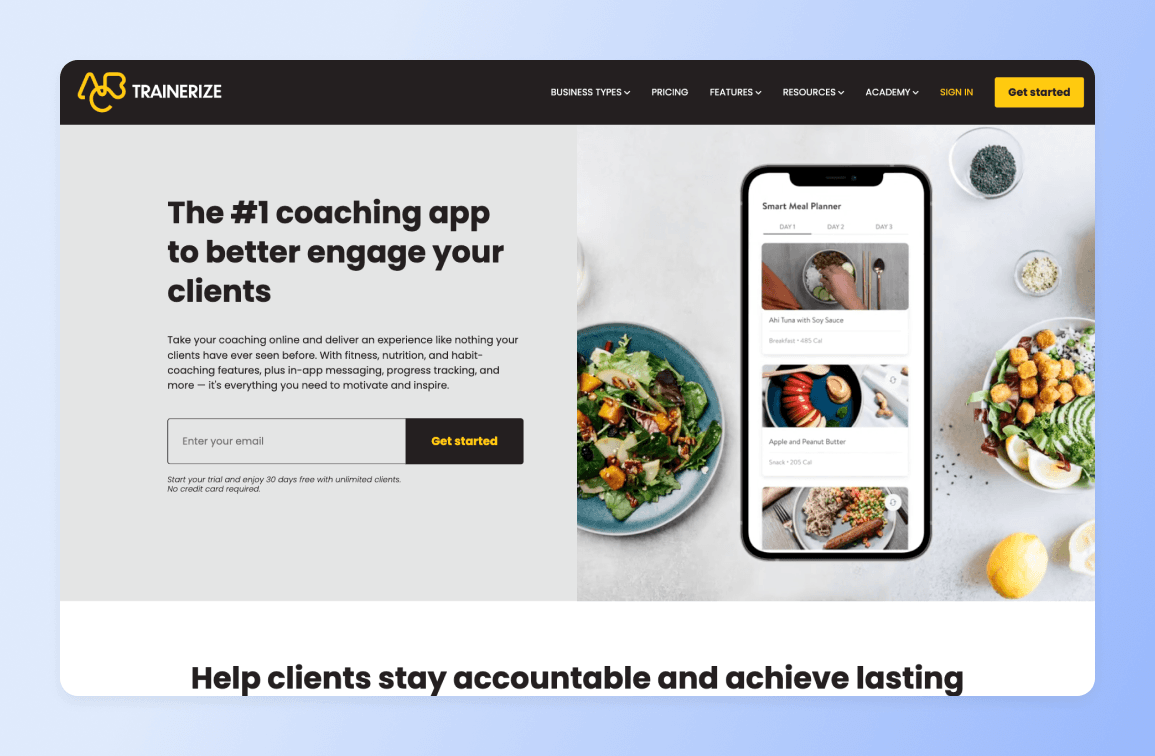
Lastly, we have ABC Trainerize—a platform specifically built for fitness coaches, personal trainers, and gym owners. It combines workout programming, nutrition tracking, messaging, and branded mobile apps in one system.
Key features:
- Habit coaching tools.
- Client engagement tools.
- Badges and engagement features.
Pricing:
Starts at $0/month for one client, with paid plans scaling based on the number of clients. There’s also a 30-day free trial available.
Ideal for:
Online fitness coaches who need a purpose-built app.
| Pros | Cons |
|---|---|
| Integrated payments and package management. | Limited flexibility outside of fitness use cases. |
| Strong engagement features to boost accountability. | Occasional glitches. |
| Suitable for both independent fitness coaches and gyms. |
💬 Users say:
👍🏼 “The best for training clients!! Love the meal plans and the exercises.” – Verified review from Trustpilot
🤔 “Good platform, but difficult to cancel when asked. Then charges for the duration of the time when you are trying to contact to cancel. Glitches not allowing you to cancel.” – Verified review from Trustpilot
Elevate your coaching with the right platform
Choosing the right coaching platform ultimately comes down to your business model, your growth plans, and the kind of experience you want to create for your clients. If you’re a fitness coach delivering workouts and nutrition plans, a niche platform like ABC Trainerize may be the right fit. If you want to work with clients on a one-on-one basis, Satori is a solid option.
However, if you’re looking to build a proper coaching business and supplement your income with digital products, courses, and a community, look no further than Circle.
Circle’s flexible approach lets you mix live coaching, self-paced courses, and community engagement, giving you the ability to scale your coaching business without losing the personal touch that keeps clients engaged.
Built for whatever you're coaching.
FAQs about coaching platforms
Is Zoom enough to run a coaching business?
Zoom is great for video calls, but it's only one piece of running a coaching business. It doesn't handle scheduling, payments, progress tracking, course delivery, or community engagement — all of which are essential for a professional client experience. Most coaches who start with Zoom end up juggling 4–6 separate tools (Calendly, Stripe, Google Drive, a course host, an email tool, a community app), which creates more admin work and a fragmented experience for clients. A dedicated coaching platform brings everything under one roof, saving you time and giving your clients a seamless, branded experience.
Which platform is best for coaching?
It depends on your coaching model. For 1:1 coaches on a budget, Satori ($33/month) offers straightforward scheduling and payments. For coaches who sell group programs, Circle ($89/month) is the best overall choice. Take applications with forms, collect installments at checkout, run a public webinar that captures every guest, then deliver live calls, courses and AI tools in one branded platform.
How much do online coaching platforms cost?
Pricing varies widely depending on what's included, but the sticker price rarely tells the full story. Here's a general breakdown:
- Basic tools (scheduling, payments, client management): $25–$50/month
- Mid-tier platforms (courses or community features included): $50–$85/month
- All-in-one platforms (courses, community, automation, analytics, and mobile apps): $85–$150/month
Keep in mind that many platforms charge transaction fees of 2–5% on top of your monthly plan, cap the number of clients or contacts you can have before forcing an upgrade, or gate key features like email marketing and integrations behind paid add-ons.
For example, a coach earning $10,000/month on Teachable's Starter plan would pay $750/month in transaction fees alone — more than Circle's highest-tier plan. Before choosing, map out what you'll actually need at your next stage of growth (and the true total cost at your expected revenue level), not just where you are today.
Can I run courses, community, and coaching on one platform?
Yes, but most platforms force trade-offs. Thinkific and Teachable are excellent for structured courses but have limited community features. Mighty Networks offers strong community tools but lighter course capabilities. Kajabi includes courses and marketing funnels but its community was acquired separately and still feels disconnected from the course experience. Circle is purpose-built to combine community spaces, course delivery, live events, and member engagement in a single platform — so your clients get one login instead of four, and you spend less time managing integrations.
Which coaching platforms have AI features?
AI features are becoming standard, but the depth varies significantly. Circle offers AI Agents trained on your own content to provide personalized, always-on coaching support to members — a capability no other platform currently matches. Circle also includes AI-powered discussion summaries, content moderation, workflow automation, and member activity scoring. Kajabi's Creator Hub helps generate course outlines and marketing copy. Mighty Networks uses AI for member matching and conversation prompts. Teachable and Thinkific offer basic AI course-building assistance. If AI-powered member engagement is a priority, Circle is the clear leader.
Which coaching platform has the best community features?
Circle has the most comprehensive community feature set of any coaching platform. It includes six types of community spaces, threaded discussions with AI summaries, rich member profiles, gamification (points, badges, leaderboards), live rooms, native video, group chat, DMs, and events — all purpose-built rather than bolted on. Mighty Networks also offers solid community tools, though users report navigation challenges and limited customization. Kajabi's community was added via acquisition and runs separately from courses. Teachable and Thinkific both launched community features recently, but they're still basic compared to community-first platforms.
What's the best platform for scaling from 1:1 coaching to group programs?
Circle is designed for exactly this growth trajectory. You can start with private spaces for 1:1 clients, add cohort-based group programs with live rooms (up to 15–20 participants), scale to community-wide livestreams (100–200+ attendees), and layer in self-paced courses — all without switching platforms. Kajabi also supports this path and adds strong built-in scheduling for 1:1 sessions. By contrast, Thinkific limits coaching to single sessions only, and Teachable's coaching features are 1:1 only with no native group infrastructure. Choose a platform that won't make you start over when your model evolves.
How does Circle compare to Kajabi for coaching?
Both platforms sell. Kajabi is good with email funnels and marketing automation. Circle sells group programs end to end: applications, installments, public webinars that capture every guest and post-checkout upsells, with community and live delivery in the same place. Circle starts at $89/month vs. Kajabi's $143/month; Kajabi includes email marketing that Circle offers as an add-on.
How does Circle compare to Mighty Networks for coaching?
Both platforms are community-first, but Circle offers a more complete coaching toolkit. Mighty Networks provides solid basic community features and a strong mobile-native experience. However, it lacks email marketing, quizzes, certificates, an open API, and advanced automations — and it charges 2–3% transaction fees on all plans. Branded apps through Mighty Pro reportedly cost $3,000+/month, significantly more than Circle Plus. Circle also offers AI Agents trained on your content, richer course tools, and deeper gamification. If you want a straightforward community with a social-network feel, Mighty Networks works well. If you're building a full coaching business with courses and monetization, Circle gives you more to grow into.
How hard is it to switch coaching platforms?
Switching platforms can feel daunting, but it doesn't have to be. Most platforms let you export member lists, course content, and payment data. Circle offers free managed migration for qualifying annual plans — a dedicated team handles the transfer so you don't have to. The typical timeline is 1–2 weeks depending on content volume. Some competitors offer migration guides but no hands-on support. The biggest risk isn't usually technical — it's the gap in member communication. Plan ahead, notify your community, and most coaches find the switch smoother than expected.
Are free online coaching platforms worth it?
Free plans can work for testing an idea, but they come with real trade-offs. Thinkific offers a free plan limited to one course with restricted features. Teachable eliminated its free plan in 2025. Kajabi, Circle, and Mighty Networks offer 14-day free trials instead. If you're earning under $1,000/month and validating your offer, a free plan or trial is a smart start. Once you need community tools, automations, branding, or scalable monetization, a paid platform pays for itself through reduced admin time and better client experience.
Do I need a branded mobile app for coaching?
Not always, but it matters more as your business grows and your prices increase. A branded app creates a premium client experience, enables push notifications, and supports in-app purchases. Circle offers branded iOS and Android apps through Circle Plus. Kajabi includes branded apps on its Pro plan ($399/month). Mighty Pro offers them reportedly starting at $3,000+/month. Teachable has only a generic student app with no branding options. For coaches charging premium prices or running professional organizations, a branded app is a meaningful differentiator.
Do I need tech skills to set up an online coaching platform?
No — most coaching platforms are completely no-code. You pick a template, connect your calendar and payment processor, and you're ready to invite clients. All-in-one platforms like Circle also offer guided onboarding and live chat support if you get stuck. If you can send an email and schedule a meeting, you can set up a coaching platform.

Head of Performance Marketing
Marcus is the Head of Performance Marketing at Circle—and Circle's main demand gen nerd.