The AI playbook for coaches — take on more clients without working more hours
TL;DR
- Most coaches stop at using AI to write. The bigger wins are in the systems that help you find clients and keep them.
- AI runs the operational layer of your business so your hours go to the work clients actually pay you for.
- The expertise you've already built is the raw material for courses and memberships that sell without you in the room.
Members only
One issue, five minutes, every Tuesday. Read by +14,200 creators.
You've probably used ChatGPT to draft an email or two. Maybe outlined a blog post, polished a sales page, or rewritten a LinkedIn bio. Handy—but then you close the tab and still run the rest of the business by hand: the scheduling, the onboarding, the session notes, the follow-ups, the Wednesday-afternoon check-in you meant to send and didn't. AI shows up in flashes, not as a system.
Seth David runs a different playbook with Talk Nerdy to Me. His accounting education business includes 30+ courses, a membership community, and a high-ticket coaching program—and an AI Agent named "Sandy" answers member questions automatically, around the clock, trained on his own material. He'd been paying $12K a year on Slack alone before he consolidated onto one platform; now the business runs at roughly a third of that, converts 80% of trials to paid, and brings in $37K+ a month. That one shift moved AI from a writing assistant to a working part of the business, so Seth's hours go to the coaching work only he can do.
Seth runs AI as a system, not a series of one-off prompts. This article shows how to build that for a coaching business—where AI does the operational work, and where it stays out of the way so your hours go to the coaching itself.
Why AI is splitting the coaching market in two
AI is sorting coaches into two groups. The ones who sell hours of generic advice are the ones it commoditizes—a chatbot can hand out generic tips for free. The ones it hands a tailwind to are the ones selling a specific transformation. AI takes over the admin and the prep while the coach keeps the part no model can do: the relationship, the judgment, the accountability. Adoption of AI has gone from rare to routine in just a few years, and the coaches using it are already pulling ahead.
The coaches pulling ahead aren't using AI to coach (necessarily). They're using it to run everything around the coaching, so they can take on more clients without working more hours or watering down the work. That comes down to three jobs: filling a pipeline, converting that interest into paying clients, and delivering coaching good enough that people stay and buy more. Here's where AI earns its place in each.
1. Fill your pipeline with AI-assisted content
Coaches win clients in a predictable way: show your thinking in public, offer something free that proves you can help or show a small transformation or “unlock”, then point the people who raise their hand toward a call or a program.
The bottleneck is rarely ideas—it's the hours. When a client session hands you the perfect example of a mistake you see constantly—the kind of post that would pull in three more people with the same problem—you’re already onto the next call. That post? Never gets written.
AI closes the gap between “I should” and “ready to post”. Hand the transcript of a workshop or a recorded client Q&A to AI and it spins out a week of social posts, or a lead magnet that actually fits your ideal customers—a quiz or self-assessment that diagnoses a prospect's problem tends to convert better than another checklist.
The draft is the cheap part, and done in minutes. Your time goes into the parts a model can't do—the specific client story, the angle you've learned from real sessions, and the insight. Do that consistently and the top of your pipeline fills itself: a steady stream of the right people raising their hands.
2. Convert and enroll without chasing
A full pipeline is only half the job. The other half is conversion—turning the hands that go up into enrolled clients.
- A prospect books a discovery call and no-shows.
- Someone joins your free workshop, tells you it was exactly what they needed, then disappears.
- Where were you? You got busy and never sent the email inviting them into the paid program.
This is where coaching revenue actually leaks—not in attracting people, but in the follow-up that turns an interested stranger into an enrolled client, and it's the first thing that slides when you're coaching all day.
Circle's Email Hub runs that follow-up for you. You write the sequence once—the same case you'd make on a good discovery call, walking a prospect from their problem to the transformation you deliver and the proof you can deliver it, ending on the invitation to book—and it fires automatically the moment someone signs up, registers for your workshop, or applies for a call. Every lead gets your best pitch whether you're mid-session, on a plane, or asleep.
It converts better than a generic autoresponder because it reacts to what the lead actually does. Your community, courses, events, and email run in one system, so the sequence can branch on real behavior.
- A workshop attendee gets the enrollment invite.
- A no-show gets the replay and a second chance.
- Someone who finishes your free intro module gets nudged toward the paid program right when they're most convinced.
That's nurture based on what they did—not a stale list lost in translation from another tool.
3. Deliver coaching that keeps clients—and grows what they buy
Once someone's enrolled, the scheduling, intake, and payment reminders can run as a background workflow, triggered automatically when a client books. With that handled, AI's real job in delivery is the part that actually moves clients: making you sharper in the room, and keeping you present between sessions.
Show up sharper, in and between sessions
Before a call, AI Copilot can summarize a client's recent activity and the long threads they've posted, so you walk in knowing where their head's been all week—the goal they set and went quiet on, the question you meant to revisit—instead of scrambling through notes five minutes before. And between sessions, where most progress stalls, a Circle AI Agent trained on your frameworks, courses, and the answers you repeat in every program replies in your methodology the moment a client gets stuck.
Someone wrestling with a concept at 11pm gets your actual approach, not a generic pep talk. You set the limits: tier it so free members can't reach premium answers, and define the words—"urgent," "I want to quit," "talk to a human"—that make it stop and hand the conversation to you.
Elsynergy's Laura Haleydt and Ginny Fears show what that looks like in practice. Within five months of posting educational content on Instagram, each was earning $10K/month coaching one-to-one—but the calls had them tied down. So they built premium programs ($1,000–$3,000) pairing courses with group coaching, and their first course pulled in over $400,000 in three weeks. A custom-trained AI coach now fields questions from their own material around the clock, and the programs have grown to 4,500+ students and generated more than $2 million over their first three years. The focus, as Laura puts it, stays on the transformation rather than selling their time.
Turn your coaching into products that sell on their own
You can grow without adding hours by turning the coaching you already do into products that sell on their own. The raw material is sitting in your session recordings, workshop transcripts, and frameworks. Feed a transcript to an AI writing tool to outline a course, then add what only you can. That’s the case study or the mistake you watch clients make every time. Build that inside Circle's Courses, where lessons sit alongside the community discussing them.
Pat Flynn's Smart Passive Income did exactly this: consolidated courses, community, and events onto one platform, shifted to cohort-based accelerators, and now sees $700K in membership revenue a year—58% of total revenue—with course completion running 2.5–3x higher in the cohort model than in self-paced learning.
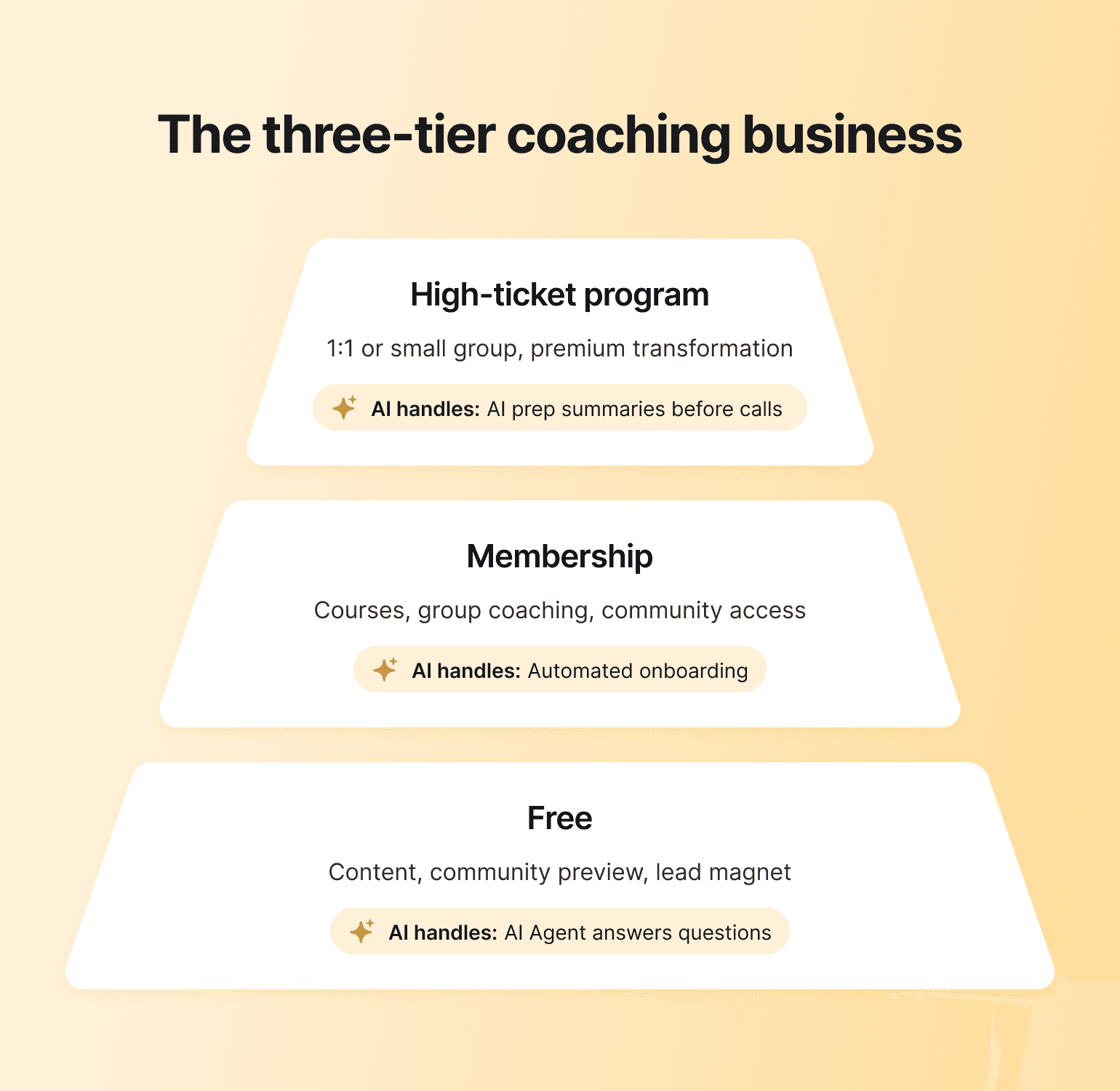
From there, paywalls and tiered memberships let you stack a free tier, a paid membership, and a high-ticket group program under one checkout—priced to the transformation each one delivers.
Set the guardrails before you scale AI
The coaches who get the most out of AI are the ones who decide upfront where it stops. Three rules keep automation working for you instead of quietly eroding the trust your business runs on:
- Label it plainly. Tell clients when they're talking to an AI trained on your material, not to you. Disclosure builds trust rather than spending it—people relax when they know what's automated and what's you.
- Keep the human on anything that matters. Set the words that make an agent stand down and hand the conversation over—"I want to quit," "talk to a human," anything that signals a client needs you, not a summary of your frameworks. AI carries the operational load; you stay responsible for the judgment, the relationship, and the calls only you can make.
- Protect client data. Before you connect any tool, confirm your client information isn't used to train outside models or retained where you can't see it. Favor systems where your data stays inside your own workspace, and keep sensitive client details out of consumer chatbots entirely.
Decide these three upfront and AI stays a tool you control—not a liability that quietly costs you the trust you've spent years earning.
Build a coaching business that grows without burning you out
Run all three jobs on this kind of system and the obvious question follows: if AI is doing this much, what's left for you? The part clients actually pay a coach for. AI can draft the follow-up and answer the logistics question at midnight, but it can't sit with someone the week a launch flops, read the thing they're not saying, or decide when to push and when to hold back. That judgment is the product—and it's exactly the work that automating everything else protects time for.
Build the business this way and growth stops meaning more hours. For any coach trying to move beyond one-to-one delivery, automation plus unified data under your own brand is what makes scaling feel sustainable instead of heavier.
Want to build an exceptional community? Start your 14-day free trial of Circle now.
AI for coaches FAQ
Can AI replace a human coach?
No. Coaching is adaptive and built on a relationship—reading what a client won't say, knowing when to challenge them, sitting with them through a setback. AI does real work around the coaching; the coaching itself is still yours.
Will my clients know they're talking to AI?
They should. The clearest practice is to label AI plainly: name your agent, tell clients it's an AI trained on your material, and route anything sensitive to you. TheICF practical guide recommends AI tools used in coaching identify themselves as AI and disclose their limitations. Transparency tends to build trust rather than spend it—clients know what's automated and what's you.
Is client data safe when I use AI tools?
It depends on the tool, so check the policy before you connect anything—and the thing to confirm is that your client data isn't used to train outside AI models. Circle'sprivacy policy states it plainly: your data is never used to train, fine-tune, or improve external AI models, and nothing is stored, retained, or logged by the model provider. The AI features run on vetted providers like OpenAI and AWS, with GDPR obligations handled as part of that. The general rule still holds for any tool: keep sensitive client details out of consumer chatbots, and favor systems where your data stays inside your own workspace.
How do I make sure AI content sounds like me?
Train it on your own material—transcripts, frameworks, past posts—and always edit the output before it reaches a client. AI gets the first draft; your voice and your real client specifics are what make it land.
Community Content Marketer
Arina is Circle’s community content marketer, sharing insights on community growth, GTM strategy, and storytelling for solopreneurs.