How to build an online business around community (not just content)
TL;DR
- For creators with an audience, the most sustainable online businesses start with recurring revenue and layer one-time products around it.
- Pre-selling an offer before you build it is the fastest way to find out whether you have a business or just an idea your audience likes.
- Running your community, courses, payments, and email from one platform beats stitching five tools together that barely talk to each other.
You have an audience. People know you for something. You're publishing on YouTube, Instagram, or your newsletter, and the attention is real—but it still feels like influence, not a business. The creators who turn that attention into something durable share a common mindset: they move the center of gravity from standalone content to recurring community membership, where members pay, show up, and refer others month after month. That's the difference recurring makes.
You don't need a massive audience to build something like this. You need a model, a validated offer, a way to reach the right people, and a platform that holds it all together.
The 6 things every online business needs
There's no reason to follow someone else's playbook to build a business online. Use what makes you unique, build the business according to your quirks and preferences, and take what makes sense to you to lay the foundation for your ideal life and hit your goals. They don't have to make sense to anyone else. However, there are 6 irrefutable facts for online business building that you can't escape:
- You need an audience who wants what you're selling
- You need to understand the financials and the operations of how a business makes money
- You need a marketing machine that finds the right people and brings them closer to your universe
- You need something to sell—the best version of which is something others can't replicate
- You need a platform that expands with your ambitions and consolidates key information and actions
- You need enough energy to launch, build a feedback loop, and build momentum (without having to restart every month)
If you can check all those things off, you're set. Here's the playbook.
Pick a business model that fits how you work
If you're a creator starting an online business from an existing audience or expertise, not every model will fit how you want to work. A coach or consultant who thrives on live interaction might use a small self-paced course as a lead magnet, but they may not want self-paced courses to become the center of the business. An educator who loves deep-dive content can bring that depth into a coaching group, as long as the format still matches the way they want to show up. Start by matching the model to your working style, then layer additional models as you grow.
Most creator businesses are layered, not locked into a single format. Freelance and consulting work can turn expertise into revenue, and eCommerce or drop-shipping can work for some online businesses, but for creators they often fit less cleanly than models built around knowledge, trust, and community. Common models define how many creators earn right now:
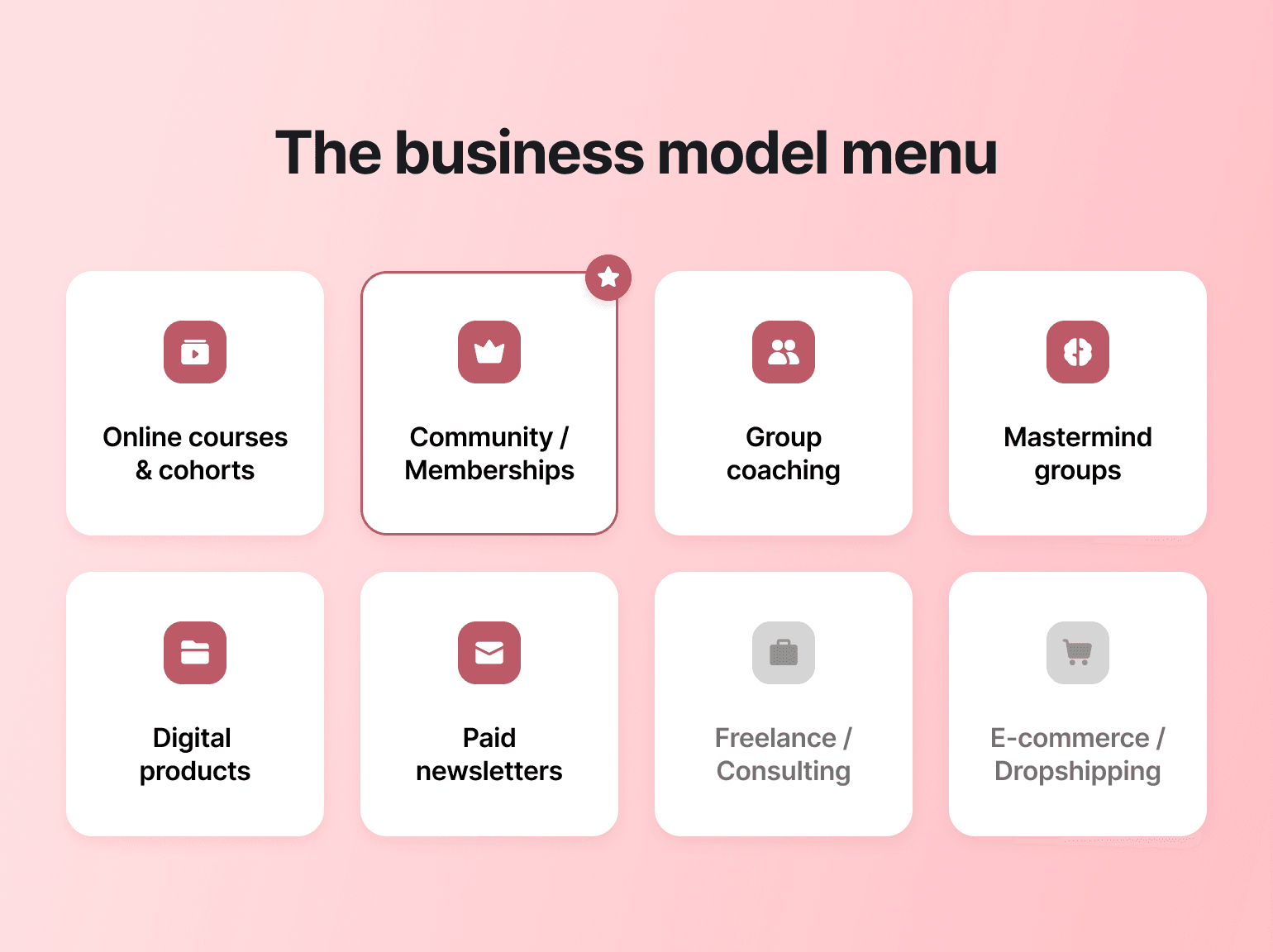
Online courses and cohorts
Self-paced lessons that teach a specific skill or outcome, usually delivered as video modules with supporting materials. High margins, broad scale, and a strong anchor offer for any creator business. Pair courses with a community space and you turn one-time buyers into long-term members.
Paid memberships and community
An ongoing subscription that gives members access to a private community, regular programming, and you. Recurring monthly or annual revenue that rewards depth and connection over shallow reach.
Group coaching
A structured program where you coach a group of members together, usually through weekly calls and shared accountability. Higher revenue per hour than 1:1, with natural urgency from cohort start dates that lets you price multi-month cycles based on who leads them, how long they run, and what access is included.
Masterminds
Small, invite-only peer groups of established operators who meet regularly to work through each other's businesses. Premium pricing per seat, but requires established credibility before launching.
Digital products
Templates, toolkits, ebooks, and other downloadable assets members can buy and use immediately. Can stand alone as a revenue stream or open the door to your higher-ticket offers.
Paid newsletters
A subscription publication delivering regular written content directly to a member's inbox. Recurring subscriptions with high audience ownership and minimal infrastructure to maintain.
Freelance and consulting
Direct client work that monetizes your expertise quickly, but usually depends more on your personal delivery than on a community-centered model.
Ecommerce and dropshipping
Product-based online businesses that can work in the broader SERP, but often fit less naturally for creators than offers built around your knowledge, audience, and recurring member relationships.
The most durable creator businesses don't pick one of these and stop; they stack them in a deliberate order. Free content builds an audience. A digital product or course converts first buyers. A membership or group program turns those buyers into recurring revenue. Start with the model that fits how you work today, then add the next layer once the first one is generating revenue consistently. Trying to launch all six at once is how creators end up with five half-built offers and no real business.
Validate your idea with money down before you build
The most common way creators waste months is building a product nobody asked for. When actually, a payment from a real person is the only signal that counts. Expressed interest, polite encouragement from friends, and "I'd totally buy that" comments are not the same thing. Here's a process you can run quickly:
- Write the transformation statement. One sentence: "I help [specific person] achieve [specific outcome] without [specific obstacle]."
- Mine communities where your audience already hangs out. Spend a few hours reading Reddit threads, YouTube comments, and forum posts in your niche. Record the exact phrases people use to describe their problems. Those phrases become part of your marketing copy.
- Run a demand validation survey. Ask: What's your #1 struggle with [topic]? What have you tried? What would solving this be worth? Would you pay for a solution? Send it to your existing audience or a relevant community using a simple form builder.
- Build a waitlist page before the product exists. Create one page with your transformation promise, a clear statement of who it's for, and a signup button. This tests whether people will take action, not just express interest.
- Pre-sell to founding members. Offer an early-buyer discount to the first group of customers before creating any content. If people pay, you have validation. If they don't, you saved yourself months.
- Deliver your first cohort live. If your model is a course or cohort, run it live with a small founding group instead of pre-recording everything up front. The real questions, objections, and wins only surface when people are actually paying and showing up—and that's the signal you need before you commit to scaling the offer.
Run this sequence end-to-end and you'll know within weeks whether you have a real business or an idea that sounded better in your head than it does in your buyers' wallets.

Before you build the next one.
Design your first offer and charge what it's worth
Most creators set their prices too low, and the cost isn't only the revenue you leave on the table. Price becomes a filter for the future and the baseline for your success. A very low price can pull in people who aren't committed to doing the work, while a higher one tends to attract members who are committed enough to show up and follow through. Charge enough that the people who say yes are the ones you actually want to work with.
Cautionary note: That only holds if the number still fits what your specific audience can and will pay — a price that filters beautifully for an audience of agency owners can just as easily price out an audience of new freelancers who are just as committed. Charge to filter for commitment, not to filter out the people you're actually trying to reach.
Pricing benchmarks to anchor against
Use these as starting points, not ceilings.
| Offer type | Price range | What it is |
|---|---|---|
| Paid challenge | $27–$97 | A short, time-boxed program (5–30 days) toward one specific outcome on a deadline — a strong first offer that warms buyers up to higher-ticket programs |
| Entry-level community membership | $25–$150/month | Recurring access to discussions, regular programming, and you — price low for self-serve, higher when you're live and hands-on |
| Signature course | $297–$997 | Your first flagship course — priced high enough to signal value, low enough to skip the sales call (climbs to $1,500–$3,000 with a track record) |
| Premium program or cohort | $1,500–$5,000+ | Courses + community + live calls in a defined cohort — above $5,000 you're in mastermind/high-touch territory |
Community tip: Keep your first challenge dead simple. Rachel Starr, a Circle community strategist and founder of the Co-Creator Society, runs hers inside one space group — a course space for 2–3 minute daily lessons, a chat space for daily accountability, and an event space for a kickoff and wrap-up call. Entry is fully automated: a landing-page signup tags the person and drops them straight into the community via an invite link, no "here's how to get started" email needed. The result? Zero manual onboarding, plus gamified points (5 per chat post, 10 per course section, 25 for showing up live) running entirely on Workflows.
A price only holds up when buyers can see exactly what they're getting for it, so name your offer with the outcome baked in. "Launch Your Newsletter in 14 Days" tells you the deliverable and the timeframe in four words. "YouTube Starter Kit" tells you the platform and the stage. Compare that to "The Mastery Program," which tells a buyer nothing and gives them no reason to hand over $997. Once your offer name does the work, our ROI calculator can stress-test the number itself, showing what different price points, retention rates, and audience-to-community-member conversion do to your business over twelve months on Circle.
Pick one platform for your business (not five)
You don't need one tool for your website, another for chat, another for events, another for courses, and another for email. That fragmented stack creates more busywork than it solves, and you'll spend your time managing tools instead of serving members. Your minimum viable infrastructure has four components:
- A membership website that converts visitors
- An email system connected to your customer and client data
- A way to collect payments
- A platform to engage your audience and share your knowledge
Augment Business School ran for two years on two platforms: courses on one, community on another. The split created constant friction. Students toggled between tools, the mobile experience was clunky, and a fragmented stack undercut a premium brand. In early 2025 the team moved everything onto Circle—courses, community, a branded app, study-group spaces, and workflows for onboarding. Within four months, they doubled their student base from 3,000 to 6,000 and hit a 61% monthly active rate. Today a 10-person team runs the whole business across 94 countries. The question is simple: can you run your community, courses, payments, email, and website from one place, and spend your time on the work members actually pay for?
Build an automated sales system that turns subscribers into buyers
Building an audience matters in general, and it becomes more powerful when you have a system that converts followers into buyers without you manually selling every day.
A sales system is more than a single email. It can include a landing page that explains the offer, a lead magnet that brings the right people onto your list, an event or webinar that helps them understand the transformation, a checkout and payment flow that makes buying easy, behavior-based offers that match what someone has already done, and community onboarding that helps new buyers get value quickly.
The welcome sequence that does the selling for you
A welcome email sequence nurtures new subscribers, delivers value, and introduces the offer. New subscribers enter automatically, receive value-first content, and encounter a product offer at the right moment. The first week after someone subscribes is when they're paying the most attention to you. A strong sequence uses that window to teach something useful, build trust, and make the case for your paid offer before the reader's curiosity fades. A weak one wastes it on a single "thanks for subscribing" email and hopes the next newsletter does the work.
The difference between the two is whether the sequence has a clear point of view, a specific next step, and a reason to act now. Use the first emails to orient new subscribers around what you believe, show them the problem you help solve, give them a quick win, explain the paid offer, and tell them exactly what to do next.
Segment by behavior, not just list size
Personalized email outreach outperforms generic campaigns. Sending course offers specifically to recent webinar attendees, or membership pitches to people who've completed your free challenge, converts better than blasting the same email to everyone.
Email Hub brings email and audience management into the same platform as your community, and Workflows turns member behavior into automated actions. When someone completes a course, attends an event, or reaches another member milestone, that behavior can trigger the next email in their sequence. You're not guessing who's ready to buy; the data gives you a stronger signal.
Add community to compound everything else you've built
Community is the multiplier that makes every other model in this article work harder:
- Courses get finished because nobody wants to be the one who quits.
- Digital products get used because members ask each other questions in real time.
- And retention stops depending on your content treadmill: members stay for the people they're showing up with, week after week.
That's what separates a community that grows around you from an audience that just consumes what you publish.
Pat Flynn's SPI community shows what compounding looks like when community sits at the center of the business. Instead of relying on monthly launch cycles, SPI runs cohort-based accelerators alongside the course library, so learners progress with built-in accountability and peer support, and the membership itself carries the business. SPI now generates $700K+ a year and 58% of its total revenue from community, with 40.3% year-over-year growth and 2.5–3x higher course completion than the old self-paced model, and it's still growing. The community went from a bonus to the core of how the business earns.
Thankfully, you don't need to start at SPI's scale to get there. Most creators on Circle launch with a single discussion space, add courses when members ask for more structure, and turn on a variety of payments once they're ready to monetize, all without a single platform migration. For the full walkthrough, see our community launch guide.
Build the business your members actually pay you for
The creators who get off the launch treadmill aren't the ones with the biggest audience or the slickest funnel. They're the ones who picked a model that fits how they work, validated it with real payments, and ran the whole thing from one place instead of five. Every hour you save on stitching tools together is an hour you can spend with the members who are paying you.
Circle is the platform built for that work. Community, courses, events, payments, email, and your website—under your brand, in one place, with the workflows and AI Agents that turn member behavior into the next right action.
Stop stitching tools together.
Building an online business FAQ
What's the most profitable online business to start as a creator?
The most profitable model is the one you can run consistently without burning out. That said, recurring revenue models like paid communities, memberships, and group coaching tend to compound faster than one-time sales because every paying member raises next month's baseline instead of resetting it to zero.
How long does it take to get an online business off the ground?
Pre-selling can generate revenue in days. A live first cohort can run within four to six weeks. A polished evergreen version usually takes another two to three months on top of that. Most creators who fail at this timeline are building before they've sold anything, rather than the other way around.
Do I need an LLC or business entity before I start selling?
No. Validate the offer first with real payments through Stripe or a similar processor. Once you're earning consistently, set up an LLC for liability protection and clean accounting. Talk to an accountant in your country before incorporating; the right structure depends on where you live and how much you're earning.
What's the biggest mistake first-time creators make?
Trying to do everything alone. The first-time creators who stall aren't usually the ones with bad offers; they're the ones trying to manage a course platform, a chat tool, a payment processor, and an email tool while also creating content and showing up for members. The work that actually grows the business gets crowded out by the work of keeping the stack alive. Pick one platform that handles community, courses, payments, and email together, and you'll spend your time on the parts members are paying you for.
How do I price an offer when I have no track record yet?
Start with the outcome, not the hours. Ask what solving the problem is worth to your buyer over the next year, then price somewhere between 10% and 20% of that number. If pricing still feels uncertain, run a founding-member round at a discount in exchange for testimonials, and you'll learn what people actually pay for rather than what they say they'd pay.
Community Content Marketer
Arina is Circle’s community content marketer, sharing insights on community growth, GTM strategy, and storytelling for solopreneurs.