What is a community business model (and how to build one)
TL;DR
- A community business model turns what you know into income that comes in every month, instead of starting from zero after every launch or contract.
- The right model for you comes down to who your audience is, what you teach, and how much live time you can give it.
- You can go from a free audience to first paying members quickly with the right validation, pricing, and onboarding structure.
Members only
One issue, five minutes, every Tuesday. Read by +14,200 creators.
It's Sunday night. You're staring at next week's calendar: four discovery calls, two coaching sessions, a webinar you regret saying yes to — and crammed into the gaps, all the actual running of the business. The invoices, the follow-up emails, the content you promised to post, the onboarding for last week's new client. The client work is the part people see (if you can even get to the testimonials and feedback part of your work ever, or whether it just stays on the backburner… forever). The rest eats your evenings.
If you keep this pace, you cover the month. Take a week off, and the income goes with it, because every dollar is tied to an hour you personally worked.
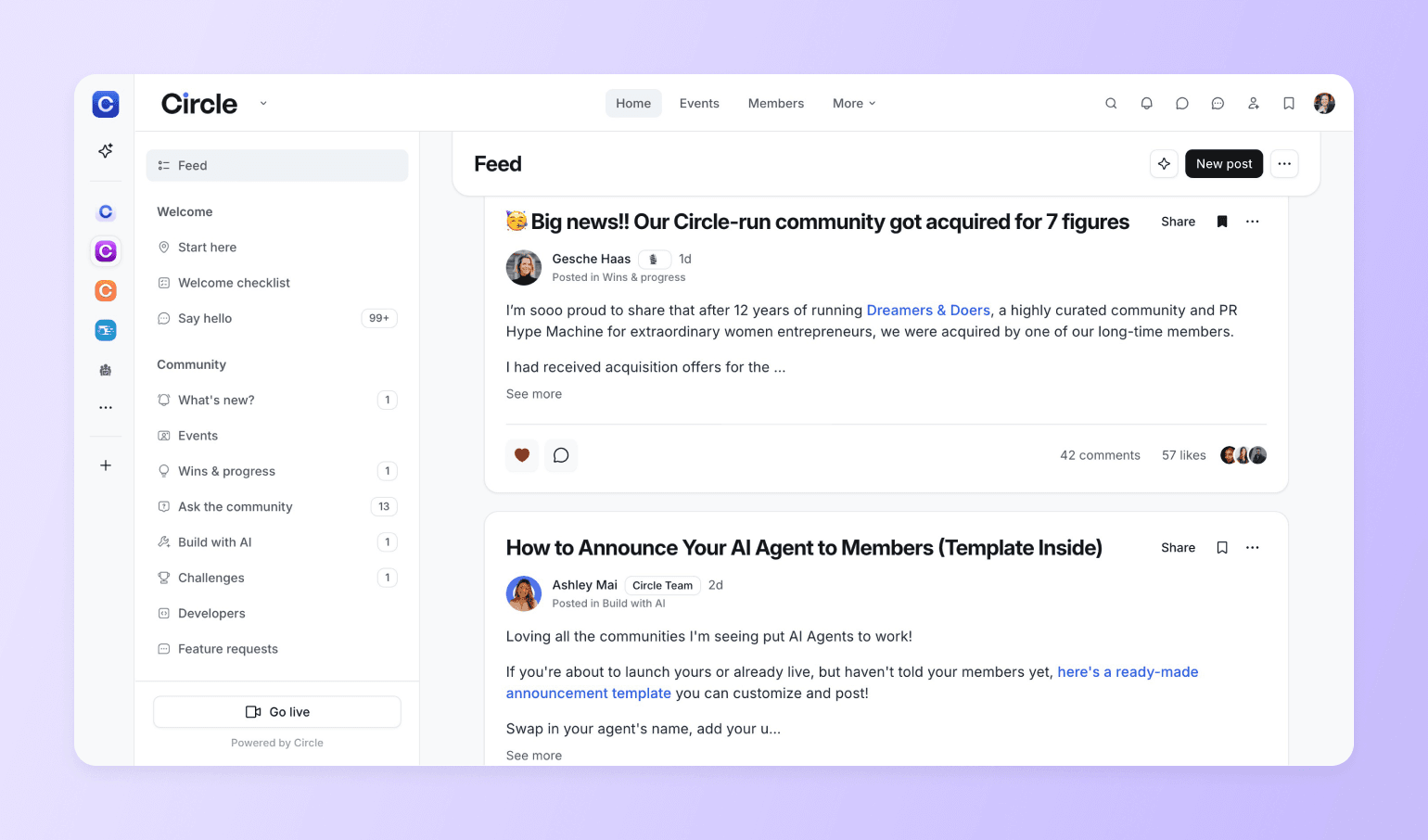
That trap is familiar to a lot of coaches, consultants, and educators. The work is good and people get results, but the moment you stop working, the income stops too. A community business model is one of the most sustainable, long-term fixes for that. You earn recurring revenue that builds month over month instead of resetting, your income stops depending on the hours you personally put in, and the business keeps running if you step away for a week. And this can become a real business asset: Dreamers & Doers, a Circle customer, recently sold their business to a member for seven figures after running it profitably for 12 years. Below, we'll cover the four models worth knowing, how to pick the one that fits you, and how to launch it without months of setup.
What a community business model is
At its core, it's simple: members get ongoing access to a private group, the content inside it, and each other, and you charge a recurring fee for it. That's it.
What that looks like in practice varies:
- A leadership coach runs a peer group where new managers rehearse their hardest conversations — the underperformer, the raise request — before having them for real.
- A fitness influencer runs a monthly class calendar, a library of follow-along workouts, and a member chat where people post progress and swap meal ideas.
- A SaaS marketing consultant runs a professional association with role-based subgroups, monthly teardown events, and a member-only job board.
Different formats, different audiences, but the same underlying structure: recurring access to your expertise and to the people chasing the same goals.
Members stick around because the value keeps building. They go deeper into the material, build relationships with the people around them, and keep making progress alongside others working toward the same goal. That's the part a course on its own can't really do.
The financials work differently too. Because members renew for as long as they're getting value, the revenue builds on itself — each month starts with income already on the books instead of from scratch. And because you own the relationship with your audience directly, no algorithm change can quietly cut you off from the people you've built this for.
The 4 community business models worth knowing
Augment Business School grew revenue 70x in its first three years on a course-plus-community model — same expertise the founders started with, different structure around it. Each model below fits a different type of expertise, audience, and time commitment. Most mature community businesses eventually stack two or three together.
Cohort-based course
Students start together, move through a live curriculum on a fixed schedule, and finish together. Enrollment opens in batches, and the price is usually higher than evergreen self-paced courses because the delivery is live and high-touch. This impacts completion rates — and ultimately, leads to happier customers because they’ve actually gotten what they came for.
The honest tradeoff is that revenue still comes in waves: it spikes at each launch and quiets between cohorts unless you run a membership alongside it. What you get in return is premium pricing and far better completion. Pat Flynn's cohort-based accelerators finish at 2.5–3x the rate of his self-paced courses — people show up when others are moving through it with them.
Best for: Subject-matter experts with an existing audience who can commit to a fixed teaching schedule—or creators with massive audiences and real expertise, who feel under-monetized, but don’t want to build a team or business themselves.
(Psst — for those folks? Circle Studios is the perfect next “do-it-for-you” step.)
Mastermind group
A small, curated peer group that meets on a regular rhythm for accountability, hot-seat problem-solving, and shared expertise. The signature move is the hot seat: one member brings a real challenge, and the group works on it together. It commands the highest price per member of any model here, because the value is the room — and it's often run as a premium top tier stacked on a wider membership, the small high-touch group above the larger one.
Best for: Experienced coaches and consultants who can curate a high-caliber peer group and want a premium offer that doesn't depend on scale.
Group coaching community
You lead structured coaching sessions for a group working on the same goals at the same time. It's more hands-on and structured than a membership where members support each other, but far more scalable than coaching people one at a time: your expertise is still the engine, but you're not selling your calendar one hour at a time. The difference from a mastermind: here, you're still the expert teaching and guiding, where a mastermind leans on peer-to-peer. Live events, course areas, and ongoing discussion (including homework, sometimes!) keeps the group active between calls — so the value doesn't disappear the moment the Zoom ends.
Best for: Coaches who want to scale past 1:1 without losing the transformation.
Paid membership community
This is the core model that the others tend to build on. Members pay for ongoing access to the group, the content, and each other, and they stay for as long as that access is worth it. Some are built around your expertise and training; others around a shared professional identity, where the draw is networking, professional development, and the status of belonging to a recognized group. In both scenarios, the draw is the people, which puts everything on the quality of the community itself. Get it right and it's the most durable model here, since there's no launch cycle to restart and no end date to renew against.
Best for: Coaches, consultants, educators, and niche professional leaders whose audience shares a strong identity or an ongoing need, and values peer connection as much as access to you personally.
TroopHR runs this model. Tracy Avin turned a one-way newsletter for isolated HR leaders into a community where members answer each other — and the durability shows: 80%+ annual retention, with 60% of new members arriving through referrals. Tracy's read on it: "You can have the best idea in the world, but without the tools to execute, it stays an idea."
How to choose your model
Think of these as factors to weigh. The wrong move isn't picking the less-than-perfect model, it's stalling on the decision while your audience waits, so weigh these honestly and then commit to a starting point.
The kind of work you do
The model should fit how you naturally deliver value. If your strength is in the room, coaching, facilitating, reading the energy of a live group, the live models play to it. If your strength is structured teaching, your curriculum is the asset and the community is what keeps people around after it ends. And if your value is the network itself, the other members and the shared identity and the access, then the connection between people is the product, and your job is to convene it well. None of these locks you in; it's just where the most natural version of your business starts.
What you can sustain
Be honest about the rhythm you can maintain, because each model asks for your time differently. A self-paced course — the thing you might be weighing these against — is the heaviest lift upfront and the lightest load after; every model here trades some of that ease for connection and retention. Cohort-based courses are intense during the active weeks and quieter between them. Paid memberships need steady, consistent effort — programming, events, showing up — every week, indefinitely. Masterminds demand the highest time per member, but they cap naturally at 8–12 seats (if not less!), which keeps the total contained. Pick the rhythm you can hold for two years, not the one that looks best on a launch graphic.
How to build yours on Circle
Whatever model you choose, the path from idea to live community follows the same four moves: bring in your first members, set up a clean structure, automate the welcome, and set up billing in a way that keeps members renewing. With Circle AI, that can all be done in one conversation.
Find your first members
Your first members almost always come from people who already trust you. Start with the audience you have — past clients, your email list, the people who reply to your posts, the ones already asking how to work with you more closely. Tell them what you're building, invite them in personally, and don't wait for a big audience before you start. Plenty of strong communities launched to a few dozen people who already cared.
The most reliable signal that you've got something worth building on is someone paying for it before it fully exists (this also means you shouldn’t be scared of people building similar things!)
Build a one-page landing page, attach a checkout link, and pre-sell a founding-member offer at a discounted rate to your first 10–20 members. On Circle, you can do this without a finished community in place: set up your community shell, turn on a Paywall for a single Space or tier, and share the checkout link straight from your newsletter or DMs. If people buy before you've recorded a single video, you have a community worth building. For more ways to land those early members, see three different approaches that creators took to get their first 100 members.
Set up your structure with Spaces
The #1 structural mistake new community operators make is overcomplicating it — spinning up a dozen spaces before there are members to fill them. Activity spreads too thin, every space looks dead, and new members can't tell where they're meant to go. Fewer spaces concentrate the conversation and make the place feel alive.
So start with the smallest structure that gives each kind of content a clear home, and name each space for exactly what's inside it — the welcome space is "Start here," not something clever nobody can decode. A minimum viable structure for most community businesses looks like this:
- Start here: a 90-second welcome video, the community's promise, and one clear first action, like introducing themselves, RSVPing to the next event, or finishing lesson one.
- Discussions: the heartbeat of the community, where ongoing conversation and questions live.
- Courses: any structured curriculum, with lessons, video, and progress tracking built in.
- Events: live calls, office hours, and workshops, all on one integrated calendar.
- Chat: real-time, lower-stakes conversation that keeps members coming back daily.
As your community grows, group these into Space Groups — by theme (Welcome, Community, Courses, Resources), by cohort, or by membership tier so the upgrade path is built into the structure. Just don't build all of that on day one; add each space when members give you a reason to.
Automate onboarding with Workflows
Early engagement is one of the strongest retention levers you have. Members who introduce themselves, attend one event, and connect with one other person in week one stay longer. But you can't personally welcome every new member forever — and you shouldn't have to.
In Circle, Workflows handle the operational layer of onboarding so you can focus on the high-value moments. A starter workflow for a paid community looks like this:
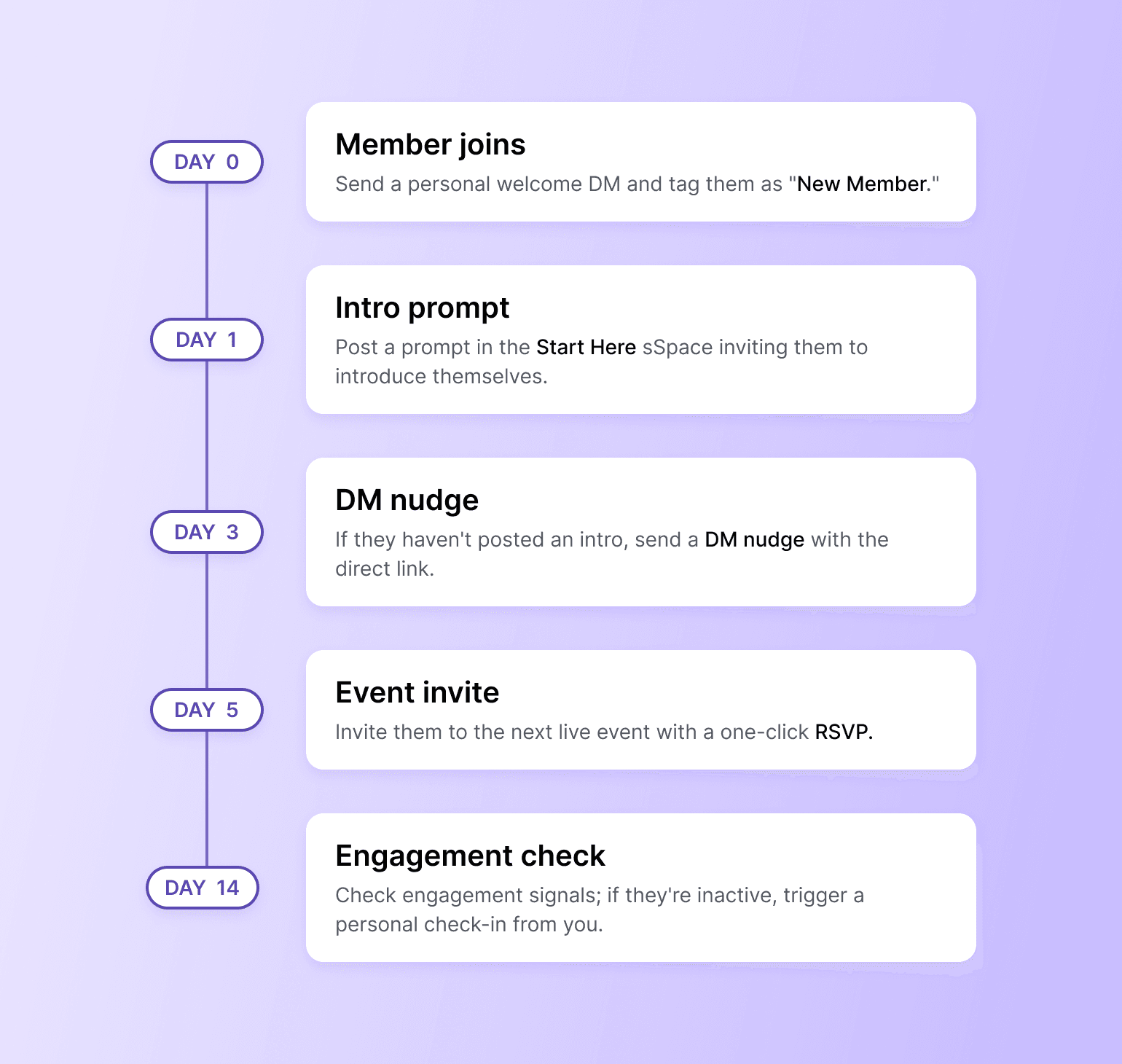
- Day 0: When a member joins, send a personal welcome DM and tag them as "New Member."
- Day 1: Post a prompt in the Start Here space inviting them to introduce themselves.
- Day 3: If they haven't posted an intro, send a DM nudge with the direct link.
- Day 5: Invite them to the next live event with a one-click RSVP.
- Day 14: Check engagement signals; if they're inactive, trigger a personal check-in from you.
Workflows handle the timing, delivery, and follow-up. You handle the conversations only you can have.
Design retention into the billing structure
The simplest structural change that can meaningfully reduce churn is to default to quarterly or annual billing instead of monthly. Longer billing terms reduce churn substantially compared to monthly: members who commit for longer are more likely to invest in the experience, engage past the initial dip, and renew.
In Circle, you can offer multiple price points on the same membership tier — a monthly option at full price and an annual option at a 15–20% discount. To estimate how your existing email or social audience could convert into community member revenue, run your numbers through the community ROI calculator.
💡 Community tip: Quarterly billing kept coming up as a churn fix among the 55 builders in Circle's community pricing guide. Ashli Pollard of The Do-ers dropped monthly billing because it didn't create enough commitment. Soulcial Suite cut monthly plans, and the quarterly tier became the default almost immediately.
Those same builders had a warning, though: their most common regret wasn't price — it was onboarding. Members churn, the builder assumes the price is wrong, when the real failure was activation. Before changing price, survey churned members, interview inactive members, and compare onboarding completion with engagement signals to find the actual issue. So the billing change only pays off if onboarding does its job too. Give every new member one real win in their first week — a completed lesson, an event attended, a connection made — before they drift.
You already have the raw material
The hard part of a community business — the expertise people want, the audience that trusts you, the problem you know how to solve — you already have. The model is just the structure that turns that into income you can count on and value you can consistently deliver, instead of a calendar you have to keep refilling. Pick the model you can start this month, get your first members in the door, and let the business compound from there.
Want to build an exceptional community? Start your 14-day free trial of Circle now.
Community business model FAQ
How much can a community business realistically make?
It depends on price point and member count, and the range is wide. A mastermind with 12 members at $400/month is around $58K a year. A mid-tier membership with 200 members at $50/month is $120K. Those assume a single price point, though — the communities that scale furthest stack tiers and offers on top of the base. Exit Five, a B2B marketing community, layers annual membership tiers, role-based subgroups, and regional chapters, and has grown 43% year over year doing it.
What's a realistic churn rate for a paid community?
Across Circle communities, average monthly churn runs between 4.9% and 7.4%. As ballpark benchmarks: under 2.5% is exceptional, around 5% is excellent, 10% is average, and 15%+ means there's work to do — with smaller communities typically churning a little higher than larger ones. Annual plans churn at a much lower rate than monthly. If your rate is climbing month over month, the issue is usually onboarding or fit, not pricing.
Do I need to be an expert to start a community business?
You need to be ahead of your members, not the most credentialed person in your field. The strongest community businesses are run by practitioners who've solved a specific problem and can help others solve it too. If you can teach what you know and convene the right people, you have enough to start.
Can I run a community business alongside a full-time job?
Yes — Tom Ross built Learn.Community over a single weekend while running Design Cuts as a full-time CEO, and now serves about 200 members at $49/month as a side hustle. The format matters: a tight-scope membership or small cohort with one live session a week and Workflows handling the rest. The decision point comes when member count outgrows the time you have, which is usually when creators either raise prices to stay small or go full-time to scale.
How long does it take to launch a paid community?
If you've already validated demand, you can have a paying community live on Circle in a week or two — not months. The build itself is fast. The longer pre-work is clarifying who it's for, what transformation it delivers, and what members get for the price. Get that right first, and the rest is just setup.
Community Content Marketer
Arina is Circle’s community content marketer, sharing insights on community growth, GTM strategy, and storytelling for solopreneurs.