Why your subscription business model lives or dies in the first 90 days
TL;DR
- A subscription business model means people pay you on a recurring schedule, so you can forecast your revenue instead of rebuilding it from zero with every launch.
- That predictable revenue only lasts as long as people stay, so retention is the real measure of whether the model is working.
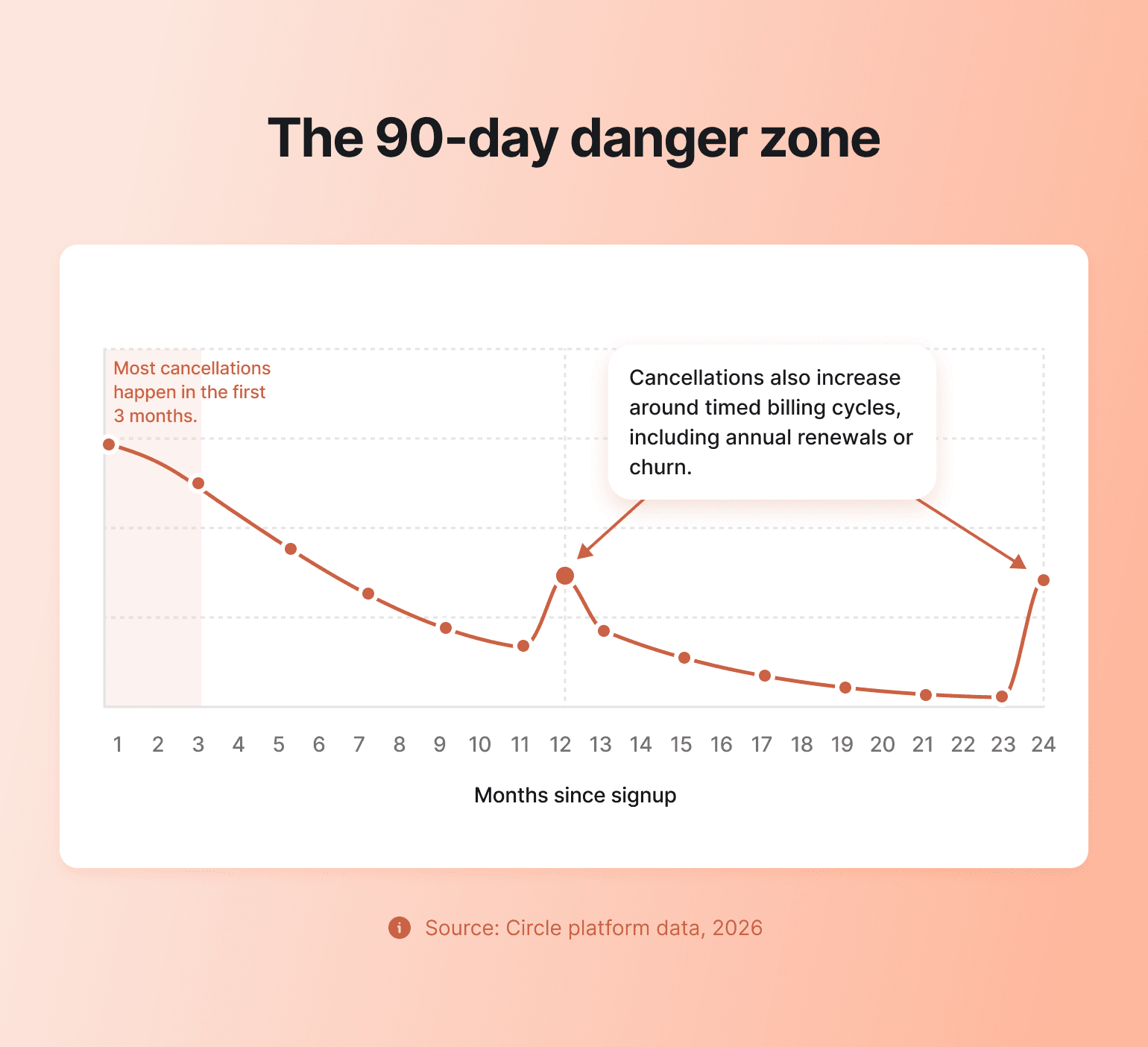
- Most cancellations happen in the first 90 days. What you do in that window — and how you bill — decides whether the model actually works.
Members only
One issue, five minutes, every Tuesday. Read by +14,200 creators.
Picture two creators at the start of the month. One runs on launches: her income for the month is zero until the next promotion lands, so the calendar is a series of sprints, each one starting the revenue count over from scratch. The other runs a subscription business. She already knows roughly what's coming in, because last month's subscribers are this month's subscribers, and their payments recur. Two very different ways to make a living—and a very different feeling on the first of the month.
That predictability is the whole appeal of a subscription model. Instead of selling the same thing to new people over and over, you charge the same people on a schedule, and the revenue compounds: this month starts where last month ended, plus whoever joined, minus whoever left. This guide covers how the model works, who it fits, and the two things you have to nail to keep it running.
How a subscription business model works
Every subscription runs on the same simple loop, and it has three stages worth understanding before you build one:
- Getting the first yes. A subscriber signs up, usually through a free trial or an entry tier that lets people try before they commit to paying.
- Billing that runs itself. Payment recurs automatically on the cadence you set, charging each subscriber's card every cycle. A hundred subscribers don't mean a hundred payments to chase, and people manage their own plan—upgrade, pause, or cancel—without it landing in your inbox.
- Earning the next month. In exchange for that recurring charge, you keep delivering something worth staying for: new sessions, fresh content, or an active community.
The first two stages you set up once and they run on their own; the third is where the actual work lives. Most of building a subscription business is really about getting that third stage right—giving people enough reason to stay that the recurring charge keeps making sense to them.
What's the difference between a subscription and a membership?
A subscription is a billing mechanism: a payment that recurs on a set schedule. Plenty of things run on it—software, apps, a paid newsletter—and the only promise is continued access.
A membership is what you build on top of that mechanism. It still bills on a subscription schedule, but the promise is bigger: people aren't just renewing access to a piece of software, they're staying for the people, the programming, and the progress they're making alongside others. A community-led membership like this is what most creators are really building when they start a subscription.
What to track with a subscription model
You don't need a finance degree to know whether a subscription business is healthy. Three numbers, worth a monthly glance, tell you most of the story—and each one comes with a rough sense of what "good" looks like.
- Retention (and its flip side, churn). Your clearest signal of whether your ongoing value is landing — and the number that carries the most urgency in the early months. Circle's platform data shows that cancellations cluster heavily in the first 90 days: most members who leave do so before month four, and the pattern holds across every price tier. The window right after someone joins is when members' commitment is most at risk. Track the three-to-six-month trend, not any single month — and treat the first quarter as your highest-stakes period.
- Average member lifespan. How long a typical member stays, and it falls straight out of churn: divide one by your monthly churn rate. At 5% churn that's about 20 months; at 10%, just 10. The longer members stay, the more each signup is worth — which is why what happens in month one matters more than what happens in month twelve.
- Recurring revenue. Your predictable monthly income from active members — the base every other decision builds on. It carries forward instead of resetting: this month starts where last month ended, plus new members, minus the ones who left.
The trap is checking these only when something feels wrong. By the time a falling number shows up in your bank account, the members behind it are already gone. A monthly glance — same day each month, five minutes — catches the drift early, while you can still do something about it. In Circle, the same dashboard shows member growth, retention, and revenue together, and activity scoring flags the members going quiet before they cancel — so you see the drift weeks before it would ever cost you.
Who the subscription business model works for
The model fits almost any creator business where the value is ongoing rather than one-and-done—but it takes different forms depending on what you sell.
- Solo experts and niche professionals. A recurring membership lets one person serve a focused audience without hiring. Tom Pardo runs Shambala on his own, a community for movie trailer editors—community, courses, and events in one place, with no stack to manage.
- Coaches and wellness practitioners. A subscription breaks the ceiling on hours you can sell, turning 1:1 work into a room where members get your expertise and each other's support. Mila Clarke built Glucose Guide, pairing expert coaching, peer support, and a food-tracking tool in one branded experience.
- Educators with a back catalog. A subscription turns years of courses and content into recurring access instead of one-off sales. The library compounds as it grows, and a surrounding community keeps members subscribed past the first course.
The through-line: if your audience needs you (or each other) repeatedly, not once, a membership subscription fits. If they get everything they need from a single purchase, it doesn't.
What a subscription business model changes about your week
In a launch model, your week is shaped by where you are in the cycle: pre-launch promotion, cart-open scramble, post-launch recovery, then building the next thing. The work changes shape every few months, and the highest-pressure weeks are the ones that decide whether you hit your number. It's a big part of why creators are switching to recurring models in the first place.
In a subscription model, the calendar flattens out and the questions change. What's on the schedule this month? Who's gone quiet in the last 30 days? What keeps getting asked in the community? What's the next thing worth building for the members already inside? None of those are launch questions. They're operating questions, and they recur every month whether or not you've planned for them.
Two disciplines decide whether members stick: the price you set against their commitment, and the value you deliver to keep them. Here's how to get each one right.
How to price a subscription business
Most creator communities undercharge, and it usually starts with skipping a step: deciding what you're charging for before you decide how much.
Decide what you're charging for
Every membership is priced on one of three things, and which one you pick reshapes everything downstream—what you produce, who you attract, and how high you can price:
- Access—the room itself: the community, the people, the conversation. Price reflects who's inside and how alive it is, so your job is curation, not constant output.
- An outcome—a result like a skill, transformation, or credential. A clear, high-stakes outcome carries the highest prices, far above the hours behind it.
- Content volume—a growing library of material. Each addition raises the value, but the day you stop adding or showing up, members start questioning the charge.
The trap is charging for one while delivering another. Price a real transformation like a cheap content library, and you leave money on the table while attracting members who quit the moment they've consumed the back catalog. Get clear on what you're charging for first, and the price stops being a guess.
The math then clarifies the stakes. To earn $100,000 a year, you need, roughly:
| # of members | Cost of membership |
|---|---|
| 500 members | $17/mo |
| 200 members | $42/mo |
| 100 members | $83/mo |
A tight, high-touch community of 100 committed members generates the same revenue as 500 loosely committed ones—with far less operational load. To run the numbers on your own community, and for real pricing examples from $27 entry programs to $9,000 annual masterminds, see Circle's pricing guide.
Choose your billing cadence: monthly, quarterly, or annual
Once you know what you're charging for and how much, billing cadence is the next lever — and it has a bigger effect on early retention than most creators expect.
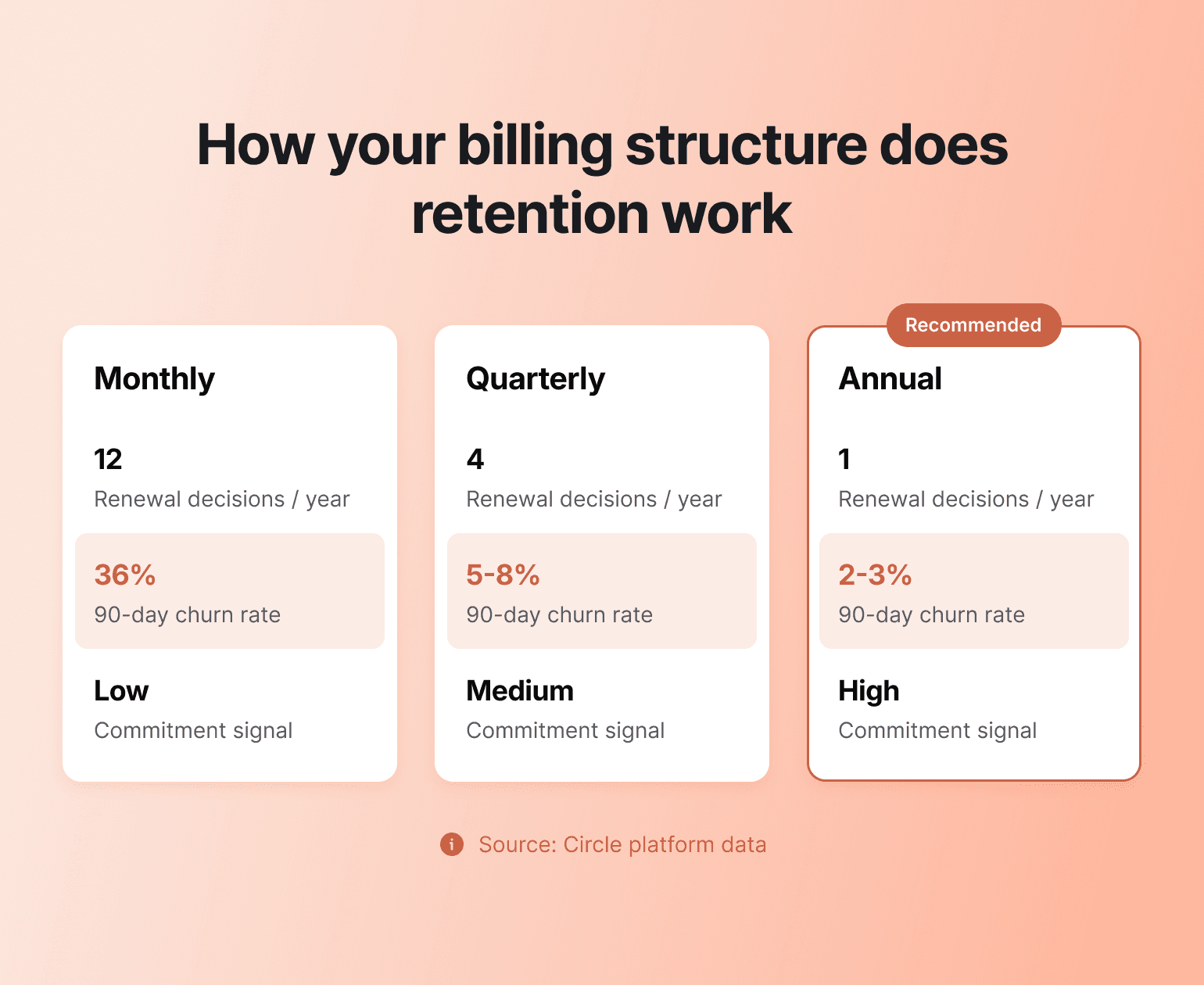
Circle's platform data shows that annual subscribers are 36% less likely to churn in their first 90 days than monthly subscribers. That gap isn't explained by who's joining; it's explained by the commitment the billing structure itself creates.
Every billing cycle is a fresh decision to cancel: monthly billing puts that decision in front of members twelve times a year, quarterly makes it four, and annual makes it once. So lead with annual as the primary option — displayed as a per-month cost — and keep monthly available for members who want the flexibility.
The data also shows that crossing the payment threshold matters more than where you set the price. Free community members cancel in their first 90 days at nearly twice the rate of members paying even a modest monthly fee — the act of paying anything creates a commitment that free access simply doesn't.
The underused middle option is quarterly, and it's less a promotion than a structural choice. Ashli Pollard of The Do-ers dropped monthly pricing entirely after finding a low monthly price didn't motivate members the way she'd hoped; she made quarterly the default, and average retention rose to 18 months. Whimsy Forge, a 700-member fantasy fitness community, took the same approach — charging $60 per quarter instead of $20 a month. As founder Candice Grobler puts it: "Quarterly billing creates a natural commitment that reduces churn compared to monthly." The pattern holds because the upfront commitment does the retention work that a low monthly price can't.
How to keep members from canceling
The fastest way to lose a subscriber is to give them nothing to return for. A content library that stopped growing, a community that's gone quiet, a coaching program with no rhythm—members notice the moment the value stops arriving, and the cancel button starts to look reasonable in comparison to their credit card bill. Keeping them is its own discipline, with retention strategies worth studying in their own right.
The other discipline is programming: a predictable rhythm of things happening. A few formats earn their place on the calendar because members can count on them:
- A standing monthly workshop or masterclass. Same week every month, teaching one thing members can apply right away. The repetition is the point—it becomes the date they protect.
- An open office-hours or Q&A call. Low production effort, high connection value. Members show up just to be in the room with you and each other.
- A cohort or challenge with a start and end date. A defined sprint—30 days, four weeks—gives passive members a reason to re-engage and a finish line to chase together.
- A recurring guest session. Bring in someone your members can't easily access on their own; the borrowed expertise refreshes the value without you producing everything yourself.
- A members-only drop. A new template, teardown, or resource released on a set cadence, so there's always a reason to log in this week instead of next.
The pattern shows up in Circle's own data: only 11% of active communities run events regularly, but those that do have 4x the monthly active users of same-sized communities that run none. Comments go up roughly 80x. DMs jump from near zero to 100+ a month, even though events have no direct tie to DMs. The relationship between live programming and async engagement is much stronger than most builders expect. If your community feels quiet, the answer probably isn't better content—it's your first recurring event.
Felippe Nardi's Inside the Show is built around live event weeks. Once he reinforced that cadence with push notifications and replays, the community saw 2x event-week engagement—proof that the programming itself is the product members pay to keep showing up for.
Finding the right rhythm takes experimentation. As Mathilde Leo, Circle's Head of Community and Customer Education, puts it: "Finding the right signature gathering for your community isn't an overnight process. No one gets it right the first time, so don't be afraid to tweak things along the way."
Run the business, not the tool stack
Pricing and programming both get harder when the pieces live in separate tools—courses here, community there, email and payments somewhere else, each with its own login and its own slice of the member's data. You spend more time moving information between tools than serving the members it's about.
Seth David, who runs Talk Nerdy to Me, was paying around $12,000 a year across his whole stack—Kajabi for courses, Slack for community, Zoom for events—with renewals pushing $15K and one Slack month alone spiking to $3,000. Offboarding a single canceled member meant cross-referencing five tools. After consolidating onto one platform, he moved more than 30 courses, brought his newsletter into Email Hub, and set up an AI Agent to handle first-line questions while he stayed on the support only he could give. His total cost dropped to just over $4,500 a year, with trial-to-paid conversion at 80%.
That's the payoff of running it all in one place: when programming, pricing, payments, and member data share a single record, the work gets lighter instead of heavier—and you spend your time earning the next renewal instead of chasing the next sale.
Want to build an exceptional community? Start your 14-day free trial of Circle now.
Subscription business model FAQ
When doesn't a subscription business model work?
When the value is one-and-done. If a member can get everything they need from a single course, template, or session, recurring billing creates friction rather than loyalty — they'll feel like they're paying for something they've already finished. The model works when your audience needs you or each other repeatedly over time, not once.
How much time does running a subscription business take each week?
Less than launching, but it's steadier. Instead of intense launch sprints followed by quiet stretches, you commit to a consistent rhythm: programming the month, keeping the community active, and watching your churn and renewal numbers. Automating the repetitive parts, like renewal reminders and event follow-ups, keeps the weekly load manageable.
Should I offer monthly or annual billing?
Offer both, but lead with annual. Annual members tend to stay longer and are worth more over time, because they make fewer renewal decisions across the year. Quarterly is a useful middle option for members who want a real commitment without the full annual jump.
What should I focus on in the first 90 days of a member's subscription?
Getting them to a win before they've had time to question the charge. Circle's platform data shows most cancellations happen before month four — which means onboarding isn't administrative, it's your highest-leverage retention tool. A strong welcome sequence, at least one live touchpoint in the first 30 days, and a clear sense of what to do next are the three things most likely to get a member through the window where they're most likely to leave.
What's the hardest part of a subscription business model?
Churn. A one-time sale is over once it's made; a subscription has to be re-earned every billing cycle, so the constant job is making sure members keep getting enough value to justify the charge. That ongoing delivery—programming, community, a price that fits what members get—is the trade-off you accept in exchange for predictable revenue.
Can I run a subscription business model with a small audience?
Yes—a tight, engaged audience often outperforms a large passive one. A focused group paying a fair recurring price can sustain a real business on far fewer members than a launch model needs, because specificity beats size: a clear promise attracts members who already know what they're paying for and are more likely to stay.
Community Content Marketer
Arina is Circle’s community content marketer, sharing insights on community growth, GTM strategy, and storytelling for solopreneurs.