Why creators need monthly recurring revenue (and how to build it)
TL;DR
- Most creator income depends on algorithms and brand deals that can disappear overnight. Recurring revenue gives you a predictable floor before the month starts.
- You don't need a massive audience: even a small base of paying members at the right price can generate income that compounds month over month.
- The strongest creator businesses use recurring revenue as the base and layer one-time offers like courses and workshops on top.
Members only
One issue, five minutes, every Tuesday. Read by +14,200 creators.
You published consistently for two years. You built an audience and even landed a few brand deals. Then the algorithm shifted, your reach dropped, and last month's income looked nothing like the month before. That's not a personal failure. It's the draw and the downfall of most creator income: it depends on one-off launches, sponsorship timing, and a platform deciding who sees your work.
Building a membership changes that. Take Bonnie Christine. She and her husband were living near the poverty line in 2012, when she decided to launch a membership for fellow surface pattern designers. No platform, no login system, just a PayPal recurring link and a blog post announcing it. Two hundred people joined her that opening weekend. For the first time, money landed in her account before the month began, enough to buy groceries that night without doing the math first. That membership became the foundation of a business that now earns seven figures a year, across courses, tutorials, and the membership itself.
That's what recurring revenue does: it pays you for work you already did, instead of work you have to go win all over again. This is how to build it from a small audience: the right members, pricing that holds, and the retention that makes it compound.
Why your income swings so hard month to month
Ads, brand deals, and platform distribution are all controlled by companies you don't own. YouTube tweaks how it surfaces videos, Instagram changes what counts as a "good" post, and your reach can drop by half in a week without you doing anything differently. When reach drops, ad revenue and organic discovery drop with it, and the courses or services that depend on that social discovery feel the hit immediately after.
Brand deals aren't much steadier. Marketing budgets shift quarter to quarter, and entire categories of sponsors can pull back at once when the broader ad market changes. When that happens, your inbox goes quiet and the deals you were counting on don't get signed. A membership flips that relationship: members pay you directly, you decide what they're paying for and how much it costs, and the income shows up on a schedule you can actually plan around. Members can still cancel, but that's a business you run, not a number a platform sets for you.
Knowing your income before the month begins
That shift shows up clearest in how each month starts. With a launch model, every month resets to zero. Sell 20 courses at $200 in January and that $4,000 is gone by February, with nothing underneath it to pay next month's rent.
Worse, you can't just run the same launch again. You've already sold to everyone who was going to buy, so the next month means a new course, a new topic, or a fresh angle on the old one. Even Ali Abdaal, who built one of the best-known creator course businesses with the Part-Time YouTuber Academy (PTYA), moved away from big live cohort launches toward evergreen content and a community hosted on Circle. Launches can work. They just don't compound.
A membership, however, compounds, expands, and grows with you and your dreams. Fifty members paying $50/month put $2,500 on the board to start each month. But first, you need to do the work to earn the members, build the value, and keep people engaged and excited. If you keep adding members and churn low, then that base grows on top of itself instead of resetting. Each new subscriber adds to the base you're already carrying into the next month, so growth builds on what came before rather than replacing it after every launch.
Bonnie Christine is what that compounding looks like given a decade to run. She started more than a decade ago, charging $5/month, with some of those earliest members still grandfathered in at that rate today. New members now pay $47/month, and the membership on its own brings in seven figures a year. The price went up tenfold; and many of the members who were there at the start never left. Plus, she’s built alumni offers for graduates, and expanded her business tenfold.

One thing to be clear about: recurring revenue is not passive income. Members pay every month (or whatever cadence you set), which means you have to deliver value every month. But the work shifts toward serving people who already trust you, which is a far more satisfying and rich use of your time than constantly hustling for new revenue.
The four things that grow membership MRR
Four things separate memberships that compound from ones that stall. You need the right kind of audience (smaller and more specific than you think), proof that people will actually pay, pricing tied to the outcome you deliver, and a churn rate low enough that new members add to the base instead of replacing the ones who left. Here's how each piece fits.
A clear promise to a targeted audience
A small, well-targeted membership beats a vague offer to a big list every time, because the people who join already know what they're paying for and stick around.
Agent on Tube Academy is a good example. Founder Sabby Bagga runs a premium-priced service for a narrow audience: real estate agents who want to use YouTube to generate warm leads. In a crowded market full of lookalike offers, delivery wasn't the bottleneck. Credibility was. Sabby was spending half of every sales call proving he and his team could deliver.
So instead of pitching harder, he changed where the proof came from. He launched a community on Circle that let prospects see client wins, ask questions, and hear directly from other members before ever booking a call. The dynamic flipped. One prospect asked whether anyone had seen real ROI on the $10K service, and his existing clients jumped in with their stories before he could answer. That prospect signed up the next day. Within three months, Sabby's community had generated $60,000 in new business.
Two things make this work, and neither is audience size. The promise is specific enough that the right people self-select in, and the community itself becomes the proof.
Pre-selling a founding membership
The founding-member pre-sell works like this: announce the community concept before it exists, offer early adopters a lower price in exchange for paying now, and use that founding cohort's feedback to shape what you build. Early interest from a small group tells you whether the idea is worth pursuing. And as Bonnie's $5 founding rate shows, the price you start at isn't the price you keep.
Here's the practical sequence for a small audience:
- Have 10 to 20 direct conversations with people in your audience about their specific challenges. Ask about the transformations they want, not whether they'd hypothetically buy something.
- Build a waitlist landing page describing the transformation your community delivers. Announce it to your existing email list.
- Open a founding-member enrollment window with a discounted price, a hard deadline, and a member cap. Deliver immediate value through live calls or Q&As. No content vault required.
- Raise prices for new members once the founding cohort closes, and build the content layer based on their feedback.
If people won't pay at a founding rate, the concept needs more work before you spend months building it.
Pricing it juuuuuust right
Once people are willing to pay, the next question is how much. Most communities land between $25 and $50 a month, with the overall average near $48. But the average is a starting point, not a target. Your goal is to price around the transformation your members get.
If you help people save tens of thousands in lawyer fees, acquisition costs, and business strategy when they buy a business, the way Codie Sanchez does with Contrarian Academy, then a membership at $10,000–12,000 a year makes sense. A community that helps business owners generate real business value is worth more than a low monthly fee. Underpricing often brings in members who treat the membership as casually as they paid for it, which hurts retention.
Circle's pricing data shows how much that varies by niche:
- Creative and hobby communities (photography clubs, writing circles, fitness groups) typically run $10–39/mo.
- Skill-building and certification communities (design, coding, marketing cohorts) tend to sit in the $40–75/mo range as the outcome gets more concrete.
- Business coaching and professional development communities (sales training, agency masterminds, executive peer networks) commonly land between $47 and $97/mo.
- High-stakes professional communities (legal, medical, finance, B2B operator groups) run well above $100/mo, often into the hundreds, and frequently bill annually.
The pricing decision gets easier when your platform supports different offer types in one place: external one-off events, tiered memberships, community-led courses, digital product sales, and more. Circle's built-in branded checkout gives you the flexibility to sell the offer that fits the outcome instead of forcing everything into one model.
Preventing churn by providing value
Pricing sets your ceiling. Churn decides how much of it you keep. Every member who leaves is one you have to replace just to stay flat. Replacing a member costs far more than keeping one, by some estimates five to 25 times more. Acquisition is the expensive part; retention is where the margin lives.
Circle's platform data gives you a benchmark to measure against:
- Under 2.5% is unbelievably good.
- Around 5% is really excellent.
- 10% is about average.
- 15% to 20% or higher is on the higher side, with real work to do.
The platform-wide average sits between 4.9% and 7.4%. The communities at the low end share one thing: members get ongoing value from each other, not just from the content.
Five retention tactics that actually work
Keeping churn low comes down to reducing friction at the moments members are most likely to drop off: the first week, the billing cycle, and the cancel click. These five tactics hold members at the highest-leverage moments:
- Engineer a first win: the faster a new member makes progress in their first 48 hours (the "a-ha" moment), the easier it is for them to remember why they joined.
- Tie value to billing: give members something fresh to look forward to each month, like premium tiers, chapter meetups, and recurring events, so the renewal feels obvious.
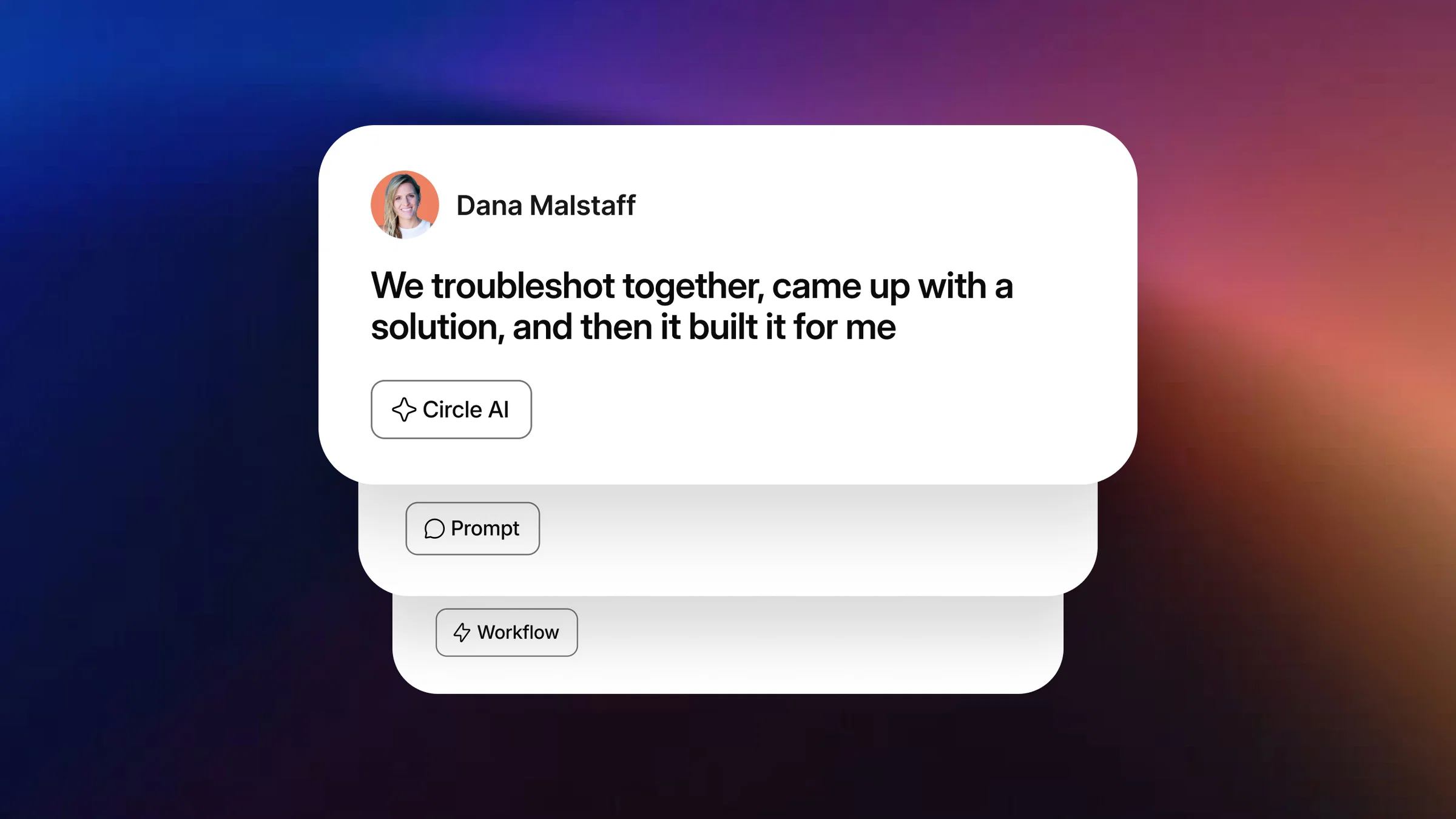
- Catch at-risk members early: proactive outreach during the at-risk window beats a post-cancellation "why did you cancel" email every time. Circle's Workflows can automate onboarding, re-engagement, and renewal reminders, so you reach members before they drift.
- Offer a pause: members hitting a temporary busy period or financial squeeze don't always want to leave for good. A pause turns a permanent loss into a temporary interruption.
- Push annual billing: annual plans improve stability by reducing how often members revisit the cancel decision.
Talk Nerdy to Me shows what that looks like when it all clicks. Seth David teaches accountants and bookkeepers how to run better practices, and before Circle his business was spread across 30+ courses, a separate membership community, and a coaching program, each on a different tool. Members had to remember where the live calls happened, where the course videos lived, and where to ask questions. That kind of friction is exactly what kills retention: members who can't find the value they're paying for stop showing up, and the cancel button starts to look like the simplest path.
After consolidating onto Circle, the friction disappeared and the retention work could compound. Seth now sees 80% trial-to-paid conversion, $37K+ in monthly revenue, and 300+ actively posting members. The tactics above are easier to run when courses, community, coaching, and billing live in the same place, because every next thing a member needs is one click away, not a separate login on a different app.
Layer one-time offers on top of your recurring base
A retained member base is also the foundation for everything else you sell. The strongest creator businesses don't choose between recurring revenue and one-time sales. They use recurring revenue as the operating floor and one-time offers as ceiling-raisers.
The reason it works: a membership and a one-time offer do different jobs. A membership gives members ongoing access, accountability, and a place to keep showing up. A course, cohort, or workshop delivers a specific transformation with a clear start and end. Members who want to go deeper will pay for that, often on top of their membership rather than instead of it.
Bonnie Christine's business runs in exactly this order. The membership is the floor, and it feeds a course business that has graduated 15,000+ designers; the membership then continues for alumni who want to stay connected after the course ends. The membership doesn't compete with the courses; it's what makes selling them repeatable, because the audience is already gathered, already paying, and already trusts the work.
That's the layered model. Recurring revenue covers your baseline every month, and one-time offers let you sell deeper transformations to the members who want them, without rebuilding your business around each new launch.
Start with recurring revenue, then layer the rest
Once the foundation is in place, recurring revenue changes the shape of your business. Instead of chasing the next launch or hoping an algorithm serves your content to the right people, you wake up on the first of the month already knowing what you've earned. Each new member adds to a base that compounds. Each member who stays gives you a return on the work you already did to bring them in.
Most operators get tripped up running all of it when the courses sit in one tool, the community in another, and the billing in a third place members never see. Pull those into one home and the retention work starts to pay off in revenue you can count on. That's what Circle is built for.
Start your 14-day free trial and build the membership base your business runs on.
Monthly recurring revenue FAQ
How is MRR different from ARR, and which one should I track?
MRR is the predictable revenue you collect each month from active subscriptions. ARR (annual recurring revenue) is the same number multiplied by 12, or the total value of your annual plans on the books. Most creators should run their business on MRR because that's the cadence members actually pay on, and use ARR when forecasting a full year or talking to investors.
How long does it take for MRR to feel meaningful?
For most creators, the first 6 to 12 months are the hardest, because every cancellation feels like it cancels out a new signup. Once you cross roughly 100 retained members, new signups start adding to a base rather than replacing churn, and the compounding becomes obvious. The speed depends more on retention than acquisition.
Do free trials hurt or help MRR?
Free trials usually help, as long as you track trial-to-paid conversion separately from MRR. A 7- to 14-day trial gives serious buyers a low-risk way in and filters out tire-kickers who won't stick around past month two. Don't count trial users in your MRR. Only count members who've been charged.
What's the difference between gross MRR and net MRR?
Gross MRR is everything you billed this month. Net MRR is what's left after refunds, downgrades, failed payments, and cancellations. Net MRR is the number that tells you whether your business is actually growing; gross MRR alone can mask a churn problem.
Can I run MRR through Stripe directly, or do I need a community platform?
You can run subscriptions on Stripe alone, but you'll be stitching together access control, member communication, content delivery, and churn workflows yourself. A community platform like Circle handles billing, access, content, and retention in one place, so a failed payment automatically pauses access and a renewed card automatically restores it, without you touching anything.
Community Content Marketer
Arina is Circle’s community content marketer, sharing insights on community growth, GTM strategy, and storytelling for solopreneurs.