Should your newsletter be free or paid? The honest truth
TL;DR
- A free newsletter is often your best audience-building tool; a paid newsletter charges readers directly for your writing; and a hybrid model uses a free newsletter to feed paid products like courses, communities, or coaching.
- The right model depends on whether your newsletter is the product or the pipeline to something bigger.
- You can pick your model based on your niche, content, business stage, and capacity, and switch it as your business grows, as long as you have the right platform.
Members only
One issue, five minutes, every Tuesday. Read by +14,200 creators.
Dave Gerhardt spent years giving away free LinkedIn content and a free newsletter before turning Exit Five into a paid B2B marketing community on Circle. The free content built the audience. The community is what people now pay for. That sequence—free at the top, paid underneath—is the move most creators should consider.
The free vs. paid decision isn't binary, and it isn't about which model is "better." It's about which of the three paths—free, paid, or hybrid—fits the business you're actually building.
If you're still in the process of building an audience to feed courses or coaching down the line, a free newsletter is the right starting point. But if you're a coach selling courses and community access, the hybrid model likely wins. At the same time, for someone selling niche expertise, a paid newsletter may be the better fit.
The rest of this piece walks you through each path, so you can match your situation to the right model.
The free newsletter: your best audience-building tool
A free newsletter scales without friction, builds trust before you ask for money, and feeds every paid offer you launch later. For most creators, that combination is hard to beat at the top of the funnel.
Where free newsletters shine
A single free list can drive readers toward your courses, coaching, memberships, and sponsorships in parallel.
Tim Slade of The eLearning Designer's Academy is a good example. Tim started with a single course in 2020 and grew to 11,000+ members by using a free newsletter and top-of-funnel content to feed cohort programs, gated workshops, and private community discussions—all now consolidated on Circle. The free list did the audience-building; the courses and community captured the revenue.
Where free newsletters struggle
Content saturation is real. Getting someone to leave their app, visit your site, and enter an email is harder than most creators assume.
However, the bigger risk is building an audience with no mechanism to convert it. Plenty of creators grow a list without a clear path to a paid offer. Even Jay Clouse, with 60,000 free subscribers, has noted that The Lab had its lowest month of applications when he hadn't been actively talking about it. The funnel needs ongoing attention regardless of list size.
Who should use this
Start with a free newsletter if you're building a coaching or consulting pipeline, plan to sell online courses or community access, or don't have an established audience yet. The newsletter is your pipeline—the teaser to how you think, work, and do business. But it's not the product.
The paid newsletter: when content is the product
A paid newsletter charges readers directly for access to your writing. The model tends to work best when the content itself has clear value to the reader, usually because it saves time, makes money, or advances professional standing.
Seth David of Nerd Enterprises is a good example of this archetype in action. Seth has taught accounting professionals for decades, and his weekly newsletter—now published through Circle's Email Hub as both a broadcast email and a permanent community post—anchors a business that earns $37K+ in monthly revenue from coaching, courses, and community. The newsletter works because his audience can attribute direct, financial ROI to what he writes.
Where paid newsletters work
Paid newsletters can earn revenue from day one, sustain premium prices in the right niche, and give you a single, focused product to build around. Every subscriber is a paying customer. Just write, publish, and get paid — but you need an audience elsewhere to opt-in
The model works hardest at the high end of the price ladder: niche professional intelligence where the content has direct financial value to the reader. A small list at the right price point, serving an audience that uses your writing to better understand hyper niche topics and use your real expertise in their life or work, can outperform what most creators earn from a much larger free list.
The common thread is straightforward: when readers can attribute clear ROI to your writing, they'll often pay premium prices to keep getting it.
Where paid newsletters struggle
The core blocker for paid newsletters is reach. To earn meaningful revenue at typical newsletter price points, you usually need a large paying base, and most categories don't support that climb. Hobbyists and lifestyle niches rarely sustain enough willingness to pay, and a paid-only model gives you fewer levers to pull when conversion stalls.
You're also building a business with only one product. There's a value-proposition trap waiting for most creators: readers don't pay for more of the same content they already get for free. When the writing slows, so does the revenue, because there's no community, course, or coaching offer underneath to catch them. It's a setup for the kind of burnout tons of creators fall into: you only earn when you create, but humans aren't machines, and life happens, so you might feel overwhelmed or exhausted here.
Who should go paid
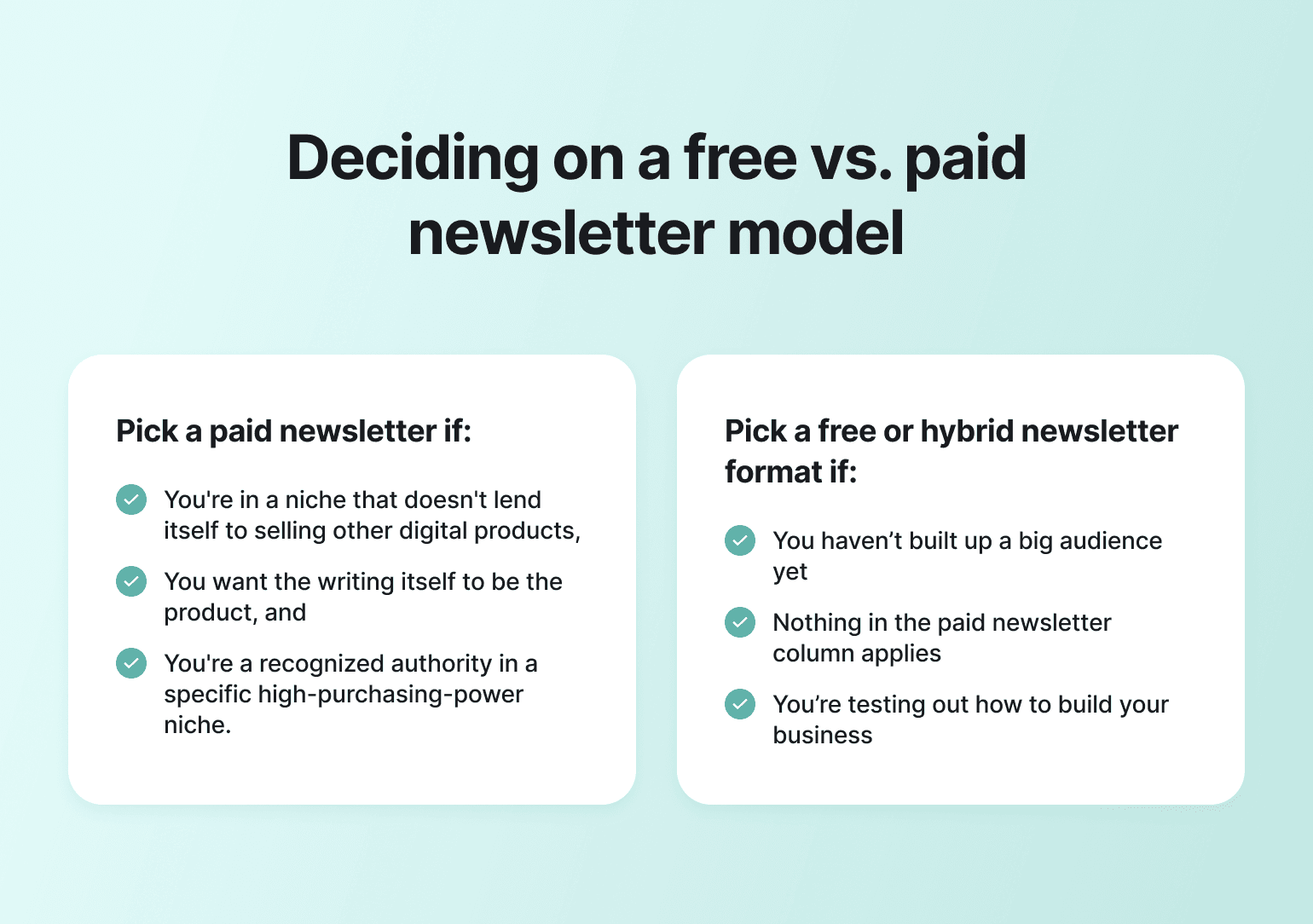
Paid newsletters tend to work best for the "analyst" archetype: a recognized authority in a specific, high-purchasing-power niche (B2B, finance, professional development) where thecontent delivers measurable ROI to the reader.
Dave Gerhardt is one example of this approach: free content built the audience, and a paid community became the offer underneath it.
If that's not you, keep reading.
The hybrid model: free newsletter + paid products
The hybrid model keeps your newsletter free to maximize reach and earns revenue through paid products such as courses, communities, memberships, coaching, or live events. The content builds trust, and the products help you provide results and earn.
Why are the economics so different?
Paid products almost always command higher prices than content-only subscriptions. A standalone paid newsletter is typically priced lower than a course, a membership with community access, or a live cohort that promises a transformation at the end of it. The pricing gap reflects what's actually being sold: access, outcomes, and transformation, not just words on a page.
Retention can also hold up better when the paid product isn't just content. Courses deliver a defined outcome. Communities build relationships. Coaching creates accountability. A paid reader who stops reading for a while may have little reason to stay, but a customer who's mid-course, mid-cohort, or mid-relationship usually does, even during quiet periods.
How to decide which newsletter model fits you
Four conditions point toward a paid newsletter: your niche characteristics support it, your content type delivers a specific outcome for readers, your business stage is built with trust, and your capacity allows you to stay on the content treadmill week after week. If none of those apply, the decision usually shifts toward a free or hybrid option.
4 factors that determine your model
The right model is the one that fits your niche, content, stage, and capacity. Run your situation through these four factors, and the answer usually surfaces on its own.
1. Your niche characteristics
Does your audience routinely buy digital products like paid subscriptions, courses, coaching, or memberships? Do brands actively advertise in your space? Niches where the audience holds budget authority (B2B, finance, professional trades) are often better suited to paid subscriptions. Hobbyists and lifestyle niches usually aren't.
2. Your content type
Readers more readily pay for content that produces a specific, demonstrable outcome: information that saves time, makes money, or advances professional standing. Coaching-adjacent content (frameworks, methodology, mindset) typically performs better as a marketing engine for paid community or coaching offers than as a standalone subscription.
3. Your business stage
Launching a paid tier too early can slow audience growth, since conversion rates tend to stay low without brand familiarity. Build the free audience first. Monetize after you've built enough trust.
4. Your capacity
A paid newsletter puts you on a content treadmill. A paid community puts you on an engagement treadmill. Both require sustained operational commitment. Pick the obligation you're willing to carry.
For most coaches, creators, and educators reading this, the honest answer is: keep the newsletter free, and build a paid community, product, or membership as the revenue engine. You already have the expertise, which means your newsletter can build trust at scale. The community is what you launch when you’re ready for people to pay to go deeper.
Your model isn't permanent, but your platform decisions (often) are
The model you pick today doesn't have to be the model you run in two years. Most successful operators shift as their business grows. You might start free to build trust, layer in a paid community once you have a few thousand engaged subscribers, add a course when members start asking how to better understand something or apply it for themselves, then introduce coaching or live cohorts when you want higher-margin revenue. The model evolves because your audience evolves.
The catch: switching gets much harder when your stack is fragmented. If your email lives in one tool, your community in another, your courses in a third, and your payments stitched across two more, every shift in your model becomes a migration project. Members or subscribers fall through the cracks, and the data doesn't follow them. You spend more time wiring tools together than serving the people paying you.
That's why the platform you choose often matters more than the model you start with. When your newsletter, community, courses, events, and payments live in the same place, changing the model is a configuration change rather than a rebuild.
You can launch a course next month, open a paid community to compliment your free one next quarter, and add cohorts next year without ever asking a member to create a new login or losing track of who paid for what.Circle is built for exactly this: start with whatever fits today, and let the platform stretch as your business does.
Free or paid, you still need an all-in-one platform
The question was never really "free or paid?" It was: what are you building, and which model fits the business underneath it?
Whichever path you pick—free, paid, or hybrid—the requirements are the same.
✓ You need direct access to your audience, independent of any algorithm that can throttle your reach overnight.
✓ You need room to evolve your model without having to rebuild your stack every time.
✓ You need everything to work together, instead of as five separate tools.
That's the case for an all-in-one platform. Circle’s Email Hub connects your newsletter directly to community activity, courses, events, and payments, so a free subscriber can become a paid member, a course buyer, or a coaching client without ever leaving your setup.
Try the all-in-one platform with a 14-day free trial of Circle now.
Free vs paid newsletter FAQ
How many subscribers do you need before charging for a newsletter?
There's no magic number, but launching a paid tier too early can limit your growth. Conversion rates from free to paid vary widely by product and audience, so there's no single reliable benchmark to plan around. Build trust and audience size first; the picture gets more interesting at scale.
Can you run a free and paid newsletter at the same time?
Yes, and many creators do. The key is making the free version genuinely valuable on its own while offering something structurally different in the paid tier. Community access, live coaching, or peer interaction often justify a paywall better than "more of the same content."
How much should you charge for a paid newsletter?
It depends on your niche and what the content delivers. Standalone paid newsletters typically price between $7 and $15/month. Analyst and B2B newsletters charge $120 to $499/year. High-value professional intelligence in finance and venture capital can command $4,000/year or more.
Community Content Marketer
Arina is Circle’s community content marketer, sharing insights on community growth, GTM strategy, and storytelling for solopreneurs.