How to price an online course to reflect its value and drive revenue
TL;DR
- Price based on the transformation your course delivers, not your hours or module count — pain-driven buyers pay for speed, aspiration-driven buyers pay for a clear future state.
- Match your price to a model that fits your delivery: flat fee for evergreen, tiered or cohort for high-touch coaching, subscription for evolving content.
- Benchmark against market rates and psychological tactics (anchoring, charm pricing), then validate with real buyers and keep iterating post-launch.
If you’re building an online course, one of the biggest choices you’ll have to make is what to charge for it.
At first, it might seem like a simple math problem: total up your costs, like your time, video gear, editing software, maybe a freelance designer or video editor, then add a profit margin and call it a day. But once you run the numbers, you probably realize it’s not that simple.
Pricing feels personal. And it can also feel like a total guessing game—or worse, emotional roulette.
- Will anyone pay for this?
- What if I price it wrong and tank my launch?
At Circle, we’ve seen creators succeed with all kinds of pricing—from $49 DIY courses to $5,000+ coaching programs. Those prices aren’t random. They’re strategic—and we’re here to help you figure out yours.
In this guide, you’ll learn how to price an online course in a way that reflects its value, attracts the right buyers, and supports your bigger business goals.
Let’s dig in!
Understand your audience’s willingness to pay
Before you price your course, you need to understand who you’re selling to—and what they’re actually willing to invest in. Don’t just guess based on things like income.
What really matters is how they see the value, how urgent their need is, and whether your course connects to something they truly care about.
To get that clarity, it helps to look at two things in particular:
Pain vs. aspiration buyers
Pain-driven buyers are looking to solve a pressing problem—fast. They tend to have a higher willingness to pay if your course offers a clear, immediate outcome.
Their problems might sound like:
- “I need to stop burning out at work.”
- “I have to land a client this month.”
- “I need to lose 10 kg in 3 months.”
Meanwhile, aspiration-driven buyers are motivated by long-term transformation. They’re willing to invest, but only if they can clearly see the future you’re helping them reach. Think: “Build a personal brand” or “Start writing books for children.”
Knowing which type of buyer you’re talking to makes a big difference in how you price and position your course.
But in reality, many buyers will feel both—pain about where they’re today, and aspiration for where they want to be tomorrow. The most compelling courses speak to both sides: they show how your course relieves immediate pain point and unlocks a bigger transformation.
Pricing is much easier when you can bridge the full gap from pain → transformation.
Beginner vs. advanced pricing sensitivity
Where your audience is in their journey affects how they see your price as well.
Beginners tend to be more price-sensitive. They’re still exploring, unsure of what’s worth paying for, and want something that feels low-risk but full of value. If your course is for beginners, keep the price accessible.
Advanced buyers, on the other hand, are usually more focused on outcomes. They’ve already invested time (and often money) into the topic and are looking for something that can move them forward faster. They’re often willing to pay more for access to expert frameworks, coaching, or "shortcuts”.
The bottom line: Try to understand your audience’s mindset and motivation. That way, it’ll be much easier to price your course in a way that feels right for them and for you.
💡Pro tip: If you’re doing interviews with your (hopeful) ideal clients, ask them:
“What have you paid for before to solve this pain point?”
That’ll give you an idea of the amount of money they’ve spent to fix this before, which is a great baseline to understand your pricing.
Pricing models and what drives them
Once you understand your audience, the next step is choosing a pricing model that fits how you’re delivering your course, and how your buyers expect to engage.
Here are four common models creators use, along with when (and why) they work👇
Flat fee
This model offers a one-time payment for lifetime access to course content. It works well for evergreen courses that don’t require live interaction or ongoing support. It’s great for creators who want to build once and sell in an ongoing way, especially when paired with email automation or a funnel.
A great example of a flat fee pricing model is Channel in a Weekend by Karin Carr. It’s a $97 mini-course that helps real estate professionals set up a client-attracting YouTube channel in just 48 hours. With templates, checklists, and short video tutorials, it’s a clear example of how a focused, outcome-driven course can deliver real value at a lower price point—without ongoing support or a huge time commitment from the creator.
Tiered pricing
Tiered models offer multiple pricing levels based on the level of support or access. For example: $197 for self-paced access, $497 for group coaching, and $997 for 1:1 support. This lets you serve different audience segments while increasing average revenue per user.
The Annual Review by Tiago Forte is a guided reflection and planning course that helps students look back on the past year, extract insights, and create a clear, values-aligned roadmap for the year ahead. It follows a tiered pricing model: $499 for the self-paced version with recorded workshops and community access, $1,994 for a live cohort experience, and $5,000 for a 1:1 coaching track.
🧠 Curious how Tiago Forte’s team built this kind of pricing structure and community ecosystem? Check out how they did it.
Cohort-based pricing
Cohort pricing is used for time-bound courses that include live teaching, community, or direct feedback components. Because the format is higher touch, prices are often in the $500–$5,000 range. The key here is perceived transformation and accountability.
Elsynergy is a great example of a high-ticket course. Founders Laura and Ginny sell premium business programs priced between $1,000 and $3,000. Their courses come with a full step-by-step system, live group coaching calls, and an online community hosted on Circle where students can ask questions and share wins.
This setup helped them make over $400,000 in just three weeks. And it’s proof that when your course offers a transformation (and live support elements), people are willing to pay more.

See the setup that made this work.
Subscription model
This model charges monthly or annually for access to evolving content, ongoing coaching, or community. It works well if you’re teaching a skill that changes over time or want to create recurring revenue.
Golf Swing Simplified by Tom Saguto is a structured training program that helps golfers build a repeatable, powerful swing. It’s run on a subscription basis, with access priced at $19.99/month or $199.99/year. The program includes a full video curriculum, ongoing content updates, and a supportive community—all designed to help members see consistent improvement over time.
📖 Courses with community tend to perform better. If you’re adding a live element or support space, check our guide on 8 proven ways to monetize your community. It’ll give you ideas to build real value—and sustainable income.
Calculate what your course is really worth
Picking the right pricing model gives you structure. But structure alone doesn’t tell you what number to put on the price tag. You need to figure out what your course is really worth—and that’s not always easy.
At first, you might be tempted to price it based on how many modules you’ve created or how long it took you to make it. But instead, it’s better to adopt a transformation-first mindset.
Amy Porterfield, creator of Digital Course Academy and a someone who knows a lot about digital courses, says people don’t pay for information—they pay for results.
The clearer and more meaningful the transformation you offer, the more value your course holds. The more money you can charge. And our internal data backs this up: courses that deliver a clear transformation and build in accountability see completion rates of 40–60% in Circle communities—well above the 12–15% average for self-paced courses.
The more consistently your course delivers real outcomes, the more it earns the right to command a higher price.
Here’s a 3-part framework to help you calculate what your course is truly worth:
1. Outcome value
What is the result your course helps someone achieve, and how important is that result to them?
If your course teaches someone how to land freelance clients, lose weight, or grow their business, the perceived value is high because the outcome directly improves their life or income.
2. Delivery cost
Factor in the level of support you’re providing. Are you offering just recorded lessons, or adding live coaching, community support, or direct feedback?
The more you help your students stay accountable and succeed, the more your pricing should reflect that hands-on experience.
3. Market benchmark
Look at what others are charging for similar transformations. If bootcamps, private coaching, or certification programs offer the same result, what do they cost? Your course may be a more accessible or efficient alternative, but it should still be priced in that ballpark.
You can also ask: What would it cost someone to figure this out on their own? Going to college could take years and rack up serious debt. Hiring a coach or joining a bootcamp might cost thousands.
If your course helps them get the same result—just quicker, cheaper, and on their own schedule—that alone makes it stand out. Price it with that in mind.
💡 Bonus tip
If you’ve got students who’ve gotten real results from your course, use their testimonials to back up your price—but do it ethically. Highlight honest outcomes, not exaggerated claims. Let your students' words speak for themselves, and avoid cherry-picking only the most extreme success stories.
Online course pricing benchmarks and what the market says
Even with the right model and strong transformation, you may still wonder:
- Is this price reasonable?
- Too high?
- Too low?
That’s when you know it’s time to dig into some market research.
Reference external sources
Use course platforms as benchmarks
Platforms like Teachable and Thinkific host thousands of courses across every niche imaginable. Use them as a research tool to see what similar creators are charging. Look up courses on your topic, check how deep the content goes, whether extras like community or templates are included, and what their price points are.
Look to Reddit for unfiltered insights
For a grassroots view, Reddit can be surprisingly useful. Communities like r/business, r/Entrepreneur, and r/coursecreators often feature real stories from creators who’ve tested pricing strategies in the wild. It’s not always polished, but it’s honest and full of lessons on what worked, what didn’t, and what buyers push back on.
Consider a high-ticket strategy
If you’re offering a transformation with high perceived value, take notes from Luisa Zhou’s high-ticket pricing strategy. She defines a high-ticket course as one that sells for $900 or more and teaches an entire system, not just a single skill. These courses can be self-paced but often include guidance, bonuses, or access to coaching.
Zhou’s core belief: when your course helps someone achieve a complete, start-to-finish transformation, it becomes far more valuable than piecemeal learning—and often costs less (in time and money) than coaching or trying to figure it all out alone.
Use price ranges
Another strategy that can help set your price is using common pricing bands. These aren’t strict rules, but they provide helpful context for how courses are typically priced based on depth, format, and support.
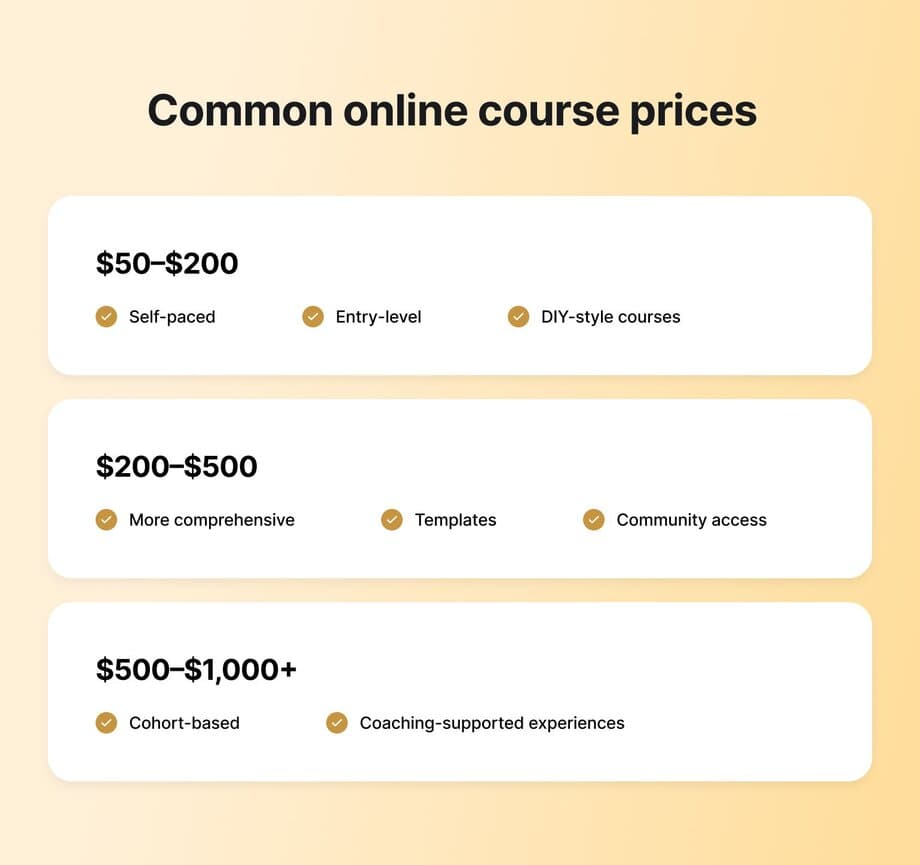
You can use these bands as a starting point, then adjust based on the unique value and experience your course delivers.
Use tools to model your pricing
Still not sure what to charge? You can play around with online course pricing calculators. These tools let you plug in different prices, audience sizes, and conversion rates so you can see what it might take to hit your income goals.
Psychological pricing tactics that work
Once you’ve chosen your pricing model and ballparked your price, you can also try a few pricing tactics to make your offer feel even more attractive.
Charm pricing
Charm pricing is when you end your course price with a 7 or 9 instead of a clean number. For example, pricing your course at $197 instead of $200. It works because of something called "left-digit bias"—we tend to read prices from left to right, so $197 feels noticeably cheaper than $200, even though the difference is only $3.
Anchoring
Anchoring is the idea that the first number someone sees sets a mental benchmark. If you show a $2,000 coaching package or higher-tier offer first, your $997 course will feel like a much better deal in comparison. This tactic works because people naturally compare prices, and anchoring helps your actual offer look more affordable and reasonable next to a bigger number.
You can see this in action on Jaunty’s social skills coaching sales page. They lead with their higher-priced Live Cohort + Community option at $1,596—visually positioned first and marked as “Best Value”—before presenting their lower-priced Recorded Masterclass + Community option at $1,197.
The anchor makes the $1,197 feel more accessible, while also framing the $1,596 as a premium investment for those seeking more transformation and live support.
Scarcity and urgency
Scarcity and urgency give people a reason to act now. You might say something like “Only 20 spots available” or “Enrollment closes Friday at midnight.” This taps into a fear of missing out—FOMO—which can make people more likely to take action quicker
Value stacking vs. feature stuffing
When pricing and positioning your course, the emphasis should always be on the transformation (where your course will take them and how quickly)—not just the components. So, instead of listing every video or worksheet, highlight the outcomes and key results your course helps them achieve.
See the difference👇
| ✅ | ❌ |
|---|---|
Build a scalable group coaching program in 6 weeks—get the full step-by-step playbook, done-for-you templates, and direct feedback from experienced coaches inside a private community | 12 modules, 6 workbooks, 8 hours of video, Slack group |
Get access to proven interview frameworks, resume + LinkedIn templates, live coaching calls, and a private network of women to land your next leadership role in tech | 10 video modules, 8 worksheets, 5 recorded interviews, 4 LinkedIn templates, Facebook group access |
Circle partner Jordan Godbey puts this really well:
The bigger the transformation (outcome) → the higher value the course.
When you lead with outcomes rather than features, buyers are more willing to pay premium prices—because they're investing in the transformation, not the content itself. He adds, "Many people are only selling one piece of the puzzle. If you connect more pieces together, you help your students achieve a bigger, and more valuable outcome."
You can see this principle in action with courses like Ship 30 for 30 that charges $800 for a 1-month cohort that helps students publish 30 pieces of writing—a clear, outcome-driven promise. By emphasizing this specific result (not hours of video), they position the course as high value and justify the premium price.
Step-by-step: How to price your online course
1. Define your transformation and audience
Start by getting crystal clear on what your course helps someone achieve, and who it’s for. A course that promises to help a beginner land their first freelance client will be priced differently from one that helps a professional scale to six figures.
2. Choose your pricing model
The way you decide to deliver your course will partially determine how much you can charge for it.
For instance, self-paced courses with minimal support tend to fall on the lower end of pricing, while cohort-based, especially those with live calls or coaching, can command higher prices. Subscriptions can work well if your content evolves over time or if you’re offering ongoing community access.
In short, match your pricing model to both your content format and your audience’s learning style.
3. Benchmark your niche
Research similar offers in your space—not to copy, but to anchor your understanding of what’s typical. Check out other courses in your niche on platforms like Teachable, Thinkific, or Gumroad. What are they charging? What do they include? How are they positioning the value? And price yours accordingly.
4. Estimate the value of your transformation
Think about what your course actually helps someone do, not just what it teaches.
- Does it help them land a job?
- Start a business?
- Book their first client?
Then ask: what would it cost them to get that same result some other way, like going to college or paying for one-on-one coaching?
If your course helps them get there faster, cheaper, or with more flexibility, that’s real value. So don’t just price it based on what’s inside—price it based on what your students can do once they’re done.
5. Factor in your production costs and ROI
How much did it cost (in time and money) to create this course? What will it take to keep it running? And how long will it take students to get to the “transformation” piece? Make sure your price allows for a sustainable return.
6. Validate your pricing
Before going all in, check your pricing with a small group of real people. Use surveys, waitlist feedback, or run a closed beta round to see if your audience agrees with your pricing, and get early testimonials at the same time.
7. Test and iterate
Pricing is never set in stone. You can experiment with early bird pricing, A/B testing different tiers, or even offering a lower price at launch with the plan to raise it as the course (and your reputation) grows.
How to optimize your pricing over time
Many creators would tell you that the most effective pricing strategies are built through testing, feedback, and ongoing optimization. As Jay Clouse calls it, “experimentality”.
Start with a beta group at a lower price to gather feedback, collect testimonials, and see if students are actually completing the course.
Then try simple pricing experiments:
- Early bird pricing: Offer a lower price to people who join first.
- Bundles: Add bonuses like templates, worksheets, or group calls to increase the value.
- Dynamic pricing: Adjust the price based on demand or enrollment windows.
As students begin completing the course (and as you launch version 2.0 or 3.0), you can start raising the price.
Finally, use tools like Stripe, Podia, or your course platform’s analytics to track conversions, revenue, and trends over time. Then adjust your pricing accordingly.
Pricing is a journey, not a one-time decision
You don’t have to get your pricing perfect on day one. Focus on the transformation your course promises, test your pricing early, and refine as you go. Above all, trust in the value you’re offering.
Once your price feels right, bring your course to life in a space that grows with you. Circle has everything you need to build high-impact courses and communities—payments, live events, discussions, and analytics—all in one place under your own brand.
Built to price, sell, and deliver.
FAQs
How much do online courses usually cost?
The range is wide because the value and delivery vary so much. Most self-paced, entry-level online courses are priced between $50 and $200. Mid-tier or cohort-based courses range from $500 to $2,000, while high-touch or coaching-inclusive programs can cost $3,000 or more.
What are the best pricing models for first-time course creators?
There’s no universal “best,” but simplicity is key when you're starting out. A flat-fee self-paced course is easy to launch and test. As you grow, you can layer in premium tiers, live elements, or community access.
Can I increase the price after launch?
Yes—and you probably should. Many creators start with a lower price to test their course and collect testimonials. Once you improve your course and launch the updated versions, it makes sense to charge more.
Contributing Writer
Paulina Major writes about online courses, freelancing, and growth. She helps creators build, launch, and grow educational communities that thrive.