Why creators are switching to membership models
TL;DR
- Creators are moving to a membership model in which members pay you directly every month for ongoing access.
- Each billing cycle should build on the last, so even a small audience of paying members can sustain a real business.
- Pick the model that fits your audience, your expertise, and the time you have. Below are five proven models and a framework for choosing between them.
Members only
One issue, five minutes, every Tuesday. Read by +14,200 creators.
Tim Slade's eLearning Designer's Academy started as a single course in 2020 and has scaled to 11,000+ members on Circle. It didn't get there from one big launch. It got there from members who kept paying, kept showing up, and kept renewing—month after month.
Before that shift, Tim was juggling Thinkific, Slack, Zoom, and Webflow, looping in a contractor whenever he needed a new landing page, and ending up with an experience that never felt integrated with his community.
If you're a creator, coach, or educator still grinding through launch cycles, chasing brand deals, or watching algorithms eat your reach, memberships offer a different path, where revenue compounds instead of resetting every quarter.
This guide breaks down why so many creators are making the move, the five membership models that actually work, and how to pick the right one for your audience.
What is a membership model?
A membership model is simple: people pay you on a recurring basis for ongoing access to something valuable. That "something" can be a community, a content library, live coaching calls, courses, or some combination of the above.
Revenue hits your bank account on a regular schedule, and the value accumulates the longer someone stays. One hundred members at $50/month is $5,000 in month one—and if you keep them, it's $60,000 by year's end without a single new sale.
Compare that to launching digital products where you start from scratch again and again, or waiting for a (hopefully, aligned) brand deal that may or may not land, and the difference is clear: memberships build a predictable base for your community.
Why the old model is breaking
Ads, sponsorships, and launches don't pay the way they used to. The work keeps getting harder, and the returns keep getting thinner. Here's what's actually going wrong: every one of those revenue sources runs on something you don't control—an algorithm, an advertiser's budget, an audience you have to re-sell to every cycle. These forces are squeezing creators who still rely on them.
Algorithm dependency caps your growth
One platform update can bury your content overnight. When your reach lives on someone else's algorithm, you can't plan a launch, sign a new hire, or commit to a long-term project with any confidence. The audience is theirs, and you're just borrowing it.
Ad revenue keeps shrinking per creator
Ad rates have been falling for years, and after the platform takes its cut, what's left rarely covers a full-time business at smaller audience sizes. Worse, ad income swings hard whenever a platform changes its policies or advertiser demand dips, so even a good month is no guarantee of the next one, making this revenue stream one that induces anxiety instead of stability.
Sponsorships are inconsistent by nature
A $10,000 sponsorship one month and nothing the next is a budgeting nightmare. Brand deals come and go based on agency budgets, campaign timing, and category fit, none of which you control. Stitching three or four of these together to stay afloat doesn't fix the problem—it just spreads the unpredictability across more sources.
If that sounds familiar, these money-mindset shifts you can make as a creator can help you rethink what a more stable business looks like.
Launch cycles create burnout ceilings
The launch model wears thin fast. You build for weeks, launch for a few days, exhaust your list, then start over. Each cycle demands more emails and more ads to hit the same numbers, because the people who bought last time aren't buying the same thing again. Eventually, you're working harder for flatter results.
Why memberships work for creators
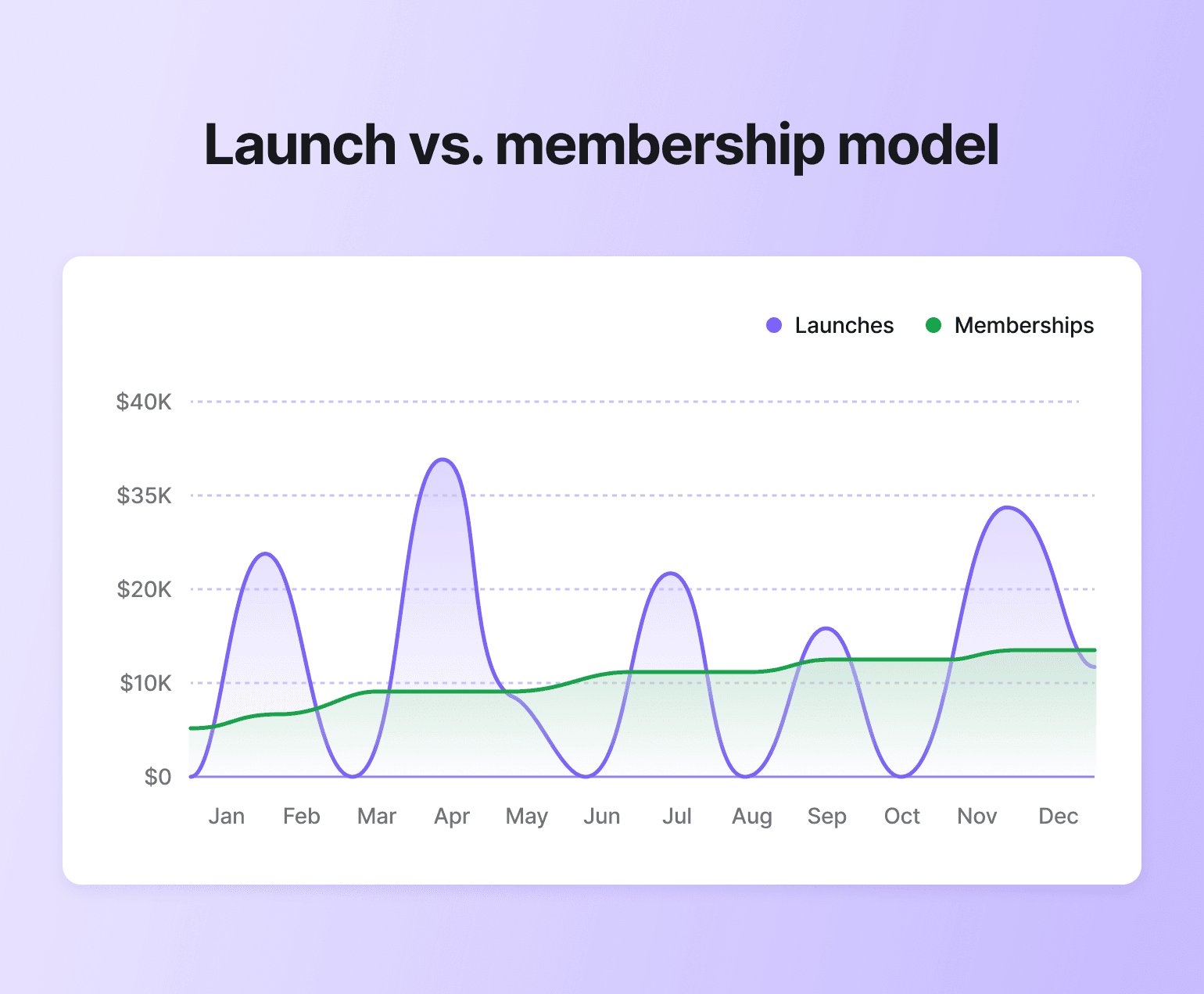
Memberships flip the model: instead of starting from zero each cycle, every paying member adds to a base that compounds month after month. That single shift changes the economics, the audience size you need, and the kind of relationship you can build with the people paying you, whether you're running a B2B marketing community or an education business. Here's what changes when you make the switch.
Your revenue stops resetting to zero
Membership revenue compounds. Every new member adds to a base that carries forward, so month two starts higher than month one, and month twelve starts higher than month eleven. That changes how you run the business: you can plan ahead, hire with confidence, and invest in quality instead of grinding out the next launch.
A small audience can be enough
A relatively small group of highly engaged people paying a fair price can support a meaningful business. 200 members at $50/month is $120,000 a year. You don't need a massive following, just the right members paying a fair price for what you deliver.
Josh Hall’s Web Designer Pro is proof. With just 250–300 members and no community manager, his membership generates $327K in annual recurring revenue and more than $817K over five years. The lesson: a small, well-served membership beats a giant audience every time—if you treat retention as part of the craft.
Want to run the numbers for your own audience? Try our Community ROI Calculator.
You own the relationship with your members
On a social platform, you're renting access to your audience. The platform decides who sees your posts, controls the inbox, and can change the rules whenever it wants—including deleting your profile and years of hard work within a single second. (And good luck trying to chat with a human to get it reinstated.)
A membership flips that. The people who pay you are in your community, on your terms. Circle is built for exactly this—your community, courses, events, and payments all live under your domain.
Upselling existing members is easier than finding new ones
Members who already pay you and experience value are 60–70% more likely to buy from you than cold prospects, who are just 5–20%.
They've taken the first small step of opting in, paid you real money, and warmed up. They trust you enough to give you hard-earned money, which means that you have much more to offer them in terms of transformation.
Members tell you what to build next
When people pay regularly, you still have to actually reach out, ask, and get feedback to know what's working.
Their cancellation can tell you what isn't—especially if you handle offboarding the way Josh Hall does at Web Designer Pro. When someone cancels, they receive an automated message that still feels personal: a thank-you for their time in the community and a simple question asking why it wasn't the right fit. And when someone signals they want to return, Josh sometimes offers a reason to come back sooner, like a limited-time annual discount.
His playbook is a powerful way to get members to create an ongoing feedback loop that shapes your product in real time—and makes it more valuable over time.
Neuroscientist Anne-Laure Le Cunff, who runs the six-figure Ness Labs membership, treats this feedback loop as a series of tiny experiments. She recommends an experimental mindset for creators: try something small inside your membership, then run a simple Plus / Minus / Next reflection on what worked for members, what didn't, and what to change next.
Even better, share the results publicly with your members—they'll often help you interpret the data in ways you wouldn't on your own, and they'll feel even more invested in the membership because of it.
The community becomes the product itself
When members start connecting with each other, the community generates value independent of you. Discussions, accountability partnerships, and peer advice all happen without requiring your direct involvement. The "community product" improves as it grows, without demanding proportionally more of your time.
5 types of membership models
The right membership model depends on what your audience is actually paying for: access to you, access to content, access to peers, a defined outcome, or some combination. Each one demands a different commitment from you and delivers a different kind of value to members. Here are the five models creators are actually using to build sustainable businesses.
1. Fan-support membership
Members pay to sustain a creator they value. The core exchange is proximity and exclusive access—behind-the-scenes content, early releases, personal messages—rather than a structured transformation. Entry tiers typically start low, with higher-touch tiers priced above that.
Best for: Artists, musicians, podcasters, and writers whose personality and process are themselves the draw.
2. Content library membership
Members pay a recurring fee to access a growing archive of videos, articles, templates, or courses. New members get immediate access to everything. The value compounds as the library expands, and each addition makes the membership more attractive to both current and prospective members. In Circle, this is what Courses, Events, and Access Groups are built for—structured lessons, video libraries, and downloads housed and organized in your community so members can learn and connect in the same place (or in specialized spaces).
Barbie Wong's Musical Nest membership is a great example of this model in a niche audience. Parents and music teachers pay to access video tutorials, downloadable practice materials, live meetups, book clubs, guest speaker talks and interactive practice challenges—all housed in a single community. Every new resource raises the membership's value for current and prospective members, and the shared identity (raising musical kids) keeps people renewing.
Best for: Educators with a deep back-catalog of content who want to package years of work into an evergreen offer that keeps delivering value to new members on day one.
3. Community-led membership
The primary value is peer connection, not creator-produced content. Members join to network, find accountability, and belong to a group with a shared identity or professional focus. The creator runs the room rather than carrying every conversation.
Dave Gerhardt built Exit Five on this exact model, turning an early membership setup into a full media and membership company. What started as a Patreon for B2B marketers is now a 6,000+-member community with annual pricing tiers, subgroups for specialties like Marketing Ops, and geo-based chapters that run in-person events in Boston, Dallas, Toronto, and Sydney. Since moving to Circle, Exit Five has doubled its annual member count and grown revenue 43% year-over-year—a textbook example of a community-led membership compounding into a real media and membership company.
Best for: Coaches, consultants, and educators whose audience shares a strong identity. Once member-to-member interaction reaches critical mass, the community becomes less dependent on you personally.
4. Course-plus-membership hybrid
A structured course anchors the offer. An ongoing membership wraps around it with continued access, live coaching, community support, and new content after the initial curriculum is complete. The course delivers a defined transformation, and the membership makes it more engaging, valuable, and sustaining.
Best for: Educators and coaches who deliver a specific skill outcome and want to keep students engaged after course completion.
5. Tiered vs. all-access pricing
This last one isn't really a standalone model—it's a pricing layer you apply on top of fan support, courses, community, or content libraries. You've got two basic choices: a single all-access pass at one flat price, or multiple tiers where different price points unlock different levels of access. Some creators keep it simple with one membership. Others add tiers as they grow to reflect different commitment levels, support needs, or access levels.
For example, one film/video editor tiers their membership based on whether you're new to your career or an expert looking to connect with peers. Others are tier-based on what's included—for example, coaching is only available in higher tiers. And many creators use annual plans to unlock special perks (lower per-month pricing, bonus content, or 1:1 time) that aren't available on monthly billing.
The tiered approach works when your audience has clearly different commitment levels and budgets. The all-access approach works when simplicity matters more than segmentation—and when you'd rather spend your time improving the membership than managing five versions of it.
Best for: Creators with a diverse audience operating at different commitment levels, or those offering both content and coaching at separately priced access points.
Most successful memberships blend elements from more than one model, so the next step is matching the right combination to your situation.
How to find the right membership model in 3 steps
Picking a membership model comes down to three questions: what your audience actually wants to pay for, what stage your business is in, and how much time you can realistically commit. Get those answers right and decisions about pricing, tiers, and content cadence get a lot easier.
Consider what your audience actually wants
If your members join for a specific skill or result, lead with a course or structured curriculum. If they join for belonging and peer connection, lead with community. The fastest way to find out which one applies is to ask 10 of your most engaged followers what they'd actually pay for—the patterns in their answers will tell you more than any framework can.
Match the model to your stage and goal
If you're in year one or building a side income, keep it simple. An all-access membership at one flat price, built for speed and validation, beats a tiered system you'll spend months designing. If you're trying to replace a full-time income, focus on pricing that supports the business you want to build from the start.
Either way, validate demand with your audience before investing months in the wrong structure—our guide on how to Build a Community walks through those early-stage decisions in detail.
Be honest about your time
Content library memberships require continually adding fresh material. Community-led memberships require facilitation and programming. If your time is limited, a single-tier community with clear rituals may serve you better than a content-heavy library that demands weekly production.
Get on the all-in-one membership platform
The creators who are thriving right now aren't the ones with the biggest audiences. They're the ones who turned a smaller audience into paying members, built recurring revenue that compounds over time, and stopped depending on algorithms, sponsors, or launch cycles to pay the bills. Memberships work because they replace reset-to-zero revenue with something more durable: direct relationships with the people who pay you, a feedback loop that makes your offer better over time, and a business that grows more valuable the longer you run it.
If you want a business you actually own, the model matters—but so does where you run it. Bringing your community, courses, events, and payments together in one place makes that model easier to operate and easier to grow.
Want to build an exceptional community? Start your 14-day free trial of Circle now.
Membership model FAQ
How much can you earn from a membership model?
Some creators run memberships as a side income, earning a few thousand a month, while others build seven-figure businesses on the back of a few hundred engaged members. The key variable is how much value you deliver per member, not how big your audience is.
What's the difference between a membership and a subscription?
In practice, the terms overlap significantly. "Subscription" typically describes paying for access to content or a product over time. "Membership" implies belonging to something: a community, a group or an experience with other people. The most successful creators combine both: recurring access plus genuine community.
How many members do you need to make a living?
Fewer than you think. A relatively small number of people paying a meaningful annual or monthly amount can add up quickly. The key variable is how much value you deliver per member.
What's the biggest risk of a membership model?
Churn. A membership thrives when members keep getting value, month after month. The creators who treat retention as part of the craft—improving the experience, listening to feedback, and refreshing the offer—build memberships that compound for years.
Community Content Marketer
Arina is Circle’s community content marketer, sharing insights on community growth, GTM strategy, and storytelling for solopreneurs.