How to make money on YouTube in 2026 (and the 6 streams that actually pay)
TL;DR
- You don't need a massive channel to earn well; smaller creators with a trusting audience can out-earn much bigger channels through sponsorships, affiliates, and paid offers.
- YouTube ad revenue can be a solid starting point, but how much you earn depends heavily on your topic and where your viewers live, so it works best alongside other income streams rather than as your only one.
- The most stable long-term income comes from turning YouTube viewers into paying members of a community you own, rather than staying dependent on the platform.
Sabby Bagga grew multiple YouTube channels to hundreds of thousands of subscribers, but the channels were never where the money was. They were the top of the funnel.
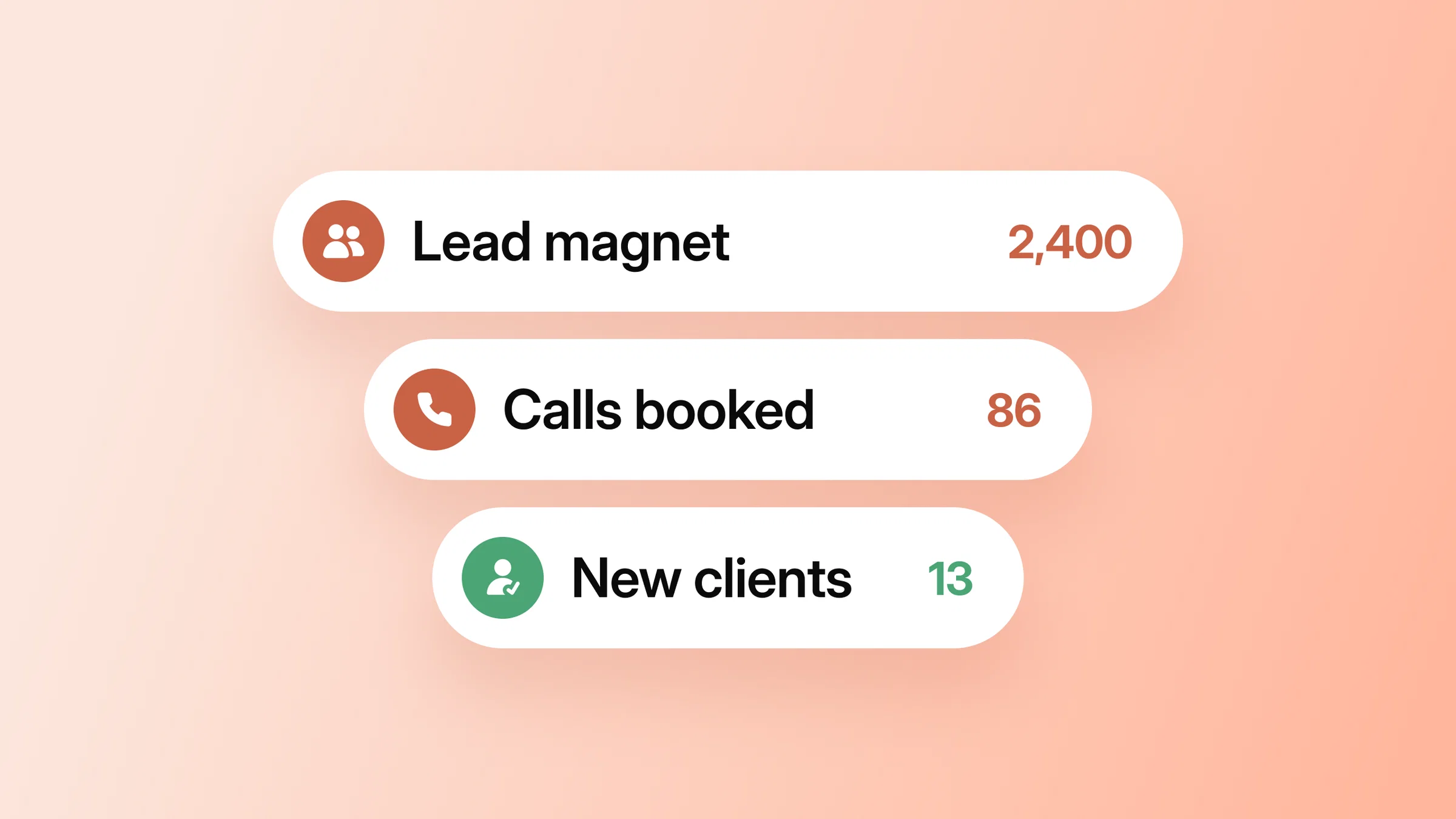
His real business, Agent on Tube Academy, charges real estate agents $10K+ to teach them how to use YouTube specifically to build local authority and generate home-buyer and seller leads. It runs inside a community he owns, where prospective students watch client wins and book calls already convinced. In its first three months on Circle, that community added 200+ members and $60K in new business — a 10x return.
That's the pattern behind the creators who make real money on YouTube: the channel earns the attention, but the durable income comes from what they build off it. This guide walks through how to get there. You'll see what YouTube actually pays in 2026 and why, which native features earn the most, how sponsorships and affiliates fit alongside ad revenue, and how the creators making the most durable income convert their viewers into members who pay them directly.
What people are actually doing on YouTube
YouTube is the world’s second largest search engine that people go to when they need to know how to do something. On any given day, tens of millions of people log in not to be entertained but to learn something specific: how to fix a dishwasher, price a service, cook a recipe from a country they've never visited, or study for a certification exam. Alongside that, whole categories of content pull people in for pure enjoyment (music, gaming, comedy, sports commentary, storytelling) and other categories exist somewhere in between (fitness, personal finance, tech reviews, business podcasts).
The creators behind all of that content roughly fall into a few recognizable buckets: educators and coaches teaching a skill, experts and reviewers walking through products and industries in depth, storytellers and vloggers building audiences around personality and narrative, independent journalists covering a beat the mainstream press doesn't, and makers or hobbyists documenting work they'd be doing anyway. The formats and audiences differ, but the underlying playbook is the same: publish consistently, build trust with a specific group of viewers, and turn that trust into something.
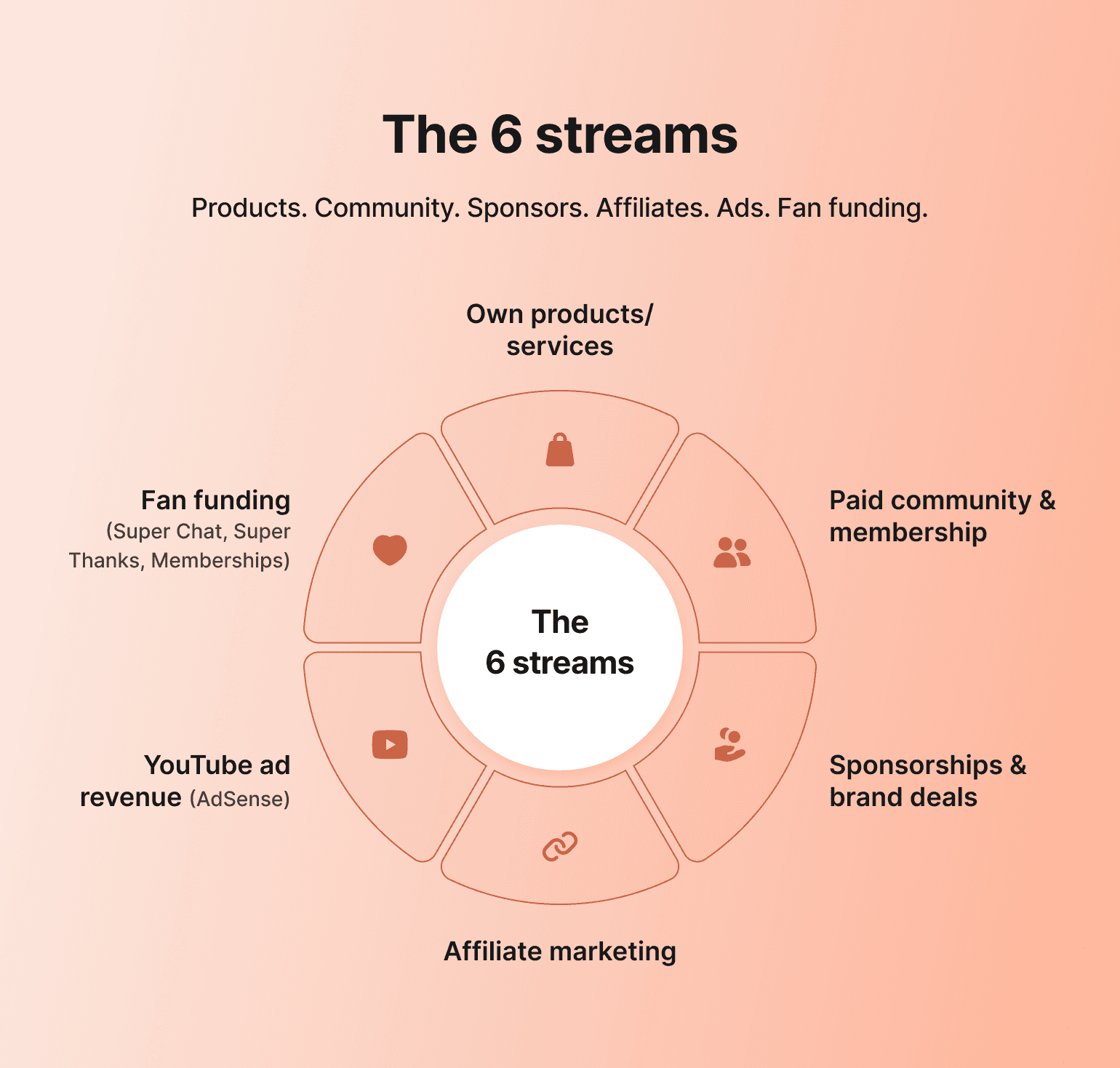
For creators who teach, coach, or share expertise, that "something" is usually a business. Here are the most common ways they turn attention into income:
- Selling your own products or services. Courses, coaching, group programs, and digital downloads that a viewer buys once or works through on their own timeline.
- Paid community and membership access. An ongoing relationship, not a one-time purchase: viewers pay monthly or annually for continued access to you, live sessions, and a private space to learn alongside peers.
- Sponsorships and brand deals. Paid integrations, dedicated videos, and product placements. Works at surprisingly small subscriber counts if your niche converts.
- Affiliate marketing. Tracked links in descriptions that pay a commission when viewers buy. Compounds over time as the back catalog keeps earning.
- YouTube ad revenue (AdSense). YouTube runs ads against your videos automatically and pays you a share of what advertisers spend. It requires no separate product or pitch, but the amount is capped by your niche's RPM and audience geography.
- Fan funding on YouTube. Channel Memberships, Super Chat, and Super Thanks let viewers pay you directly during a livestream or on a video, on top of any ad revenue. Meaningful for creators who go live regularly, more of a supplement than a foundation.
Most creators end up combining several of these at once rather than picking just one. The rest of this guide walks through each stream in more detail, starting with the one YouTube handles for you.
What YouTube actually pays (and why that number won't sit still)
Ad revenue is the one stream YouTube handles for you, so it's worth understanding how it works before you plan around it. When a video plays on YouTube, the ads that run in front of it, in the middle of it, or alongside it are sold through an automated auction. Advertisers bid to reach the specific viewer watching, based on things like the video's topic, the viewer's location and interests, and the time of year. YouTube runs that auction, takes a cut, and pays the rest to the creator whose video hosted the ad.
That model is why two channels of similar size can pull in wildly different paychecks. A channel whose viewers advertisers want to reach (business owners searching for tax software, for example) earns far more per view than one with a broader entertainment audience, even at identical subscriber counts. You're paid for the ads shown against your views, not the views themselves.
Two numbers get quoted when people talk about YouTube earnings, and only one of them tells you what you'll actually make. CPM (cost per mille) is what advertisers pay YouTube for every 1,000 ad views. RPM (revenue per mille) is what you actually take home for every 1,000 video views on your channel, after YouTube keeps its 45% cut and after views without ads are counted in too. RPM is the one that reflects your real earnings.
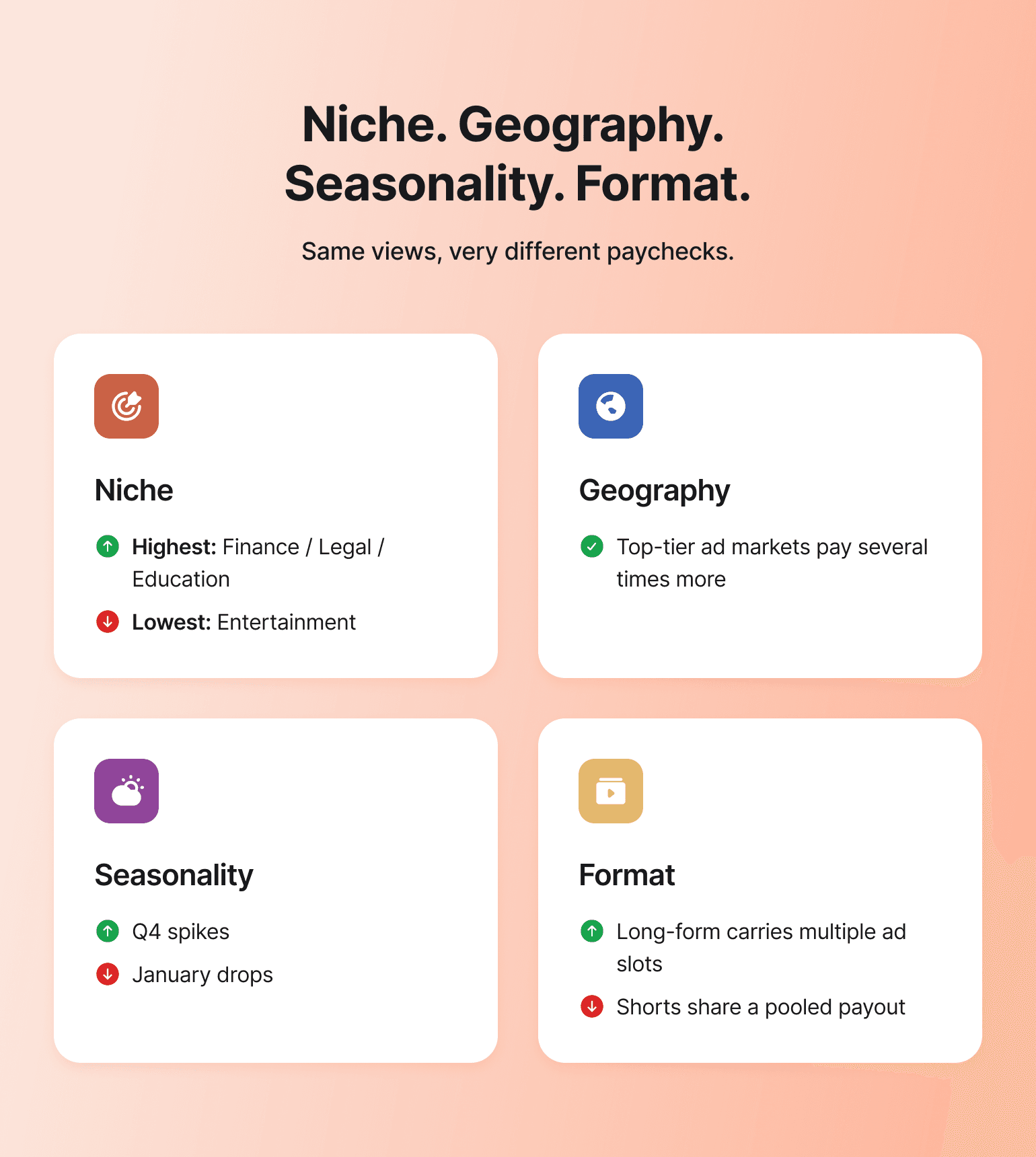
Four factors do most of the work in setting your RPM:
- Niche. RPM varies more by niche than almost anything else — high-intent categories like personal finance and English-language education can reach $10–$22+, while broader entertainment and vlog content often lands closer to $1–$6. For a fuller breakdown of realistic income by niche and channel size, see Circle's YouTube earnings guide.
- Geography. Ad rates vary widely depending on where your audience is watching from, because advertisers pay more to reach viewers in higher-CPM markets. The same channel can earn several times more from an audience in top-tier ad markets than from one in lower-CPM regions, even with identical view counts.
- Seasonality. Q4 ad rates run well above the annual average as holiday budgets pour in, then CPMs drop sharply in early January as advertisers reset budgets for the new year.
- Long-form pays far more than Shorts. Long-form videos earn far more per view than Shorts, because long-form carries multiple ad slots per video while Shorts share revenue from a smaller pooled ad break spread across many creators.
How you can actually get paid via YouTube
YouTube pays you in three different ways, and only one of them is money YouTube itself hands over.
Ad revenue, the Partner Program's fan-funding tools, and Shorts payouts are YouTube's own systems, cutting you in on ad dollars and viewer support directly. Sponsorships and affiliate income work differently: brands and retailers pay you, and YouTube is just the stage the deal happens on.
Knowing which bucket a stream falls into tells you how much control you actually have over it — and sets up the real question you may be wondering: how much of your income should depend on YouTube staying exactly as it is today?
The YouTube Partner Program: how you unlock monetization
Before YouTube pays you anything through its own tools, you need to be in the YouTube Partner Program (YPP). It's YouTube's official monetization program, and in 2026 it has two eligibility tiers:
- First tier: 500 subscribers, with three uploads in the last 90 days and either 3,000 watch hours or 3 million Shorts views. Getting in gives you access to fan-funding features: Channel Memberships, Super Chat, Super Thanks, and YouTube Shopping. Ad revenue isn't included yet.
- Second tier: 1,000 subscribers, plus either 4,000 valid public watch hours in 12 months or 10 million Shorts views in 90 days. Cross that line and you unlock ad revenue sharing: 55% of long-form ad revenue, a cut of YouTube Premium revenue, and 45% of Shorts Feed ad revenue.
Most creators aim straight for the second tier, since that's where ad revenue actually kicks in.
And YouTube keeps tightening this rule: it renamed "repetitious content" to "inauthentic content" in July 2025, then renamed it again to "Generic or Repetitive Content" in July 2026, adding new categories for low-effort and sensitive-topic AI content. The core rule hasn't moved: templated videos with little variation between uploads don't qualify. Real commentary and disclosed synthetic content are still fine.
Live streaming and fan support: viewers paying you directly
Once you're in YPP, three features let viewers pay you directly, on top of any ad revenue.
- Super Chat. Viewers pay to highlight their message during your live streams so it stands out in the chat.
- Super Thanks. Viewers tip on any video or Short at four price points between $2 and $50.
- Channel Memberships. Viewers pay a recurring monthly fee to your channel for perks like custom badges, emoji, and members-only content.
You keep 70% of the revenue after taxes and fees, with YouTube covering credit card costs. That's generous by platform standards.
The catch is the same as with ads: fan support depends on your presence on YouTube. If you stop showing up consistently, the income slows fast. It works best as a supplement to a broader revenue stack, not a foundation.
What YouTube Shorts actually pay
Shorts are YouTube's short-form vertical videos, similar to TikTok or Instagram Reels, and they earn very differently from regular videos.
Use Shorts for discovery, not direct income. Payouts typically land in the tens of dollars per million views, compared to thousands of dollars per million for long-form videos in the same niche. You'd need tens of millions of Shorts views a month to clear meaningful ad income.
Here's why they pay less: ad revenue from the Shorts Feed gets pooled monthly by country, split with music rights holders, then divided among creators by their share of eligible views. You keep 45% of your allocated share. Long-form videos, by contrast, carry multiple direct ad slots per video.
The play is to treat Shorts as the invitation. Use Shorts to get discovered, then funnel those viewers to long-form videos, an email list, and eventually a paid community.
Sponsorships and brand deals: paid partnerships with companies
A sponsorship (or brand deal) is when a company pays you to mention their product in a video. It usually shows up as a short segment inside a regular video ("this video is sponsored by…"), a full dedicated video about the product, or a passing mention with an on-screen graphic. The company gets exposure to your audience; you get paid a flat fee for the placement.
You don't need a huge channel to land them. Creators with just a few thousand engaged subscribers get paid integrations, and mid-tier creators typically charge $1,000 to $10,000+ per sponsored video. Dedicated videos from mega creators can exceed $200,000.
Niche moves the numbers more than size does. Finance and business content commands the highest sponsorship rates because those audiences carry more purchasing intent than lifestyle or entertainment audiences, so a finance creator with 10,000 subscribers often out-earns a gaming creator ten times the size.
The downside: sponsorships are still someone else's decision. Brands choose you, and when ad budgets tighten across the industry, your pipeline tightens with them. Great as one stream, risky as your only one.
Affiliate marketing: commissions on products you already recommend
Affiliate marketing is simple: you drop a tracked link (in a video description, pinned comment, or on your site), a viewer clicks and buys, and the seller pays you a commission set by their program. No inventory, no customer support, no product of your own. You can start before you qualify for YPP.
The advantage over ads is that affiliate revenue compounds. A tutorial from two years ago is still searchable, still getting views, and still generating clicks and commissions in the background. Every new video adds another earning asset while your entire back catalog keeps paying. Ad revenue demands constant new uploads and algorithmic luck; affiliate income builds on its own.
There's a secondary benefit that matters if you're pre-YPP: affiliate sales prove your audience will buy on your recommendation. That signal is worth more than the commissions themselves. It tells you which products, price points, and pitches resonate, which is exactly what you need to know before you launch anything of your own.
The stream you own: turning viewers into paying members
RealPars started as a YouTube side project teaching industrial automation and grew to 1.2 million subscribers. Founder Shahpour Shapournia didn't stop there: RealPars moved onto Circle, taking 1,200+ members and 130+ courses with it, and now serves 100+ enterprise clients including PepsiCo and Pfizer. That's the difference between every stream above and this one. YouTube decides your RPM, brands decide whether to sponsor you, affiliate programs set the commission. A paid community is different. You own the audience, set the price, and keep the relationship even if your channel disappears tomorrow.
A paid community is a private, subscription-based space where your most engaged viewers pay for deeper access to you and to each other. That usually means some combination of exclusive content, live sessions, courses, coaching, or peer discussion, all in one place. Members typically pay monthly or annually, which gives you predictable recurring income instead of chasing the next launch or algorithm shift.
The reason this matters for creators: a few hundred members paying $30 to $50 a month can out-earn a channel with a million subscribers running on ads alone. And unlike YouTube revenue, that income doesn't drop when you take a week off or when Google changes its policies.
RealPars isn't alone in making that shift. Anna Tyrie ran five YouTube channels teaching English (over 1.1 million subscribers combined) and wanted a way to turn viewers into paying students. Her English Like A Native community, built on Circle, now runs more than 650 events, 1,000 members, and 2,700 posts, with new students auto-onboarded into Spaces based on their language level.
The pattern in both cases is the same: the YouTube audience was already there. What changed was where the relationship lived.

Your audience already exists.
How the mix shifts as you grow
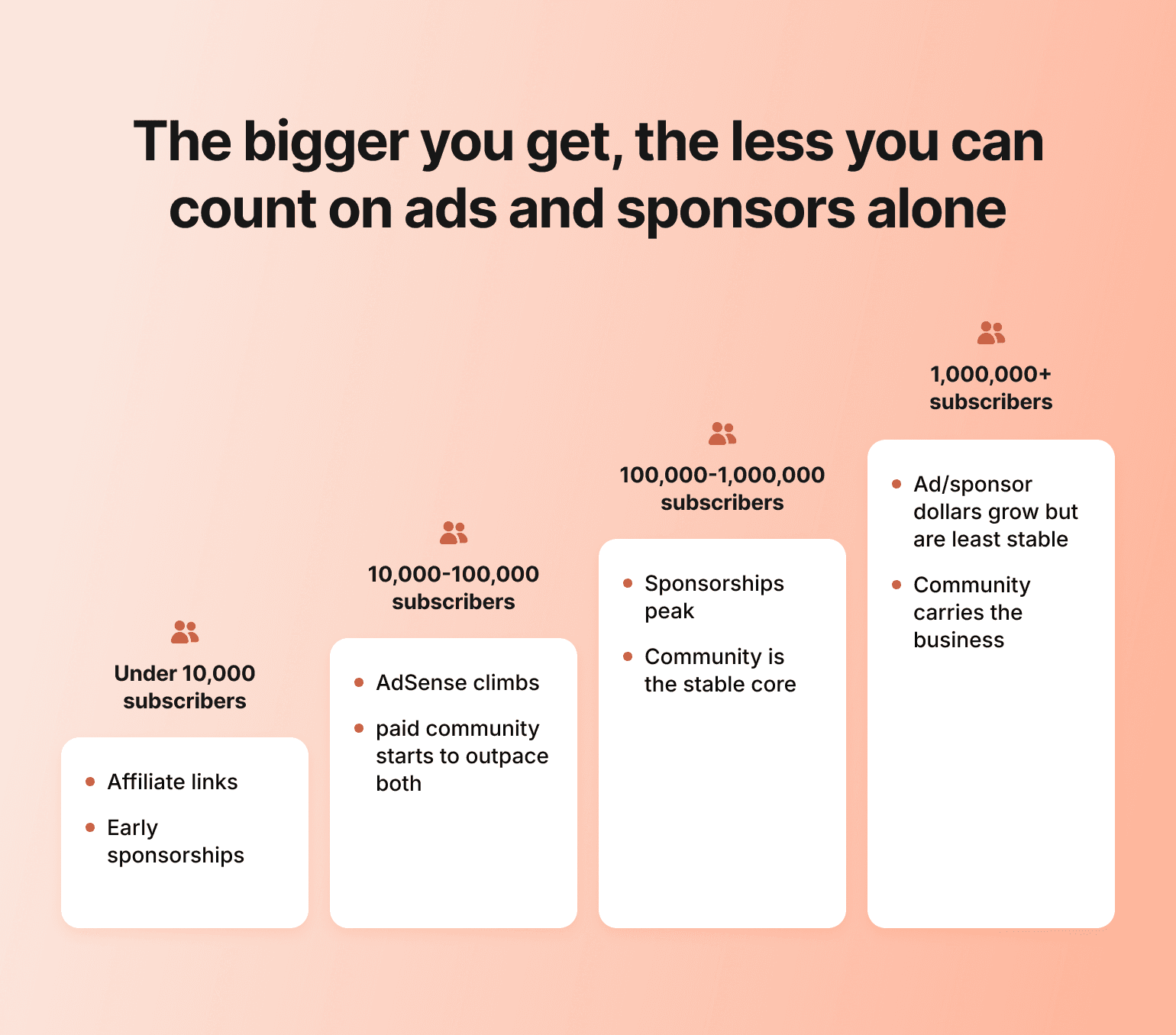
No single stream carries a creator all the way. Durable income comes from stacking multiple income streams, and the mix changes as your channel grows.
- Under 10,000 subscribers. Affiliate links and early sponsorships carry this stage. Ad revenue technically unlocks at 1,000 subscribers, but at this size the views are too low for it to add up to much. The goal isn't income yet; it's proving which offers your audience will actually click, buy, or join.
- 10,000 to 100,000 subscribers. AdSense starts adding up to something real and sponsorships climb as your average views grow, but this is also where a paid community can already start to outpace both. You don't need six-figure subscriber counts to convert a few hundred people into paying members, and once that happens, recurring membership revenue often overtakes anything ads or brand deals are bringing in.
- 100,000 to 1 million subscribers. Sponsorships peak as a share of income and AdSense becomes meaningful, but the creators building something durable at this size have usually already made community the stable core underneath it.
- More than 1 million subscribers. Sponsorship and ad dollars get bigger in absolute terms, but they're also the least stable part of the mix; brand budgets and algorithm shifts hit hardest here. RealPars, cited above, crossed a million subscribers and kept growing by building the actual business inside an owned community instead of chasing bigger sponsorship checks.
Circle's 2026 Community Trends Report found that 88% of community builders now monetize primarily through memberships, while only 18% still rely on sponsorships.
At every stage, YouTube works best as the marketing channel for a business you actually control. If you want to see what that could look like for your channel, the Community ROI Calculator models what converting a share of your existing social or email audience into paying members is worth.
Bringing it together
YouTube pays you for attention. But attention is rented, and the rent changes without warning: an algorithm update, a sponsor budget cut, a demonetization sweep. Durable income comes from using YouTube for what it's genuinely great at (finding your people) and then moving the relationship somewhere you own.
Circle gives creators one branded place to run that business: courses, community, events, payments, and member relationships in a single platform, instead of a feed that can drop your reach overnight.
Own the business YouTube can't take away.
YouTube monetization FAQ
How many subscribers do you need to make money on YouTube?
You can earn affiliate commissions and sponsorships with no minimum at all. Native fan-funding features become available before ad sharing inside YPP, and ad revenue requires the higher YPP eligibility tier.
How much does YouTube pay per 1,000 views in 2026?
It depends heavily on niche and audience location. Finance and business channels can earn many times more per view than entertainment channels, and US-heavy audiences typically command stronger ad rates than lower-CPM regions.
Do YouTube Shorts make good money?
Shorts usually work better as discovery than as direct income, so use them to grow your audience and funnel viewers to long-form content and owned offers where the revenue is stronger.
What's the most profitable way to monetize a YouTube channel?
For most creators, brand deals are the largest single stream, but a paid community delivers stronger revenue per person and more stability when the audience is a good fit. The best model usually stacks sponsorships, affiliates, owned products, and recurring memberships.
Can you make money on YouTube without ad revenue?
Yes. Affiliate marketing, sponsorships, digital products, coaching, and off-platform memberships all work without YPP membership. Many creators earn more from these than from ads long before they qualify for ad revenue sharing.
Community Content Marketer
Arina is Circle’s community content marketer, sharing insights on community growth, GTM strategy, and storytelling for solopreneurs.