How to build a sales funnel that fits your coaching offer
TL;DR
- The right coaching funnel follows your offer price, audience warmth, and delivery model.
- A community- or DM-first path can qualify prospects through participation and conversation before you ask them to book a call or buy.
- Build the manual version first, measure each handoff, automate the stages that convert, and leave the rest manual.
You've already sold your high-ticket coaching program in your DMs. Someone replied to a post, the conversation got real, they asked how to work with you, and you closed it. The short path works. But when you sit down to plan the next ten clients, you don't reach for the DMs. You reach for an ad, a landing page, a lead magnet, an eight-email sequence, and an automated webinar, because that's what a funnel is supposed to look like. And that shape reroutes your warmest prospects, the ones who were happily buying in the DMs, through infrastructure built for total strangers.
So you go looking for a template. You Google "sales funnel" and hit a wall of noise: tripwires, VSLs, evergreen webinars, value ladders, diagrams with more boxes than you have clients. Plenty of shapes, none of them telling you which one a coaching offer like yours actually needs. This guide is about that decision: how to match the funnel to your price, your audience, and how you deliver, then measure each handoff before you automate anything.
What a coaching sales funnel does
A coaching sales funnel is just the path a stranger travels from first hearing about you to paying you, and then to sticking around. It runs through the same key stages: awareness, engagement, consideration, decision, delivery, and retention. The one rule that makes it work: every stage points the prospect at a single next action, never a menu of them.
You don't build those stages from scratch. You already own the pieces; the funnel just gives each one a job. Your short-form video handles awareness. Your Thursday workshop is where engagement happens. The opt-in on that workshop page turns a watcher into a lead you can follow up with. The $47 starter offer is the first time money changes hands. If you can't say which of your assets does which job, you don't have a funnel, just a pile of pages. Some coaches skip most of the pages on purpose: community-first coaching leads with live client work and real conversations, and lets that engagement do the qualifying a landing page can't.
Prove the offer before you build the machine
Before you pick a funnel shape, you need an offer you know converts. Not one you think will convert. One that's already produced sales in real conversations, so you know the promise lands, the price holds, and you've already heard every objection. Everything downstream (the pages, the emails, the ads) is just amplifying what's already working. If it isn't working yet, you're amplifying a problem.
The four things live sales conversations give you
Real sales conversations aren't just a way to make money before the funnel exists. They're the research phase. Every time you get on a call or trade DMs with a prospect, you're gathering the four things you'll need before you build any pages or automation:
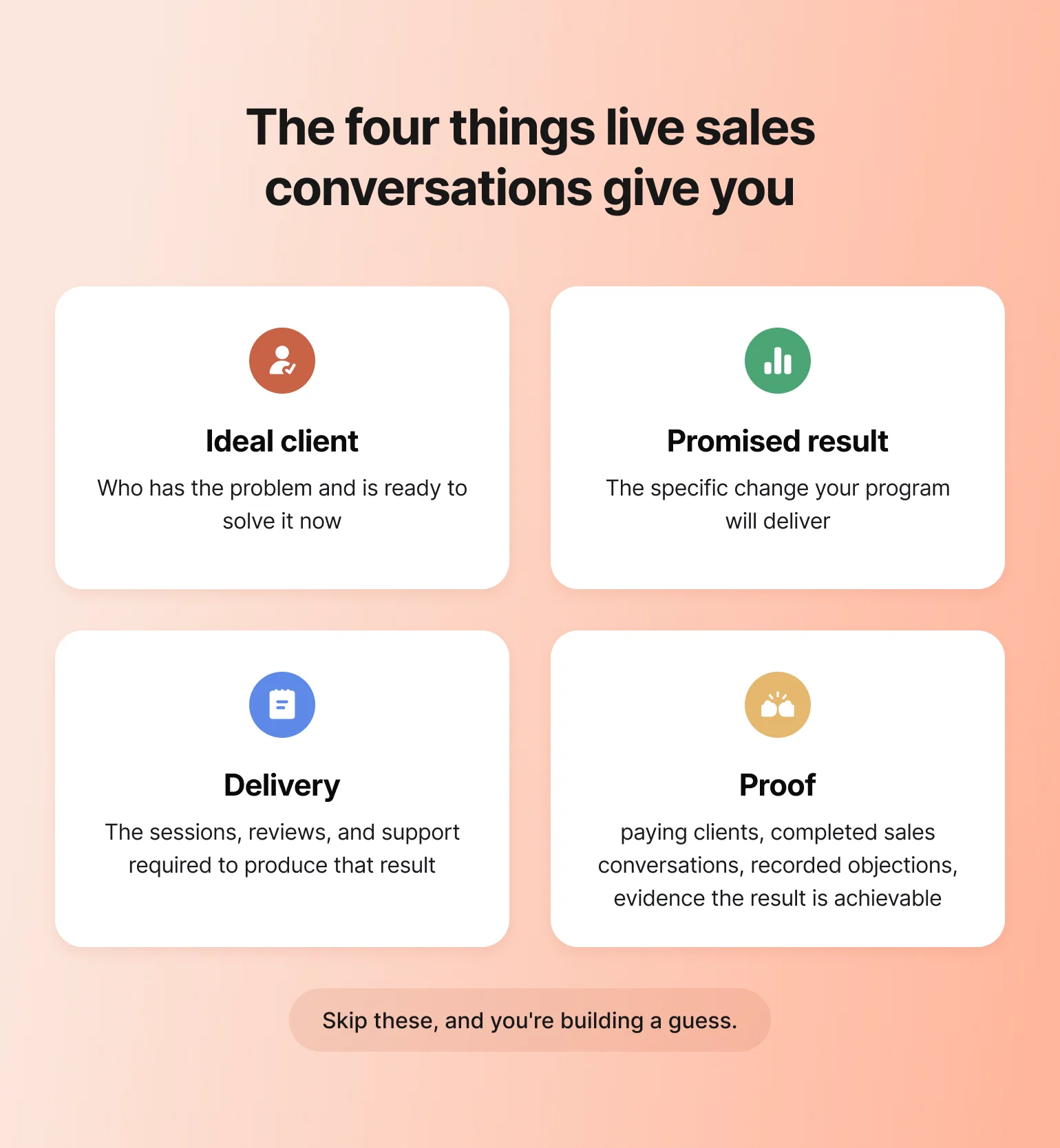
- Ideal client: who has the problem and is ready to solve it now.
- Promised result: the specific change your program will deliver.
- Delivery: the sessions, reviews, and support required to produce that result.
- Proof: paying clients, completed sales conversations, recorded objections, and evidence the promised result is achievable.
Without those four, anything you build downstream is a guess dressed up as a plan.
Make your first ten sales the manual way
A good rule of thumb: make your first ten sales the manual way (DMs, calls, referrals) before you build the automated version. Ten is enough to hear the same objection more than once, see which promise actually pulls buyers in, and know which parts of your delivery clients care about. It's the same rule at every level: prove something works by hand before you automate it, never the other way around.
Let those conversations pick your lead magnet
Those same conversations also tell you what to give away for free. If "I don't know where my leads disappear" keeps coming up, build the specific thing that answers it, a quick funnel-leak scorecard, not a broad "grow your business" guide. The free thing works when it names a problem the buyer has already told you they have.
What this looks like in practice
Tom Ross is a good example of this sequence. He had a full-time CEO role and a first child on the way, along with a rule that his side project had to pay for itself or stop, so he couldn't afford to guess. He collected just under 400 Google Form responses before he built a single space, using them to confirm the offer and the audience were real. Then he built the whole community over a weekend and launched through a waitlist email and a virtual launch party. Learn.Community grew to an estimated 200 members at $49/month — a $50K membership side hustle. Demand first, then the minimum infrastructure that demand justified. Our community launch guide walks through planning that minimum launch sequence.
Choose the funnel that matches how trust forms
Now that you've got an offer you know converts, the next question is what path to build around it. And the answer depends on one thing: how your buyers get ready to say yes.
Different buyers need different things before they'll hand over money. Some need a one-on-one diagnosis of their specific situation. Others need to learn one thing before your offer makes sense, and it's the same lesson for everyone in their position. Others build trust by hanging around, watching how you show up, and seeing other members get results before they buy. Each of those readiness patterns points to a different funnel shape, and picking the wrong one means adding steps your buyer doesn't need (which slows them down and costs you money) or skipping steps they do need (which loses the sale).
Every stage in your funnel should be resolving one of those readiness gaps. If a stage isn't, cut it.
The three funnels to choose from
That readiness pattern points you to one of three funnel shapes. Here's how they line up:
| Funnel type | Best-fit offer level | Audience warmth | Primary traffic source | Operational load |
|---|---|---|---|---|
| Appointment funnel | High-ticket coaching | Warm or referred | DMs, referrals, organic content | High per prospect |
| Webinar funnel | $997 to $5,000 programs | Warm or cold with repeated teaching | Email, content, or paid traffic | High during validation; lower after proof |
| Community-first funnel | $47 to $5,000 offers | Warm through participation | Community content, DMs, workshops | Moderate and relationship-led |
Appointment funnel
An appointment funnel is built to do one thing: get a warm prospect to book a call with you. Its front end is simply your existing work: someone who's followed your content, or been referred by someone who has, arrives already warm. From there it's just an application and a call, where you decide together whether they're a fit. The trust was built before they ever raised their hand, so there's nothing to nurture in between. It's the shortest path to a high-ticket sale.
How it works: it relies on trust that already exists. The application does the qualification the funnel would otherwise do across five emails, and the call does the persuasion a sales page would otherwise do across three scrolls. That's why it only works with warm or referred prospects. Cold traffic doesn't know you well enough to fill out a serious application, and a call with a cold prospect turns into a pitch instead of a diagnosis.
How to build it:
- Pick your trusted source of prospects. Content that gets shared in your niche, a podcast you host or guest on regularly, a referral partnership, or your own DMs. If you can't name where the applications will come from, the rest of the funnel doesn't matter.
- Write an application that filters on four things. Ask what problem the prospect wants solved in the next 12 weeks, why now rather than next year, whether the stated investment is money they actually have, and how many hours a week they can put against implementation. If any answer is weak, the call won't fix it.
- Book the call only with prospects who pass all four. Everyone else gets a polite decline or a lower-ticket alternative. Protecting your calendar is the whole point.
- Run the call in a set order. Diagnose the gap, confirm the fit you already spotted from the application, explain what the program delivers and how, then decide together. If you're doing more than half the talking, the diagnosis half didn't happen.
- Enroll and onboard immediately. The gap between "yes" and "started" is where high-ticket sales go cold.
The same application discipline is what separates browsers from buyers in six-figure memberships.
Webinar funnel
This funnel is built around one live or on-demand teaching session that shifts a prospect's belief before you ask them to buy. They register, they show up, they watch you teach, and at the end you make an offer. Everything before the webinar is designed to get them in the room. Everything after is designed to close the ones who didn't buy on the spot.
Amy Porterfield runs the best-known version of this. Her signature webinar framework is almost boringly simple: grow the email list for a few weeks before a launch, drive everyone to a live webinar with email and ads, teach one thing, make the offer, then follow up by email. She's run that same shape across launch after launch for years. The webinar isn't a gimmick in her model; it's the one place she can move a belief at scale before she asks for the sale.
How it works: the webinar earns its place when one belief stands between your prospects and your offer, and they all share it. A financial coach whose prospects don't believe they can save on their income, for example, has to shift that belief before the offer will land. If most of your prospects are already sold on the "why" and just need the "how," a webinar is a step you don't need.
How to build it:
- Name the one belief you have to change. Write it in a single sentence before you build anything. If you can't, you're planning a class, not a sales webinar.
- Put the outcome in the registration headline. Name a specific result and cut the thing the buyer dreads doing to get it. "How to book five clients a month without cold outreach" pulls far more registrations than "Join my webinar on client acquisition," because it promises the win and answers the objection in one line.
- Build the reminder sequence. Show-up rate is the biggest lever you have. Send a confirmation, a day-before reminder, a morning-of reminder, and a "we're live" nudge, plus SMS if people opt in.
- Teach it live for the first few runs. You can't see where attendees drop off until you've watched it happen in real time. Once the live version reliably converts, turn it into an evergreen, automated one.
- End with an application or a checkout. Higher-ticket offers send people to an application; lower-ticket offers go straight to checkout.
- Split the follow-up by what people did. Attendees who didn't buy get one message, no-show registrants get another, and buyers get pulled out of the sales sequence entirely.
Teaching live first pays off because an evergreen webinar hides more drop-off points than you'd expect. Dr. Destini Copp, a digital product strategist who runs several evergreen funnels of her own, maps the handoffs: a registration page, a thank-you page, the on-demand session itself, and a replay page. Each is a spot where an attendee can quietly disappear, and you only learn where by watching a live run before you automate.
Community-first funnel
A funnel where the community itself does most of the qualifying. Instead of pushing every prospect toward a call or a webinar, you invite them into a space where they can see how you show up, hang out with other members, and watch other people get results. The ones who are ready then raise their hand for the paid offer.
How it works: buyers self-select. Watching a client win described in a peer's post is more convincing than reading it on a sales page, because they trust the peer. Watching you answer a question in a thread is more convincing than a video ad, because they see the thinking, not the polish. By the time they book the call or hit the checkout, most of the persuasion has already happened. This is the funnel that fits when your offers span a low-cost membership through higher-priced coaching, and when you have the time to be present in the space.
Community Tip: The persuasion here runs on prospects watching you think in the threads, which only happens when you're actually in there. A member-facing AI Agent trained on your past answers keeps it going when you're not: it fields the repeat questions in your voice, so someone reading at midnight gets a real answer instead of silence. It extends your presence in the space, but it doesn't close anyone. That stays your conversation. AI Agents are available on Circle Plus.
How to build it:
- Set up the path. Social content or referral → DM conversation → free community, workshop, or challenge → visible participation → paid membership or application → coaching. Each step exists to make the next one feel obvious.
- Reply to the exact problem they named. Then invite them to one thing: "You mentioned referrals have plateaued. Thursday's workshop maps the first three acquisition leaks." If they take you up on it, that's your signal they're ready for the paid next step.
- Watch who actually participates. Someone who posts twice, replies to a few others, and shows up to a workshop is signaling they're ready. Reach out to them personally.
- Make the paid offer its own post. A "learn more" link buried in a thread won't convert. A dedicated post that names the offer, the outcome, and who it's for will.
- Close by hand. The community does the warming; a personal DM or a short call does the closing. Don't automate that last step.
Sabby Bagga sells a $10K+ service to real estate agents, and his sales calls used to open with him proving he was worth listening to. He launched a Circle community where prospects could watch client wins and hear from existing members before booking. Within three months it added more than 200 members and generated $60K in new business, a 10x ROI. Prospects started arriving at calls convinced, so the calls could open on diagnosis.
Tip: Automate the mechanical half of this handoff: a Workflow triggers the member onboarding email when someone joins or subscribes to a paywall, adds tags, and fires a re-engagement message when a member goes quiet. The welcome DM stays a manual step, and whether a conversation shows genuine fit stays your call. Standard Workflows need Business or higher. Circle Plus includes Email Hub, which uses contact-based pricing.

Watch readiness happen.
Build the offer ladder around the delivered transformation
Once you've chosen how trust forms, you need something for buyers to actually buy at each level of readiness. This is the offer ladder: a set of paid rungs that each deliver a different amount of support at a different price, so someone who's not ready for the $5,000 program has somewhere to go, and someone who's already gotten value from a $47 workshop has an obvious next step.
What a coaching offer ladder looks like
The common value-ladder model starts with a free or low-cost entry point and ascends through higher-value offers. For coaching, ascend according to the support each client needs, not the number of modules. Behind a $5,000 program, that might look like:
| Price | Offer | What it delivers |
|---|---|---|
| Free | Scorecard | Shows a prospect exactly where their funnel is leaking. |
| $47 | 90-minute workshop | Walks through one acquisition path they can copy. |
| $997 | Four-week group program | Fixed cohort dates, weekly calls, and feedback between sessions. |
| $5,000 | 12-week 1:1 program | Weekly sessions and reviews, for clients who need individual diagnosis and accountability. |
| $49/month | Alumni membership | Monthly reviews and fresh experiments — the reason graduates keep paying. |
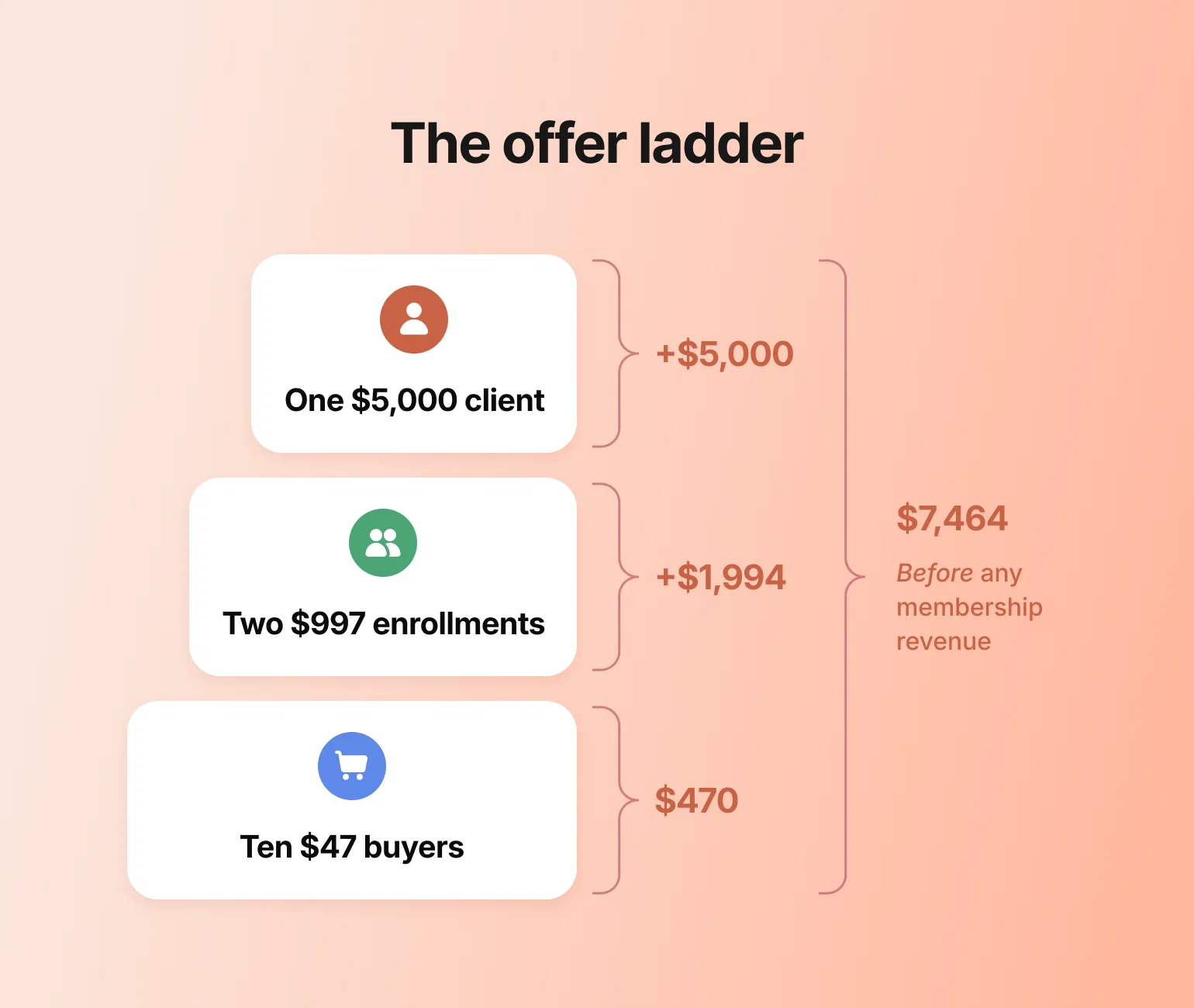
Ten buyers at $47 is $470, two group enrollments add $1,994, and one coaching client brings the path to $7,464 before any membership revenue.
Let the delivery write the copy
Each rung's sales page should lead with what it concretely delivers, because that's what the buyer is actually deciding on. Put the tangible thing up front:
- $997 group program: lead with the cohort dates and the weekly call schedule. Fixed dates are what the buyer is committing their calendar to, so they belong at the top of the page.
- $49/month membership: name next month's actual programming, the review, the experiment, the new benchmark. That upcoming work is the reason someone renews, so make it visible.
- $5,000 1:1: ask on the application how many hours a week they can put toward implementation. That capacity makes or breaks the result, so get it answered before the call, not on it.
If you can't describe what happens in the first week of a rung, its sales page can't either.
The rung most coaches skip
Most coaching funnels stop at the $5,000 sale and call it a win. But a one-time sale is a one-time sale, and the client who just paid you $5,000 is the single most likely person to pay you again if you give them a reason. That reason is the alumni membership: not "stay in touch" pricing, but real monthly programming (a review, an experiment, a new benchmark) that keeps them getting results after the intensive ends. Retention starts the moment the sale closes.
Tip: Give each rung its own paywall: one-time checkout for the workshop, installments for the 1:1 program, a subscription with a trial for the membership. Professional and higher plans include paywalls. The installment option in particular can make a high-ticket rung more accessible to a buyer managing cash flow.
Measure the handoffs before you automate them
You now have an offer, a funnel shape, and a ladder. What you don't yet have is any idea which parts are working. That's what measurement is for, and it has to happen before you touch automation, because automating a broken handoff just breaks it faster.
The four handoffs to track
Once the ladder is live, track four handoffs: opt-in, application or registration, call to client, and retention. Find the earliest material drop and fix that one. Fixing later handoffs first is like patching a leaky roof from the top down: the water still finds the same hole.
Tip: For the handoffs that happen inside your community, you don't have to build a dashboard to find the leak. Ask Circle AI a plain question, like which space or event is losing members, or where new members go quiet, and it pulls the answer from your community data. It confirms with you before it changes anything, so spotting the break is the automated part and deciding the fix stays yours.
Landing-page opt-ins and webinar attendance vary with traffic source, audience warmth, timing, and the promise, so external benchmarks won't tell you much. Use your own baseline. On retention, published churn benchmarks put a healthy monthly band at 4.9% to 7.4%, where roughly 5% is excellent and 10% is average. If your churn is above that band, you have a retention problem no amount of new signups will fix.
Fix the first broken handoff, not the traffic
When a funnel underperforms, the instinct is to buy more clicks. But more traffic through a broken setup just makes everything more expensive: costs climb, stress climbs, and results stay flat. The move that actually works is to find the earliest place people are dropping out and fix that.
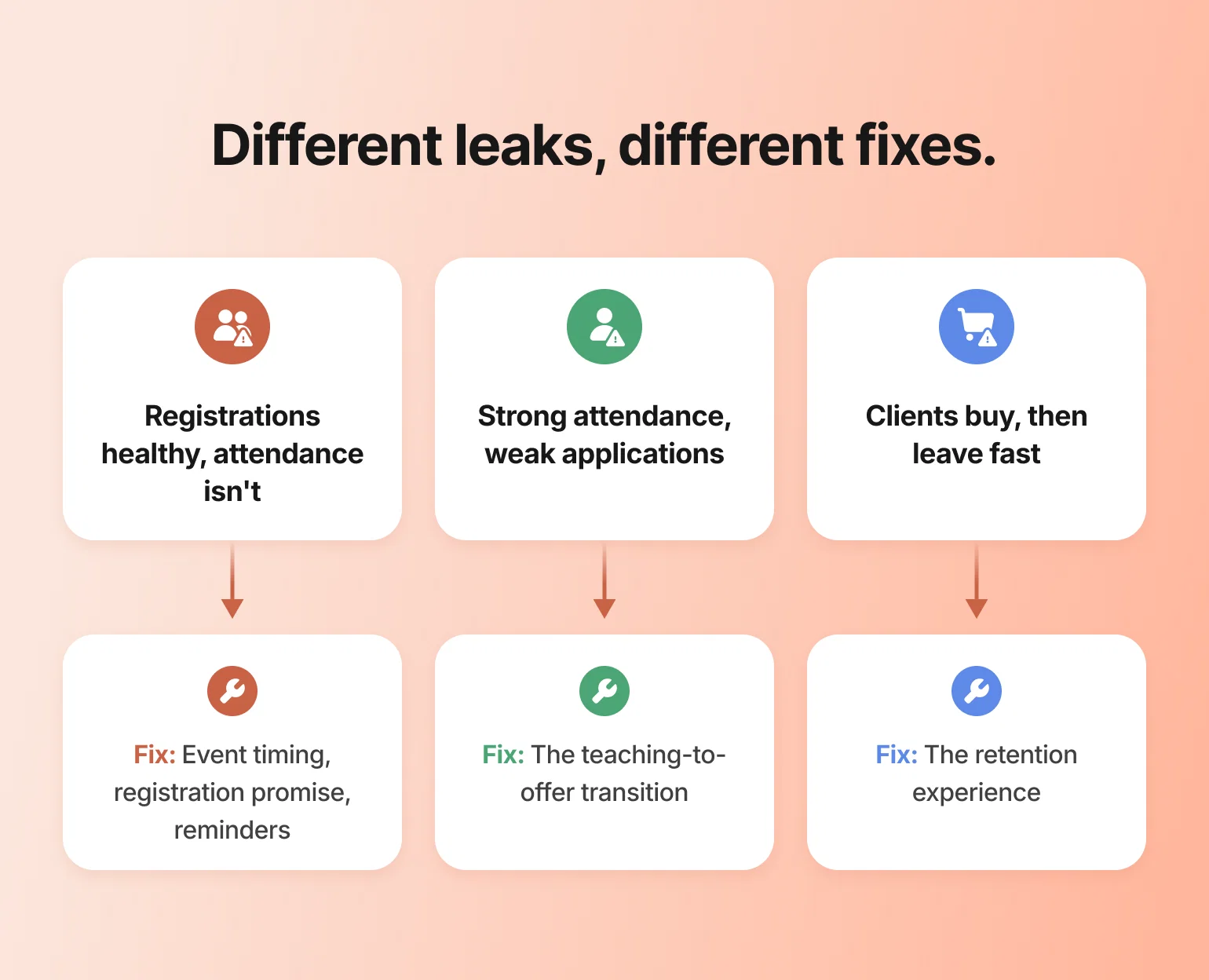
Take the webinar funnel as the example. Each drop-off points to a different fix:
- If registrations look healthy but attendance does not, work on event timing, the registration page's promise, and the reminders.
- Strong attendance with weak applications points at the teaching-to-offer transition instead.
- If clients buy but leave the membership fast, you've acquired them, but the retention experience needs work.
Delivered results become the proof that feeds the offer flywheel.
Automate the mechanical, keep the human
Automation is for the mechanical work: a paywall subscription that fires the onboarding email and adds the tag every time, without you ever opening the tab. The diagnosis and fit calls stay yours.
Why the stack matters here
You can only measure the handoffs if your tools are connected. Spread this funnel across a separate website builder, community tool, email platform, payment processor, course platform, and CRM, and you're reconciling six sets of data before you can see whether one handoff converted. Keep it in one system and the whole funnel is visible in one place, which is the difference between fixing the right drop-off and guessing.
Build a funnel you can actually see
The funnel you build this year isn't the one you'll run next year. Rungs get tuned as you hear new objections, handoffs shift as your audience changes, and today's automations become next quarter's rewrites. The coaches who compound aren't the ones with the fanciest funnels; they're the ones who kept their warmest prospects on the short path, measured everything they could, and only automated what had already earned it. All of that depends on seeing your whole funnel in one place instead of stitching it together across six tools, and that's what Circle is built to give you.
Fix what you can see.
Sales funnel coaching FAQ
Do I need a sales funnel for my coaching business?
Every coach needs a repeatable path from attention to enrollment. Content to DM to call provides that path when each step has one purpose and one next action, with paid ads and automation added when they fit the offer.
What is a sales funnel for coaches?
A sales funnel for coaches is a connected system that links acquisition, trust-building, conversion, delivery, retention, and the next offer. Checkout connects conversion to delivery and retention. You should be able to name each handoff and see where people stop.
Do sales funnels really work?
Yes, when they formalize a path that already converts in real conversations. A funnel doesn't create demand; it repeats a sale you've made by hand. The ones that work have handoffs you can see, so you know which stage to fix instead of guessing.
Am I ready to build a high-ticket coaching funnel?
A good sign you're ready: you've closed the offer live enough times that you can predict a prospect's objection before they raise it, and the sale no longer feels like a custom negotiation each time. If every close still feels bespoke, automating the funnel will only scale the guesswork, so keep selling by hand until the pattern is obvious.
Should I sell 1:1 coaching, group coaching, or a course?
Choose 1:1 when the result requires individual diagnosis, group coaching when clients share an implementation path, and a course when the result is repeatable with less support. Decide delivery first: it determines price, qualification, copy, and funnel type.
Community Content Marketer
Arina is Circle’s community content marketer, sharing insights on community growth, GTM strategy, and storytelling for solopreneurs.