How to get coaching clients: 8 strategies that actually work
TL;DR
- Most coaches don't have a client problem, they have a proof problem: prospects can't see the work before they're asked to pay for it.
- Build it in order: nail the niche, get visible proof, run a warm pipeline, then price the offer so it pays.
- Get this right once and you stop re-selling your credibility at the top of every call, because the proof is already sitting where prospects can read it.
Will deShazo had spent eight years closing high-ticket sales: more than 13,000 discovery calls, over $6M in deals, and his own method, SALTED Selling, built from what worked. That track record is exactly the proof a coaching prospect wants to see before they buy. But when he launched his coaching business, Seasoned Sales, he hit the wall most coaches do: all that proof was sitting in a Google Doc, where no prospect could see it and no one could buy. So, with two daughters under three and almost no sleep, he built the missing piece on Circle in two weeks: a two-page site and a backend coaching community, instead of a stack of separate tools wired together. Once prospects could see it for themselves, the clients came. He closed $15,000 in his first two months, on his way to a $600,000 first-year target.
The lesson: proof only works when a prospect can find it, and building the pipeline that puts it in front of them is the part of any coaching business guide that coach training skips. This guide covers eight strategies for closing that gap, in the order you should actually build them: sharpen the niche, collect proof, run a warm pipeline, then price and package the offer so the pipeline pays.
What is a coaching client?
A coaching client is someone who pays you for a defined transformation over a defined engagement: a package, cohort, or retainer tied to a specific outcome you both name up front. That's what separates a client from a prospect. A podcast listener, a newsletter subscriber, or someone who liked your last post is a prospect, a person still moving toward that decision. A client has agreed to the outcome, the timeline, and the price.
Prospects convert into clients when they can see the outcome clearly, recognize themselves in the person you serve, and watch someone like them get the result before they're asked to pay. The strategies ahead build that path, starting with the outcome itself.
8 clear-cut strategies to find coaching clients
1. Define one specific outcome for one specific client
A niche names a person and the outcome they want. Broad labels like "relationship coach" or "career coach" don't do that; they drop you into a long lineup of people who sound the same. A specific niche does the opposite, naming exactly who you help and what changes for them, like "marketing coach for coaches who want more paying clients."
Write your one-sentence niche in this shape: "I help [specific person] get [specific outcome] in [specific timeframe or context]." A few worked examples:
- Career: "I help mid-career women leave law for in-house counsel roles within six months."
- Sales: "I help roofing and solar owners close more high-ticket residential deals."
- Business/marketing: "I help newsletter operators turn their first 1,000 subscribers into a paid community."
- Health: "I help people newly diagnosed with type 2 diabetes stabilize their glucose without giving up the foods they love."
Two tests tell you whether you've gone specific enough. First, the recognition test: can you describe your ideal client in one sentence that makes them think "that's me"? Second, the search test: real prospects type phrases like "leadership coaching for women in tech." If your niche can't be typed as a search, it's still too abstract. If you're stuck, start with finding your niche.
Once the outcome is specific, your next job is collecting proof that it can happen.
2. Coach a few people free in exchange for something specific
When you're starting out, you're stuck in a loop: you need proof to land clients, but that proof comes from clients you don't have yet. A few free clients break it. Make the exchange explicit: a complimentary program in exchange for detailed feedback and a testimonial if they get results. With testimonials from those first clients, you can quickly create the visible proof prospects look for before they buy.
What to ask for, and when
Ask your client for the testimonial while the work is still live. Clients are most energized about the work when they're in the middle of it, not weeks after it's wrapped and they've moved on to the next thing. Don't ask "would you write me a testimonial?" and hope for prose. Send four numbered questions they can answer in a Loom or a short email:
- "Where were you before we started, in one sentence?"
- "What's changed since, with a specific number or milestone if you have one?"
- "What almost stopped you from saying yes?"
- "Who would you tell to work with me?"
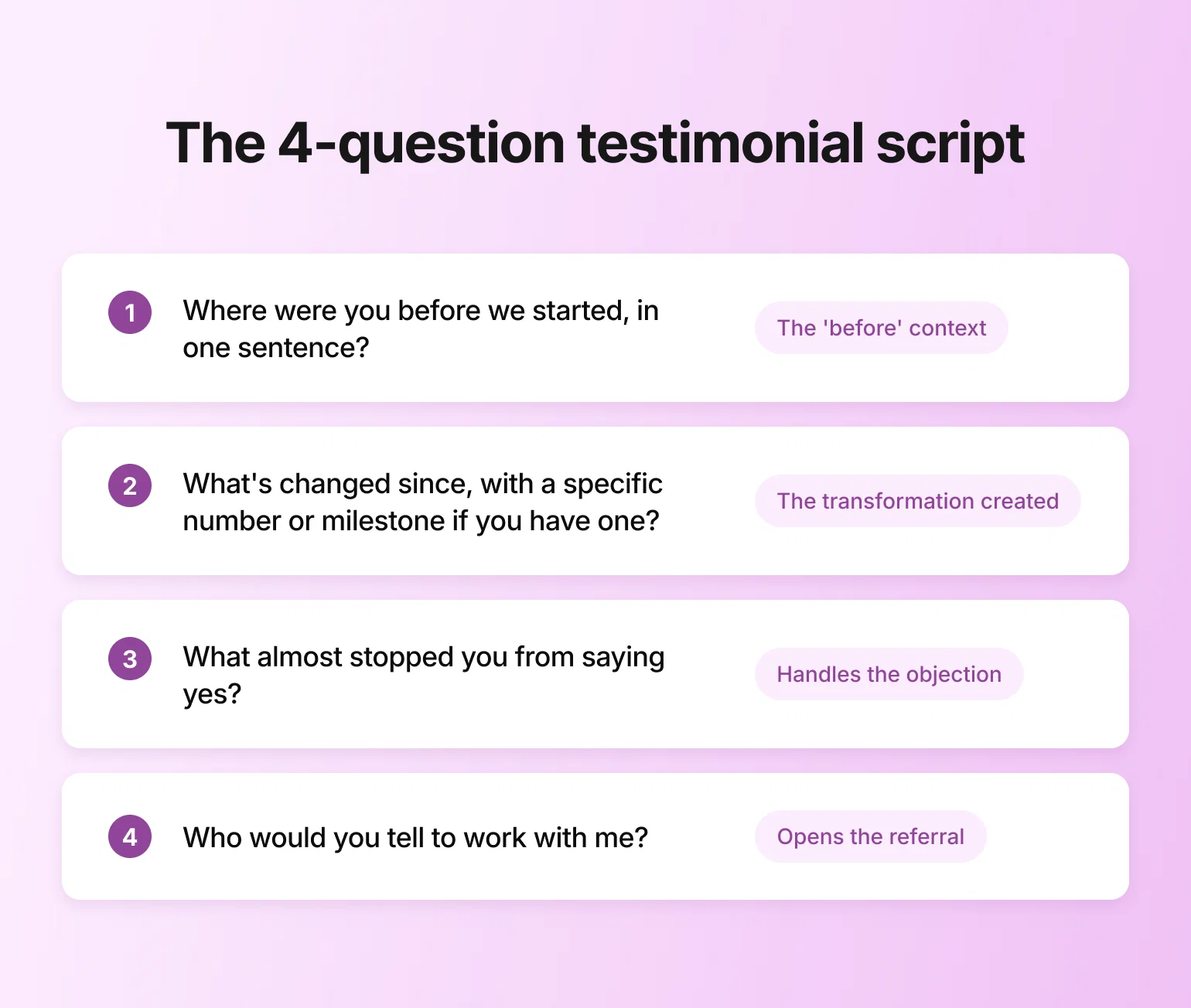
Question 3 handles the objection your next prospect is holding. Question 4 opens the referral, which is where the magic happens. A study of roughly 10,000 bank customers found referred customers carry at least 16% higher lifetime value, and later referral research found they refer 30% to 57% more new customers themselves. Yet even satisfied clients may not refer unless you ask.
Tip: Put the terms in a written coaching agreement, even for pro bono work; name the deliverable (testimonial + permission to publish outcomes as a case study) so the exchange is explicit.
3. Use a community so prospects experience your coaching before they buy
Most coaches think of community as a marketing channel. It isn't, or at least not primarily. The real reason to build one is that community makes the coaching itself work better. It gives members more access to you between calls, and it gives you a place to get to know them, to see where each one is stuck and coach the real problem instead of guessing at it. It also means you're not the only source of answers: members hold each other accountable, field each other's tactical questions, and share wins that show newer members what's possible. All of that makes the coaching stick, and clients who finish, stay, and get results are the ones who renew and refer.
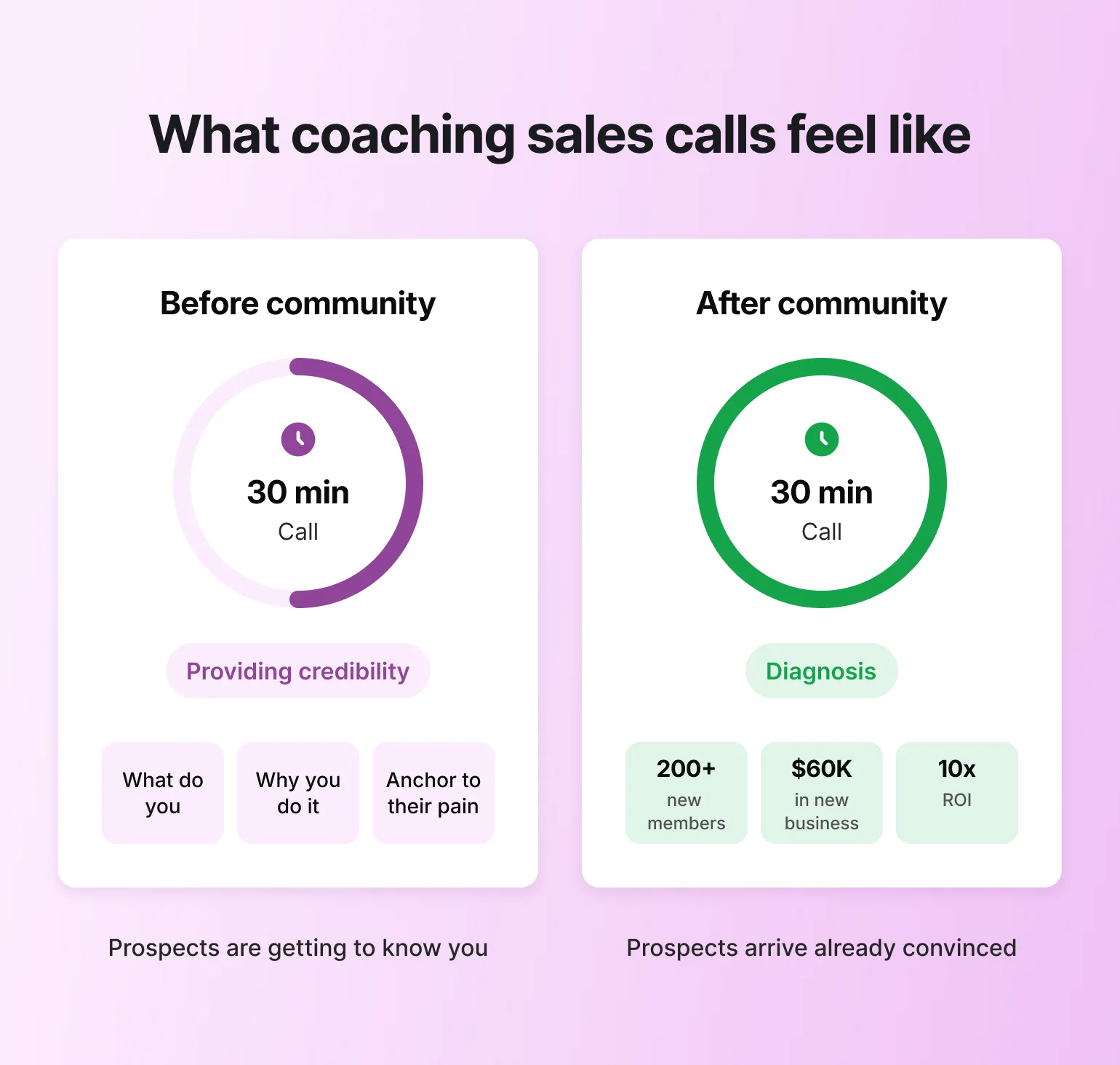
The marketing benefit is downstream of that. Once members are getting real results in a shared space, those wins become the social proof that shortens your next sales call. Prospects arrive warm because they've already watched people like them succeed.
Sabby Bagga saw this play out in his own funnel. He was losing the first half of every sales call to proving credibility. His Agent on Tube Academy teaches real estate agents to use YouTube to generate warm leads, and the offer costs more than $10,000, a price prospects wouldn't commit to on a cold call. So he launched a Circle community where prospects could see client wins and hear from existing members before ever booking a call. Three months in: more than 200 new members, $60K in new business, a 10x ROI. Calls no longer start from zero credibility; prospects arrive already convinced.
Tip: You don't have to design the setup yourself. With Circle Eclipse, you describe the community you want, and it builds the structure with your approval. Tell it something like: "Set up a free Wins Space where prospects can see client outcomes, a gated coaching Space behind a paywall, and a welcome DM the moment someone joins the free Space." It proposes the spaces, access groups, and paywall configuration on a live canvas, and nothing gets created until you approve it. What used to take a weekend of clicking through settings now takes a conversation.

Describe it. Circle builds it.
For the broader foundation, our Launch your community guide walks through the community-led acquisition model, and the membership funnel strategy guide maps the free-to-paid path in detail.
Once the path exists, content gives new prospects a reason to enter it.
4. Create content using your ideal client's own words
Steal the phrasing your clients already use. Voice-of-customer research works because the strongest copy reuses what customers already say. The raw material is everywhere. Amazon reviews of the books your ideal client reads, niche forum threads, your own discovery-call transcripts, and unprompted feedback comments all capture the exact phrasing prospects use to describe their problem, and that phrasing becomes your headlines and email subject lines.
A worked example. A career coach reads through Amazon reviews of a popular career-change book and keeps seeing the same line: "I'm good at my job, but I dread every Sunday night." That becomes the headline: "For the person who's good at their job but dreads every Sunday night." Next to the generic "Career coaching for professionals in transition," the difference is entirely in whose words you used.
Community Tip: If you run Circle's AI Agents to answer member questions, open the AI Inbox and read those conversations. The phrasing members use when they ask something is the phrasing that belongs in your next post titles and subject lines.
Then publish on one channel, consistently. Running two very different channels at once can spread your effort too thin. Pick one and experiment until you can build a process around it so the strategy becomes a growth engine. Once a channel is producing, content repurposing extends the winners without splitting your attention.
When one channel starts working, borrowed audiences help you put that message in front of more of the right people.
5. Get in front of other people's audiences
A borrowed audience is one someone else has already built: a podcast host's listeners, another creator's community, a newsletter's subscriber list. Show up there and you inherit trust you'd otherwise have to earn from scratch. On a podcast it transfers straight from the host, and the effect shows up in the numbers: host-read ads produce roughly a 50% lift in purchase and recommendation intent over non-host-read ones. That finding is about ads rather than guest appearances, so use it only as evidence that host trust can influence listener intent. Guest spots need their own conversion proof. Expertise-led exposure can also help the right listeners recognize challenges they had not yet named.
Pitch podcasts and speaking slots whose audience matches your one-sentence niche. Send the host an episode-fit angle and one client result their listeners will recognize, and offer a guest workshop inside their own community. A pitch that actually gets replied to reads like this:
Subject: Episode idea: why mid-career lawyers stall right before they leave
Hi [Host],
I heard your episode with [prior guest] on [specific point]. I coach mid-career women leaving law, most recently helping [Client] land an in-house counsel role at [Company] after six months. Three angles your listeners haven't heard: [one], [two], [three]. Happy to run a 30-minute workshop for your community after the episode airs.
On air, name one free resource by title (a checklist, a swipe file, a live workshop), then move those listeners onto a list or community you own so the reach doesn't evaporate with the episode.
Those owned leads still need a sales process that qualifies fit instead of forcing persuasion.
6. Use discovery calls to qualify prospects
Use the call to decide whether this is a fit. The discovery call's primary goal is determining whether what the buyer needs matches what you offer. Pitching hard inverts that. Treat the call as mutual qualification. Diagnose the problem and check need and budget before you offer anything. Walk away from a bad fit. Diagnosis also helps the buyer feel understood before you ever make an offer.
Three questions check fit and commitment early:
- "What motivated you to reach out for coaching now?" surfaces urgency.
- "What's the main challenge you're facing right now?" surfaces the problem you'd actually be coaching.
- "What would need to happen in our conversation for you to feel confident moving forward?" surfaces commitment.
Cap the call at 30 minutes. Put a five-field questionnaire on your booking page so obviously poor fits screen themselves out before they see your calendar:
- What outcome are you hoping to achieve in the next 90 days?
- What have you tried that hasn't worked?
- What's your realistic budget range for coaching? (with three tiered options, the lowest at or near your package price)
- When would you want to start?
- How did you hear about me?
Free discovery calls make more sense for paid coaching packages where qualification protects hours you'd otherwise lose.
Once calls are filtering for fit, your package and application step can reinforce that selectivity.
7. Price for the result and add an application step
Value-based fees price your contribution to the results the client achieves. Session pricing does the opposite. Once a client anchors to an hourly session number, they do the math on what each session costs instead of focusing on results. Package the outcome instead. Set the number against pricing examples from comparable programs. A worked starter package: "Land your first three paying coaching clients in 90 days" for $2,400 total or three payments of $850, including six 60-minute 1:1 sessions, direct chat access between calls, and access to the client community and template library.
Make people apply
An application step can make the program feel more selective and help filter poor fits before your discovery call has to.
For a premium network, exclusivity is the value: the moment anyone can walk in, it stops being worth paying for. And a generic first impression undercuts that value further, making the price of admission harder to justify. Gregg Pajak co-founded Whoggga as a relationship-first networking community for business owners, and every applicant clears a multi-step vetting process before joining. Whoggga's vetted membership has a branded app built on Circle Plus, so the room a new member walks into matches what they applied for. Whoggga reports that 90% of members are monthly active, with 177 app hours in a single month and 2x growth through the branded app. A branded app is an expense, and it only earns back when the branded first impression supports the price of admission.
When demand fills your available 1:1 hours, the delivery model has to scale without diluting the result.
8. Switch to group coaching when your 1:1 calendar is full
Your one-on-one income has a hard ceiling: the most clients you can handle times the most you can charge each one. Once you can see that ceiling coming, group coaching is how you grow past it. Build the program before your calendar actually fills, though. Coaches who wait until they're maxed out are usually too slammed to build the backend, so start while you still have room.
How to price group seats
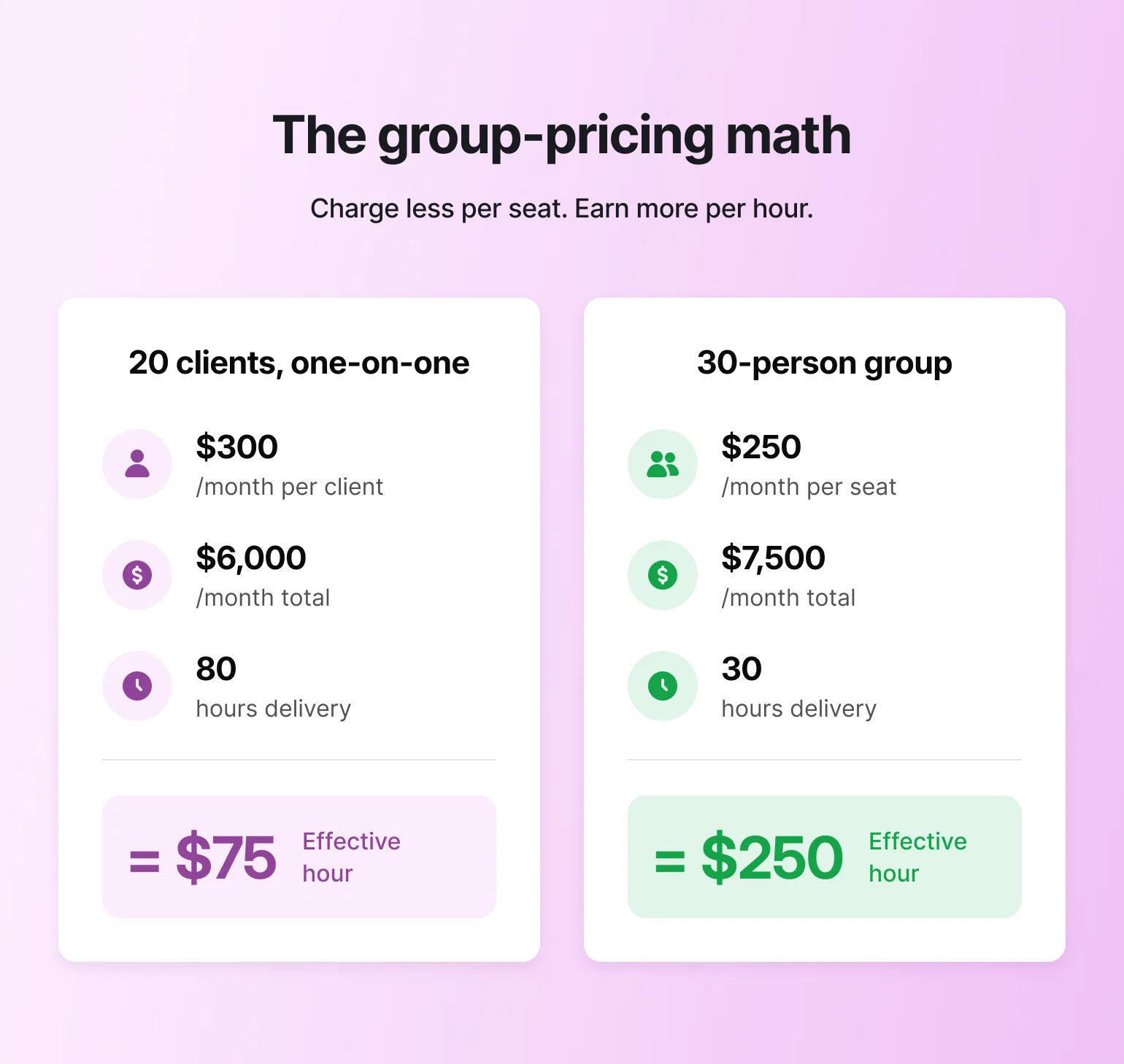
Here's the counterintuitive part of pricing a group: each seat can cost a member less than a 1:1 session and still earn you more per hour. The recurring revenue model shows why. Twenty 1:1 clients at $300 a month brings in $6,000, but it takes about 80 hours of delivery, so you're earning roughly $75 an effective hour. A 30-person group at $250 a month brings in $7,500 for about 30 hours of delivery, closer to $250 an hour. So price each group seat below your 1:1 rate, while still charging for the outcome and the peer value.
A workable cohort shape: a 12-week Structured course inside a dedicated Space, one 60-minute group call a week, one asynchronous hot-seat thread a week, and a live Q&A in weeks 6 and 12. A Structured course drips each new module a set number of days after a member's enrollment date, so people who join late still move through the sequence in order. When you're ready to build one, the group coaching guide covers format, cadence, and pricing.
Sequence these plays instead of trying to launch them all at once.
Start with one strategy at a time
Here's the thread running through all eight strategies: every client you already have is your next client's reason to say yes. Their results become your proof, your referrals, and your best content, so the fastest way to get more coaching clients is often to get better outcomes for the ones in front of you now. That's also why you shouldn't try to run all eight at once. Pick the stage you're actually at. If you're starting from zero, land your first 100 paying members first. Then do one strategy well for a quarter before adding the next. Deliver results people can see, put them where prospects can find them, and the work starts building on itself instead of starting from scratch on every call.
Turn clients into proof.
Getting coaching clients FAQ
How do I get coaching clients with no experience?
Coach a test group free in exchange for detailed feedback and a testimonial if they get results. That puts your proof level closer to competitors who have far longer client lists, and each free client becomes a referral source once you ask.
How long does it take to get your first paying coaching clients?
Timelines vary, and visible proof can compress the path from first conversation to paid client.
How much should I charge for coaching?
Session pricing anchors clients to your time, so package a named outcome over a set period and price the transformation. Value-based fees are priced on your contribution to the client's result.
Do free discovery calls actually work for coaches?
Yes, for paid coaching packages, provided you treat them as qualification. Keep them short, check for fit and commitment early, and use a pre-call questionnaire so mismatched prospects are less likely to reach your calendar.
When should I switch from 1:1 to group coaching?
Once the revenue ceiling described above caps you, group delivery is the next move. Build it while you still have calendar room, since a group needs a course curriculum and a seat price set off your 1:1 rate before the first cohort starts.
Community Content Marketer
Arina is Circle’s community content marketer, sharing insights on community growth, GTM strategy, and storytelling for solopreneurs.