If you’ve ever searched “how much money do YouTubers make,” you’ve probably seen wildly different answers. That’s because YouTube income isn’t a single number—it depends on niche, audience, geography, and how creators monetize beyond the platform.
If you’re toying with the idea of starting a YouTube channel and dreaming of growing it as big as ex-doctor-turned productivity expert Ali Abdaal, keep reading. In this guide, we’ll look at real earnings, common myths, and what sustainable YouTube income actually looks like today.
How much do YouTubers really earn in 2026?
In 2026, most YouTubers will earn some money, but only a minority make a stable full-time income from ads alone. Early-stage channels (under ~20,000 monthly views) often earn $20–$300 a month, growing creators (50,000–150,000 monthly views) earn around $400–$1,500, and established channels (~250,000+ monthly views) can make $2,000–$5,000+.
Consistent $10,000+ monthly incomes usually come from sponsorships, products, or courses, not AdSense alone.
Why averages are misleading (RPM ≠ income)
Averages flatten reality. When people quote YouTube earnings, they’re usually referring to RPM (revenue per 1,000 views), but RPM alone doesn’t translate cleanly into income.
RPM can vary widely based on:
- Niche
- Audience location
- Content format
- Video length
- Seasonality
A creator earning $3–$5 RPM might make a few hundred dollars a month even with steady views, while another earning $10–$15+ RPM can reach the same income with far less traffic.
RPM behaves a lot like a search engine. It rises and falls based on advertiser demand. For example, back-to-school content about parenting or college prep may see RPM increase in late summer when brands are actively competing for attention. Finance and tax-related videos often spike in the first quarter of the year. Even something niche, like tutorials about fixing a specific kitchen sink model, can see temporary RPM jumps if there’s a product recall or sudden search surge.
Because advertiser demand shifts throughout the year, a “good” month doesn’t necessarily repeat. That’s why RPM alone is a poor predictor of reliable income.
The real driver: combining revenue streams
Creators who earn consistently tend to rely on more than one income source. Instead of treating YouTube ads as the business model, they treat them as one input.
That shift matters more than ever. According to Circle’s 2026 Community Trends report, 32% of creators report declining reach on social platforms, even when they continue publishing consistently. When distribution becomes less predictable, relying on a single revenue stream tied to views becomes increasingly risky.
Creators with more stable income typically combine ad revenue with other monetization paths, such as:
- Sponsorships
- Affiliate income
- Digital products
- Memberships
Put simply: sustainable YouTube income today depends less on ads and more on diversification across the same audience.
The main ways YouTubers make money in 2026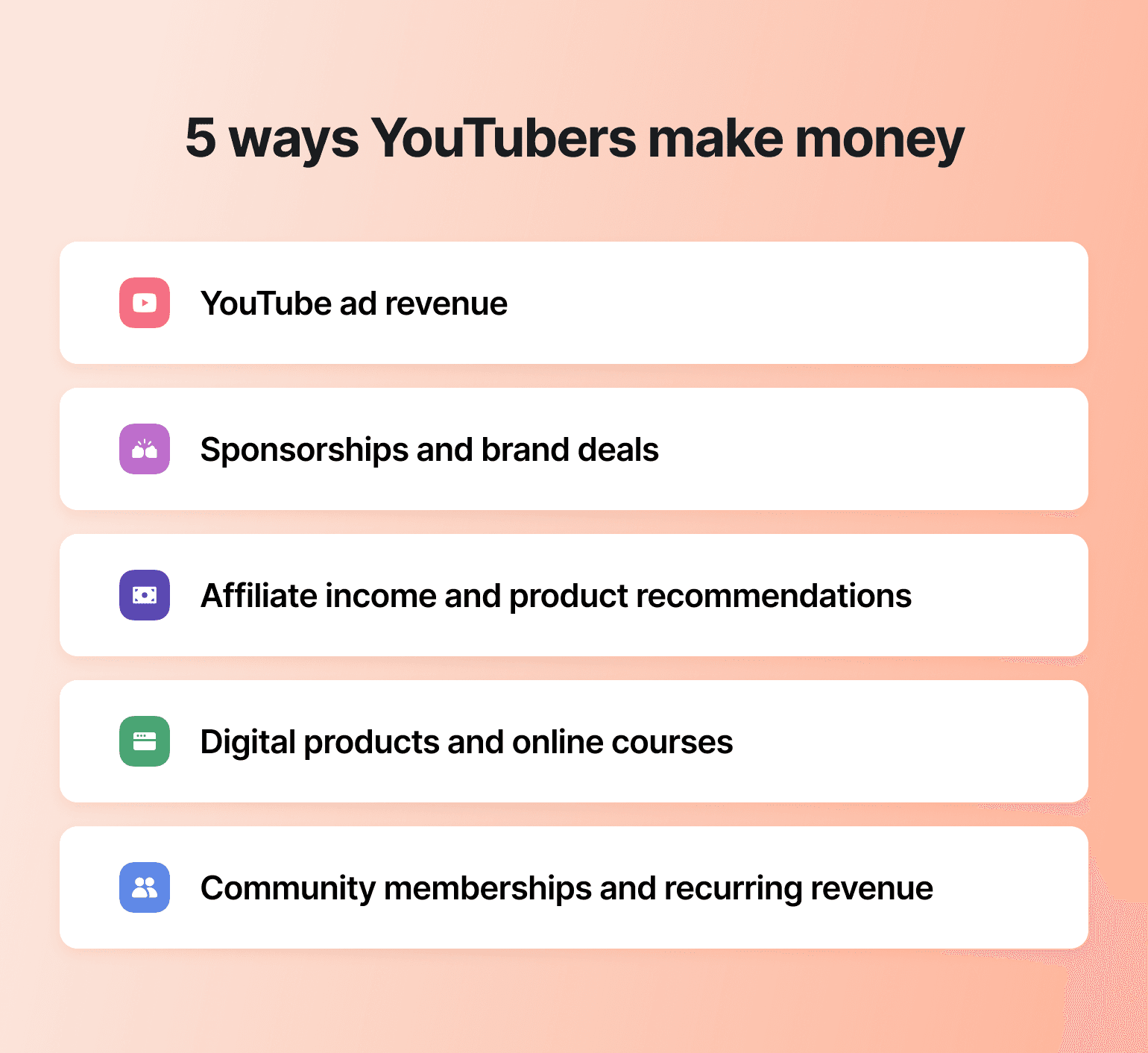
Most YouTubers who earn consistently do so by combining several income streams. Some are built directly into YouTube, while others live outside the platform.
YouTube ad revenue
Ad revenue is usually the first income stream you can unlock. Once your channel is monetized, ads run on videos, and you earn a share of that revenue.
At a macro level, ads are massive. YouTube has shared that it has paid out more than $100 billion to creators, artists, and media companies over the last 4 years, which speaks to the scale of the ecosystem and the role ads continue to play.
At the individual level, though, ad revenue behaves very differently. Earnings rise and fall with views, watch time, and distribution. That makes income difficult to predict month to month.
Sponsorships and brand deals
Sponsorships involve partnering with brands to feature products or services inside videos. These deals tend to depend more on audience trust and niche alignment than raw subscriber count.
When the fit is right, brand deals can be meaningful. But they’re rarely consistent. Budgets shift, campaigns pause, and seasonal slowdowns happen. Plus, as a creator, you can’t really control any of these factors.
Affiliate income and product recommendations
Affiliate marketing lets creators earn commissions by recommending tools or products they already use. Links typically live in video descriptions or are mentioned naturally within content.
This model works best when viewers trust the recommendation and are already problem-aware. Affiliate income can compound over time, but it still depends on viewer decisions that creators can’t fully control.
Digital products and online courses
Digital products and courses let you monetize your expertise directly. Instead of earning per view, you earn by helping viewers achieve a specific outcome.
For many creators, this is where income becomes more intentional. You can launch a product and continue to improve it over time while content on YouTube continues to drive interest without requiring constant promotion.
Community memberships and recurring revenue
Community memberships focus on ongoing value rather than one-off transactions. You can turn your YouTube audience into a business by offering them a space for discussion and direct fan support in exchange for recurring payments.
This model shifts income away from algorithm-driven spikes and toward longer-term relationships. Communities often become the center of your digital business, with YouTube acting as the top of the funnel that brings new people in.

Ad revenue is unpredictable. This isn't.
How YouTube’s monetization program actually works
As we said earlier, earning income through YouTube ads is the first step in monetizing your presence on the platform. And like anything else, it helps to understand how YouTube’s monetization system actually works.
We’ve covered this in-detail in our guide to calculating your YouTube earnings, but here’s a quick low-down👇
The Partner Program basics
To earn money directly from YouTube, you need to be accepted into the YouTube Partner Program.
To qualify, you currently need:
- At least 500 subscribers
- Three valid uploads
- Either 3,000 public watch hours in the last 12 months or 3 million public Shorts views in the last 90 days
Once accepted (and as your channel continues to grow), you unlock access to monetization features such as ads, channel memberships, Super Chats, Super Thanks, and YouTube Premium revenue sharing.
Shorts monetization vs. long-form monetization
Shorts and long-form videos are monetized very differently.
Long-form content earns through ads shown on individual videos. Payouts are tied to watch time, viewer behavior, and advertiser demand. This model tends to reward longer, more evergreen content.
Shorts monetization works through a shared revenue pool funded by ads shown between Shorts. Earnings are based on how your content performs relative to others in the pool. Shorts are powerful for reach and discovery, but income is usually less predictable on its own.
What YouTube Premium pays (and why it’s rising)
When YouTube Premium members watch your content, you earn a share of subscription revenue instead of ad revenue. Payouts are based on watch time.
As more viewing shifts toward subscriptions and connected TVs, Premium has become a quieter but growing part of how creators earn on YouTube.
How much YouTubers make by views & subscribers
To move past anecdotes, it helps to look at real numbers. We reviewed recent creator disclosures on Reddit and YouTube itself to understand how earnings typically scale with views and subscribers. Here’s what we found:
Earnings per 1,000 views
For most monetized channels, earnings per 1,000 views typically fall between $10 and $22 RPM, depending on niche, audience, and retention.
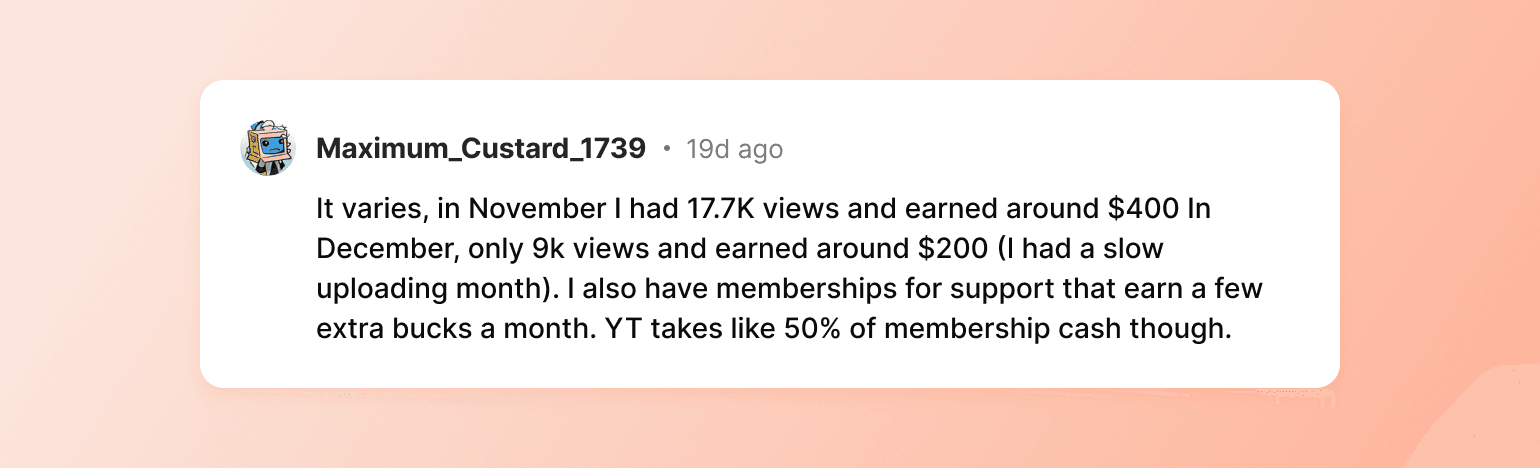
One Redditor who runs a lifestyle channel with an older (65+) audience, shared that they earned around $400 from roughly 17,700 views in a strong month. That works out to about $22 per 1,000 views, which is on the higher end and reflects strong audience loyalty and demographics.
Another creator reported an RPM of $12 to $15, which they noted is already considered high and more common in niches with strong advertiser demand.
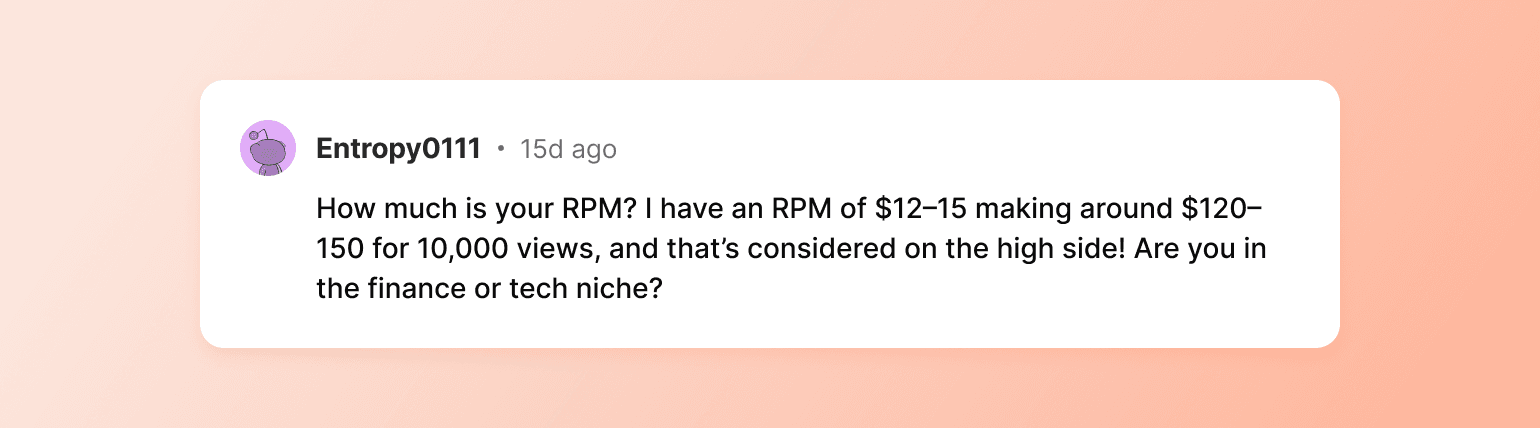
The takeaway: even at the same view count, RPM can vary significantly based on who’s watching and how advertisers value that audience.
Earnings per 1 million views
Once channels cross into the 1-million-views range, earnings start to diverge even more.
One creator passed 1 million total views with around 9,000 subscribers. They earned approximately $4,500 in one month, followed by $3,500 the next.
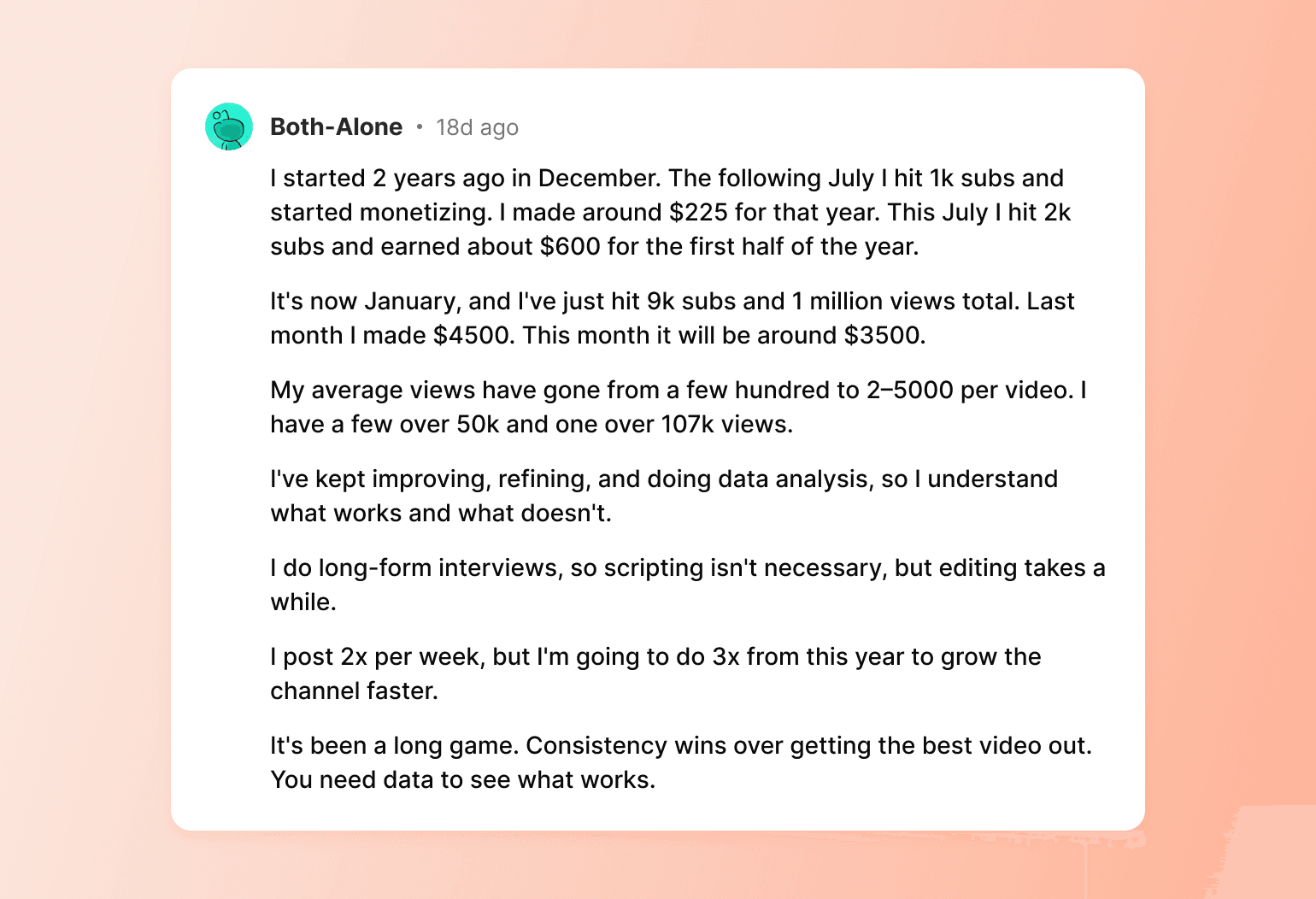
What’s notable is that this wasn’t driven by a single viral hit. Their average videos now pull 2,000–5,000 views, with several over 50,000 and one crossing 100,000 views.
At the higher end, the earnings spread widens even more. Pat Flynn, founder of the Smart Passive Income community, has shared multiple real examples showing just how different outcomes can be at the same view count.
In one case, a long-form video with 1 million views generated nearly $30,000 in revenue. Another 1-million-view video earned around $9,000, while a third brought in $3,700 for the same number of views. Same creator. Same platform. Vastly different results.
How much creators earn at 1k, 100k, and 1M subscribers
Another way to look at YouTube income is by subscriber milestones.
At around 1,000 subscribers, you unlock monetization. One Redditor shared that after just 10 days of being monetized, posting one long-form video per week, they earned $135.
For most creators at this stage, earnings typically fall in the $20 to $150 per month range, depending on views, niche, and consistency.
At 100,000 subscribers, income often moves into the four- to five-figure annual range. For example, a money education channel, According to Nicole, earned $58,929 CAD (about $43,000 USD) in AdSense revenue over a year with roughly 100,000 subscribers. Mind you, finance-related niches are among the highest-paying on YouTube.
At the 1M+ subscriber level, YouTube income can become substantial, especially in high-value niches. Codie Sanchez, a serial entrepreneur, community builder, and CEO of Contrarian Thinking, who has 17 different income streams, earned around $360,000 from YouTube AdSense in 2024 alone.
What most YouTubers really earn based on creator data
Two patterns show up quickly when you look at real-world creator earnings.
First, ad revenue varies wildly—even at similar view counts. Second, most creators don’t rely on YouTube alone. Ads tend to make up just one piece of a much larger income picture.
Neither of those should come as a surprise.
Why creators rely on multiple income streams
For most creators, ad revenue alone isn’t stable enough to rely on. Codie is a good example of that—she has over 17 sources of income 😱. And that’s because if you’re looking to build a sustainable business, you can’t rely on views or clicks alone. Ad income fluctuates, which makes it hard to predict or plan around.
Building multiple streams of income—whether through affiliates, digital products, merch, or sponsorships—helps smooth out the volatility that comes from ads. It also allows you to reduce dependency on a single platform for income.
The early-stage reality: most creators earn under $10K
The early stages of a YouTube channel are slower and less profitable than many people expect. That pattern mirrors the broader creator economy. According to Circle’s 2026 Community Trends Report, many digital creators are either pre-revenue or earn under $10,000.
Reaching beyond that level usually requires sustained experimentation, including:
- Testing new content ideas
- Improving thumbnails
- Tightening titles
- Looking at data to learn what earns clicks and making sure your videos are actually watched till the end
Some experiments will work. Some won’t.
If you stick with it, you’ll start to see clear patterns in what resonates with your audience—and thus, more about your audience overall. But long-term, the goal for many creators isn’t ads alone. It’s about laying the groundwork for monetization that gives you more control and stability.
Burnout, solo founders, and platform risk
There’s also a very human constraint at play. Circle’s research shows that 48% of creators operate solo, managing content, growth, and monetization without a team.
Doing everything alone for long enough often leads to burnout. In fact, 25.8% of creators cite burnout as a barrier to growth. For YouTubers whose income depends on constant output, that pressure compounds quickly.
Add shifting algorithms and declining reach, and maintaining momentum becomes harder. This is often the breaking point where creators start looking at monetizing beyond YouTube.
Realistic earnings scenarios for different types of YouTubers If you’re trying to understand what you could realistically earn on YouTube, it helps to think less about subscriber milestones and more about what you’re actually teaching or offering your audience. Let’s go over a couple of scenarios!
The education creator (YouTube → course → community)
If your channel teaches a repeatable skill, courses and community are often the most natural next step.
Take Ultraspeaking—a YouTube channel focused on helping people feel confident on camera and in high-pressure speaking situations. The videos break down ideas, frameworks, and mindset shifts. Their main monetization model? Cohort-based courses teaching on-camera confidence skills + coaching (all on Circle).
If you teach a skill—whether that’s communication, design, fitness, or coding—this model applies directly to you. Use YouTube as the attention engine. Then offer structured programs that help people go from knowing to doing. Over time, you can layer in a community to tie it all together.
The personality creator (YouTube → sponsorships → merch)
If your channel is built around your personality, point of view, or entertainment value, you can monetize it through brand sponsorships and merchandise.
Brands pay you to feature or mention their product because your audience trusts you and pays attention to what you recommend. Merch, meanwhile, comes next as a way to turn that attention into owned revenue, letting your audience support you directly by buying products that reflect your identity, humor, or values.
The niche expert (YouTube → coaching → digital products)
If your channel is built around a specific skill or domain expertise, use YouTube to publish educational content that solves real problems and builds trust with viewers who want deeper, more personalized help.
Take Kristen Bousquet, creator monetization coach and founder of Soulcial Suite. On her YouTube channel, she shares practical guidance on brand deals, pricing, positioning, and creator income. Her content solves a clear problem: helping creators land consistent, well-paid partnerships. Instead of relying on AdSense alone, Kristen built a layered business around that expertise.
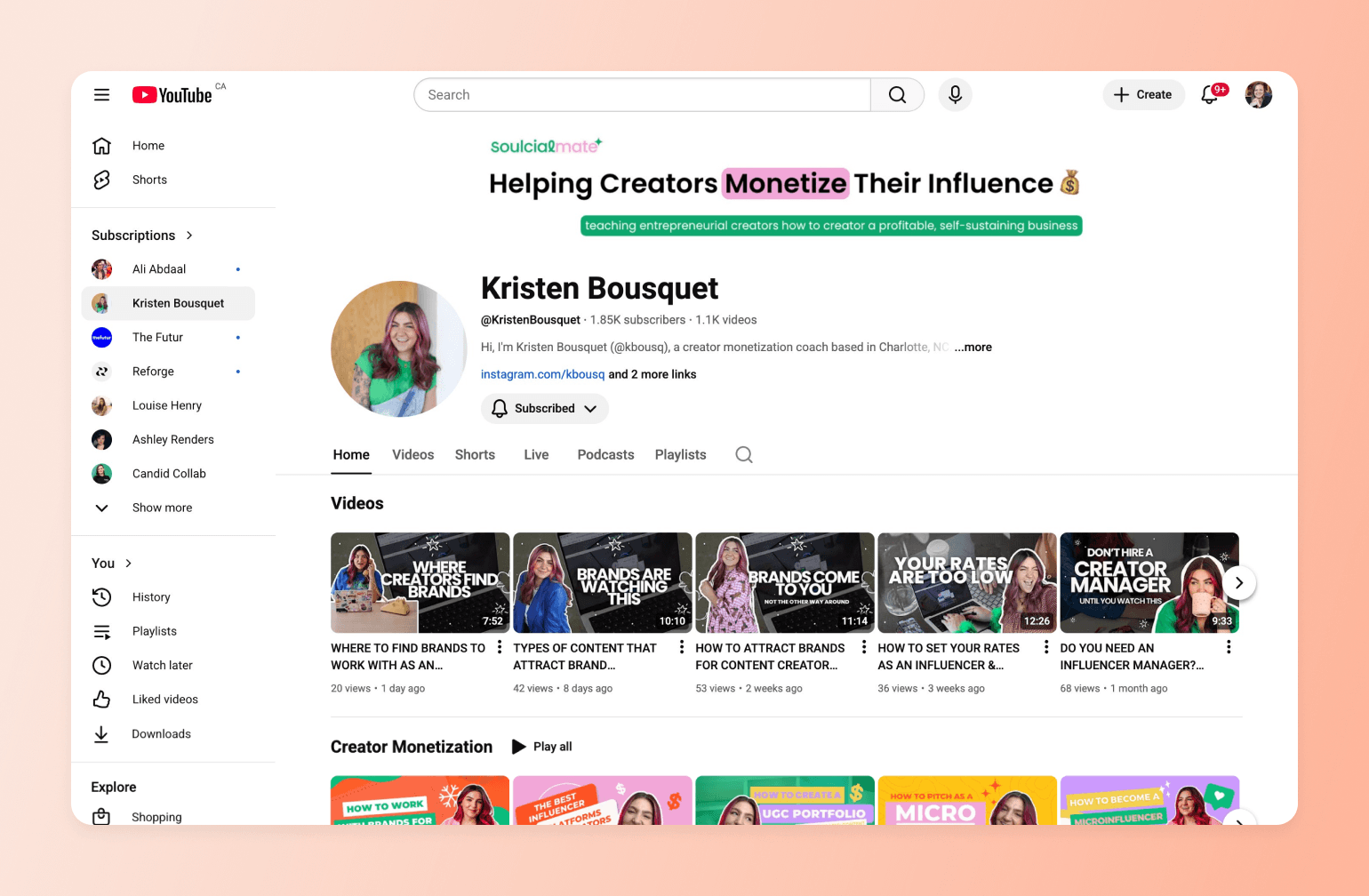
She offers structured education through her Brand BFF course, live coaching calls, and accountability challenges. Then she brings it all together inside Soulcial Suite—a paid membership community.
YouTube drives discovery. Coaching deepens transformation. The community creates recurring revenue. Over time, this model becomes more stable than views alone. Instead of earning only when a video performs, you earn by helping a specific audience solve a specific problem—at scale and in a space you control.
The Off-YouTube monetization engine (where income actually becomes sustainable)
If you want to reduce pressure and build a more predictable income, you need to find ways to monetize your YouTube audience beyond ads. Broadly speaking, there are three paths. Most creator businesses usually use a mix of all three.
Selling courses and digital products to your audience
One option is selling a course or digital product. If you have a niche skill, a repeatable process, or a system that’s helped you achieve a clear outcome, you can package that knowledge into something you sell more than once.
Sean Cannell, a YouTube strategist whose passion for video helped him go from broke and jobless to building a thriving seven-figure business, did exactly that.
He used YouTube to publish practical, search-driven videos about video creation and gear, building trust with creators long before selling anything. As his audience grew, he turned that attention into courses, a book, and a paid education community under the Think Media brand.
YouTube remained the discovery engine. His products became the foundation of the business.
"A lot of creators struggle because they need a business and marketing mindset, and a lot of business and marketers struggle because they need the creator mindset."
— Sean Cannell
Building a paid community for recurring revenue
For many creators, the most sustainable layer of their business is a community. Just like Sean did, many YouTubers eventually explore this option as a way to move beyond ad revenue. The main advantages?
- First, communities create recurring revenue from members who choose to stay month after month.
- Second, communities deepen your relationship with your audience. You move beyond likes and comments into real conversations, ongoing feedback, and a clearer understanding of what your most engaged viewers actually need.
Building your community on specialized platforms like Circle can really pay off. Circle gives you one place to host paid communities, discussions, courses, events, and content—so your audience isn’t scattered across tools or platforms you don’t control. That makes it easier to deepen engagement, understand what your members value most, and turn attention from YouTube into recurring, sustainable income.
Alongside memberships and discussions, you get tools like a website builder, email marketing automation, analytics, and even a branded app—so you can grow your community like a real business, not a side project.
The best part? Everything lives under your own brand, in a space you control, meaning changes to YouTube algorithms don’t dictate your income.
Turning YouTube attention into a business (The YouTube → community flywheel)
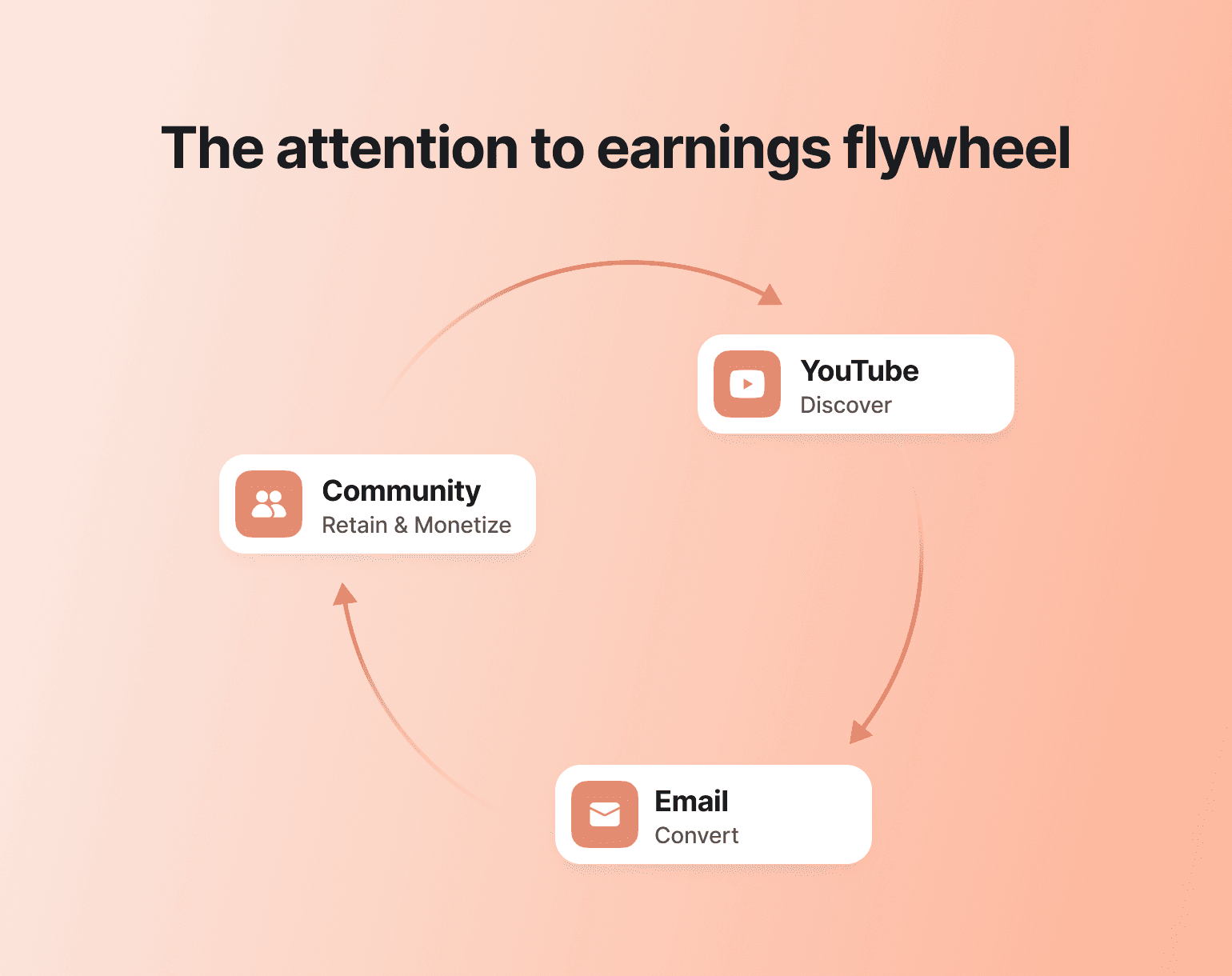
If you look across all of the scenarios above, a clear pattern emerges. The creators who build a stable income don’t rely on YouTube in isolation. They use it intentionally—as the top of a system that moves people toward deeper, owned relationships.
That system is what we’ll call the YouTube → community flywheel.
Capture attention with YouTube
Treat YouTube as your discovery engine. This is where new people find you, often for the first time, through search, recommendations, or shared links.
As per Circle’s data, 67% of new members discover creators through social platforms, which makes YouTube ideal for reaching audiences who don’t know you yet. Your goal is to put out content that earns trust before asking anything in return.
Convert with email (the stability point)
Once YouTube has done its job and captured attention, your next move is turning that attention into something you own. For most creators, that’s email.
Unlike social platforms, email isn’t affected by algorithm shifts or reach drops. When someone joins your list, you can reliably reach them to share new content, test ideas, and introduce offers over time. In other words, email becomes the connective tissue between discovery and monetization, and the foundation that makes the rest of the flywheel work.
Retain & monetize with community
The crème de la crème of monetization is a community. This is where you create a dedicated space for your audience to get involved, not just consume. Members can:
- Ask questions
- Share wins
- Join live sessions
- Connect with others who care about the same things they do
Instead of relying on one-off views or launches, you build an ongoing relationship (in a space you control) with the same people over time, which helps you build sustainable income over time.
Why this protects creators from algorithm volatility
When your income depends entirely on views, you’re at the mercy of systems you don’t control. A tweak to YouTube’s algorithm, a drop in reach, or a slow ad season can undo months of momentum overnight.
Meanwhile, off-platform monetization allows you to own the relationship with your audience. You still benefit from YouTube’s reach, but your income isn’t tied to whether a video gets pushed this week or not.
How to choose your revenue mix as a YouTuber
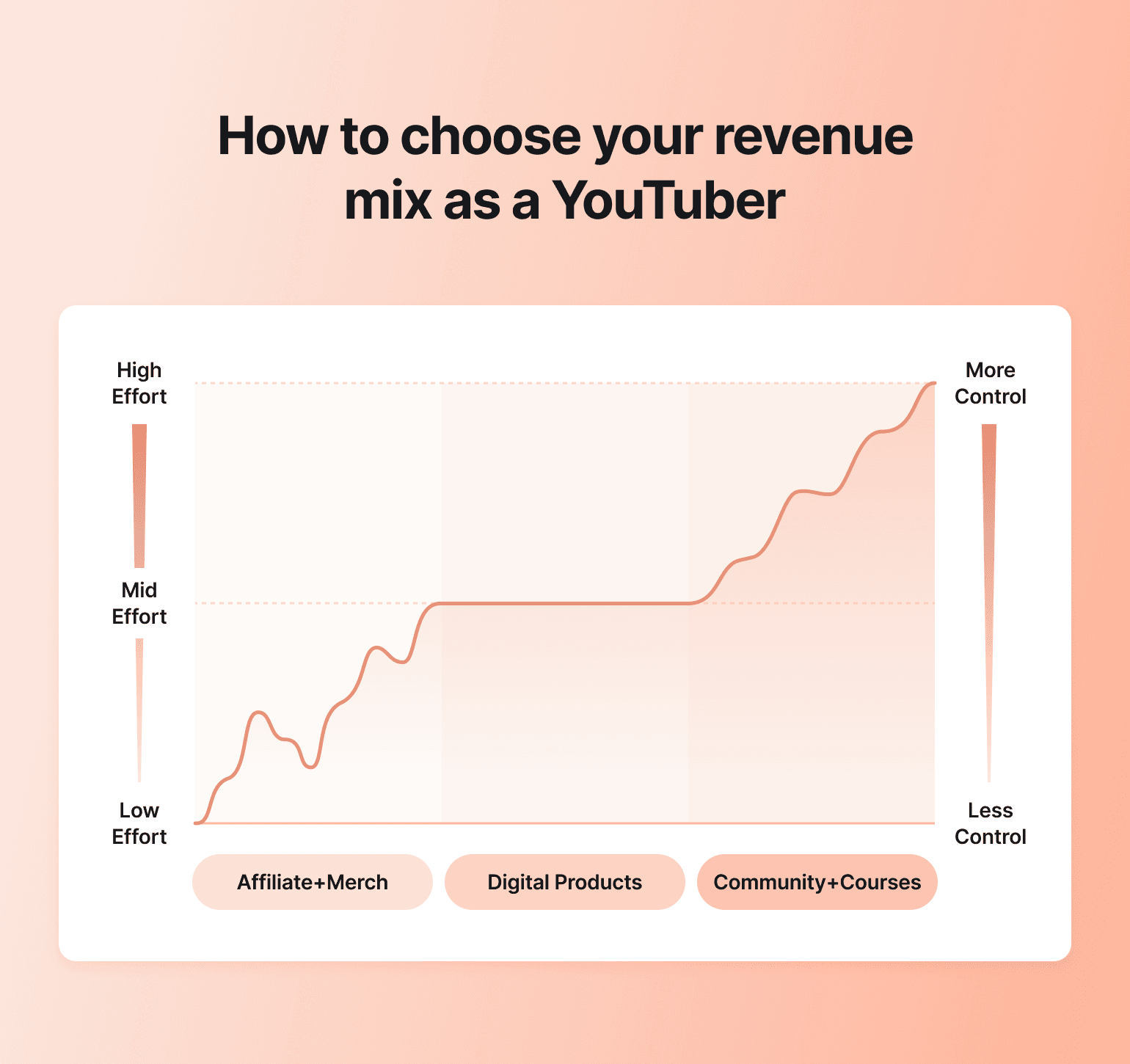
Once you understand the YouTube → email → community flywheel, the next question is: how should you actually monetize your YouTube audience?
The answer depends on three things:
- Your available time
- What makes sense for your audience
- How hands-on you want your business to be
You don’t have to commit to one path forever. Most creators start with what’s easiest, then layer toward what’s more sustainable.
The low-effort path (affiliate + merch)
This path works best when you have steady views and strong audience trust, but limited time.
Affiliate income lets you earn by recommending tools or products you already use. Merchandise adds a simple way for fans to support you and signal belonging.
The upside is speed. You can set this up quickly and start earning without building much infrastructure. The downside is volatility. Income depends on traffic, seasons, and external partners, which makes it difficult to predict month to month.
The mid-effort path (digital products)
Digital products sit in the middle. Think guides, templates, workshops, or short courses that solve a specific problem your audience already asks about.
These take more upfront work, but they scale better than affiliates or merch. Once created, you can sell them repeatedly and refine them over time. This path works well when your channel teaches something practical and repeatable.
The sustainable path (community + courses)
Communities and courses offer the most long-term stability. They require more involvement, but they also give you more control.
For many creators, this becomes the foundation that everything else feeds into. YouTube drives discovery. Email builds the relationship. Courses and community turn that relationship into predictable revenue.
Final thoughts
In 2026, the biggest shift is not how much creators can earn, but how they earn it.
More YouTubers are becoming creator-entrepreneurs. They use the platform for discovery, then build real businesses around their audience. Relying on ads or a single revenue stream is simply too fragile.
Stable creator income today is layered. YouTube brings attention. Email creates a direct connection. Products, courses, and communities generate predictable revenue. The creators who earn consistently are not building on platforms they don’t control. They own the relationship and monetize it in spaces designed for long-term growth, like Circle.
The creators who stay ahead of platform shifts read this.
FAQs
Can small YouTubers make money?
Yes, small YouTubers can make money, but you should manage your expectations carefully. Many early-stage creators earn modest amounts from ads, often ranging from tens to a few hundred dollars per month. The real opportunity comes when you stop treating YouTube as a business and start treating it as the entry point.
If you’re helping people solve a niche problem or learn a skill, you can start monetizing through digital products, courses, or a community. These revenue streams can provide more sustainable income than ads alone.
What are the highest-paying niches on YouTube?
According to OutlierKit's 2026 data, the top 5 consistently high-paying niches are:
- Betrayal & revenge narratives (RPM ~$12.82, CPM ~$20–25)
- Personal finance (RPM ~$10–15, CPM ~$15–22)
- Make money online (RPM ~$9–14, CPM ~$15–20)
- English learning/education podcasts (RPM ~$11.88, CPM ~$18–22)
- Legal/court & family law content (RPM ~$9–12, CPM ~$12–18)
That said, high RPM doesn't guarantee success. Competition, credibility, and your ability to serve a specific audience matter just as much as the niche itself.
Do YouTubers make money if they don't get ads?
Absolutely. In fact, many creators intentionally don't rely on ads at all. Ads are tied to views and algorithms, which makes them unpredictable. The more stable income usually comes from what you offer beyond YouTube. That could be digital products, coaching, merch, courses, or a community. In this model, YouTube's job is discovery, not revenue. You use it to earn attention and trust, then monetize through channels you control.
Contributing Writer
Paulina Major writes about online courses, freelancing, and growth. She helps creators build, launch, and grow educational communities that thrive.