Why free communities are harder to grow than paid ones
TL;DR
- Free communities feel like the safe first move, but with nothing at stake, members join, look around, and disappear.
- A small price changes that: it filters for people who actually show up, stay engaged, and renew.
- The strongest model gives away content to build trust, then charges for the community and connection people can't get anywhere else.
By day, Tom Ross ran a community of 1M+ creatives as a design expert. On the side, he spent years giving away free community-building advice, just a personal project with no real plan behind it. Then his first child was on the way, and the side project needed to become real income or stop. He validated demand with a Google Form, built the whole community on Circle over a single weekend, and priced it from day one. Today Learn.Community runs at roughly 200 members paying $49 a month — a real, recurring $50K side hustle.
Most creators in his position would have done it differently: open the community for free, let people pile in, and figure out monetization from there. Tom skipped that step entirely. He built his audience with free content, then built the paid community directly, so there was never a free tier to convert or a room full of lurkers to inherit. That's not a small choice. The free-first instinct is exactly what causes most free communities to stall: people come in, they don't know where to go, the same three members carry every conversation, and most signups never log in again.
Here's why free communities decay, what changes the moment members pay, and how to build a paid model that can actually grow and sustain itself, instead of a room full of quiet accounts.
Why free communities decay into ghost towns
Free communities usually look healthiest at the signup stage. Then a few months pass, and the room feels like a ghost town: full of people who had every reason to enter and no clear reason to come back. Here's why.
No filter at the door, and quiet compounds fast
A free community removes every filter at the door, so most people walk in out of curiosity. Participation in online communities skews heavily toward inactivity: many members watch, a smaller group contributes occasionally, and a tiny core carries most of the activity, with nothing to stop that core from burning out or drifting away.
That has a compounding effect: discussions go inactive, contributions get no response, and the value stops feeling relevant. The community gets quiet, then quieter, until members stop treating it as a place to return.
The culture sets early, and it's hard to reset later
Your first 100 members set the room's culture, and in a free community, they usually joined with no plan to contribute. The norm becomes skim, take, and leave, and every new member who reads the room adopts it.
That culture doesn't reset on its own when you flip a paywall on later. The lurkers stay lurkers, and the paid members you're trying to add walk into a room that's already quiet. It's easier to build a paid culture from the first member than to renovate a free one after the fact, which is why the "start free, monetize later" plan tends to stall at the switch.
What a small payment actually changes
Payment changes what members have at stake, which gives your onboarding, events, discussions, and long-term engagement work something to build on.
Paying is a commitment device
Charging a price members notice is a commitment device. Paying upfront can increase course engagement in the weeks following the payment, and community builders can use the behavior behind it. Bonnie Christine saw it firsthand: she launched her first membership with nothing more than a recurring PayPal link, and 200 members joined that same opening weekend. That first paid membership became the recurring backbone of a business that's since graduated 15,000+ designers.
Members who pay expect to get more, and that expectation itself pulls them into participating: they show up to the first call, post the first question, and treat the room as something they've bought into rather than something they're browsing. When they then invest their own effort by posting and showing up, they value the community more because they helped build something in it. Free members miss that loop.
Price becomes a filter, and a virtuous cycle
The commitment effect scales as price goes up, and high-ticket communities are where it's most visible. Whoggga, a networking community for business owners, charges $4,200 a year. The payoff shows up in the numbers: 90% of members are monthly active users, roughly 3x the ~29% average for communities its size. When members pay a price they have to think about, they treat the community and each other's time seriously. That creates a virtuous cycle: higher price attracts more committed members, more committed members engage more, more engagement makes the community more valuable, and a more valuable community justifies the higher price.
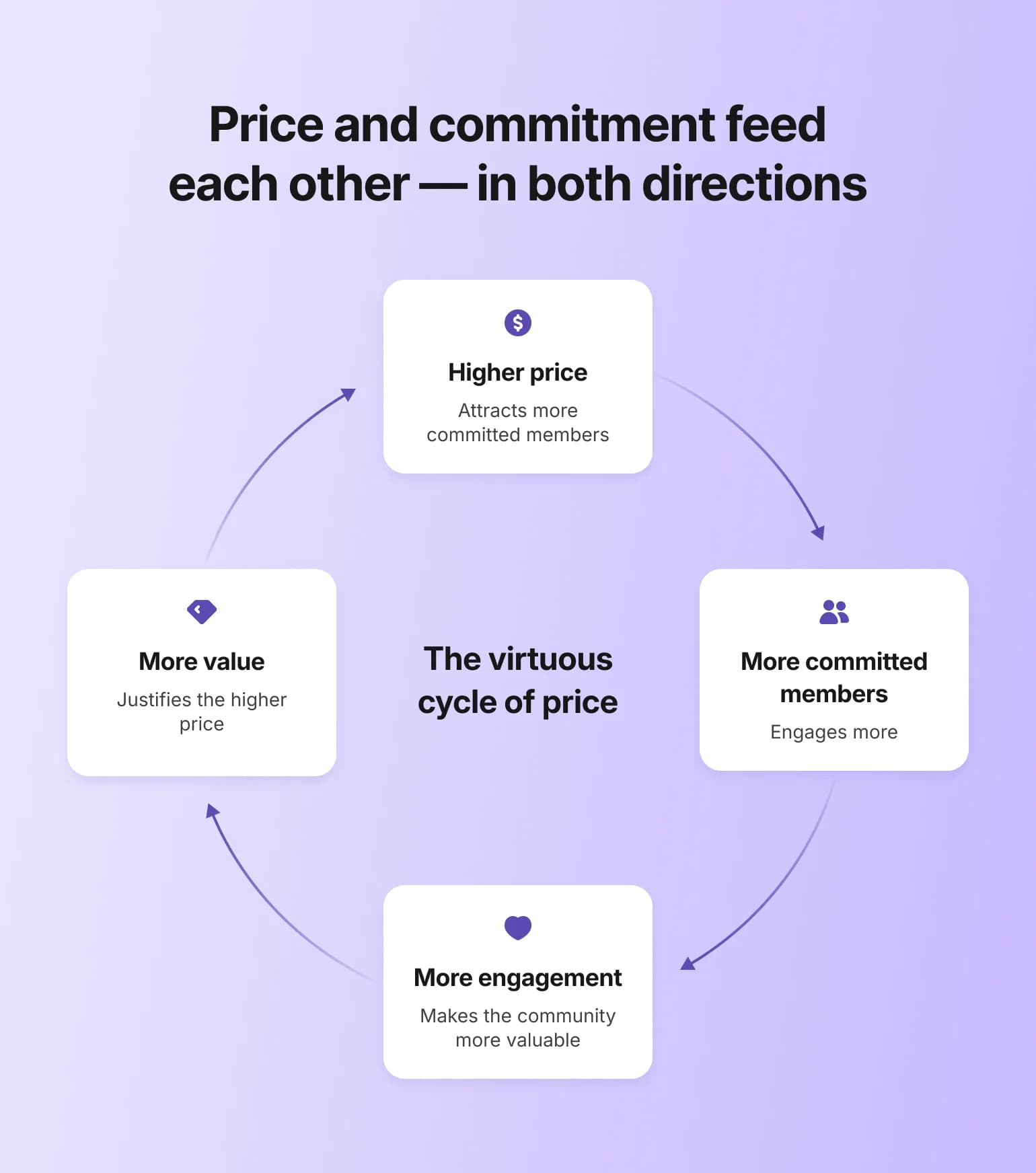
That cycle only holds if the price still fits the audience paying it. Whoggga's $4,200 works because business owners can expense it and the ROI is obvious; charging that much for a hobbyist community would just filter out the members you actually want. The lever isn't "charge more" in the abstract — it's charging what your specific audience can justify without a sales call, then letting the commitment effect do its work from there.
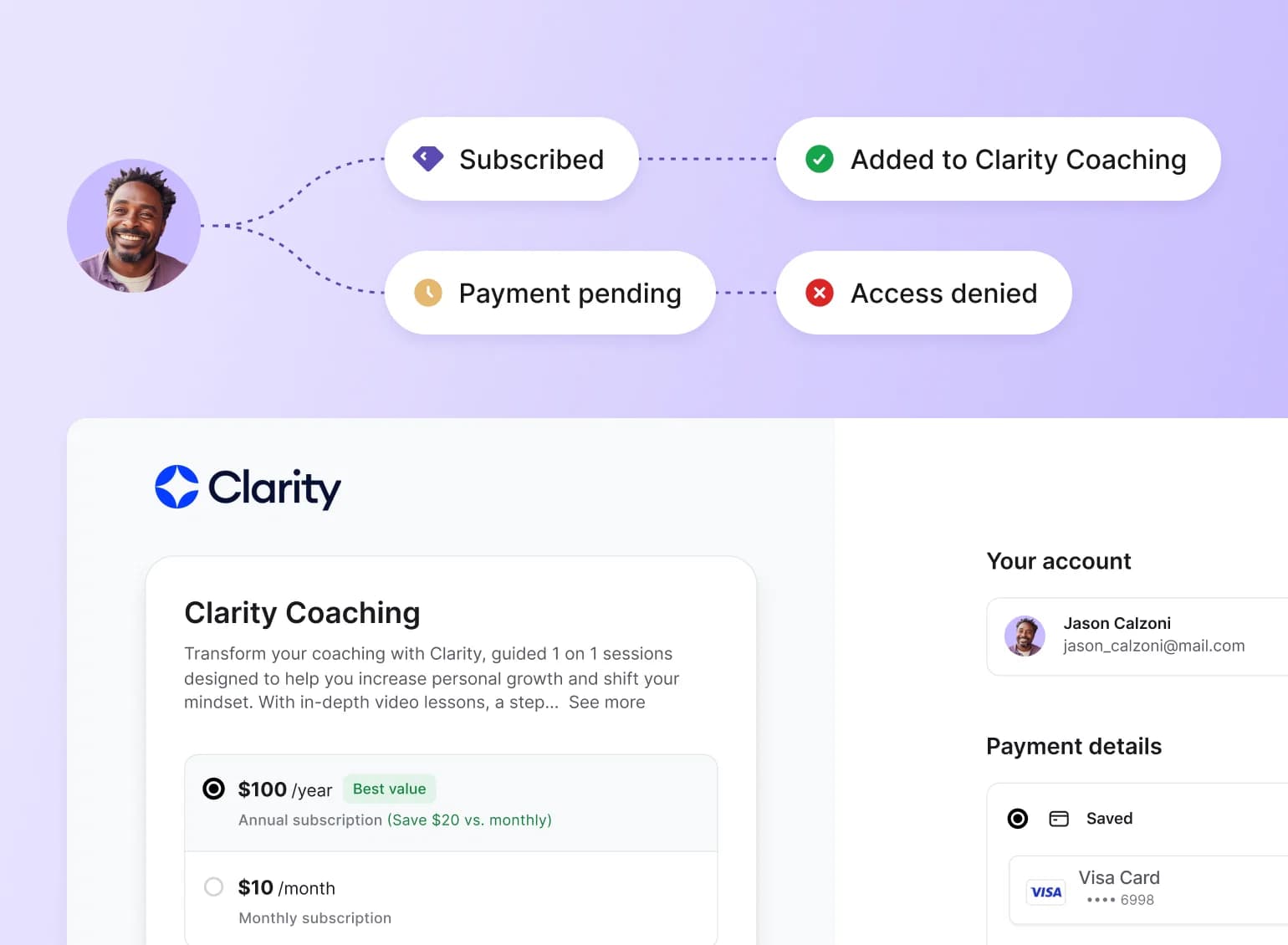
Charging that kind of price also means access has to be handled cleanly: members should get the right spaces the moment they pay, and lose premium access the moment they lapse. That's exactly the job payments are built to do: it ties access directly to payment status, so you're not manually policing who belongs in each premium space. Branded paywalls with testimonials and installment plans let you charge what a serious offer is worth without bolting on a separate checkout tool.
The first price is the only one that's hard
$0 to $10 is a fundamentally different decision than $49 to $59. The first one asks a member whether this is worth paying for at all. Every increase after that only asks whether it's still worth a little more, a much smaller question, because they've already answered the bigger one once. That's why paid communities can raise prices without losing much of anyone: the members who stick around already made the harder call. Just setting up a paywall doesn't do that work on its own, though: paid access still needs activation and a real reason to keep paying.

Ready to charge for it?
Small and paid beats big and free
Tom Ross's $50K side hustle isn't an outlier, it's the math working as designed. Two hundred committed members outperform thousands of curious ones because the moment someone pays, they become a real unit of revenue and attention instead of a login that might resurface someday. Here's why the math favors the smaller, paid room every time.
Run the revenue-per-member math
Run the math before you chase another wave of free signups. 500 paying members at $20/month is $10,000 in real monthly revenue. 50,000 free members is $0, no matter how good the content is or how many of them show up. Revenue-per-member makes the business case obvious: a creator with 500 paying members already has a business. A creator with 100x the audience for free still just has an audience.
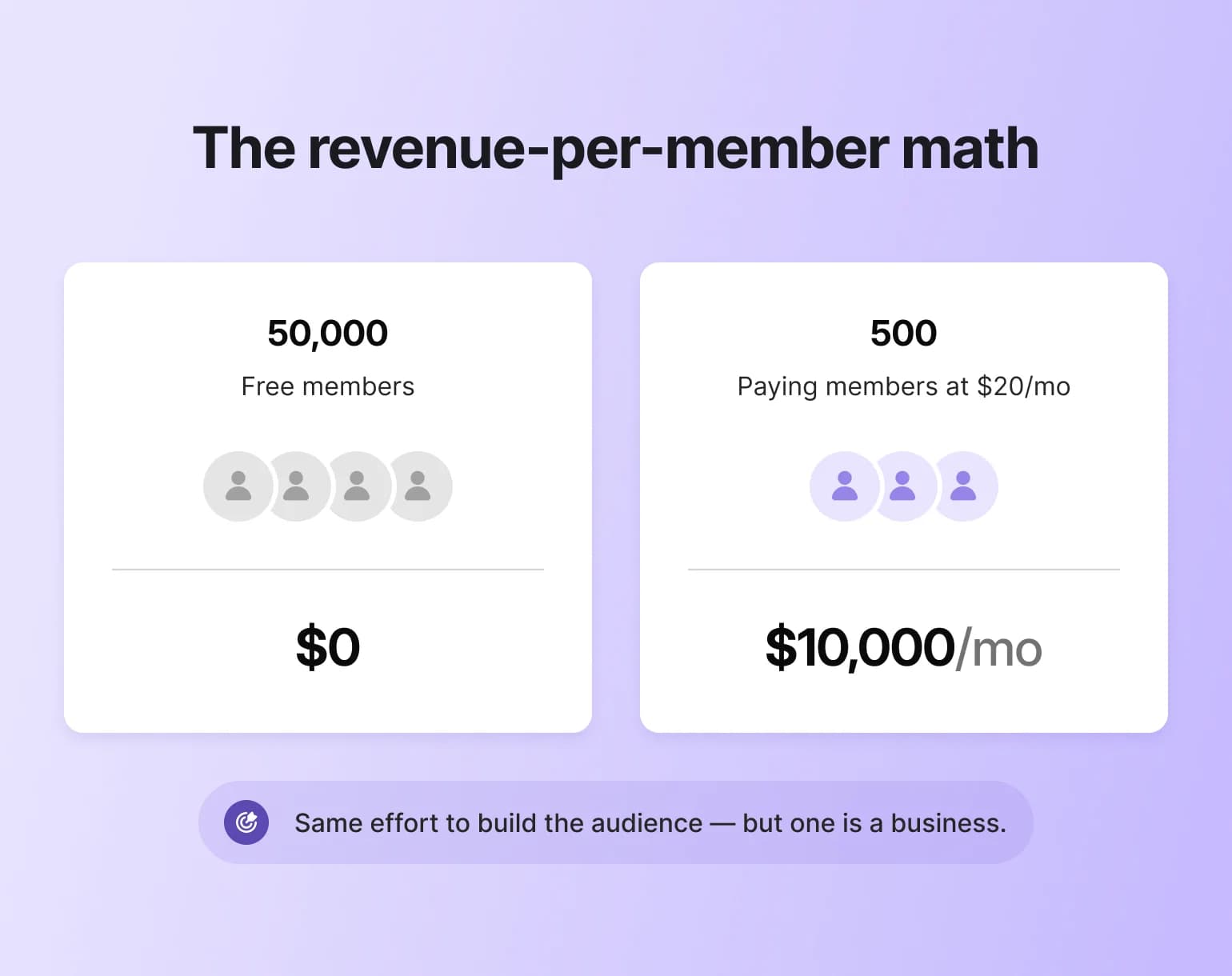
The smaller paid group is often the stronger business too, because it's far easier to serve 500 people deeply than to serve 50,000 people at all. That's the logic behind monetizing a community: consistent, paying participants matter more than passive reach.
Paying members give you a clearer signal
A paid community also gives you cleaner feedback. If 500 paying members stop attending events or stop paying, you have a business signal to investigate. If 50,000 free subscribers never participate, the signal is harder to read, because they may never have intended to participate in the first place.
Community beats content, even on retention
Retention isn't just about whether someone paid, it's about what they're paying for. A content library can be canceled quietly, no one notices but the billing system. A community is harder to walk away from, because leaving means leaving the people in it, not just the content. TroopHR's 80%+ annual retention points to something more specific than commitment alone: a paid community can out-retain even strong content products.
Good Inside, Dr. Becky's parenting membership, saw this directly when the business shifted from one-off courses to an ongoing membership: the platform now runs at a 47% monthly active rate, driven by online community engagement, the relationships members build with each other, not a content library or a borrowed social feed. That relationship is what a free tier can't replicate. Fewer paying members who actually connect with each other can be the stronger model than a much larger, quieter crowd.
An application step is a second filter
Commitment at scale depends on who you let in, too, and price isn't the only lever. Application steps can pre-qualify serious members before they ever see a price. The Roofing & Solar Reform Alliance, founded by Adam Bensman, is a clear example: Adam rebuilt his transactional training business as an application-only network anchored by a code of conduct, then raised the price from $12,000 to $15,000 with no drop in close rate, and posted his lowest churn in eight months across Adam Bensman's 2,800-member network. As Adam puts it: "The product itself is the community. People come for the training, but they stay for the collaboration."
Give away the content, charge for the community
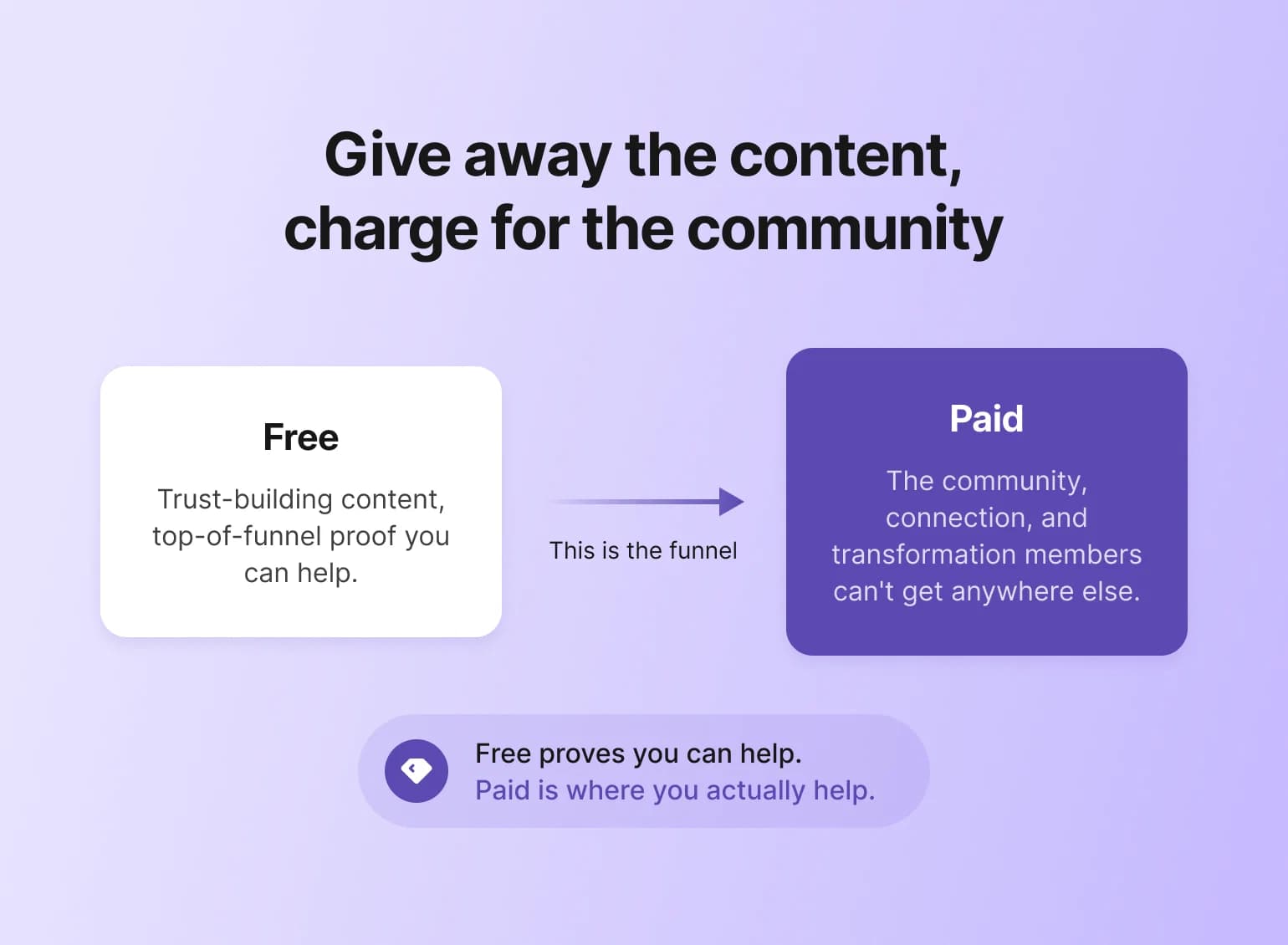
The strongest paid community model lets free content build trust, then reserves the deeper connection and transformation for members. Keep trust-building content free, especially at the top of the funnel: it attracts people and gives them a reason to believe you can help. Analysis of free versus paid newsletters supports the same pattern: a free content layer scales with less friction and builds trust before any paid offer converts. Charging for the wrong layer slows the whole model down.
Dave Gerhardt built Exit Five exactly this way. He spent years giving away free LinkedIn content and a free newsletter, then migrated Exit Five to Circle in 2022 and built it as a standalone paid community. The free content built the audience; the community is what people now pay for. As Dave says: "Circle made it possible for one person with an idea to build a real business around community."
This works because the thing people pay for has shifted. Your free content proves you can help. Your paid community delivers the help: the promise that members will make progress toward a goal or a skill they want to master.
If you want to model what turning your existing email or social audience into paying community members could look like, the Community ROI Calculator is built for that math. Once the paid community exists, the work becomes keeping members long after they join, and AI Agents can handle repeat questions and after-hours onboarding so your team spends time on the conversations only a human can have.
The community you charge for is the one worth building
A free community feels like the cautious choice, but it removes the one signal that turns a crowd into members: commitment. Charge even a little, and you filter for people who show up and stay invested, which is why a smaller paid community can out-earn and out-engage a free audience with more members. Give away the content that builds trust, then charge for the community that delivers the transformation. That's the model that grows.
If paid community is the model, Circle gives you one branded home for the pieces that make it work: community, courses, events, payments, and email. That means less time stitching tools together and more time serving the members who actually pay to be there.
Ready to build the community worth charging for?
Free versus paid community FAQ
Is it harder to grow a free community than a paid one?
Free communities usually grow faster in raw signup terms because there's no barrier to entry. But those members tend to join out of curiosity and disappear, so a free community is much harder to sustain and turn into a real business than a paid one, where members have a reason to stay engaged.
How much should I charge to see a commitment effect?
Even a small amount works, because the jump from $0 to any price is the biggest psychological filter you'll ever apply. Start with a price your ideal member can justify without a sales call, but high enough that they treat the membership seriously.
Should I give away my content for free or put it behind a paywall?
Give away the content that builds trust and grows your audience, then charge for the community and transformation people can't get anywhere else. Gating your top-of-funnel content slows audience growth, while a free content layer feeds every paid offer you launch later.
How many paying members do I actually need to make a living?
Fewer than most creators assume. The more each member pays, the fewer members you need to build a meaningful business. Tom Ross runs a roughly $50K-a-year membership from about 200 members at $49/month, and a committed paid community can support a strong business when pricing and member outcomes support retention.
Can I start free and switch to paid later?
You can, but if revenue is your goal, running the community with activation and commitment in mind from the start makes the switch easier. Some engaged free members may upgrade when a paid tier launches, and that opportunity is concentrated among already-active members, so design any free community around real participation from the start.
Community Content Marketer
Arina is Circle’s community content marketer, sharing insights on community growth, GTM strategy, and storytelling for solopreneurs.