The difference between a personal brand and a business brand
TL;DR
- Build under your own name if members are really paying for you: your judgment, your feedback, your time in the room.
- Give the business its own name if members are paying for a result that a curriculum, a team, or the community delivers, even when you're not around.
- You don't have to pick one for everything. Let your name bring people in, and give the product or community they join a name of its own.
The founder you follow on LinkedIn might not be writing the posts. The face on the sales page might be a Synthesia avatar. The brand story in the welcome email might have been drafted by Claude from a five-bullet brief.
A solo founder can now stand up a professional-looking brand in an afternoon: name, logo, voice, launch site, welcome sequence, even an About page.
So the question changes. It's no longer which brand you can pull off, because anyone can. It's which one is right for you, and how to tell when that answer should change. This article covers how personal and business brands differ, how to choose between them, and how to shift from one to the other as you grow.
How a personal brand differs from a business brand
A personal brand is you, in public. People follow you for your point of view and your track record. They buy because they want your judgment, and they describe the offer by your name. In other words, you're either the product or the reason people trust the product.
A business brand works the other way around. It's a named thing that isn't you, like a company, program, academy, or community. Members trust what it delivers: the method, the mentors, the curriculum, or the peers inside it. It has its own results, so members can point to what it does without mentioning you. You might be front and center, quietly in the background, or long gone. The brand keeps delivering either way.
The two aren't mutually exclusive, and you don't have to pick one for everything. Your name can do one job while a business name does another.
| Personal brand | Business brand | |
|---|---|---|
| What it is | A reputation built around one named individual | A named entity (company, program, community) with its own identity |
| How it grows | Founder visibility, personal audience, direct relationships | Named product, documented method, transferable systems |
| Example | Pat Flynn, Jay Clouse, Tom Ross | Smart Passive Income, The Lab, Learn.Community |
With those definitions set, the useful question is which one your specific offer should lead with.
How to choose between a personal brand and a business brand
Your brand should match what members think they're buying when they hit "buy." Real creator businesses show the difference clearly. In some, the founder's own track record is the product. In others, the business has grown into something members would join without the founder at the center.
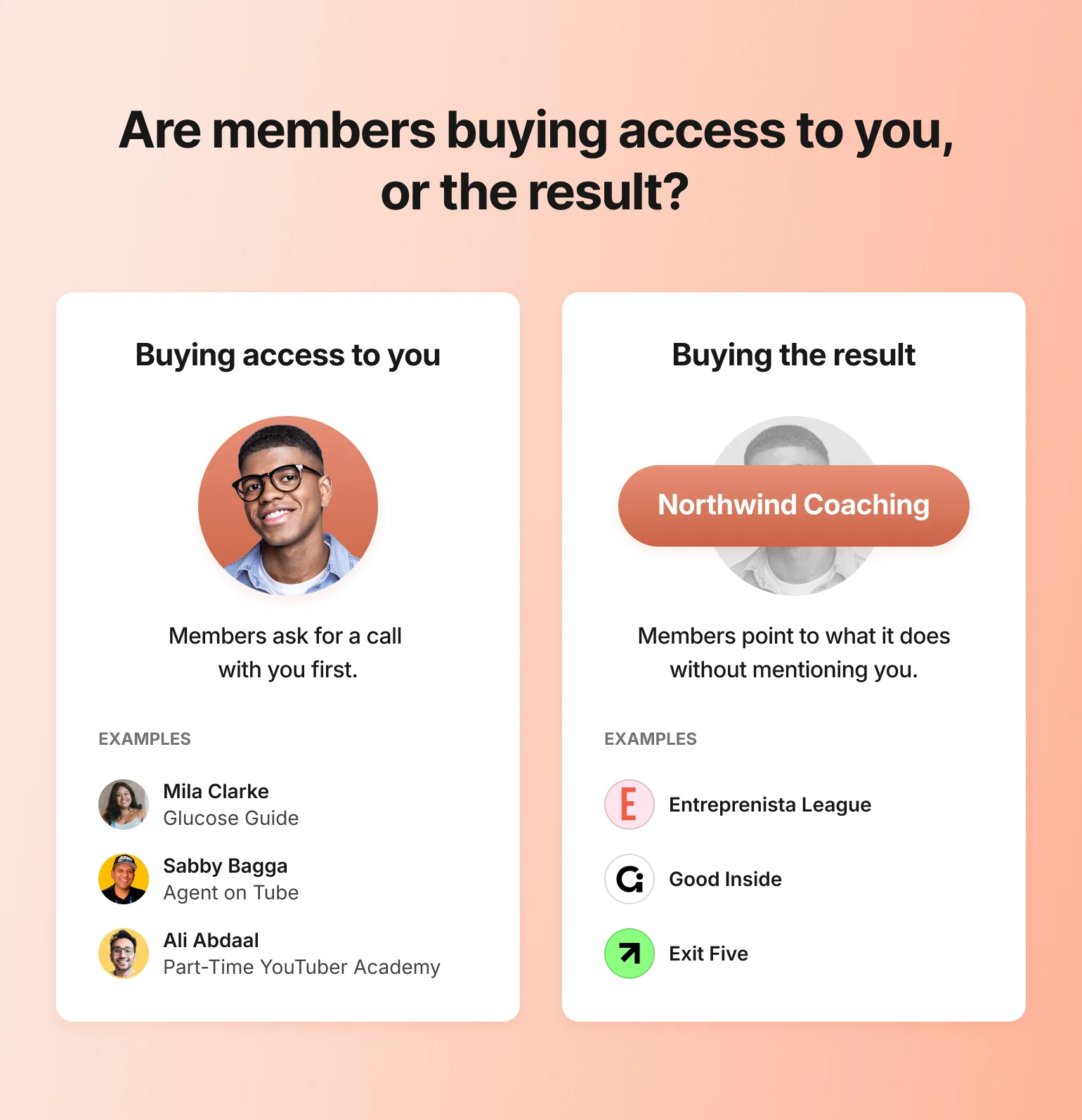
Your name leads when members are buying you:
Mila Clarke has spent more than a decade helping people with diabetes through her Hangry Woman brand, which has 165,000+ followers, and now runs expert-led coaching events and peer support in her Glucose Guide community.
Sabby Bagga grew multiple YouTube channels to hundreds of thousands of subscribers and now charges premium prices to teach real estate agents how to use YouTube to generate leads.
Ali Abdaal built his audience on YouTube and teaches other creators how to do the same through his Part-Time YouTuber Academy.
The business needs its own identity when members are buying a result that keeps arriving on the days you're not there:
The Entreprenista League grew out of a podcast into a community of close to 3,000 women founders, where a five-person community team runs programming and members host events.
Good Inside grew out of Dr. Becky Kennedy's Instagram following into a membership with 100,000+ parents, where coaches lead smaller support sessions alongside her live workshops.
Exit Five started as a small Patreon run by Dave Gerhardt, a two-time CMO, and is now a global B2B marketing community with local chapters and a branded app.
Not sure which list you're in? Look at how your last few members bought. If they all asked for a call with you first, they were buying you, whatever name is on the checkout page.
If the signals are mixed, the table below gives you four questions to settle it.
| What are members buying? | Personal brand | Business brand | The deciding question |
|---|---|---|---|
| Trust | Confidence in a specific expert | Confidence in a method, mentors, or an institution | Would they enroll if another qualified person introduced the offer? |
| Delivery | Direct feedback from you | Curriculum, mentors, systems, and peers | Who produces the promised result each week? |
| Delegation | Admin can move; your access stays central | Core teaching and support can move to named people | Can someone else deliver the same defined experience? |
| Ownership | Your reputation is the main asset | The company owns a repeatable member experience | What's valuable if you leave? |
If the signals conflict, go with the delivery row. It's the hardest to argue with, because whoever produces the result each week is what members are really buying.
Why a personal brand helps you get discovered and trusted
A personal brand gives a business a face. Jon Michail, a Forbes Coaches Council member, argues that a company's name and logo aren't enough on their own. Someone has to become the face that builds credibility and trust, and he says the personal and business brands should feed each other.
AI tools make polished content easy to produce, and audiences are wary of AI-written news. Ofcom's News Report 2026 found that 56% of UK adults said they would trust an AI-written news story less than one written by a person.
So lead with what's hard to fake: a clear point of view, and examples from real client sessions. Those also give people something to remember you by. A study in the Journal of Brand Management that interviewed 25 senior leaders in Lithuania found that LinkedIn personal branding benefits both the leaders and their organizations.
Jay Clouse shows what this looks like in practice. He runs Creator Science and its paid community, The Lab, but he shows up on social media as himself. He uses his personal accounts, in his words, "to draw attention to my one main project: Creator Science." The personal brand is where attention starts. The business is where it lands. The Lab runs on Circle, is capped at a few hundred full-time creators, and has earned more than $1.25M since launching in 2022.
Clouse builds that attention through creator brand work and uses community marketing to turn it into paying members. He walks through that handoff in his Community Masterclass.
How to move from a personal brand to a business brand
You may want to stay a personal brand forever, and that's a legitimate choice. If you want to grow into a business brand, start by deciding what you want the business to handle without you, like onboarding new members or running a cohort. That goal sets how far you need to go through two shifts.
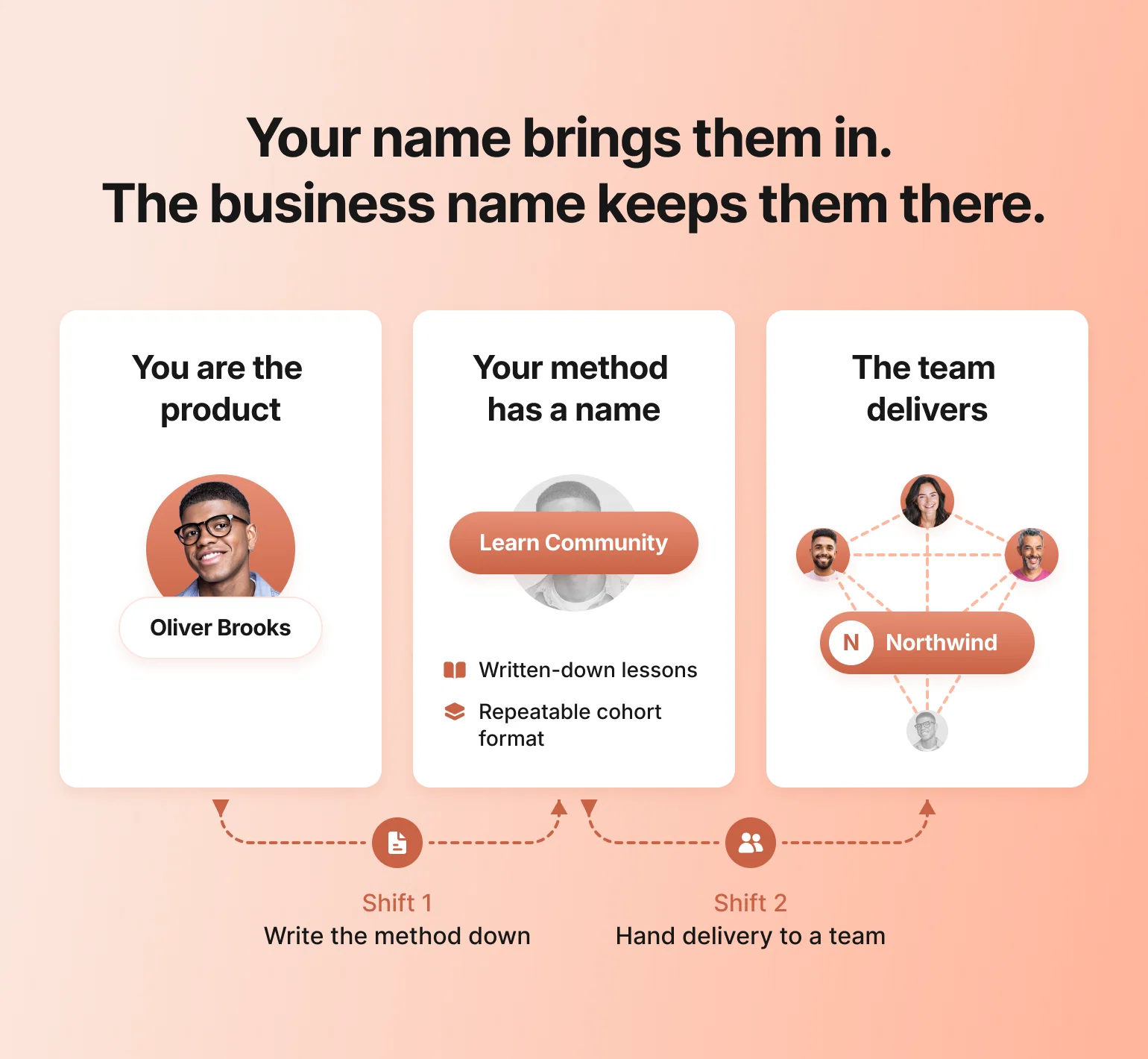
Start with your own name while you're the product
Early on, your name should be doing all the work, because your judgment is what members are buying. Use this stage to build the track record the business will inherit: results you can point to, and notes on what you do each time. For the full how-to, see how to build a personal brand.
Turn your method into a named offer
The first shift is turning what you do into something you can deliver the same way every time. Write down the lessons and exercises, decide what members should leave with, and run each cohort the same way. Once someone else could follow that format, the offer is ready for a name of its own.
Your personal audience is what gets it off the ground. Tom Ross had spent his evenings sharing free community-building content. Before building anything, he sent that audience a Google Form to test demand and got nearly 400 responses. He then launched Learn.Community, named for the topic rather than himself. It now has nearly 200 members at $49/month.
Chris Donnelly followed that order. He built a LinkedIn audience by teaching for free, sold a first cohort of ten founders at $5,000 before the curriculum existed, and used the results from seven of them to relaunch with up to 100 seats. That program is now The Creator Accelerator, which he runs on Circle with cohorts of 100 to 200 people. By his own account, it can make $5 million to $10 million a year. The full story is in how Donnelly built it.
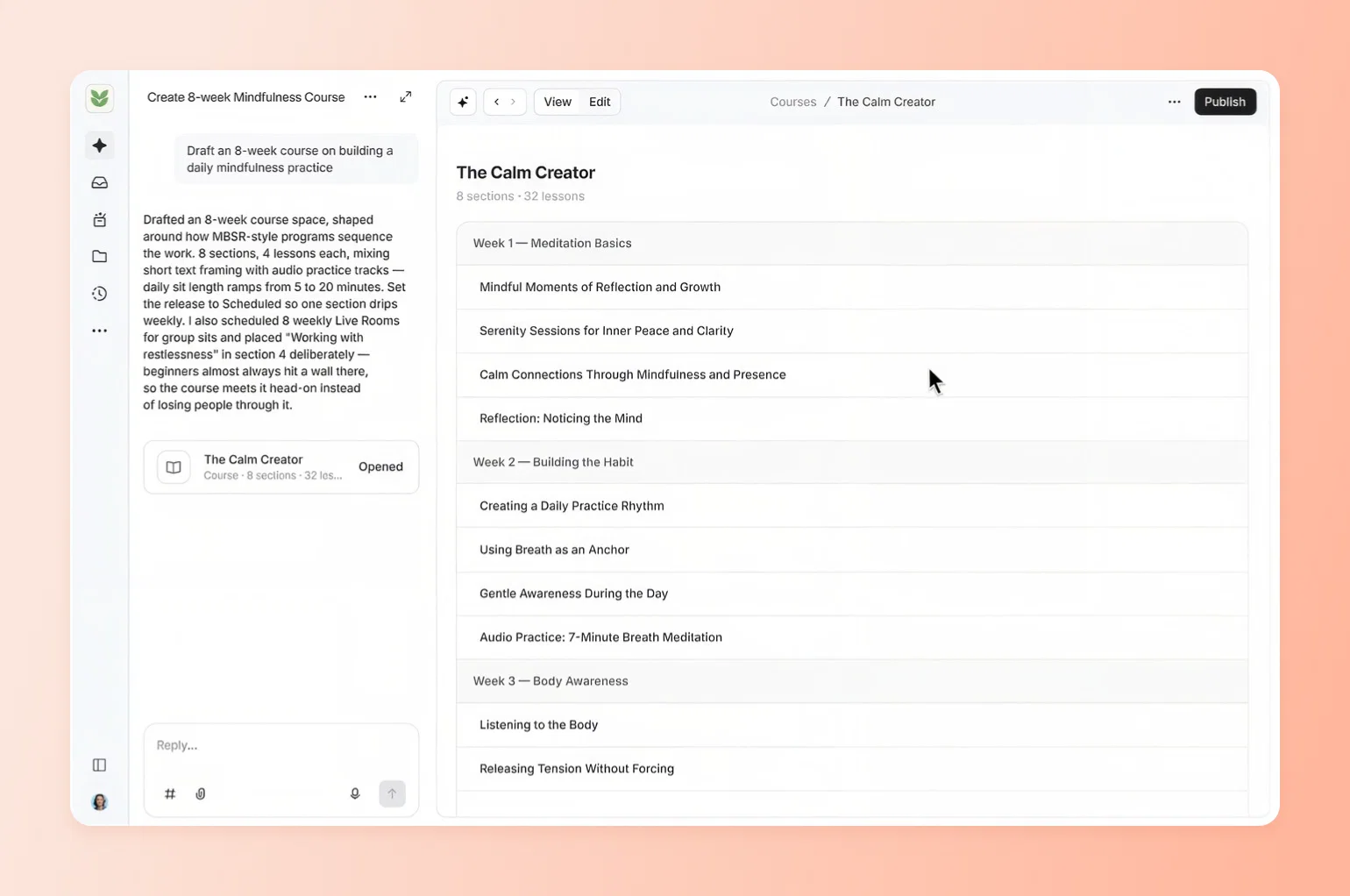
Community Tip: Documenting your method is the slow part. Describe your course to Circle AI, or point it at content you already have, and it can draft the modules, lessons, and quizzes. A draft is generic until you add the client stories and judgment calls only you can supply.
Let the business name lead once a team delivers
The second shift happens when members start getting value from people and systems other than you. Mentors lead recurring sessions, members help each other, and support no longer routes through you. At that point your name on the checkout no longer describes what members are buying, so the business name should lead.
A quick check: when a member has a question, see who they tag. If it's a mentor or the space rather than you, members already trust the business over the founder.
When to keep your own name and skip the rebrand
None of this makes the shift mandatory. If members are buying access to you, renaming may cost more than it returns, and staying founder-led on purpose is a legitimate choice.
Why naming your program gives members something to belong to
Smart Passive Income generated more than $700K in membership revenue in 2024, 58% of company revenue, and the company reports 2.5x to 3x higher course completion rates. None of that is filed under Pat Flynn's name. It sits with a named membership that members join, leave, and recommend on its own terms. A founder name rarely gives members that: a shared identity for where they belong. Once the name exists, the curriculum, the recurring events, and the peer relationships all attach to it. Each becomes a reason to renew that doesn't depend on you being in the thread.
Getting there took a rebuild. SPI had generated more than $1M each year from individual course sales, but its courses, events, and community sat across a fragmented stack of separate tools. Monthly launches exhausted the team and the audience, and students learned alone. Pat Flynn consolidated courses, community, events, and three membership tiers onto Circle, then replaced isolated self-paced courses with cohort-based accelerators. Flynn's take: "If you're building anything today—whether it's courses, coaching, content, or products—community needs to be part of your strategy."
The practical version is small and specific: name a paid program space after the program, not after yourself, so new members know which thing they joined. That community naming decision shapes the rest of your brand community.
Community Tip: Put the program name, not yours, on everything members see first: the community name, the welcome post, event titles, and onboarding emails. Introduce yourself in the welcome post as the person who runs it.

Give your program its own home.
Signs your business is still a personal brand, and how to fix them
Renaming the business doesn't make it a business brand on its own. If members still buy, get their results, and trust it because of you, you have a personal brand with a new name on it. That's founder dependency, and it shows up in three places: selling, delivery, and trust. Each fix below moves one of them from your name to the business.
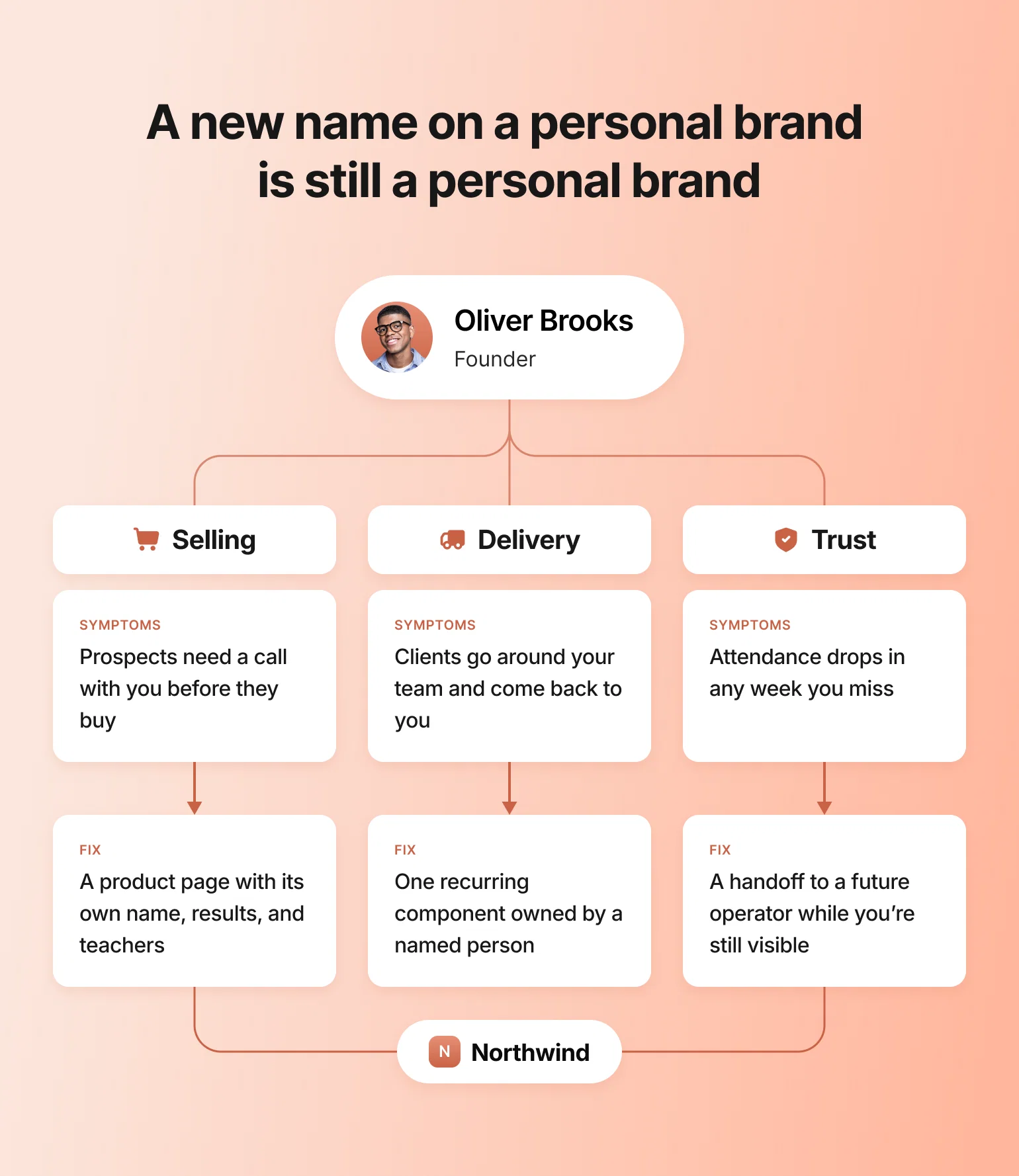
Fix selling when every deal needs you on the call
Founder-only selling appears when prospects require a call with you before they buy, even when someone else would deliver the work. Compare leads and sales in weeks you publish against weeks you don't; if they collapse without you, prospects are buying access to you through the page. You can stay visible while every offer points to a product page with its own name, results, and teachers. The page has to answer the question the sales call was answering for you, which is not "is this person credible" but "will this work for me without them."
Fix delivery when clients bypass your team
Founder-only delivery appears when clients go around the people you've hired and come straight back to you. A personal-name business quietly reinforces this by making you look like the default person for every project, even after the team can deliver the work. The fix is to assign one recurring component to a named person and let that ownership be visible. A fractional community builder can own member welcomes and weekly prompts.
Fix trust when the community goes quiet without you
Founder-only trust appears when attendance and discussion drop in any week you miss, which makes it the hardest of the three to delegate your way out of late. Members built the habit around your presence, so removing it without a replacement reads to them as the community winding down. The fix is a handoff you make while you're still visible. Introduce the future operator, give that person ownership of a recurring session, and let members build direct trust over several months before your own presence changes. Do it while attendance is healthy, not once it has already slipped.
How to keep your voice as the business grows beyond you
Growing a business brand doesn't mean disappearing from it. It means choosing which moments stay yours. Keep your name on what only you can do, like your public point of view, a signature live session, and the final say on the curriculum. Give the business name the repeatable parts: onboarding, recurring events, and member support. Circle's community workflows can handle onboarding and follow-ups under that business name while your personal channels keep doing the discovery work. To start, list everything you did for members last month and mark each item "only me" or "anyone with the playbook." The second list is what the business name should own.
Whichever name leads today, the choice isn't permanent. Start with the name members already trust, usually your own, and hand the repeatable parts of the business to a name of its own as a team starts delivering them.
Hand the playbook to your business.
Personal brand vs. business brand FAQ
What is the difference between a personal brand and a business brand?
A personal brand is one person's reputation, and a business brand is an organization's. Beyond who members trust, the choice changes three practical things. Pricing: a personal brand sells access to you, while a business brand can sell a defined program. Risk: your opinions and off days reflect on a personal brand directly, but a business brand gives you some distance. Hiring: staff at a business brand represent the organization, not you.
Should founders build a personal brand or a company brand first?
Either order works, as long as the two brands end up feeding each other. If you already have an audience, launch under your name and name the offer later. If you're starting from zero with an offer that doesn't depend on you, start with the business name, but give it a visible host or founder from day one. Before committing to any business name, check the trademark register and that the domain and social handles are free.
Can a business survive with only a personal brand?
Yes. Coaching, consulting, and masterminds can run entirely on one name, and staying personal on purpose is a legitimate choice. The trade-off is capacity: income is capped by the hours you can work, and there's little for a buyer or successor to take over. If you stay personal, price for scarcity by capping seats or cohort size, as long as that price still fits what your audience can afford, and write your method down anyway so a sick week doesn't stop delivery.
Can you switch from a personal brand to a business name without losing your audience?
Yes, if you make the change in steps. Announce the new name before you switch, keep your own name visible as the host for the first few cohorts, and point old links and handles at the new home. Keep the results and the format the same, so members who joined for you can see that nothing they paid for has changed.
Do your customers expect to see a person or a polished company brand?
Give members both: a person to trust and signs that the business will still be there next month. Show a real person with a name, face, and story, then back them with a team page, clear terms, and member results. To see which one matters more to your members, ask two questions during onboarding: "Who introduced you to us?" and "What did you believe you were buying?"
Community Content Marketer
Arina is Circle’s community content marketer, sharing insights on community growth, GTM strategy, and storytelling for solopreneurs.