TL;DR
- AI is now mainstream even for small and solo businesses, so doing more with less is the price of staying in the game, not the thing that wins it.
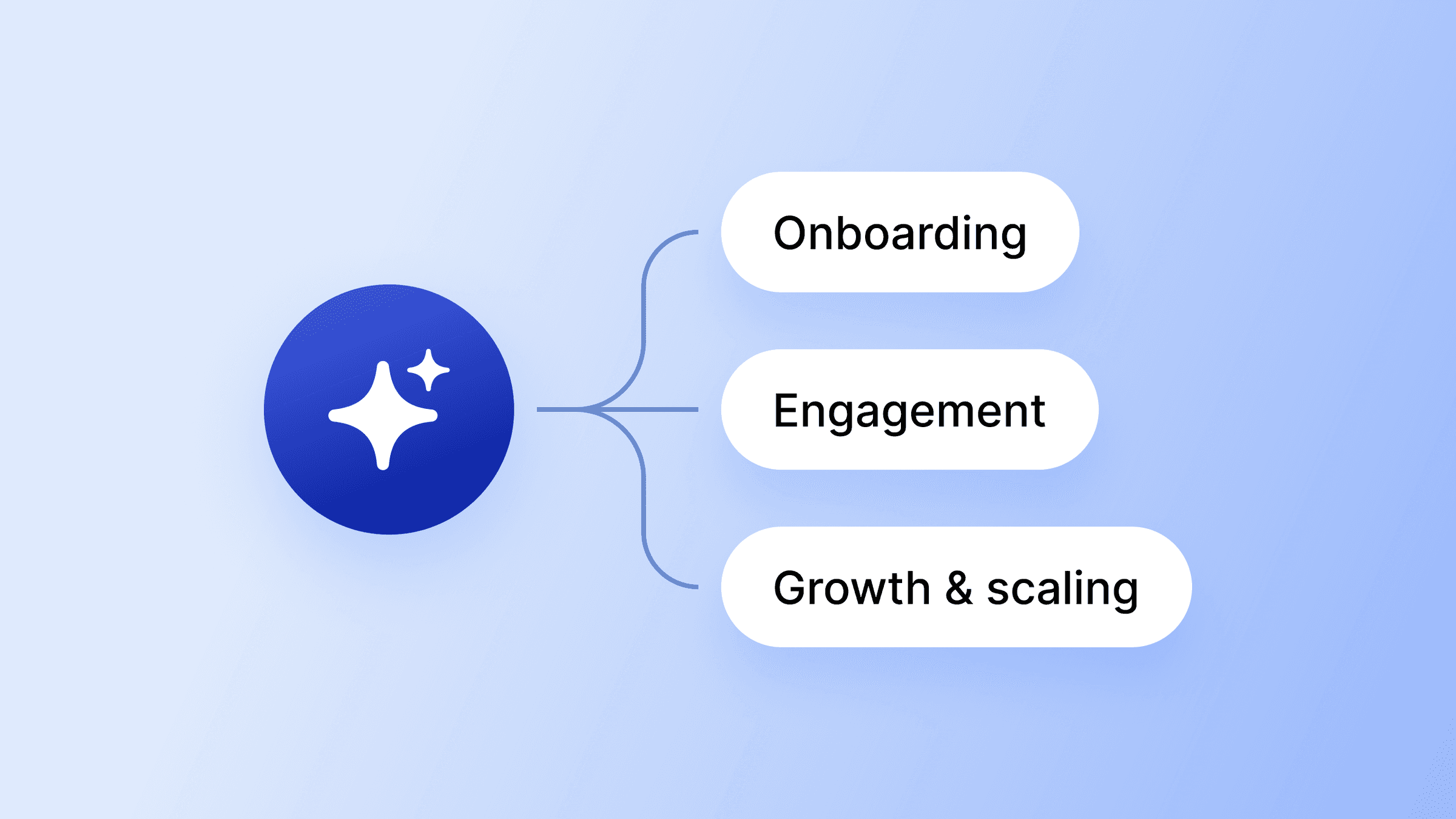
- The operational layer is where AI pays off for a creator business, so the smart first moves are the repetitive jobs you already dread.
- The edge AI can't hand your competitor is the human relationship inside your community, and freeing up your hours to build it is the whole point.
Justin Welsh runs a $15 million company with no employees and 200,000+ readers — and AI does a lot of the heavy lifting. But he's the first to say that isn't the impressive part. AI can now spin up content, systems, and funnels in an afternoon, and "the boring, mundane, miserable parts of work can be automated," as he puts it. The skills he spent twenty years building are getting commoditized in real time. What can't be copied is the part he's betting his second act on. "Fun is a moat AI cannot cross," he says.
And fun is human. Your enthusiasm, your taste, the specific way you show up — that's what makes people care, and no competitor can copy it by buying the same tools. For a business built on an audience or a community, that human edge has a concrete shape — the relationship you have with the people who follow you. The creators pulling ahead know it, which is why they aren't using AI to churn out more of the same; they're using it to buy back the hours to build that relationship.
Everyone has AI now, so efficiency isn't the edge
Almost 60% of small businesses now say they use AI, more than double the rate two years earlier, according to the U.S. Chamber of Commerce. A good AI tool now does what you'd once have needed a first hire for, at about the price of a streaming subscription. The catch is that your competitors have the exact same leverage. When efficiency is this cheap and this common, it stops being an edge.
Why AI alone won't set you apart
Most of that adoption isn't producing a real advantage. MIT's 2025 research on AI in business found that 95% of pilots delivered no measurable financial impact, and the cause wasn't the models. It was a learning gap: generic tools that don't adapt to how your business really works, dropped in without rewiring anything around them. Speed alone doesn't give anyone a reason to choose you.
Your relationships are the edge that can't be bought
Line up what AI can do against what it can't, and the split is clear:
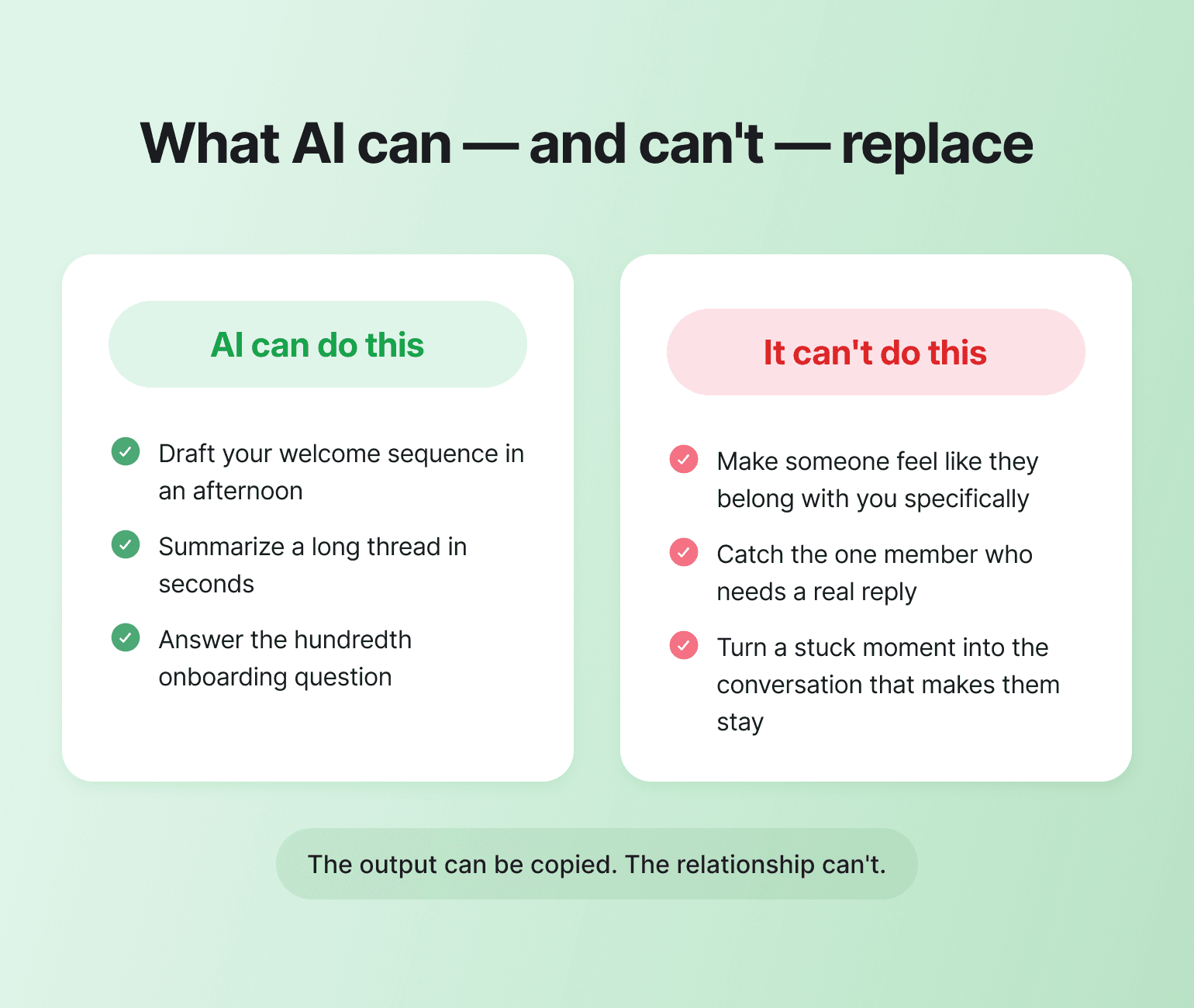
Hand AI the left column all day; the right column is where loyalty forms. And loyalty is the most durable revenue a creator can build — the member who renews a third year, the one who brings two friends, the room that's become their people.
This flips the usual advice. You've heard you should keep humans in the loop for the sensitive moments: the hard conversations, the judgment calls. True, but that framing treats the human as a safety net for when AI falls short. It's the reverse. That connection isn't the fallback, it's the whole offer, and AI's only job is to protect your time for it.
Tracy Avin's TroopHR holds 80% annual retention on exactly this division of labor. For years Tracy was the bottleneck, answering every question and brokering every introduction, with only one of her to go around. Building the community on Circle let members support each other directly while the team runs structured programming and members create even more of their own. The result: more than 80% of members renew each year, and 60% of new members arrive through referrals — numbers that come from people who feel connected, not from anything you can automate into existence.
Five ways creators actually put AI to work
You don't need all five of these on day one. They're the jobs to hand off as you grow — each one buys back hours, and each one keeps you in the loop where it counts.
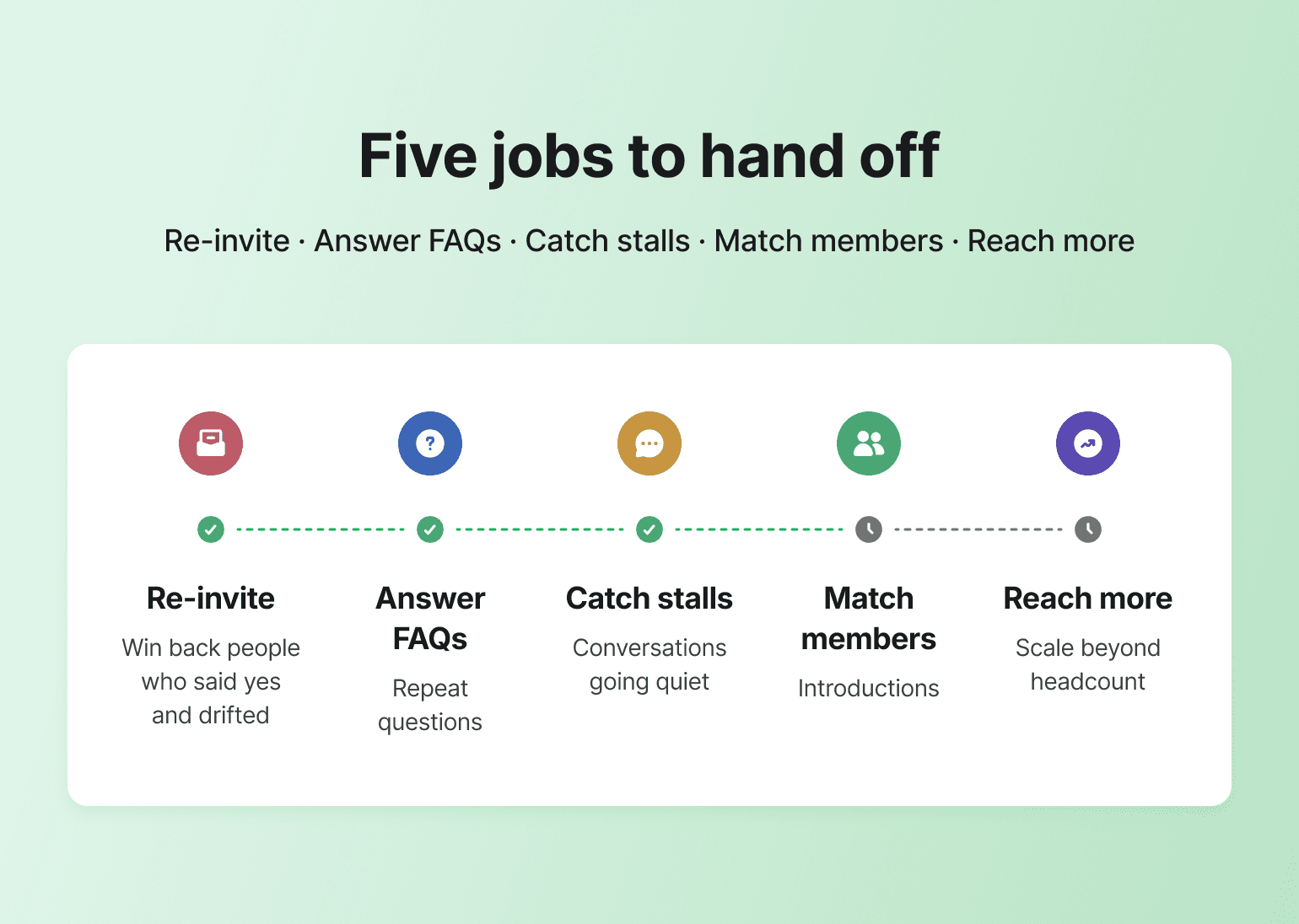
Win back the people who said yes and drifted
Some of the people most likely to join already said yes once. You invited them, the interest was there, and then the email got buried and they went quiet. Left alone, that's a steady trickle of warm prospects lost every week.
Rachel Starr, a membership strategist and Circle Certified Partner, put this on autopilot. An automation runs on a weekly schedule, finds everyone invited in the last seven days who never accepted, and resends them the invitation. "It's quietly brought back members I would have otherwise lost," she says. It skips test accounts and duplicates, so each person gets one nudge and then ages out, rather than a spam loop. The automation does the chasing, but you still own the words: it sends whatever invite copy you've saved, so the warmth has to come from you first.
💡 Tip: Start with human warmth, and multiply that with automation and AI. If you start with generic, you'll get generic back.
Answer the repeat questions so you don't have to
Every creator loses hours each week to the same handful of questions — how to get started, where to find things, the FAQs you've answered a hundred times — and they arrive everywhere: email, DMs, social, your community. In Circle's own community, AI workflows answered more than 100 member questions in a single month and freed up an estimated 45 to 65 hours once moderation and feed cleanup were counted.
This is the operational layer Circle AI is built for — trained on your spaces, courses, and posts, it fields those repeat questions around the clock so the answers people get sound like yours even when you're asleep, while you stay the one who handles anything that needs a real read on a person.

Answered before you wake up.
Catch the conversations before they go cold
The threads that stall are where retention quietly leaks: someone posts a question or shares a win, nobody responds in the first day or two, and the moment passes. Multiply that across a week and the misses add up.
Rachel also turned her Monday triage into a standing job for AI. Every Monday morning a recap of her Circle community lands in her inbox, already sorted into four buckets: threads that need her reply first, good conversations that stalled and could use a nudge, member wins worth celebrating, and healthy discussions she can leave alone. Each item is one line with a link straight to the post, ordered by what needs her first. The triage that used to eat an hour now takes about ten minutes, and she spends the time she saves replying — the part only she can do.
The natural next step is an agent that doesn't wait for Monday: one that keeps a running list of what needs you next, re-prioritizing as the week moves, and that you can point at any backlog that piles up — unanswered DMs, comments, a support queue.
Introduce the people who should meet
Introductions are the thing everyone running a community knows they should make and nobody has the bandwidth for: when someone new posts an intro, who are the few people they should meet? Doing it by hand means holding every member's profile and backstory in your head, which is slow and error-prone.
Linart Seprioto's team at Circle Studios, which had just migrated a 1,300-member community to Circle from Slack, solved it differently: they had AI read every intro post and, for each newcomer, suggest a handful of existing members who shared their goals, challenges, or industry. That was a full set of matches across 100+ intros in about twenty minutes. AI does the reading and the shortlist; you tag the person who's the best fit and make the introduction yourself, because a connection brokered by a real person is the one that sticks.
Reach more people than your headcount should allow
The real prize is serving far more people than your team size should allow. Take the Entreprenista League, the female-founders network Courtney Spritzer and Stephanie Cartin grew out of their podcast: a five-person community team runs more than 300 events a year for roughly 3,000 members, with a Circle AI Agent helping members find their way around so the team isn't fielding the same "where do I…" questions all day. That's the kind of reach that used to demand a much bigger team — the AI and the platform absorb the overhead so the humans spend their time where members actually feel it.
If you want to go deeper on the tactics above, we've broken down where to start and what to track as you hand more work over.
Why running lean depends on one connected foundation
Most of the wins above look small on their own. They compound when the tools behind them share the same data. Picture the full path a creator runs — someone finds you on social, lands on your site, joins your email list, buys a course, and becomes part of your community. When AI sits on top of all of it in one place, the agent answering a question already knows what that person bought, the welcome workflow knows how they found you, and the Monday recap knows who's gone quiet since their last purchase. Bolt a separate AI chatbot onto a tool that doesn't share its data and you're back to stitching systems together by hand — the exact fragmentation that eats a creator's time.
That connected foundation is what Circle is built on: community, courses, events, email, payments, and AI on one platform, so the efficiency and the relationships it protects aren't scattered across systems that barely talk to each other. This is when the efficiency that felt commoditized finally earns its keep — not as your edge, but as what funds the edge no competitor can copy.
The edge no one can copy.
AI for creator entrepreneurs FAQ
Can AI run a creator business by itself?
No. AI can run unattended for stretches, but it works because a human set its scope and checks its judgment, not because it's left alone. Give it the repeatable jobs and clear rules for when to hand a conversation back to you, and it holds up. Point it at decisions that need your read on a person, and it doesn't.
What AI tools do solo creators really need to start?
Fewer than the hype suggests. A general tool like ChatGPT or Claude covers drafting and brainstorming, and once you have people to support — an email list, a course, a community — an AI agent trained on your own content can field the questions that come up again and again. Start with one job you already dread, prove it works, and expand from there rather than buying a stack of tools you'll never fully use.
Will AI replace coaches and creators?
AI replaces tasks, not relationships. The parts of your work that are repetitive and rules-based are the parts AI does well; the parts that depend on trust, judgment, and human connection are exactly what people value and what keeps them paying. Used well, AI gives you more time for the second kind of work, not less.
Where should a creator start with AI?
Start where the work is repetitive, low-risk, and easy to measure — usually the questions you answer over and over and the steps every new follower or customer goes through. Those are the safest places to hand work to AI before you trust it with anything closer to your people. Once that's running smoothly, move on to engagement nudges and support.
Is AI worth it for a one-person business?
For most creator businesses, the value is in hours returned. Automating repetitive support can free up dozens of hours a month, which for a solo creator is often the difference between a business that scales and one that stalls. The investment pays off fastest when you aim AI at the busywork that's been crowding out higher-value work.

Head of Product Marketing
JK Sparks is Circle's Head of Product Marketing, shaping the positioning, messaging, and go-to-market strategy behind the company's biggest product launches.