Email segmentation based on what your members actually do
TL;DR
- Email your members based on their specific behaviors and attributes to make sure your message hits home.
- For most creators, the behavior worth segmenting on is scattered across separate tools for courses, payments, and community that don't share a record with their email.
- Once every signal lands on one member profile, the useful segments build themselves.
Ever feel like your email strategy is just you broadcasting into the void, never hearing anything back? It usually means the same email is going to everyone, so most of it lands on the wrong people. The upgrade offer goes to members who already upgraded, the beginner guide goes to your most advanced members, and eventually people stop opening at all.
Email segmentation is how you fix that. You group subscribers by something they share, then tailor each send to the group.
An email that matches what a member has done gives them a reason to keep opening the next one. Done well, segmentation is one of the highest-leverage moves in email: segmented campaigns earn roughly 30% more opens and 50% more clicks than a single blast to the whole list. For a membership business, that gap is the difference between an email list that drives membership renewals and referrals and one that slowly goes quiet.
What email segmentation is
Email segmentation divides your subscriber list into smaller groups based on shared traits, then sends each group a message built for them. You email the 400 active members one thing and the 600 new signups another. In practice, your email platform applies tags to describe people (active member, course completer, event no-show), and a segment combines those tags into a group you can message across multiple categories at once, like people in a specific country who also carry a specific tag.
Segmentation isn't personalization. Segmentation decides who gets a message; personalization shapes what that message says. Segmentation is the "who," and it comes first: pick the wrong group and it no longer matters how good the writing is, because it's reaching people it was never meant for. There's a deliverability payoff too: relevant emails earn more engagement and fewer complaints, which signals your mail is wanted and helps protect your inbox placement.
Four standard types of email segmentation
Segmentation usually falls into four categories:
| Type | What it groups by | Example from this piece |
|---|---|---|
| Demographic | Measurable traits — age, occupation, career stage | Bookkeeping creator splitting sole proprietors from agency owners |
| Geographic | Location, timezone, language | Language educator sending workshop invites at three local times |
| Psychographic | Values, attitudes, mindset | Running coach separating first-5K members from marathon PR chasers |
| Behavioral | What people do — click, buy, complete, ignore | One member clicks every "advanced tactics" link; another only opens "getting started" posts |
The first three describe who someone is. The fourth describes what they've done, and for community businesses that's usually where the strongest signal lives. Two members can share an age bracket, a city, and a purchase date, and one will renew for three years while the other churns after month one. Behavior is what tells them apart.
The behavioral segments that matter most for community builders
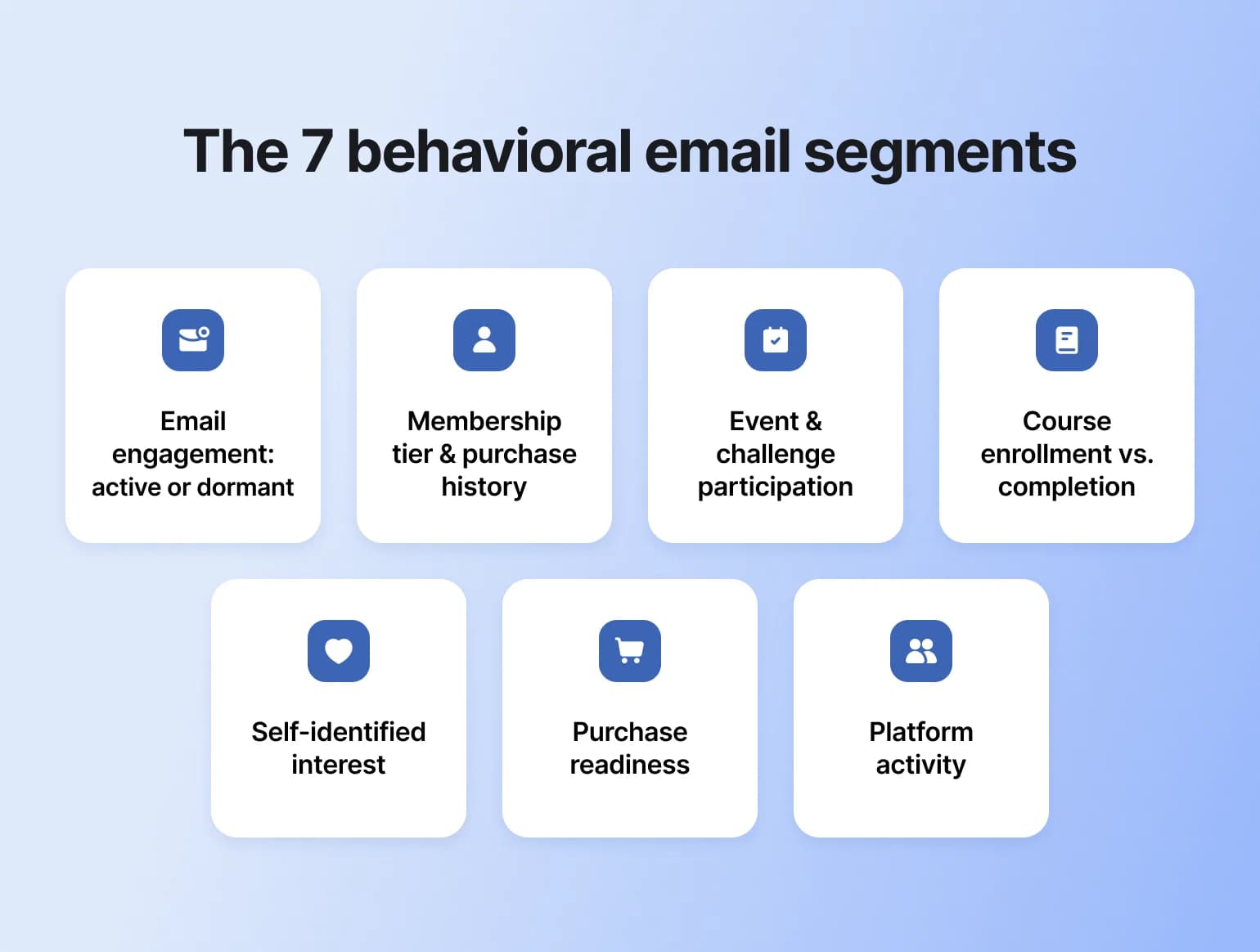
Start with two or three of these segments, then expand. These behavioral segments consistently earn their keep:
- Email engagement (active vs. dormant): how consistently a subscriber opens and clicks. Your most engaged subscribers can take more frequent sends, while dormant ones need a re-engagement track before they slip away.
- Membership tier and purchase history: what someone has already bought or joined, from free vs paid to one-time buyer vs subscriber. Paying members are ready for content that builds on what they own; free members need trust before any pitch.
- Event and challenge participation: who attended a live session versus who registered and skipped it. Attendees want a follow-up on what they learned; no-shows need the replay and a different nudge.
- Course enrollment vs. completion: enrolling and finishing are different behaviors. A course creator can send finishers a next step, while someone who never opened lesson one needs re-engagement, not another lesson.
- Self-identified interest: when a member clicks a link that signals "I'm a coach" or "I want the advanced track." They just told you who they are, so message them accordingly instead of guessing.
- Purchase readiness: signals that someone is about to buy but hasn't yet, like booking a discovery call or visiting your program page. Unlike purchase history, it looks forward, so these hot leads deserve a direct, timely offer.
- Platform activity: what members do inside your community, like logging in and posting, separate from whether they open your emails. An active member can look dormant in your inbox, so this stops the "we miss you" note going to someone who logged in an hour ago.
The segments that change results usually combine two of these signals, which is where a generic newsletter turns into an email that reads like it was written for one person. Take a free member who logged into the community five times last month and opened your last three emails, but has never bought. They don't need the general newsletter. They need one email: a short story from a member who started where they are, plus a dated invite to the paid tier.
Or take someone who bought your program, finished module one, then left module two unopened for two weeks. Skip the weekly digest. Send a single "stuck on module two?" email with one small win they can get in five minutes. And a top-tier member whose logins fell from most weeks to none? Handle that one by hand, with a short personal note from you, not an automated "we miss you."
Keeping one top-tier member is worth far more than a random cold signup. Each of these combines two signals a standalone email tool would file in two different places. That's why they beat the batch-and-blast, and why they're hard to build.

Revealing the secrets, and the segments.
Why many creators segment with half the picture
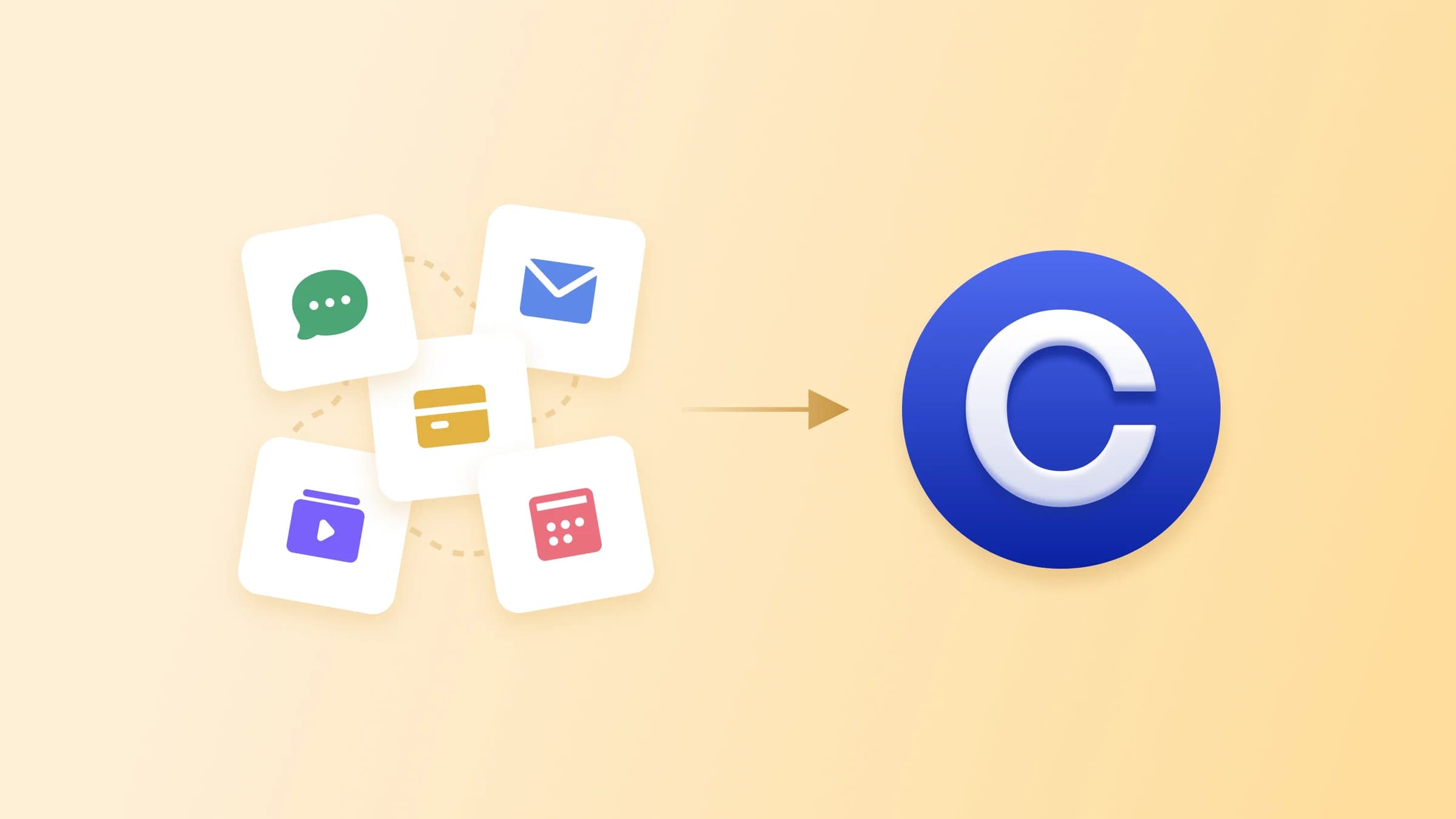
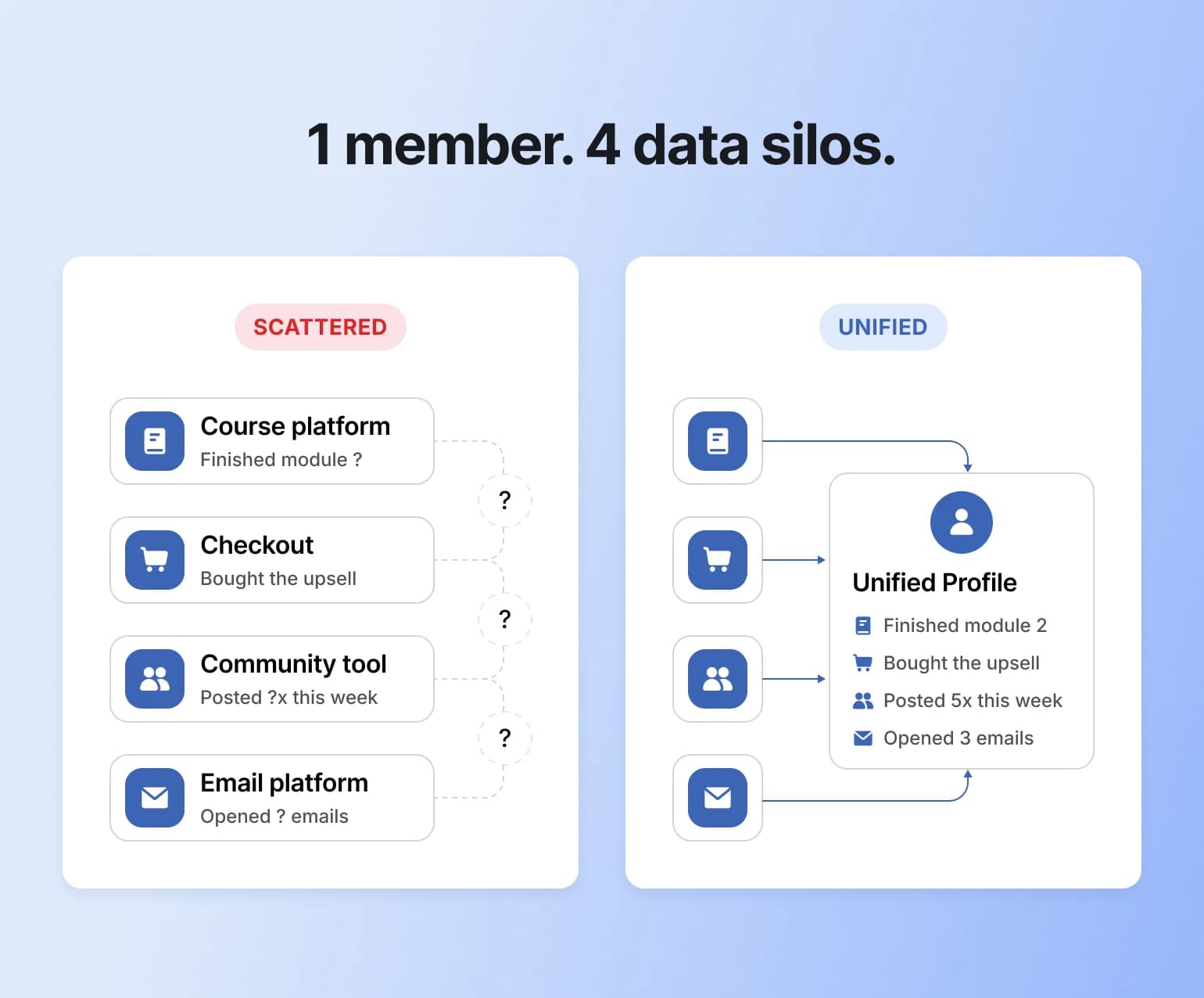
The catch is that most email platforms can't see the behavior any of those segments depend on. Course progress lives in your course platform. Payments live in your checkout. Discussion activity and event attendance live in your community tool. Each becomes a separate database with no shared member profile, so your email platform has no idea who finished the course, who's active in the community, or who bought the upsell. You end up reconciling data by hand, and solo operators usually leave it undone. The more your website, courses, email, community, checkout, automation, scheduling, and CRM don't talk to each other, the harder it gets to use member data well.
The pattern shows up clearly in businesses that eventually consolidated. Before it moved onto Circle, Codecademy's community was scattered across five platforms, which head of community Jonathan Truong said made measuring engagement "like comparing apples to oranges to cars to tennis balls." The team evaluated more than 12 platforms before migrating piece by piece, and since the May 2024 launch, the community has grown to about 100K members, with 82% of learners achieving their goals and more than 30 clubs launched from zero.
Pat Flynn's Smart Passive Income hit the same wall at a different scale: courses on Teachable, community on Facebook, events on Zoom, held together with Zapier. After moving all of it onto Circle and shifting to cohort-based accelerators with built-in accountability, community now drives 58% of SPI's total revenue, with 2.5x to 3x higher course completion rates and 40.3% year-over-year revenue growth.
Fixing segmentation usually means fixing the tool stack first.
💡 From the Circle community: When Income School moved off its WordPress plugin patchwork onto Circle, the whole migration took 30 days start to finish with zero members churned.
Once behavioral signals from every system land on one member record, the segments you couldn't build before start to build themselves.
Email segmentation works best when the data is already there
Segmentation means grouping people by what they do and sending each group something relevant. Getting that data out of five different tools has always been the hard part. Solve that, and behavioral segmentation stops being a project you keep meaning to do and becomes something that runs quietly in the background while you focus on your members.
When your community, courses, payments, and email share one record on Circle, you stop reconciling spreadsheets and start emailing people based on what they did, the moment they do it.
One record. Every signal.
Email segmentation FAQ
What's the difference between email segmentation and personalization?
Segmentation decides who receives a message; personalization shapes what that message says. You might segment your list into course completers, then personalize each email with the member's name and the specific course they finished. They work together, but segmentation comes first.
How many segments should I start with?
Start with two or three high-impact segments tied to one clear goal, then expand as you learn. Layering too many criteria into a single segment shrinks it to a size where results become unreliable, so keep your first set of segments simple before adding complexity.
What's the best way to segment a membership or course community?
Behavioral segmentation, based on what members do, is often more useful than demographic or geographic criteria for community businesses. Behavioral signals reveal intent, while members often share the same age bracket or location.
Why can't my email platform segment by course completions or community activity?
That data usually lives in separate systems, your course platform, your community platform, and your checkout, none of which share a profile with your email system. Without a unified member record, your email platform only sees opens and clicks.
Should I use lists or tags for segmentation?
Use tags for anything that changes, like engagement level or member status, because tags update automatically as behavior shifts. Reserve lists for broad, stable groups and custom fields for fixed attributes like join date. Behavior-based tags let segments update themselves instead of requiring manual sorting.
Community Content Marketer
Arina is Circle’s community content marketer, sharing insights on community growth, GTM strategy, and storytelling for solopreneurs.