How to build a profitable social media sales funnel
TL;DR
- A social media sales funnel moves followers onto an email list or community you own, so you can follow up and sell without relying on the feed.
- Instagram, TikTok, and LinkedIn each send people off a post differently, from comment-triggered DMs to a single bio link, so build around what your platform offers.
- Check each step of the funnel weekly, from post to repeat purchase, and fix the earliest place people drop off.
Sixteen months into running her business, Ashley Renders still didn't have a website. She'd built an audience of more than 20,000 people with daily Instagram Reels about storytelling, and every sale ran through organic social media. So she built a landing page in Notion in 10 minutes—on a train—and sent followers to a $20 two-day challenge.
The landing page gave her followers somewhere to go outside the feed, which matters because selling straight from the feed is fragile for two reasons. First, most followers never see a given post: for brand accounts with 10,000 to 50,000 followers, the average Instagram reach rate is 5.50%. At that rate, a post from an account with 20,000 followers would reach about 1,100 of them. Creator accounts can differ, but the pattern holds: most of your audience doesn’t see any single post.
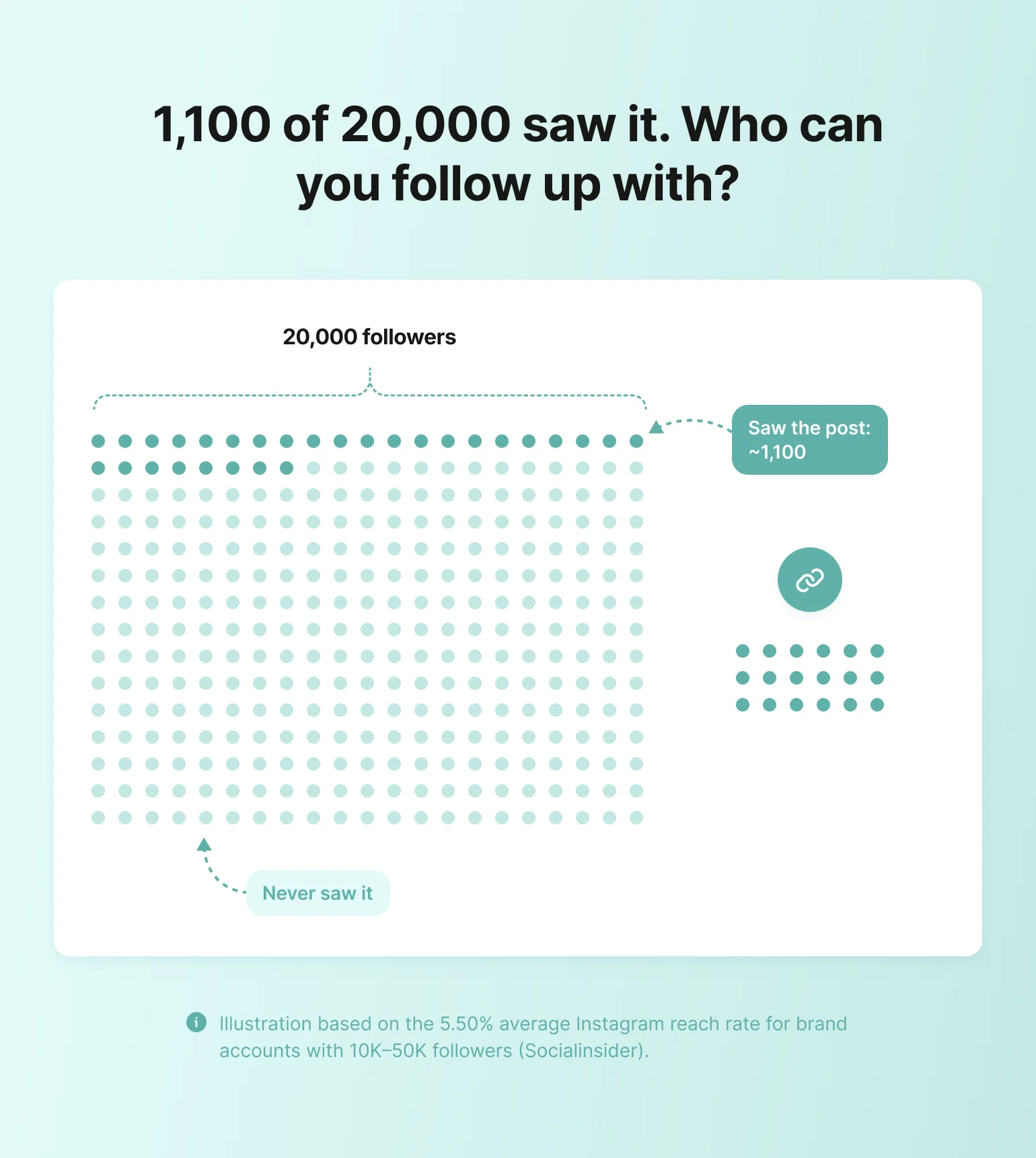
Second, the people who do see it leave no record, so you can't follow up unless the feed shows you to them again.
Below, you'll learn how to move followers from Instagram, TikTok, and LinkedIn onto a list or community you own, then turn them into paying members.
What is a social media sales funnel?
A social media sales funnel is the path that moves someone from discovering your work on a social platform to taking a clear next step you can measure. For a creator, coach, or educator, that path keeps going past the first click—into an owned touchpoint, a paid offer, onboarding, retention, and (hopefully) advocacy.
Here's what each stage looks like from the follower's side and yours:
| Stage | Follower's action | Your action | Where it happens | Primary measure |
|---|---|---|---|---|
| Discovery | Views, saves, or comments on a useful post | Publish one promise and one CTA | Social post or profile | Reach and meaningful engagement |
| Owned capture | Requests the resource, registers, or subscribes | Deliver it and capture permission to follow up | Email list, free community, event registration, or landing page | Owned signups |
| Paid entry | Buys one clearly defined result | Present one offer at a proportionate price | Sales page and checkout | Purchases |
| Onboarding and retention | Completes a first action and returns | Direct them to the right space, course, or event | Member experience | First action completed and repeat participation |
| Advocacy | Shares a result, referral, or testimonial | Make member outcomes visible | Community and social channels | Referrals and member-led growth |
The rows show the usual order, but buyers can skip ahead. Someone might buy a low-priced workshop straight from a post and only join your email list afterward, so track each stage even when it happens out of sequence.
How to build a social media sales funnel on Instagram, TikTok, or LinkedIn
Every platform helps people discover you, but each one gives you a different route for moving them off it and into a community you own. Here's how the three compare:
| Platform | What drives discovery | How people leave the platform | Natural first owned step |
|---|---|---|---|
| Reels and carousels | Comment-to-DM, Story links, and the bio link | An email signup for a free resource, or a low-ticket challenge | |
| TikTok | The For You feed, search, and lives | One website link, unlocked at 1,000 followers in most markets | A landing page that you update as offers change |
| Posts and newsletters | Links in your profile's Featured section | An email signup or a free workshop registration |
Whichever platform you start on, the job is the same: get the follower onto one destination you own.
Instagram: move followers from comments and DMs onto your list
On Instagram, a post can get you seen, but it can’t capture anyone’s email. The capture happens in the step after the post, when you ask people to comment, tap a link, or visit your bio. Decide where that ask will send people before you publish. If you’re still choosing which Instagram income streams to build around, our guide to making money on Instagram compares nine of them.
Each route fits a different kind of offer:
- Comment keyword, for a single free resource. A meal-prep coach posts one high-protein lunch and asks people to comment "LUNCH" for the full week's plan. Instagram's private replies feature lets a DM tool like ManyChat send the link to everyone who comments.
- Story link, for anything with a deadline. A photography teacher announces a free editing workshop happening Thursday and adds a link sticker to that day's Story. Viewers can register in one tap before the Story disappears 24 hours later.
- Bio link, for offers that are always open. A piano teacher keeps her paid membership and her free community in her bio, which holds up to five links. Anyone who finds her account months later can still join.
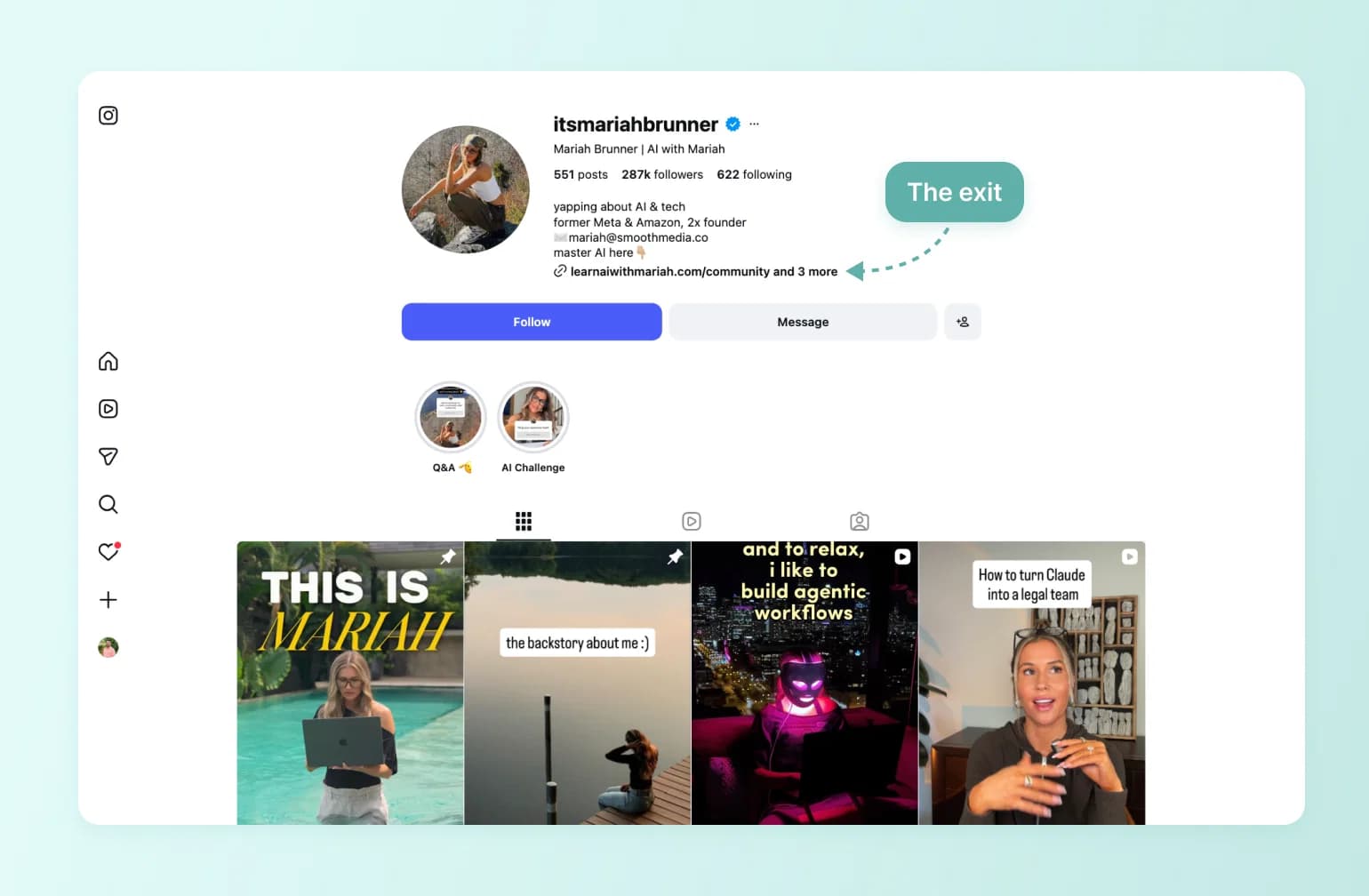 How the comment-keyword route works
Here's how it runs for a free workshop-planning checklist:
- The post says, "Comment CHECKLIST and I'll send the workshop-planning checklist."
- An automated DM replies to each comment and asks for an email address.
- The checklist arrives in their inbox, and the follower is now on your list.
- The next email connects the checklist to one paid offer, such as a live challenge where they finish the plan.
Every message in that sequence points to one next step, so nobody has to choose between offers.
Wherever the link points, keep the destination and the offer in one place. Ashley's first challenges ran in Facebook, held together with Stan Store and Zapier. After she moved everything to Circle, her Reels pointed to one landing page, now rebuilt with Circle's website builder, and that page links straight to checkout for the challenge.
TikTok: send viewers to one link, and add lives once you qualify
TikTok shows your videos to people who don't follow you yet, through the For You feed and search. It's built for reach, but it gives you very few ways to send people off the app.
The main exit is the website field, a single clickable link that sits under your bio. It's the only place on your TikTok profile where a viewer can tap through to a page you own, so it carries your whole funnel. Depending on your market, TikTok unlocks it for personal accounts at 1,000 followers. In some markets, a registered business account can get it sooner by submitting its business documents. Availability varies by country, so check which options your account shows.
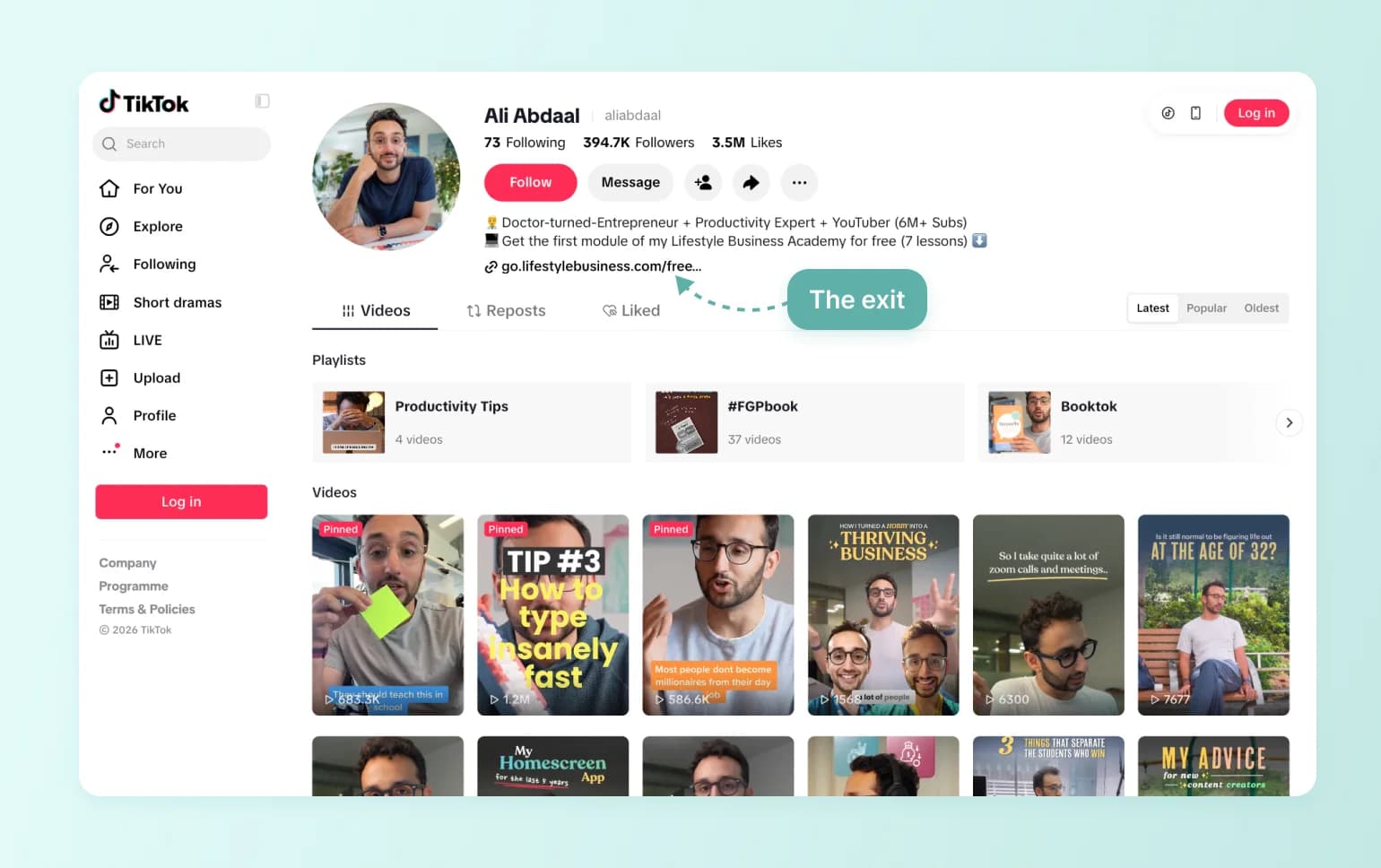
Until then, check the Links section of your profile, where TikTok may still let you connect your Instagram or YouTube account. Instagram's bio links and comment-to-DM sequences have no follower minimum, so that's the best place to send early viewers.
Once the website field unlocks, point it at a landing page with one signup form, and change the offer on that page instead of swapping the link.
Here's what that looks like in a few niches:
- Fitness coach. A 30-second video fixes one common squat mistake and ends with "Free 7-day mobility plan, link in my profile." The landing page collects an email and sends the plan.
- Language teacher. A video corrects one pronunciation mistake beginners make and offers a free guide to the sounds they find hardest. The signup form delivers the guide and adds the viewer to the email list.
- Career coach. A video rewrites one viewer's résumé headline on screen and offers the full résumé template. The template arrives by email, followed by an invite to a paid résumé workshop.
In each case, the video shows one fix and the free resource takes the viewer one step further.
TikTok LIVE unlocks at the same follower mark, and you need to be 18 or older. Check TikTok’s LIVE eligibility page to see whether LIVE is available on your account. A live works as a free preview of your paid offer, so teach first, pitch briefly, and leave room for questions. Close every live by naming the one offer behind your profile link.
Community Example: Hoon Lee, who runs Everyday Korean, uses this split in his live workshops: 40 minutes of teaching, 20 minutes of selling, and 30 minutes of Q&A. His workshops run outside TikTok, with seats filled by Instagram and Facebook ads, but the same structure fits a TikTok LIVE.
LinkedIn: use your profile and newsletter as the bridge
LinkedIn suits coaches, consultants, and educators who sell to professionals. Posts handle discovery, and two features handle the hand-off. LinkedIn's Featured section sits on your profile and accepts external links, so pin your lead magnet or workshop registration there.
LinkedIn newsletters are open to every member, and subscribers get notified each time you publish. People subscribe inside LinkedIn, though, so treat the newsletter as discovery. Use each edition to point readers to something you own, like an email signup or a free workshop.
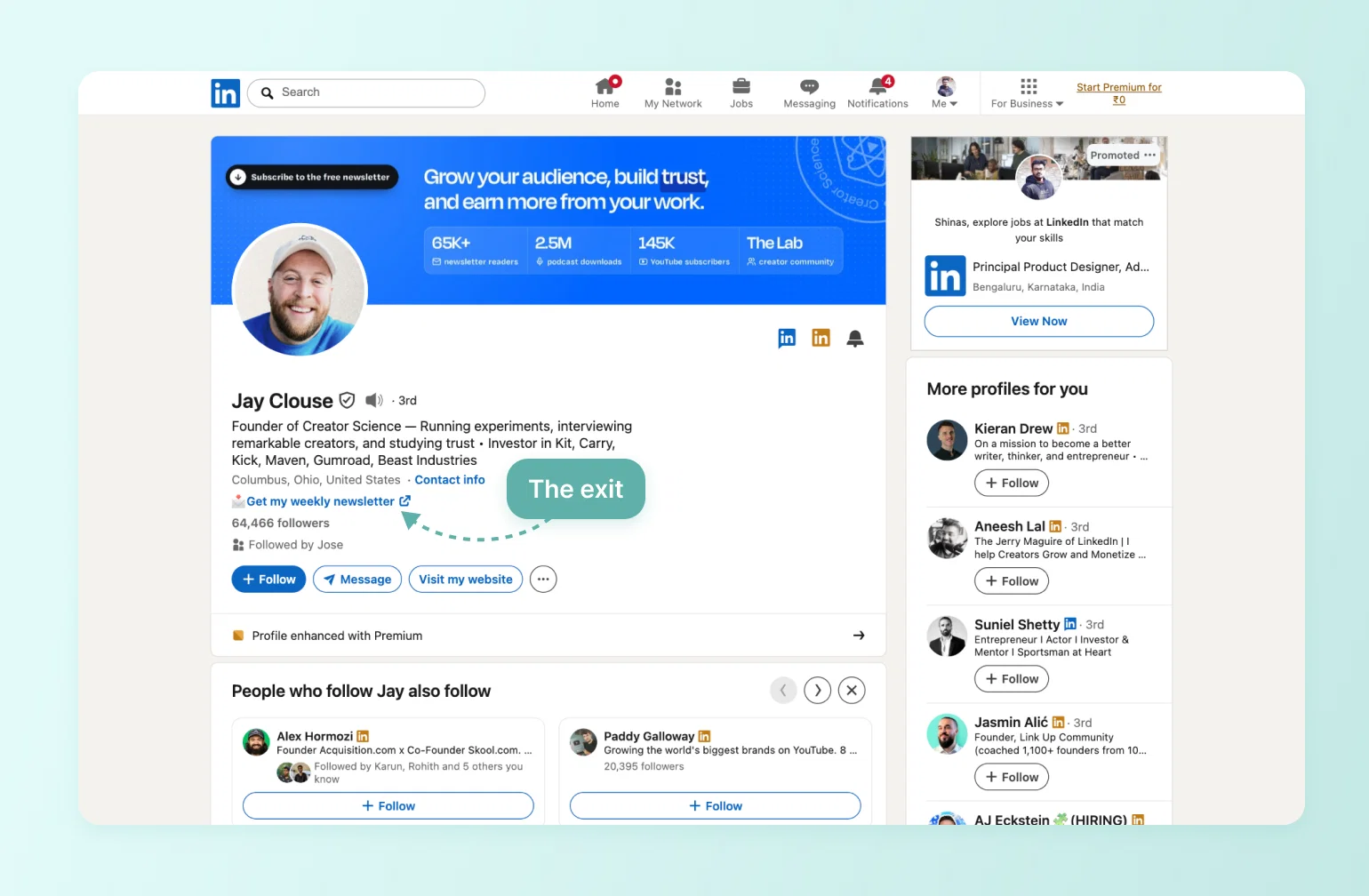
How to turn new followers into paying members
Each platform's exit sends people somewhere. Where they land, and what you offer them once they're there, decides whether a follower ever becomes a paying member.
Choose where to send new followers
Pick the destination by what the post promised and what you plan to sell next. Here's how each option plays out:
| Destination | Best for | Example |
|---|---|---|
| Email list | A downloadable resource | A bookkeeping coach posts three mistakes freelancers make with quarterly taxes and offers a free deduction checklist. It lands in their inbox, and the follow-up emails introduce a paid tax-prep workshop. |
| Event registration | A live training | A yoga teacher offers a free 30-minute session on easing lower-back tightness. Registering captures the email, and the session ends with an invite to a paid six-week program. |
| Free community | An ongoing conversation | A UX designer hosts a weekly portfolio critique for career switchers. People join a free community to post their work, and a paid tier adds one-on-one reviews. |
| Landing page | An offer that’s always (or sometimes) open | A sourdough baker sells a self-paced course that runs year-round. The page explains what’s inside and takes payment, so the link in the bio never has to change. |
Whichever you choose, it should lead naturally into your first paid offer.
The bigger the offer, the more context the owned step has to carry. Sabby Bagga, co-founder of Agent on Tube Academy, sells a $10K+ service to real estate agents. He often spent the first part of his sales calls proving he was credible.
So he put a Circle community between his content and the call, where prospects could see client wins and hear from members before booking. A short onboarding form asks new members whether they want to hear about his one-on-one services, and a yes books the call automatically. Within three months, Sabby added $60K in new business, a 10x ROI.
Keep the free step and the paid step in one system. A paid workshop can sit inside a private Space that opens the moment payment clears. Email Hub signup forms sync instantly, so the follower who asked for a template and the member who paid sit on the same profile.

Own the next step.
Set the price of your first offer
Once someone is on your list or in your free community, the next ask is your first paid offer. Its job is to get a yes without a long explanation. That usually means a low price and one specific result the buyer can picture, like finishing a plan in a two-day challenge or fixing one problem in a live workshop.
Two tiers of the same offer make the decision easier. Buyers choose how much access they want, such as the workshop alone or the workshop plus live coaching, without having to understand a second product.
Plan the step after that first purchase before you launch. Someone who has already paid you once is the easiest person to invite into something ongoing, like a membership, and that next invite is the core of a membership funnel strategy.Angelica Grunewald built hers this way. She started by selling individual AI automation courses for a few hundred dollars each. When she later launched a membership at $99 a month or $949 a year, she offered everyone who had already bought a course a free 30-day trial. Her one-time courses became the way into her ongoing membership.
Community tip: The exception is a warm waitlist, which can carry a bigger first offer. Burnout and career strategist Tara Kermiet piloted a six-week cohort after feedback from her social media audience. She built a 75-person waitlist first and gave it a $797 price against the $997 public price. The cohort opened with 10 founding members, against her goal of seven.
Plan what buyers see right after checkout
What happens in the minute after payment decides whether the buyer logs in a second time. They should land inside the thing they were promised, with a welcome that says where to go first. Here's the sequence:
- Checkout sends the buyer straight into the Space or course named on the sales page.
- A welcome message states one observable first action, such as: "Open the first lesson, complete the planning prompt, and post your answer." It links to that discussion directly, never the home feed.
- The next live event or discussion gives them a reason to return inside seven days.
- Buyers who post get a short acknowledgment, and buyers who haven't logged in since get a direct-link nudge.
Every step points to one place, which is most of what good community onboarding comes down to.
Circle's branded checkout and community paywalls grant Space access the moment payment clears. From there, community workflows on the Business plan and above can filter buyers by when they last logged in and send the nudge to anyone who hasn't come back.
How to measure your social media sales funnel
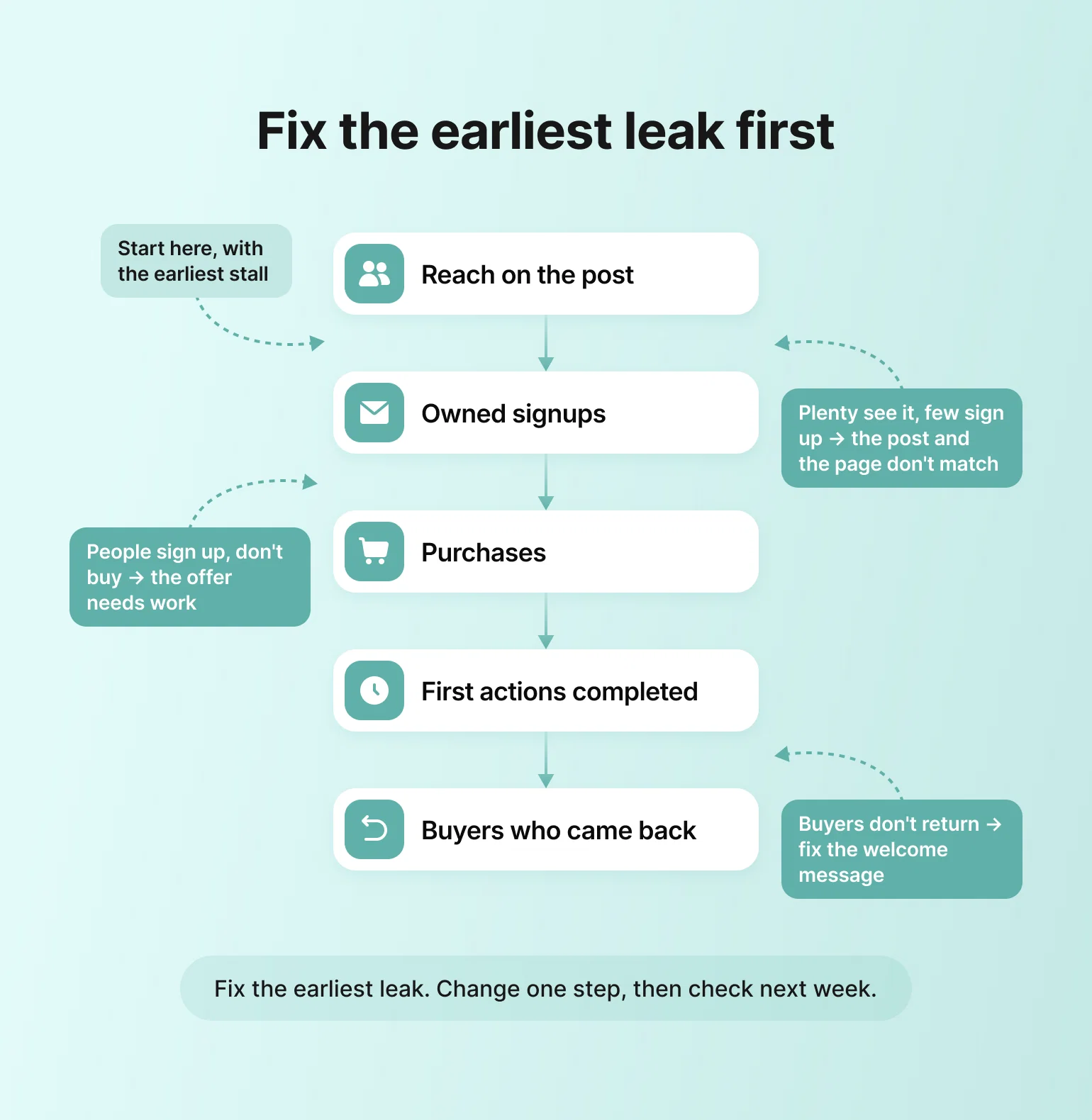
Once the path runs end to end, a weekly check shows you where people drop out. Write down five numbers:
- Reach on the post
- Owned signups from it
- Purchases from those signups
- First actions completed by those buyers
- Buyers who came back in the following weeks
Then compare each number with the week before, and find the earliest one that stalls. If plenty of people see the post but few sign up, the post and the page don't match. If people sign up but don't buy, the offer needs work. If buyers don't come back, fix the welcome message.
Change only that one step, and leave the rest alone until your next check. That way, you'll know what made the difference.
Run your whole social media sales funnel from one place with Circle
Every funnel in this guide depends on hand-offs: from post to signup, signup to purchase, and purchase to a member's first post. Each one is easier to track and fix when your landing page, email list, checkout, and community live in the same place instead of four separate tools.
Circle connects all four. A follower who signs up through an Email Hub form and later buys lands on the same member profile, so their signup and purchase stay connected.
Email Hub automations and community workflows handle the predictable follow-up, like a welcome email when someone joins, a follow-up after a purchase, and a nudge for buyers who haven't logged in. Coaching, feedback on member work, and anything sensitive stay with you.
From there, the funnel can feed itself. Give members a dedicated Space to share their wins, and ask permission before featuring one in a post. A result in a member's own words does more for your next follower than any claim you could make yourself, and these member advocacy tactics take it further.
Begin with one platform, one owned destination, one first offer, and one welcome path.
Give followers somewhere to go.
Social media sales funnel FAQ
Which platform should I build my funnel on first?
Start where people already respond to you. Count comments and DMs, since they say more than follower totals. Build the full path on that one platform before adding a second. When you do expand, content repurposing keeps the workload manageable, and pointing both platforms at the same owned destination keeps your numbers comparable.
How many followers do I need before building a funnel?
Fewer than you think. The right 20 to 50 people matter more than a large audience when you're starting, and that small group is where your first 100 paying members come from. Build the path once people repeatedly ask for the same next step: capture that question, create one destination that answers it, and invite those people first.
Should I start with organic content or paid social?
Organic first. Run one path organically until owned signups and sales show up in your weekly numbers. Paid traffic can then scale a path that already converts, the way paid ads now fill Hoon Lee's workshops. It can't fix a confusing offer, though—it only makes you pay for the confusion faster. To work out what you can afford to pay for each member before you start, see our guide to building a paid media strategy your membership can afford.
What makes a good lead magnet for a community funnel?
One that solves a narrow problem and ends where your paid offer begins. A lead magnet that fully solves the problem leaves no reason to buy. A template that gets someone halfway, with the finish covered in your workshop, gives them one.
How do I track buyers who move between social platforms, email, and community?
Give each platform its own destination link, such as a separate signup form or landing page per channel. Record the same stages for each: link visits, owned signups, purchases, and repeat participation. You can then compare hand-offs channel by channel without chasing one attribution number per buyer.
Community Content Marketer
Arina is Circle’s community content marketer, sharing insights on community growth, GTM strategy, and storytelling for solopreneurs.