The most profitable coaching niches in 2026 (real Circle data!)
TL;DR
- The most profitable coaching niche isn't the one with the highest sticker price. It's an urgent problem sold to a buyer with the budget and authority to say yes.
- Circle's data on coaching offers shows business & marketing is the deepest market, real estate and money & investing command the highest group-coaching prices, and most niches land at a median group program between $1,000 and $2,500.
- Favor a niche you can sell again next quarter over one big number you can't repeat.
Three years ago, nobody would have put "AI coach" on a list of profitable coaching niches. Now there are people running full practices around it—helping founders pick tools, teaching marketers how to prompt, coaching executives on what to automate and what to keep human.
The map keeps redrawing itself like that, which makes choosing a niche feel like a guess. And a wrong guess tends to surface in the same place: the end of a discovery call.
Pretend you've just finished one. You quoted $1,500, and the prospect said, “Let me think about it.” That's the median group coaching program price on Circle if you’re coaching around business and marketing, so the number isn't crazy. Meanwhile, another coach in the same niche is quoting far more. The top tenth of programs cost $13,854 or more, over nine times (9x) as much. That's across 1,105 group coaching paywalls in Circle's data, all in one niche, all selling the same kind of offer.
What separates the two isn't the niche label. It's the buyer underneath it: whether they have the budget and the authority to say yes, whether you can reach more buyers like them next quarter, and whether your delivery model turns each engagement into income you can count on.
Most coaches never get to that question. You copy a price from a coach you admire, build the offer around it, and hope it lands. Months later, you still can't say whether the niche can support you.
Below: how to weigh any niche on those terms, what Circle's own coaching-paywall data shows, and how to test your pick with real buyers before you build.
What makes a coaching niche profitable?
Profitability comes down to five things, and only one of them is the price on your offer. Market size isn't on the list: a solo coach's income is capped by the clients you can serve and the ones who renew, not by how many people theoretically have the problem. When two niches look equally good, reach is the tiebreaker, because nothing else produces revenue without a repeatable way to get in front of the right people.
| Factor | What it measures | Weak when | Strong when |
|---|---|---|---|
| Problem urgency | How fast the buyer has to act | The timeline is a year or longer | A decision forces action inside 90 days |
| Buyer purchasing power | Whether they can fund the work | They can't comfortably afford a low-ticket offer | An employer or business controls the budget |
| Ease of targeting | Whether a channel concentrates them | No channel gathers them in one place | A list, referral source, or relationship already reaches them |
| Client capacity | How many you can serve before you're full | Intensive 1:1 caps you fast | Group or cohort delivery serves many at once |
| Renewal or expansion | Whether the work continues | One-and-done once the problem's solved | Ongoing need, or it expands into teams |
The more factors landing on the strong side, the better the niche pays.
The same skill, two different niches
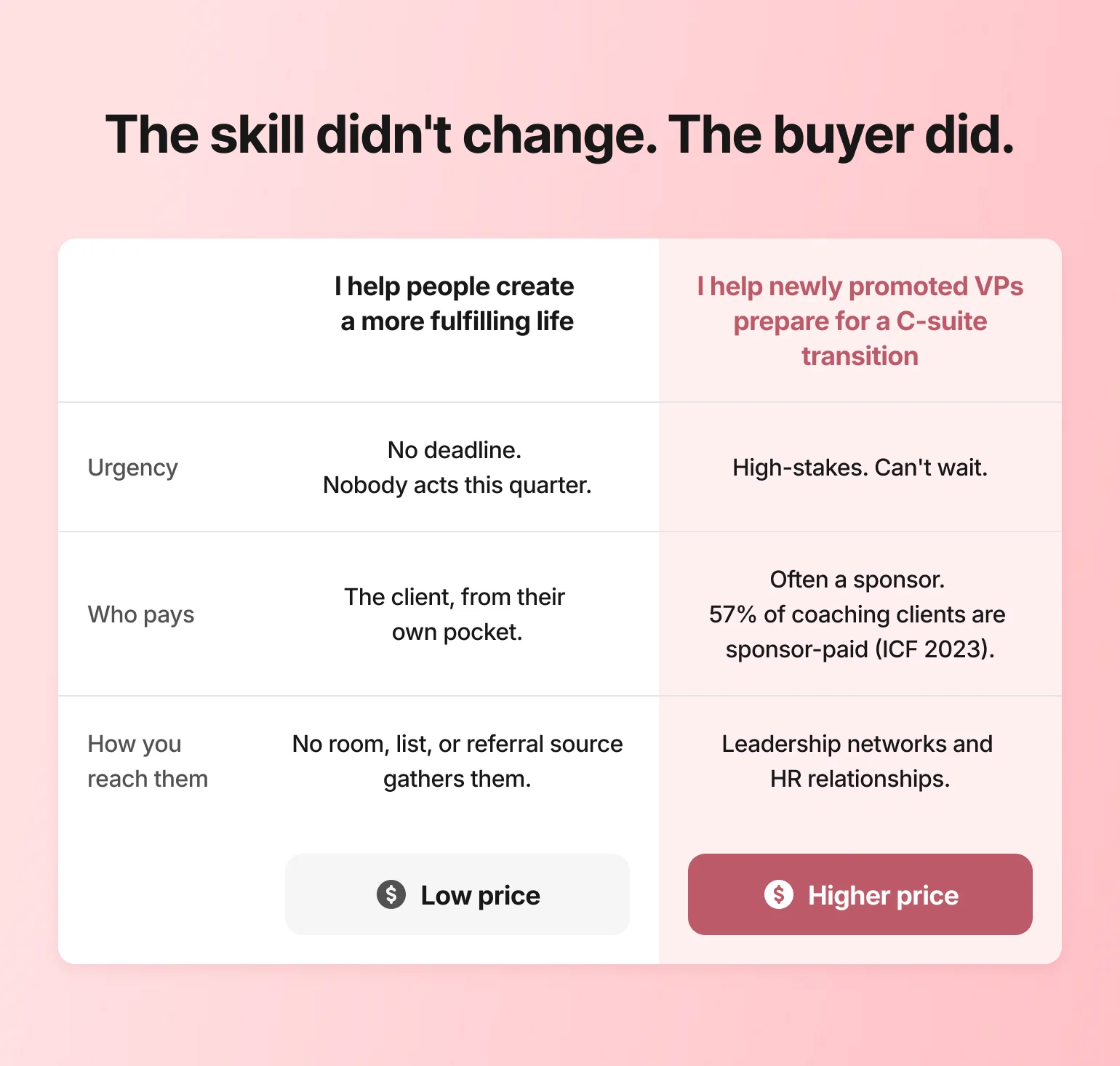
Take one coaching skill and point it at two promises: the broad one, "I help people create a more fulfilling life," and the specific one, "I help newly promoted VPs prepare for a C-suite transition."
The broad promise is rarely urgent enough to make anyone act this quarter. The person paying reaches into their own pocket, which keeps the price low, and no room, list, or referral source gathers "people who want more fulfilling lives."
The VP version flips each factor. A C-suite transition is high-stakes and can't wait. The VP is the one being coached, but someone else often pays: in the International Coaching Federation's 2023 Global Coaching Study, 57% of clients were sponsored, meaning someone other than the client paid. And you can reach these buyers through leadership networks and HR relationships instead of hoping the right person finds you (which is truly its own marketing strategy). That doesn't mean B2B always beats consumer, only that this setup has more working in its favor.
One reality check before you get excited about the higher rate: you'll hit the capacity ceiling first. Reserve 12 client-facing hours a week and hold one 60-minute meeting with each client weekly, and you can carry about 12 clients at once. Biweekly sessions stretch that to about 24, before prep and admin.
What Circle's data shows about coaching prices
Across 18 niches with enough data, the median group coaching program on Circle costs anywhere from $564 to $5,000, and business & marketing is by far the deepest market.
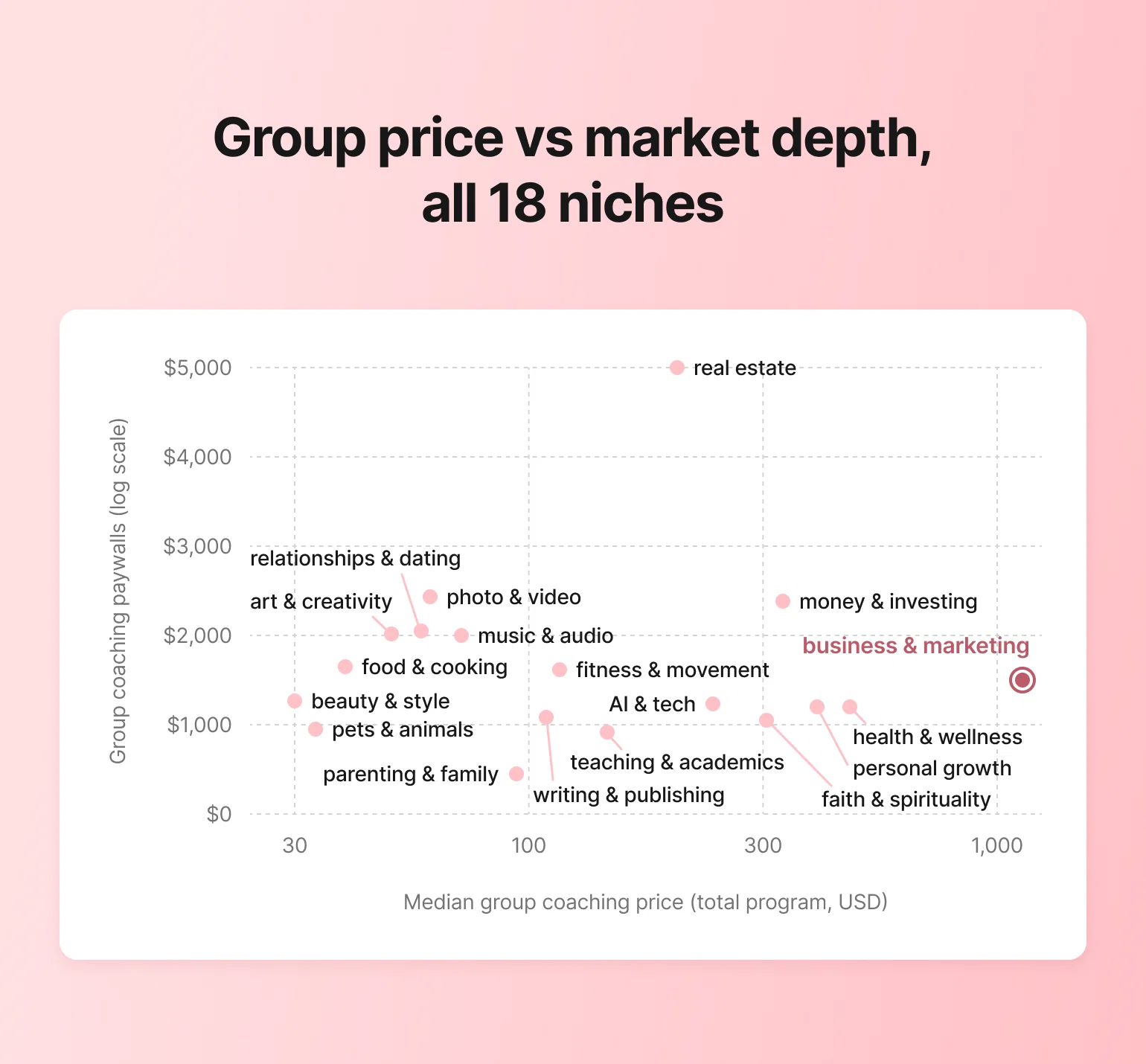
The dataset covers 72,505 paywalls from ~14,691 Circle communities. Every figure here is a list price on a paywall that had at least one completed transaction, not what a coach takes home.
What stands out
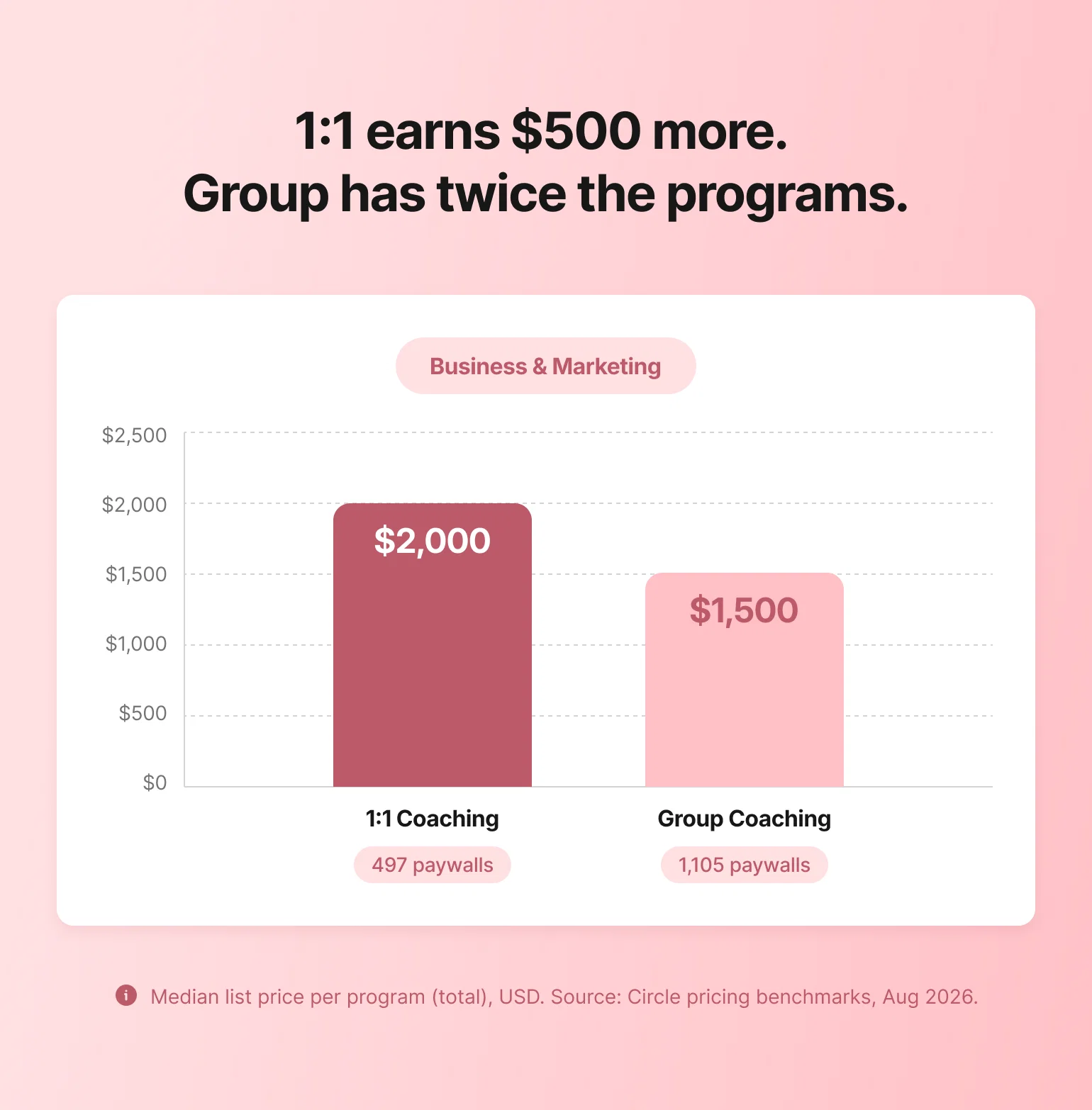
- Business & marketing is the deepest market. 1:1 coaching has a $2,000 median across 497 paywalls, and group coaching has a $1,500 median across 1,105 paywalls.
- Health & wellness and personal growth come next in 1:1 coaching, at lower prices. Health & wellness has a $1,191 median across 469 paywalls. Personal growth has a $1,073 median across 272 paywalls.
- Money & investing pairs depth with a high ceiling. Group coaching has a $2,394 median across 358 paywalls, and the top tenth of programs cost $51,480 or more.
- Real estate group coaching has the highest median. It's $5,000 across 221 paywalls
The pattern fits the rest of this article: the niches that pay well are the ones where buyers have a budget attached to the problem. It also shows where the money isn't: parenting & family sits at a $564 group median.

Price your offer against real data.
Which coaching niches perform best on those criteria?
These are the five categories most coaches choose between. The three that show up in Circle's data come first, ordered by how deep their markets are. Executive and career coaching come last because Circle's categories can't isolate them. None wins on every factor, and the biggest lever is who the buyer is, which can move a niche up or down without changing the coaching at all.
1. Business coaching
Business coaching helps founders, owners, and leadership teams run their business better: growing revenue, cutting costs, sharpening execution. You might fix an operational bottleneck like pricing or onboarding, or structure a leadership team's decisions and accountability. You can deliver it 1:1 or as a monthly retainer for a team, charging more for the team engagement.
In Circle's data, the closest category is business & marketing: a $2,000 median for 1:1 programs and $1,500 for group programs, with more paywalls than any other niche.
Buyers want proof of results they can see before they book a call, and positioning that doesn't overpromise: "document a pricing and onboarding system in 90 days," not an income you can't guarantee. Regulators agree. In January 2025 the FTC proposed expanding its Business Opportunity Rule to cover business coaching that claims to help buyers earn income, and in 2023 it settled with business-coaching company Lurn over deceptive money-making claims, requiring it to turn over $2.5 million.
Agent on Tube Academy shows how to sell a premium-priced service without pushing harder on the pitch. It helps agents use YouTube to build authority and generate warm leads. Rather than lean on the pitch, it used Circle to let prospects see client win stories and peer conversations before booking a call, then added a branded app and an onboarding form that books a call automatically when a new member asks about one-on-one services. It added 200+ members in its first three months and generated $60,000 in new business in that time.
2. Health and wellness coaching
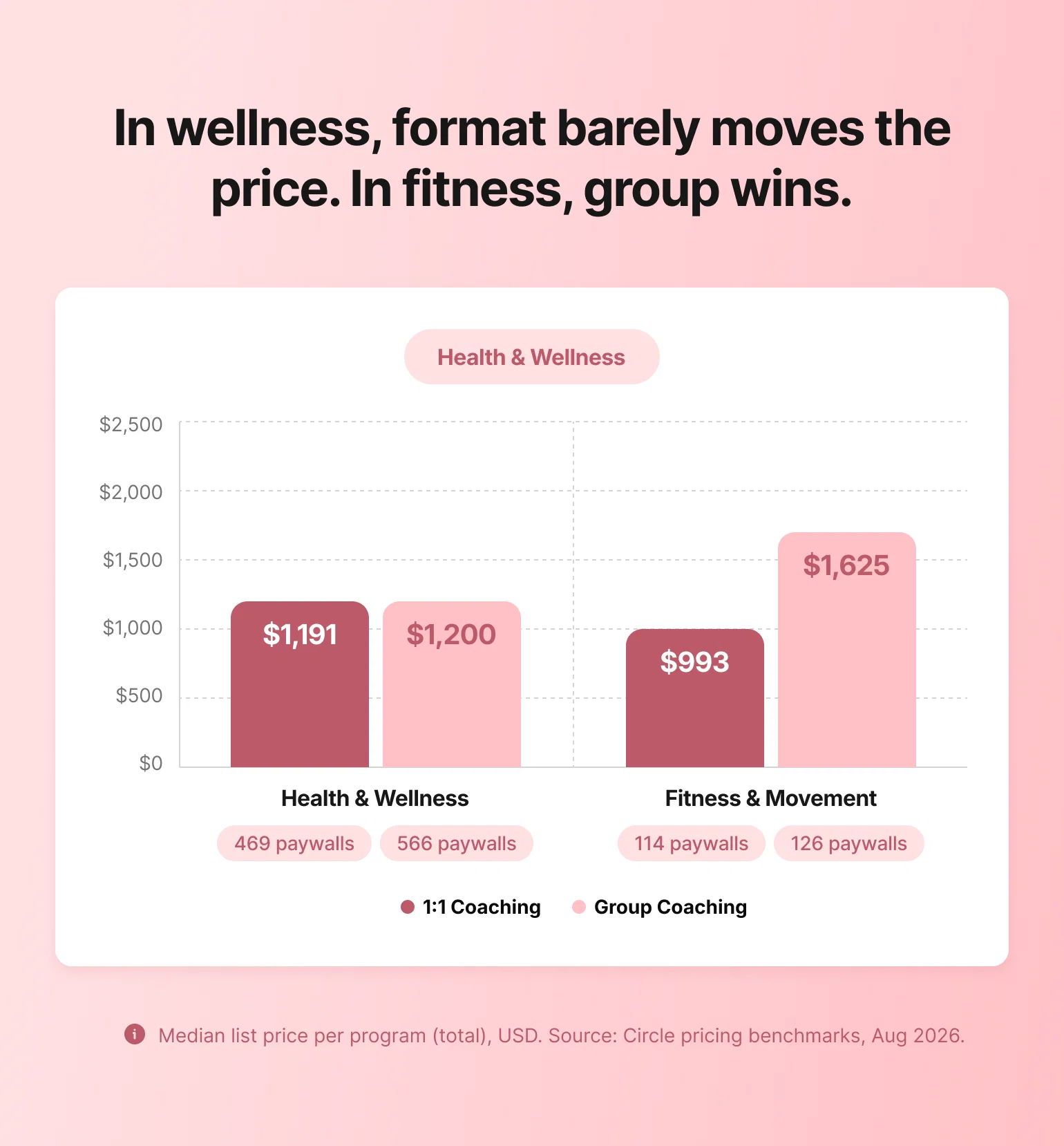
Health and wellness coaching covers fitness, nutrition, and wellness outcomes. In Circle's data the closest categories are health & wellness ($1,191 median for 1:1 and $1,200 for group, with 469 and 556 paywalls) and fitness & movement ($993 and $1,625, with 114 and 126). The ceiling can rise when an employer or clinic funds the work, as long as your credentials and lawful scope fit it.
What buyers check for first is legitimacy. For fitness, that means a recognized training certification, such as NASM's, which is accredited by the NCCA. For broader health and wellness, the National Board Certified Health & Wellness Coach (NBC-HWC) credential is issued by the National Board for Health & Wellness Coaching, which says healthcare systems and wellness programs look for it. Respect the scope-of-practice line: coaches guide behavior change, while the Academy of Nutrition and Dietetics describes medical nutrition therapy as a medical treatment practiced under state licensure and certification laws, which vary. Institutional buyers want one more thing: a named population and a measurable outcome they already budget for.
Two Circle communities show both formats. Anaïs Muller, a state-registered midwife, sells Hormone Flow, a French-language, six-month hormonal health program, for a one-time $1,010. It includes 12 one-to-one video consultations, a personalized protocol, and live Q&A sessions, which is close to the $1,191 median for 1:1 health and wellness coaching. On the group side, nutritionist Julie Daniluk's Thrive Hive costs $139 a month for weekly group coaching calls plus a resource library, and lists 196 members. A member who stays a full year pays about $1,680, above the $1,200 group median. Note that both are list prices from Circle Discover, not what the coaches earn.
3. Life coaching
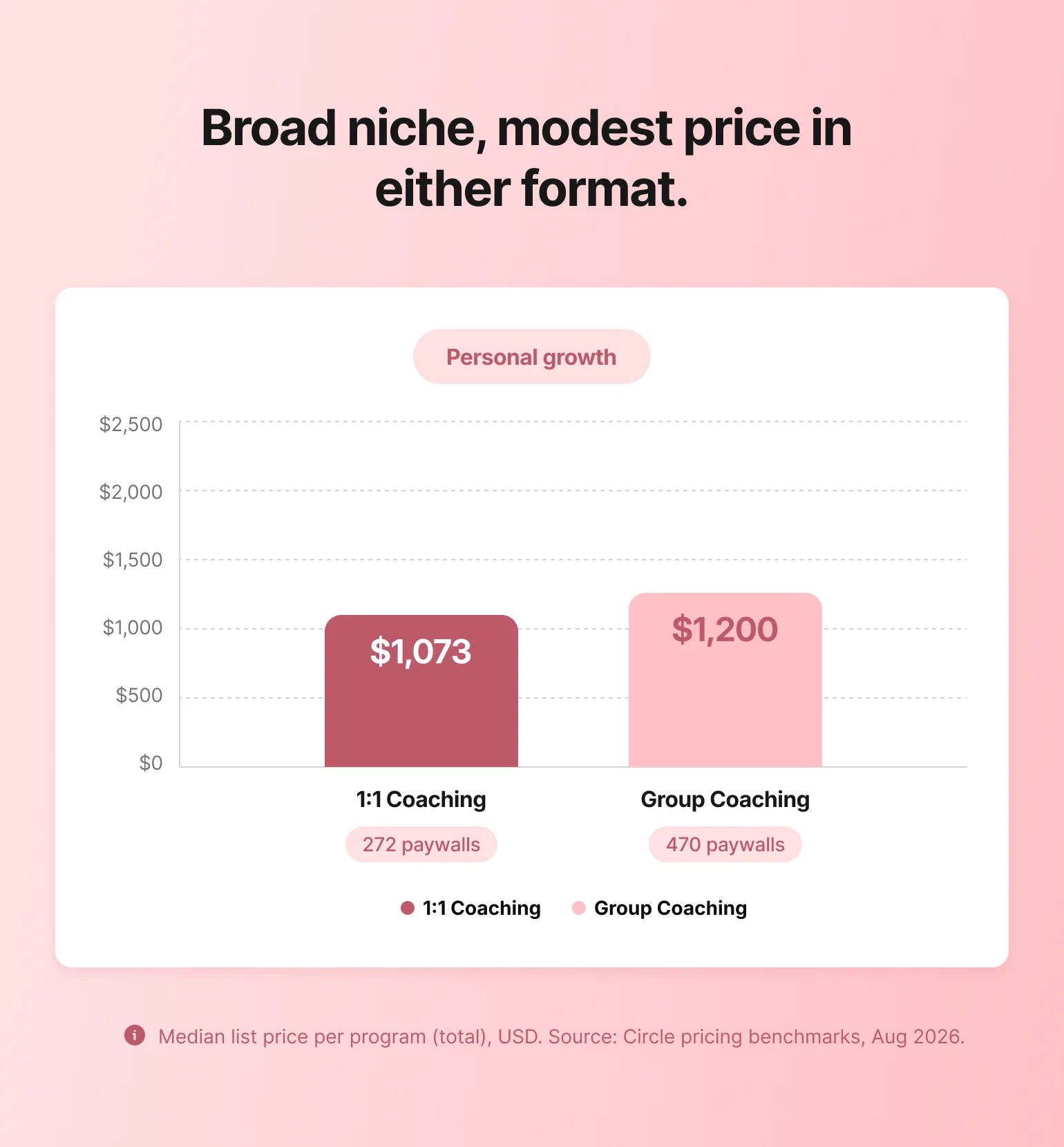
Life coaching is the broadest consumer niche: general life, mindset, and fulfillment. Circle's closest category is personal growth, which looks a lot like health & wellness on price ($1,073 median for 1:1 and $1,200 for group) with 272 and 470 paywalls. So breadth isn't the problem. A broad promise like "I help people live a better life" is hard to sell to anyone in particular, so the work is to swap it for a named audience with an urgent trigger.
One example is Bernadette Logue's The Circle, a weekly group life coaching membership. It costs $97 a month or $970 a year, and members get a live group call every week, a monthly guided audio tool, four quarterly workshops, and a private forum. Her list price works out to about $1,164 a year, close to the $1,200 group median for personal growth. That's a list price, so it says nothing about how many members she has.
That's also what makes clients sign on: a promise specific enough that the right person recognizes themselves in it, and trusted access to that audience. If that describes you, the community-powered coaching launch steps walk through turning a named audience into a paid community.
4. Executive coaching
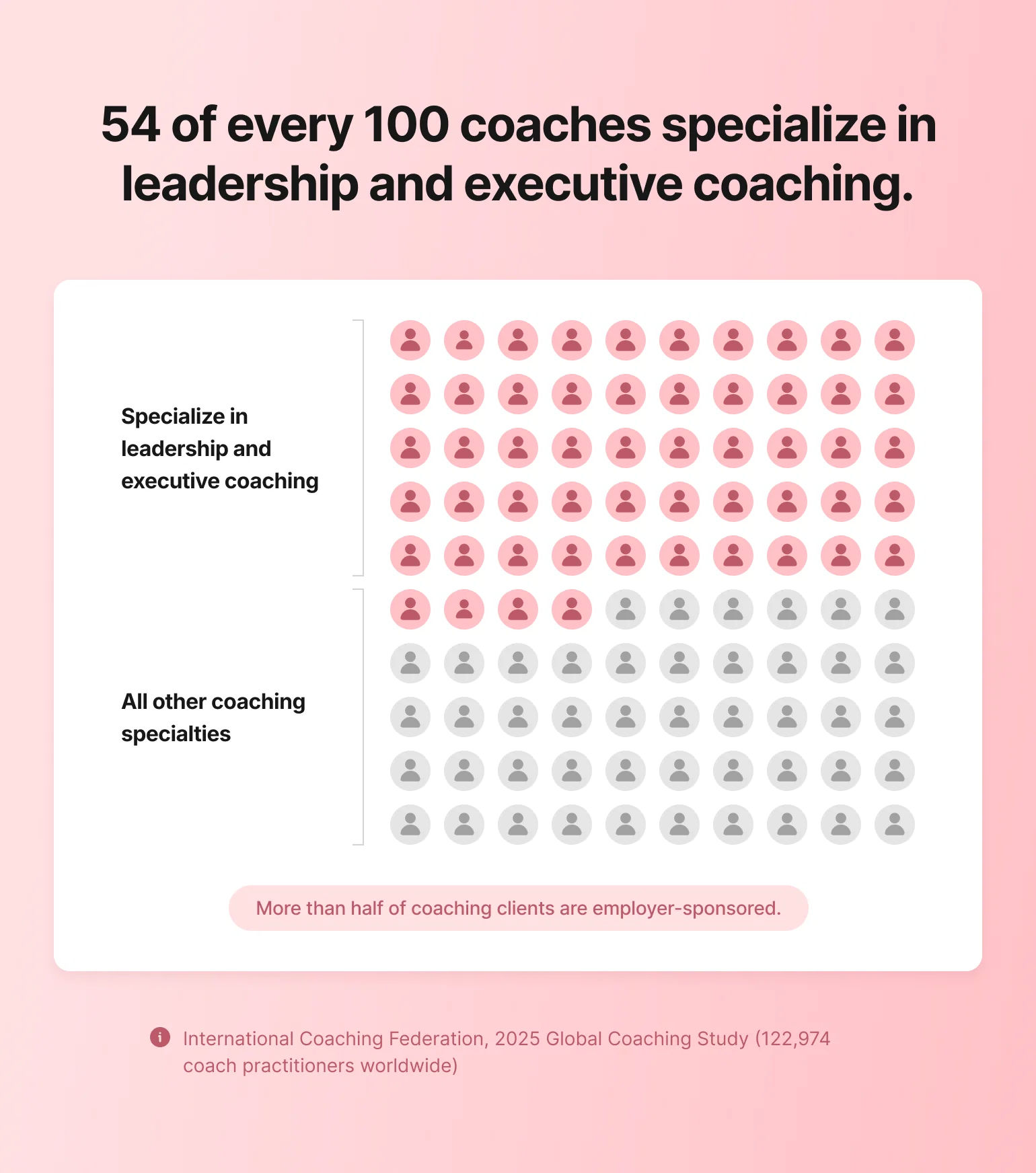
Circle's data has no row for executive coaching, so we can't price it directly from our own numbers. What the International Coaching Federation reports is that it's crowded and employer-funded. Its 2025 study counted 122,974 coach practitioners worldwide, 54% of them specializing in leadership and executive coaching, with more than half of coaching clients being employer-sponsored.
Executive coaching means working with senior leaders, newly promoted VPs, C-suite executives, high-potentials, where the employer or an HR sponsor usually pays. The work is high-stakes: preparing a leader for a C-suite transition, de-risking succession, or developing leaders the organization has already invested in. Winning the buyer takes more than a good offer. Sponsors want leadership experience, credentials that clear their bar, and proof from inside their world, like leadership referrals and HR relationships.
Chief shows the membership version of this. Its Executive Coaching tier pairs one-on-one sessions with a vetted executive coach, matched on working style, industry, and level of responsibility, with access to Chief's network and leadership programming. The announcement doesn't state a price, so it's an example of the format, not of what executives pay.
5. Career coaching
Career coaching also has no row in Circle's data, because coaches who do it often describe themselves by audience, not by "career." It guides individuals through job transitions, promotions, and career moves, and most of it is sold to the person making the move, who will pay for a specific outcome like landing a promotion or nailing the interviews for a defined transition. An employer or outplacement budget can pick up the tab, which shifts the same offer from consumer-priced to institution-priced. Either way, the promise has to name one outcome, not open-ended "career help."
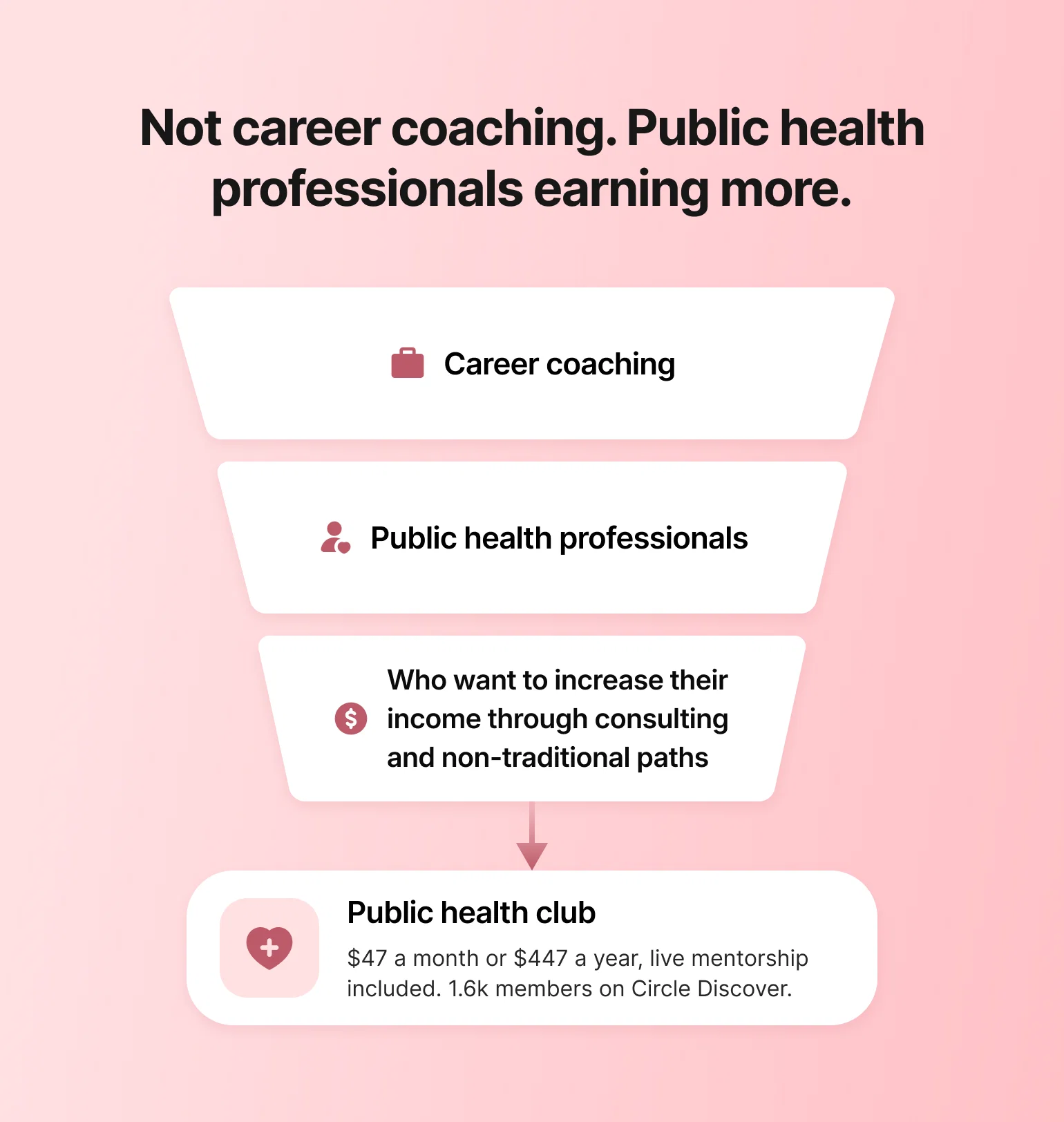
Dr. Desiree Strickland shows what naming an audience looks like in practice. Instead of generic career coaching, she built Public Health Club for public health professionals who want to increase their income through consulting and non-traditional paths. When members told her the price was too high, she held the line. The club now charges $47 a month or $447 a year, with live mentorship included, and Discover lists it at 1.6k members.
Emerging niches worth watching
Coaches invent niches faster than any category list can track them. None of these five has its own row in Circle's data, so what follows are demand signals from outside sources, not price benchmarks. Treat them as hypotheses to test with real buyers.
Menopause and perimenopause coaching
In a Mayo Clinic Proceedings study of 4,440 employed women aged 45 to 60, 13.4% reported at least one adverse work outcome from menopause symptoms, and 10.8% had missed work in the prior year. On the employer side, SHRM's 2026 benefits study found 27% of employers offering menopause support, up from 18% a year earlier. Surveys define that benefit differently, so treat the trend as more reliable than any single percentage.
The communities already forming around this niche show what it looks like in practice. OB-GYN Mary Claire Haver runs Community at The 'Pause Life on Circle as a free, physician-led space for menopause education and live events, and Discover lists it at 146.2k members. That's an audience this large gathering around expert guidance, which is the demand a coach with a narrower audience could serve. Discover member counts can include free members, so read them as audience size, not paying customers.
AI-adoption coaching
AI-adoption coaching helps people and teams put AI to work: which tools to use, how to prompt them, and what to automate versus keep human. The skills demand is real: Microsoft and LinkedIn's 2024 Work Trend Index found 75% of knowledge workers using AI at work. But that measures usage, not what people pay coaches. Circle's nearest category, AI & tech, has a $1,225 median group coaching price across 256 paywalls and a $748 median for 1:1, below business & marketing.
The AI communities on Circle Discover split by who needs to use AI at work. Just Start AI is a learning space for trade and service professionals, operators, and leaders adopting AI, and it lists 983 members. humAIn community is a network for HR professionals and business leaders responsible for AI adoption, and it lists 957 members. It's Swedish-language, so the demand isn't limited to English speakers. Both serve people who need to apply AI, not build it, which is the job this niche is named for.
Longevity coaching
Longevity coaching helps people who want to live longer and healthier make sense of testing, protocols, habits, and supplements. The spending is there: McKinsey's 2025 wellness survey puts US consumer wellness spending above $500 billion a year. Weight-management companies are also pairing coaching with GLP-1 medication, as WeightWatchers did when it launched a GLP-1 program and clinic in late 2023. Keep the offer inside what your credentials permit.
On Circle Discover, longevity shows up as education, not coaching. The Livelong Women's Circle is a women's health and longevity membership built around monthly expert sessions, and it lists 2.8k members. Fully Optimized Health is a hormone and longevity education platform, and it lists 934. Communities this size show people want to learn about longevity — whether someone can apply this as a coach is an opportunity question, not a demand one.
Burnout coaching
Gallup reports that 27% of US full-time employees very often or always feel burned out at work, with 31% of women versus 23% of men. The need is clear, and so is the question to test: whether burned-out people or their employers will pay for coaching, rather than just wanting relief.
Burnout shows up on Circle Discover around a named group. Thrive PhD is a wellbeing community for doctoral researchers dealing with burnout and self-doubt, and it lists 155 members. That's small, so it's evidence of a specific audience, not a mass market, and it fits the question above about whether burned-out people will pay for coaching or just want relief.
ADHD and neurodivergent coaching
The CDC estimates that 6.0% of US adults, about 15.5 million people, have a current ADHD diagnosis, and more than half were diagnosed at 18 or older. That's a large audience working on focus, systems, and follow-through, often after years of generic productivity advice.
ADHD communities on Circle are sometimes (often) peer-led. The Attention Deficit Disorder Association runs ADDA Social, a private community for adults with ADHD with peer support groups, body doubling, and webinars, and it lists 2.5k members. A nonprofit running a community this size shows adults with ADHD already gather for structure and accountability, the same follow-through problem described above.
What makes coaching income hold up year to year?
A niche that looks good on paper still has to add up to a stable year, and two things decide whether it does: how concentrated (or diversified) your revenue is, and how much of it renews.
Concentration is the quiet risk. Carrying your year on a handful of big clients feels efficient, but if losing one takes a real bite out of your income, that year is more fragile than it looks. Spread the same total across more clients and it steadies. Renewals work the other side: every client who re-signs is income you don't have to win again, so a niche where the problem recurs, or the relationship deepens, refills part of next year before it starts. Both come down to how much of next year you'll have to rebuild from scratch.
To see it clearly, track your coaching income on its own, apart from courses, consulting, or anything else you sell. Otherwise you can't tell whether the deep work is holding up or something else is quietly covering for it.
Which delivery model improves the economics?
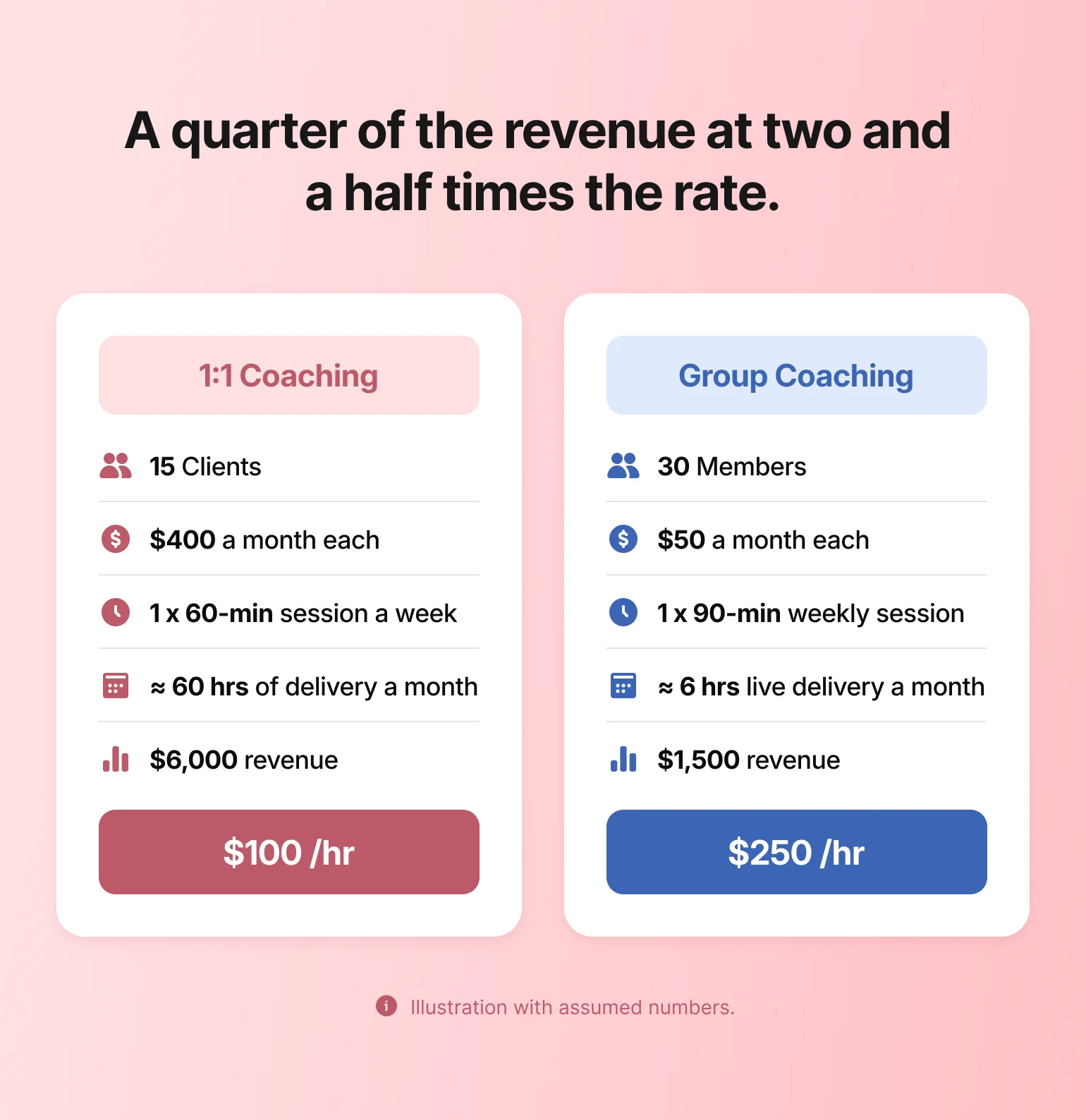
The delivery model you pick sets your real hourly rate, so work it out before you build the offer. Here's an illustration with assumed numbers: 15 one-on-one clients paying $400 a month, each with one 60-minute session a week, means about 60 hours of delivery a month for $6,000, or $100 an hour. Move 30 members into a group paying $50 a month for one 90-minute weekly session, and it's about 6 hours of live delivery for $1,500, or $250 an hour. That's a quarter of the revenue at two and a half times the rate, because adding one more member doesn't cost another hour. That's why solo coaches often shift from 1:1 toward a recurring membership or drop-in group coaching.
Group isn't always the answer. Premium 1:1 still wins for confidential work a client pays for dedicated access to, and a recurring revenue model only pays off when the problem keeps coming back. If it's solved once and done, a fixed challenge or cohort beats an open-ended membership.
The setup used to be the tedious part. A group program juggles discussions, resources, live sessions, payments, and moderation, and stitching them across separate tools eats the hours you just saved. Circle's coaching tools are built for the move from 1:1 clients to a group program, with Circle AI helping build the program around your idea so your time goes to members, not setup.
John Meese, who teaches coaches to launch group programs in his SOLD OUT Coach Club community, tested this himself on camera. He asked Circle AI to create the spaces for a new group coaching program and named four: a group discussion space, a resource library course, a cohort events space, and an office hours events space, all grouped under one space group. His demo video walks through the setup, down to adding an enrollment paywall.
Community tip: Move one problem that keeps repeating in your 1:1 calls into a weekly group session before you build a full membership around it. Set it up as a paid space and schedule it as a recurring event before layering on more systems or programming.
How should I validate my choice?
The mechanics and the revenue math can point you at a niche, but neither can tell you whether real buyers will pay for it. That's what live sales conversations are for. Before you rebrand around a niche or build anything expensive, spend a focused period selling it and let the market tell you if it holds.
Start with a one-sentence offer
Write one sentence that names four things: the buyer, the outcome, the format, and the price. For a business coach that might be: "I help newly promoted agency operations managers cut handoff delays through a 12-week delivery-review program for $2,500." That price sits above the $2,000 median for 1:1 business coaching on Circle, which is only defensible if the buyer has a budget for the problem. The same shape works whatever you coach:
- Executive: "I help newly promoted VPs get through their first 90 days in a C-suite role with a six-session transition intensive, billed to their employer."
- Career: "I help laid-off senior marketers land a new role in 60 days through a structured search sprint, funded by an outplacement budget."
- Health and wellness: "I help perimenopausal women in demanding jobs hold their energy through the workday with a 12-week program, offered as a company-paid benefit."
- AI-adoption: "I help marketing teams cut reporting time in half by adopting AI workflows, in a four-week rollout billed to the department."
Then take whichever one fits you into live sales conversations with people who match. Ask how they handle the problem now and who controls the budget before you make the offer. Aim for three paying beta clients before you build anything expensive. That's enough to see whether delivery actually holds.
Let the conversations tell you what to fix
If most prospects name the handoff delay before you do, problem recognition is there. If they name it but stall at $2,500, test the price and the offer separately, then evaluate the channel. A stall usually points at the packaging, not the niche. Fix the smallest variable first.
If you're coaching in a regulated space, check scope alongside demand. Before you promise medical or nutrition outcomes, find out which activities require a license or registration where you work, list every activity your offer promises and every claim your marketing makes, then remove anything your license doesn't permit or you can't substantiate.
One yes isn't proof
Luisa Zhou, who teaches coaches how to build their businesses, started with a simple offer: a five-month package at $5,000. Her first client said yes without hesitating. "Then I pitched the same offer to 30 people in a row – and they all rejected me." One yes wasn't proof the offer would repeat. She asked what the lowest price was that she'd charge without resenting her clients, landed on $1,500 for three months, and three clients signed within weeks. The weak point was the price and package, not her ability to coach.
The best-paying niche is the one you can sell and deliver
The best-paying niche for you isn't necessarily the one with the highest ceiling. It's the one where the buyer can pay, you can reach them again and again, and you can deliver the result without building a business you'd hate to run.
Buyer access is what makes or breaks it. Say a health coach reliably fills 20 spots at $350 a month: that's $84,000 a year. It's also $4,200 per client over 12 months, close to the 75th percentile for health and wellness group coaching on Circle ($4,423) against a $1,200 median, so it's a target to earn your way toward, not a starting assumption.
An aspiring executive coach with no leadership track record, no credentials, and no route into corporate procurement is bringing in nothing, no matter how high the rate could go. So before you commit, be honest about whether you can actually reach and close the buyer, not just whether the niche looks lucrative.
Deliver past cohort one.
Profitable coaching niches FAQ
Do you need a certification to start a coaching business?
For selling most coaching, buyers pay for proof of results, not letters after your name. A specific outcome you can point to does more than a certificate. The exception is regulated work: anything touching medical, mental health, or nutrition outcomes is where licensing rules apply, and promising results you're not licensed to deliver is how coaches get into trouble. Check your state's rules before you promise them.
Which coaching niche is best if you're just starting out?
The one where you already have credibility and a way to reach buyers. A niche you can prove you've solved, through your own career, results, or lived experience, lets you skip the years it otherwise takes to build authority. Beyond that, favor a specific, urgent problem over a broad one: "help newly promoted managers survive their first 90 days" is easier to start selling than "help people lead better," even though the second sounds bigger.
Can you have more than one coaching niche?
Eventually, but not at the start. Splitting your focus before one niche is working leaves you with two half-built pipelines and a message no buyer quite recognizes. Prove one niche can sell and deliver first, then add a second, usually an adjacent audience or a natural next step for the clients you already have, so your existing proof and referrals carry over.
Is the coaching market too saturated to make money?
It's crowded, but crowding at the generic level isn't the same as crowding at the specific one. The International Coaching Federation's 2025 study counted 122,974 coach practitioners worldwide, up 15% since 2023, so a vague promise has plenty of competition. Naming a precise audience and an urgent problem moves you out of that pile, which is why it does more for you than picking a bigger-sounding category.
What should I charge when I'm just starting out?
Charge for the outcome, not your experience level. New coaches routinely undercharge because they price their hours instead of the result. Start with a defined package tied to a specific transformation, then set the number against what that outcome is worth to the buyer and what your audience can realistically afford. For context, across the 18 niches in Circle's data with 30 or more group coaching paywalls, median program prices run from $564 to $5,000, and 14 of them fall between $1,000 and $2,500. A common path is to price a little low for your first few clients to build case studies, then raise it with each new wave of proven results.

Co-founder and Chief Revenue Officer
Andy is the co-founder and Chief Revenue Officer at Circle, responsible for making Circle's creative and numbers work together.