How one person can run a community business with AI
TL;DR
- The question isn't whether to use AI — it's knowing which work needs you and which work it can handle better than you.
- Building each week around one anchor piece and letting AI adapt it turns a single idea into a week of content without starting from scratch.
- An owned community gives a one-person business one place to grow, monetize, and run operations — with AI handling the overhead so you show up where it counts.
Members only
One issue, five minutes, every Tuesday. Read by +14,200 creators.
Seth David had built something real. Thirty-plus on-demand courses, a paid community, a high-ticket coaching program, a steady stream of member questions from accounting professionals who trusted him. The business was working. That was the problem. The operational load — answering questions he'd answered a hundred times, onboarding new members, keeping the community moving — had started eating the hours he'd built the business to protect. He wasn't failing. He was drowning in his own success.
His solution wasn't to hire. He moved everything onto Circle, trained an AI Agent on his courses and community, and named her Sandy. Sandy now fields the routine questions. Seth stays focused on the coaching only he can deliver.
That's the whole thesis, already lived.
The moment the one-person business became inevitable
The idea of a million-dollar one-person business isn't new.
Tim Ferriss was writing about it in 2017, and Elaine Pofeldt's book that year documented dozens of people already doing it. What changed is the ceiling. In early 2024, Sam Altman reset expectations entirely: "We're going to see 10-person billion-dollar companies soon. Even one-person billion-dollar companies." By 2026, for educators and creators, it reads like a description of something already underway.
Justin Welsh crossed $15M running a one-person business built entirely on courses, a newsletter, and an affiliate program — zero employees, 94% operating margins. Dan Koe runs a $4M+ operation on a 98% margin and put it plainly in a March 2026 post: "You do everything you would have done before, but you use AI to do it faster, with higher quality, and with less guesswork." These aren't outliers — they're the leading edge of a structural shift. Solo-founded startups went from 23.7% of all new companies in 2019 to 36.3% by mid-2025, and the model is spreading fast through the creator economy.
Ferriss has been doubling down on this shift ever since his 2017 post, backing Nas.com, an AI-enabled platform built specifically for solo creators with zero followers and zero marketing budget — whose pitch is: "The next wave of wealth will not come exclusively from the Fortune 500, but from hundreds of millions of people." Ole Lehmann, who has built his entire brand around this thesis, tied the trend to something structural: AI doesn't just make one person more productive — it's also causing the mass layoffs that push talented people toward building their own thing. It's a feedback loop.
None of this is a coincidence. The tools got good enough, the cost structure inverted, and a specific kind of operator emerged: someone who builds non-replicable assets that compound — courses, memberships, communities — and uses AI to run the operational layer so they can stay focused on the teaching, coaching, and creative work that actually requires them.
That's who this guide is for. And in 2026, with Circle Eclipse, the infrastructure to do it is better than it has ever been.
Turn your weekly work into compounding content
Content is one of the best places to start, because for a one-person business the ceiling on it isn't ideas — it's hours. You can only sit down and create something original so many times a week before the rest of the business starts slipping, and every channel you've committed to is still waiting on you. The most efficient approach is to build the week around one anchor piece and use AI to reshape it for every other channel.
- Create one anchor piece each week. A live workshop, coaching call, or recorded video where you actually teach something. Treat it as the only original asset you owe the week, because everything downstream depends on it.
- Extract the best moments. Run the recording through auto-generated transcripts and AI summaries to surface the strongest quotes, frameworks, and explanations worth lifting out.
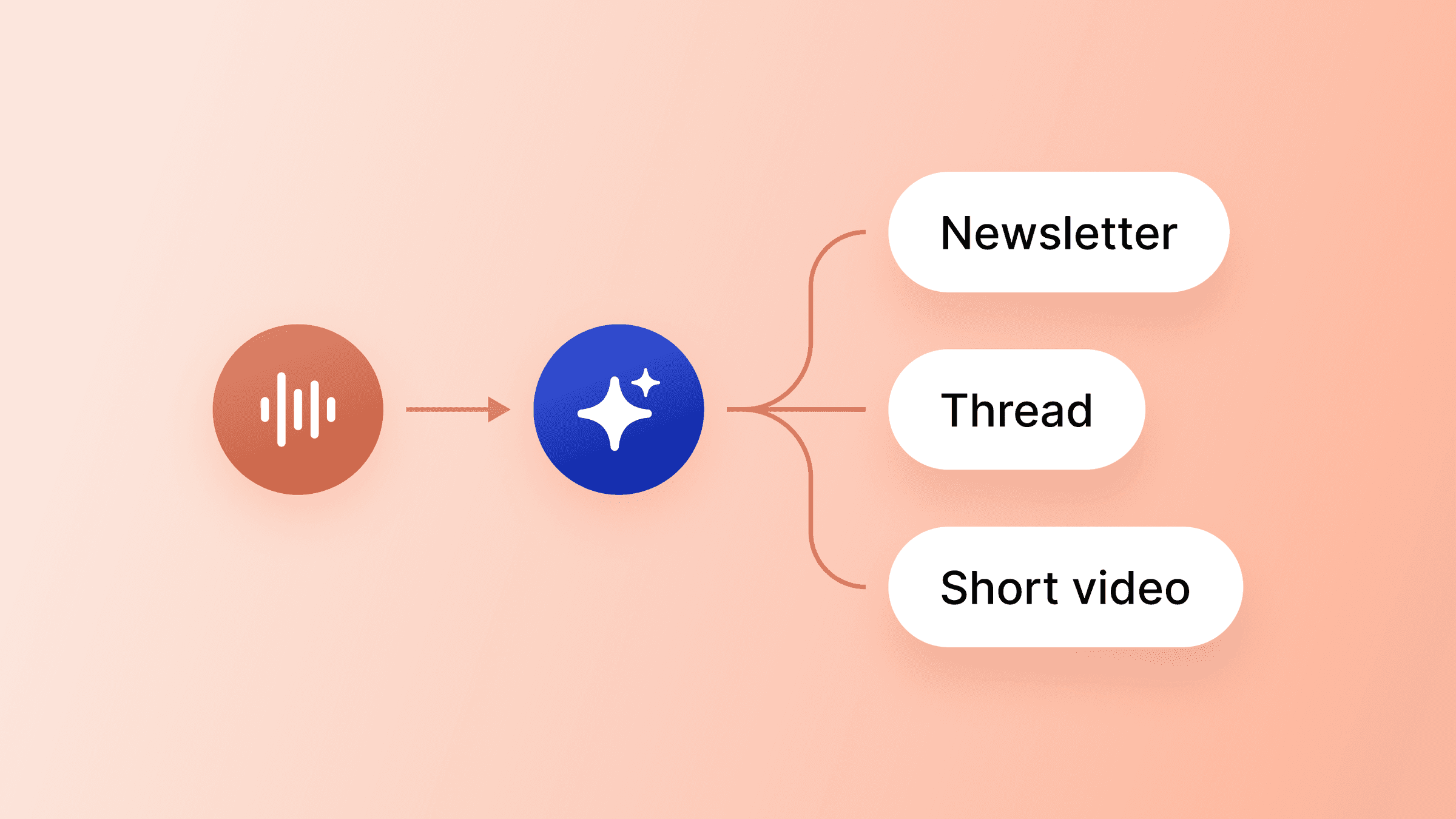
- Draft adaptations from those highlights. Use AI to turn the same idea into a community post, an email, social captions, or a short-form script, then rewrite each draft so it sounds like you. Here’s our favorite content repurposing playbook.
- Publish to your community first. Send the lead piece as an email broadcast and a permanent community post, so paying members get the strongest version before anything reaches an open feed.
- Distribute the rest where you're still growing. Push the adapted versions to LinkedIn, YouTube, a podcast feed, or your newsletter list, treating them as on-ramps back to the community where the deeper conversation lives.
Run this for a quarter and the compounding effect is hard to miss: you stop guessing what to post, your library grows into a searchable archive your AI Agent can answer from, and one workshop keeps paying off across every channel for weeks. The distributed versions point back to the community, so the whole system compounds — more content, more on-ramps, more reason for paying members to stay.
Build an owned community around the work
Most solo creators end up with an audience scattered across platforms they don't own. A community pulls them into one place you do — and that's what makes everything else in a one-person business possible. With members, events, content, email, and payments all running in the same space, every action a member takes feeds one connected record instead of sitting in a separate tool.
That connected record is what lets AI do real work for you. Because it can see the whole member picture — not a slice copied from another app — AI can run the operational side of the business on its own: onboarding new members, sending renewal reminders, firing win-back sequences when someone goes quiet, all moving the trial-to-paid journey forward whether you're online or not.
And from Eclipse onwards, discovery doesn't have to mean fighting algorithms you don't control. Circle Discover is a marketplace where members share their goals — what they're working on, what they're trying to become — and get routed to the communities best positioned to help them get there. For a solo creator, it's a new acquisition channel you turn on with a switch. The members who arrive are already self-selected. They've raised their hand.
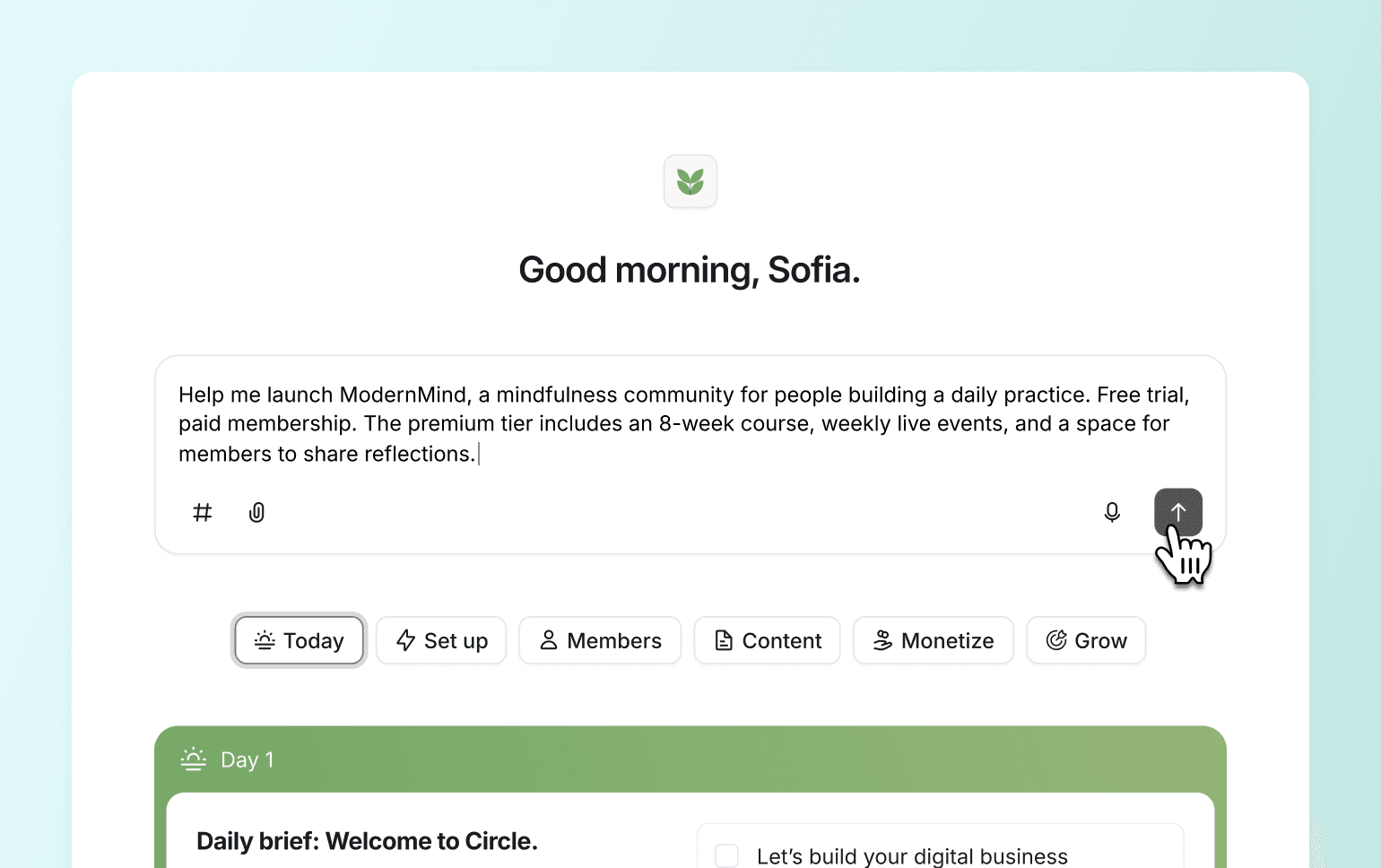
If you're starting from scratch, Circle AI now handles the build too. Describe what you want — the tiers, the content, the experience — and it proposes the complete structure: spaces, access groups, landing pages, paywall configuration. What used to take weeks now happens in a conversation.
Tom Pardo's Shambala community shows what one person can do with that setup. Tom runs a global community for movie trailer editors entirely on his own, using Circle Plus to host the community, courses, live events, email marketing, and AI Agents from one place. In the first three months, 60+ professional editors from LA, New York, London, and Paris joined, with Tom acting as the only human in the loop. The busywork runs in the background; he stays the voice and the expert members showed up for.
How AI runs your day-to-day
Once the business lives in one community, AI stops being a scattered set of shortcuts and starts running the operation alongside you. The trick most solo creators miss is matching it to the right work: the repetitive, pattern-based tasks that don't need your judgment in the moment, and the ones that quietly eat your calendar one fifteen-minute interruption at a time.
Run the routine work
The repetitive, member-facing work is the first thing to hand over. With an AI Agent trained on your courses, transcripts, products, and spaces, you can:
- Answer the questions you've answered a hundred times, so members get help the moment they need it.
- Greet and onboard new members by name, pointing them to their first useful action before you're even at your desk.
- Catch members up on long threads and busy Spaces with AI summaries, so no one has to scroll back through a week of posts to follow along.
You step in the moment the question stops being procedural: when someone's stuck, confused, or quietly thinking about canceling.
Grow what's working
The same approach covers the marketing a solo operator rarely has time for. Circle AI can:
- Repurpose a single workshop recording into a draft email, a community post, and a handful of shorter pieces using the transcript — so you start from an edit instead of a blank page.
- Read your community and email analytics and tell you in plain language what's actually landing, so you know what to make more of.
- Segment members by activity and course progress, then trigger a workflow that invites the most engaged ones to upgrade, without you watching the dashboard for the right moment.
You stay the one deciding what to say and who to prioritize; the busywork of getting it out is no longer yours.
Circle AI sits across your community, and pulls every notification, DM, moderation report, and course comment into one Circle Inbox, instead of scattered across tabs. It surfaces the recurring questions and unmet needs that never make it into a public post, and greets you each day with a brief of what actually needs your judgement, giving you a clear read on what to build, teach, or fix next.
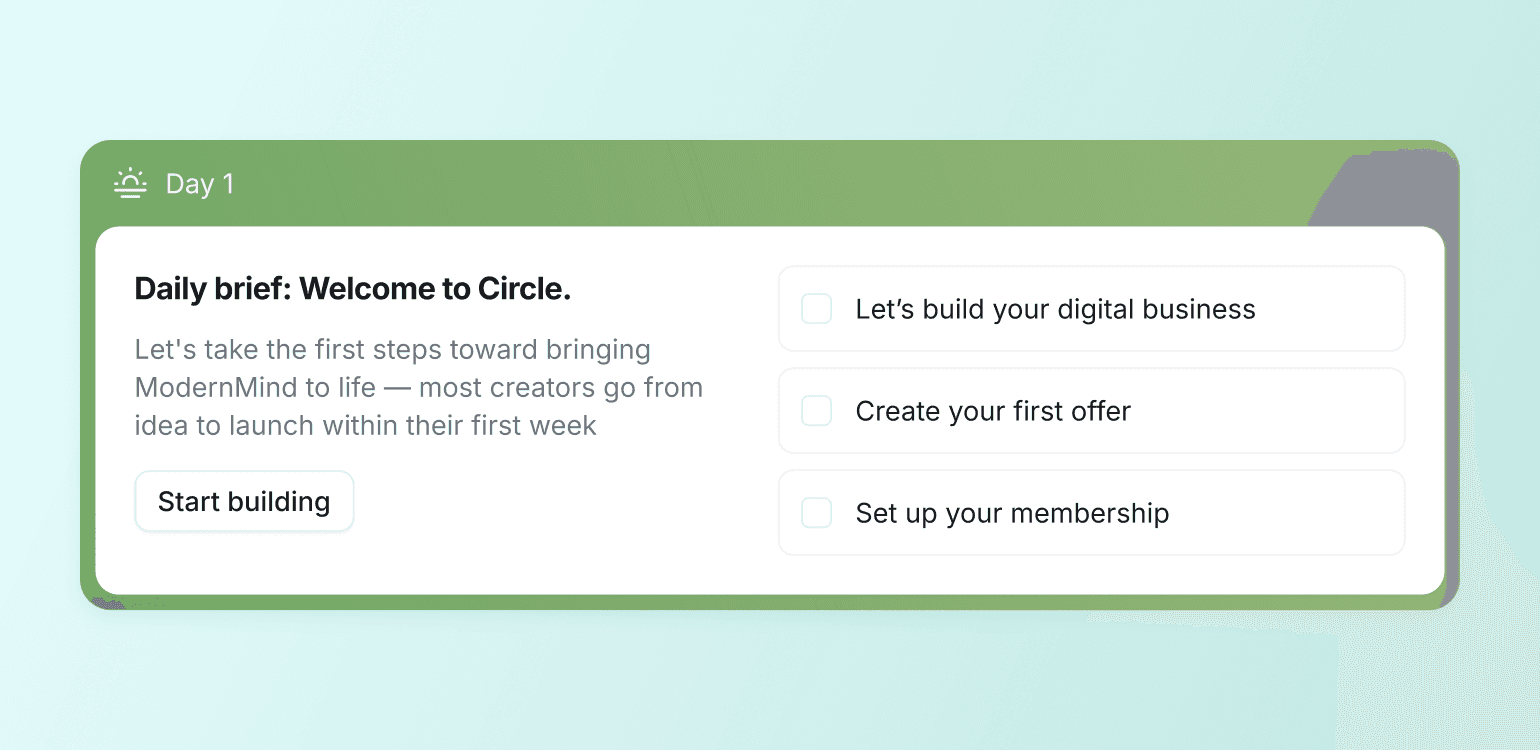
Community tip: One solopreneur running her community on Circle turned her Monday-morning review into a standing task: every week, the past seven days of activity gets sorted into what needs her reply, what stalled and could use a nudge, and which member wins deserve a shout-out, each with a direct link to the post. The AI does the sorting; she does the responding. The triage that used to eat her Monday now takes ten minutes, and all of it goes to the part only she can do.
The one decision that simplifies everything else
Dan Koe's framework for where to use AI and where not to is more useful than any tool list: "In a world drowning in AI content, the only unique thing left is you." Your experiences, your perspective, your specific way of seeing the work — that's what's appreciating in value as everything else gets cheaper.
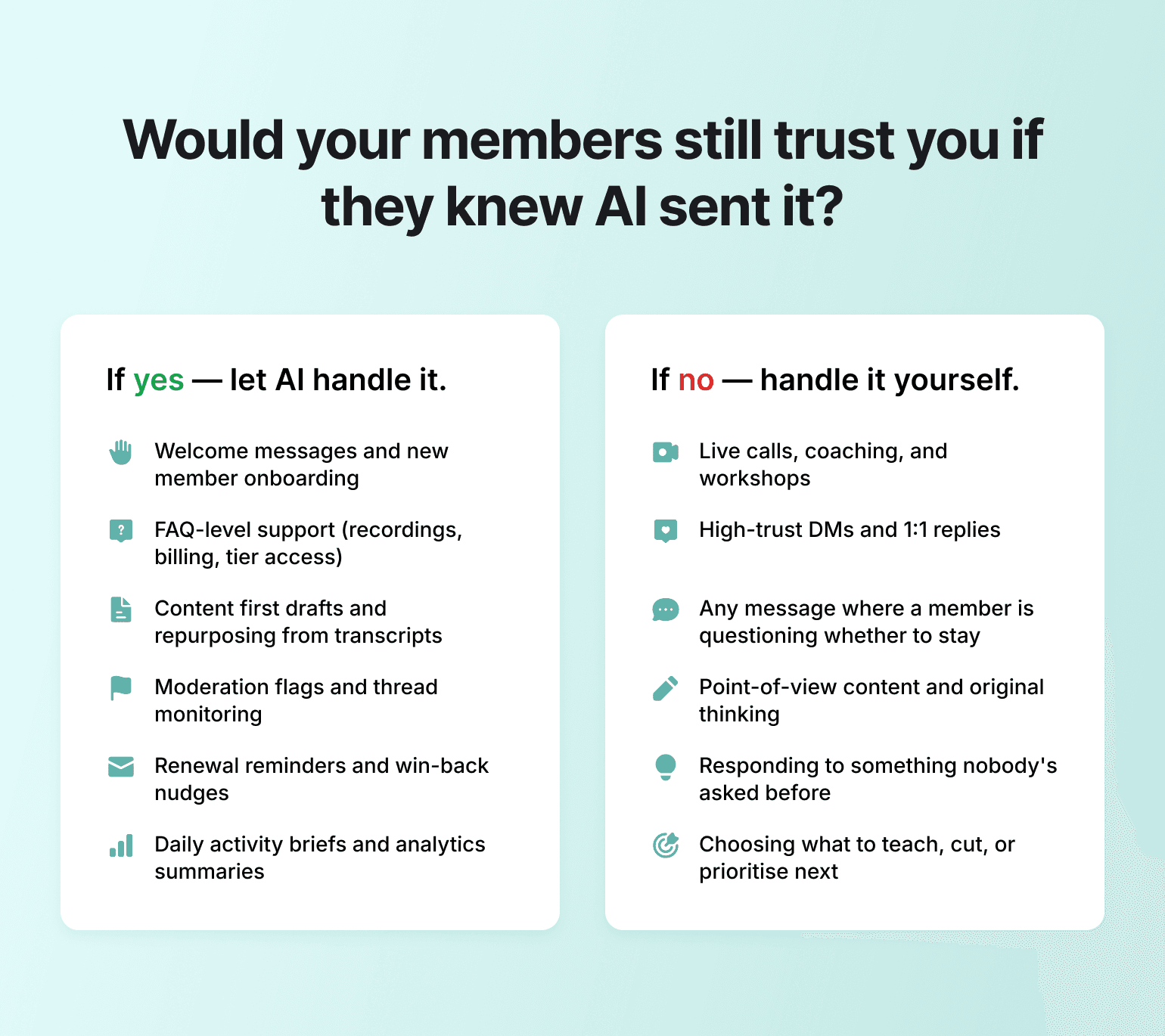
The simplest version of the AI-vs-human decision is this: if a member could tell this came from AI, would it cost you trust? If yes, you do it. If no, hand it off.
That covers welcome messages, FAQ-level support, content drafts, moderation flags, and renewal nudges on the AI side. It covers live calls, high-trust DMs, and any reply where a member is questioning whether to stay.
The four things only you can do
Members pay you for your voice, your judgment, and the specific way you see the work. Four things sit underneath that, and none of them are things AI can produce on its own.
- Point of view. After years in your field, you've formed an opinion about what's worth doing, what's overrated, and where the consensus has it wrong. That filter is why people show up to learn from you specifically. AI can summarize every expert; it takes a person to disagree with them well.
- Taste. Choosing what to teach this month, what to cut from a draft, which member question deserves a long reply instead of a quick acknowledgement: that's pattern-matching from work you've actually done. AI happily produces ten options. Picking the right one is the job.
- Memory of specific people. You know the founder who joined last year and just hit their first $10K month. You remember the coach who's been quietly building toward a launch since spring. That continuity is what makes a community feel like a place where someone notices you, instead of a logged-in dashboard.
- Judgment in new situations. When a member asks something nobody's asked before, or a thread heads somewhere the community guidelines don't cover, AI defaults to the safe, average response. You can read the room, take a position, and stand behind it.
The clearest way to know you've drawn the line right between AI and human is whether your calendar is filling up with the work you started this business to do, or with repetitive operational work that AI can already handle. If it's the second, the line has moved, and it's worth pulling it back.
What comes after solo
A one-person business doesn't work because you do everything. It works because you choose well: the operational layer runs on AI and a single system that holds your community, courses, payments, and content together, and your hours go to the judgment, taste, and relationships that made people join in the first place.
For most creators, Circle AI and Circle Discover will be everything they need. But if the business grows beyond what one person and a well-configured AI stack can manage, Circle Studios exists for exactly that moment — a full-service partnership where Circle's team designs the program, builds the community, runs operations, and drives growth. The principle is the same one that makes the solo model work: great creators should focus on what only they can do, and have the right team handle everything else.
Get that division right and being one person stops being the ceiling. It becomes the whole appeal.
Want to build an exceptional community? Start your 14-day free trial of Circle now.
Solopreneur FAQ
What's the difference between being a solopreneur and a freelancer?
A freelancer sells skills and time to clients, with income tied to billable hours. A solo creator builds a business around assets — courses, memberships, communities — that earn beyond direct labor. A freelance consultant bills $150 an hour; a solo creator sells a $99/month community that runs whether they're online or not.
How much do solo creators typically earn?
The range is wide, and it's widening. Most one-person businesses earn modest incomes, but a growing share now clear six figures and beyond, according to U.S. Census Bureau nonemployer business data. The deciding factor is rarely effort — it's model architecture. Operators who sell their time hit a ceiling; those who build assets like memberships, courses, and communities earn beyond the hours they personally put in.
Can I run a paid community completely on my own?
Yes — that's exactly what Tom Pardo and Seth David are doing. The realistic ceiling without AI is roughly 100–150 active members before operations start breaking. With Circle AI handling support, onboarding, and moderation, that ceiling is considerably higher and the floor of your own time commitment drops significantly.
Where should I use AI in a one-person business, and where shouldn't I?
Run every task through one test: if a member could tell this came from AI, would it cost you trust? If yes, you do it. If no, hand it off. That covers welcome messages, FAQ-level support, content drafts, moderation flags, and renewal nudges on the AI side — and live calls, high-trust DMs, and any reply where a member is questioning whether to stay on yours.
Is a community membership a strong model for a one-person business?
It's one of the most durable. The value of the community grows as members create more for each other, and the revenue doesn't reset every month the way one-off launches do. It works especially well for coaches and educators whose expertise can be extended through cohorts, courses, and group programming over time. Not sure where to start? See how Circle is priced for solo creators.
How do I know when to start charging for my community?
Two signals: consistent member contribution and rising operational demand. When members are creating value for each other, and moderation and support start to feel like a real job, a paid tier usually makes sense.
Community Content Marketer
Arina is Circle’s community content marketer, sharing insights on community growth, GTM strategy, and storytelling for solopreneurs.