How to structure membership tiers (with examples)
TL;DR
- A single price only fits one kind of buyer, which leaves the people who'd gladly pay more with nothing bigger to buy.
- Two or three well-drawn tiers let you charge more at the top, protect your time, and stay easy to join at the bottom.
- Name each tier after the outcome the member is buying, not a rank — "Find Clients / Raise Rates / Build the Agency" sells itself; "Basic / Pro / Premium" makes people guess.
A member messages you: "Hey, do you ever do 1:1 strategy calls? Happy to pay separately." You read it twice. They're not asking for a discount; they're asking for more, and you don't have a "more" to sell them. You start mentally pricing a call, blocking off a Friday afternoon, wondering if you should also build a small group coaching thing, and whether that means rebuilding your whole checkout. Meanwhile, three prospects ghosted that same checkout this week because your one price felt like too big a first step. One door, two separate problems.
That's the quiet cost of a flat fee: it serves one buyer and ignores everyone above and below them. Structuring your pricing so the people who want more can pay for more, and the people who need an easy entry point can find one, is what closes that gap. This guide covers how many tiers to run, what belongs in each one, how to name and price them, and how to make upgrades feel like a natural next step instead of a sales pitch.
Why one flat price leaves money on the table
A flat fee is one number trying to do three different jobs: pull in cautious newcomers, satisfy the consistent members, and hold onto the people who want more of your help or time (not less). Those are three buyers, not one, and a single price serves only one of them well.
A single price serves one buyer
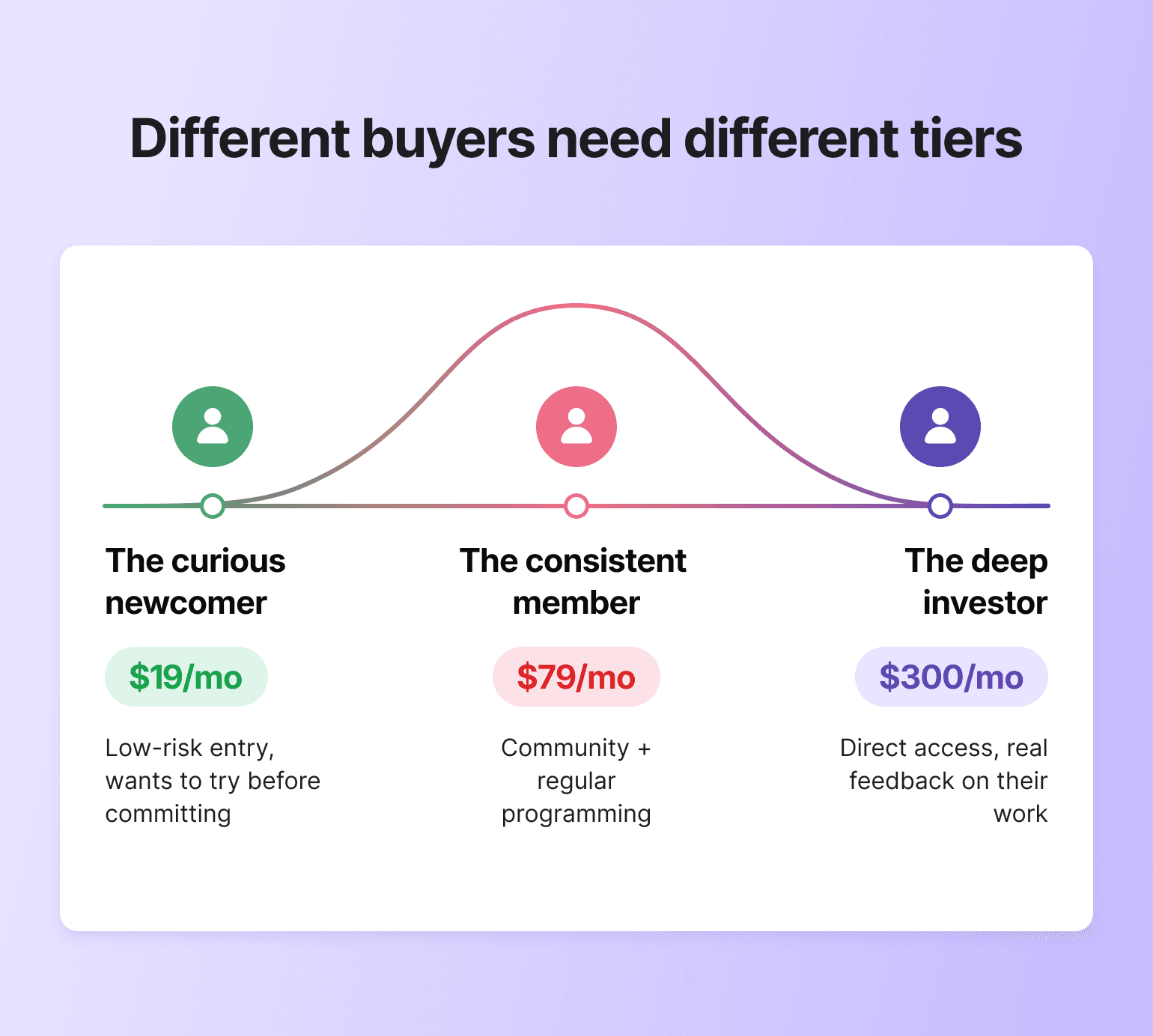
Picture your audience as a curve, not a dot. Say you run a community for freelance marketers.
- At one end, the freelancer who's been reading your newsletter for six months and would test the waters at $19 to see if the community's worth it.
- In the middle, the established freelancer who'll happily pay $79 for the discussions and a monthly group call.
- At the far end, the one running a 10-person agency who'd pay $300 a month for office hours with you to help with real client problems.
Same niche, three very different budgets. Pick any single price and you're betting your entire revenue on one slice of that curve, leaving money on the table at the top while pricing out the people who'd start small at the bottom.
Tiers capture more willingness to pay
Tiers only work if the difference between them is something a member can actually feel. The members willing to pay more have to believe they're getting more of what they want for that price. A copywriting community where the $39 tier gets the forum, the $99 tier gets weekly hot-seat reviews of real client work, and the $249 tier gets a monthly portfolio audit with you is doing this right. Meanwhile, a "Basic / Pro / Premium" structure where the only difference is the number of downloadable templates isn't, because nobody upgrades for more PDFs.
Pat Flynn's SPI Community, built entirely on Circle, is the clearest proof of what the ceiling looks like when tiers are drawn well:$700K+ in annual membership revenue, representing 58% of his total business income.
How many tiers you actually need
The number isn't a gut call. There's a defensible range, a structural reason behind it, and one decision that matters more than the count itself: which tier a new member lands in on day one.
Keep the choice set small
The answer holds across almost every community: two or three tiers. Circle's analysis of 55 communities lands on two to three tiers as the sweet spot for most communities. Add a fourth and start making any decision harder.
Why fewer choices convert better: the jam experiment
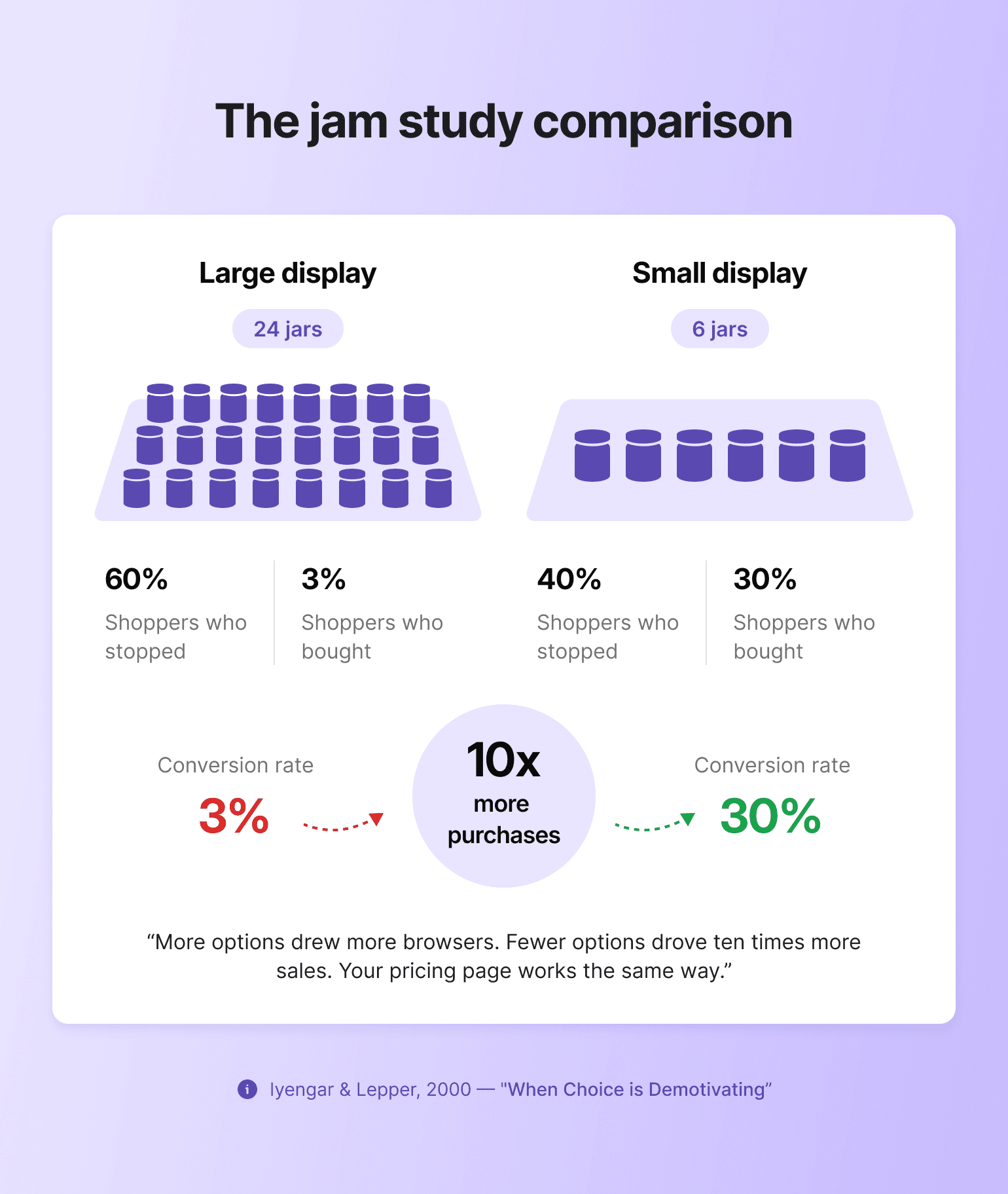
In 2000, psychologists Sheena Iyengar and Mark Lepper set up two tasting tables at a grocery store — one with 24 jams, one with 6. The larger display drew more browsers — about 60% of passing shoppers stopped. But of those who stopped at the 24-jam table, only 3% actually bought. At the 6-jam table: 30%. Ten times the conversion rate, with a quarter of the options.
The finding became one of the most-cited results in consumer psychology, now called the paradox of choice, and has been replicated across product categories, retirement plans, and subscription services. It’s reshaped how a generation of designers and product managers thought about pricing, because more options increase interest but decrease commitment. When a decision feels hard, the easiest move is no decision at all.
Your pricing page is a tasting table. Three tiers with clear distinctions between them is the six-jam table. Four tiers with overlapping benefits is the twenty-four.
The reason to cap it there is what happens when you don't. Picture four tiers in practice: a prospect lands on your pricing page, opens a comparison table with sixteen checkmarks, can't tell whether tier two or tier three is the right fit, closes the tab, tells themselves they'll "come back to it," and doesn't. Every extra column on a pricing page is another reason to stall. Two tiers force a real choice between "in" and "all in." Three add a recommended middle that does the choosing for most people.
Build tiers around buyer stage
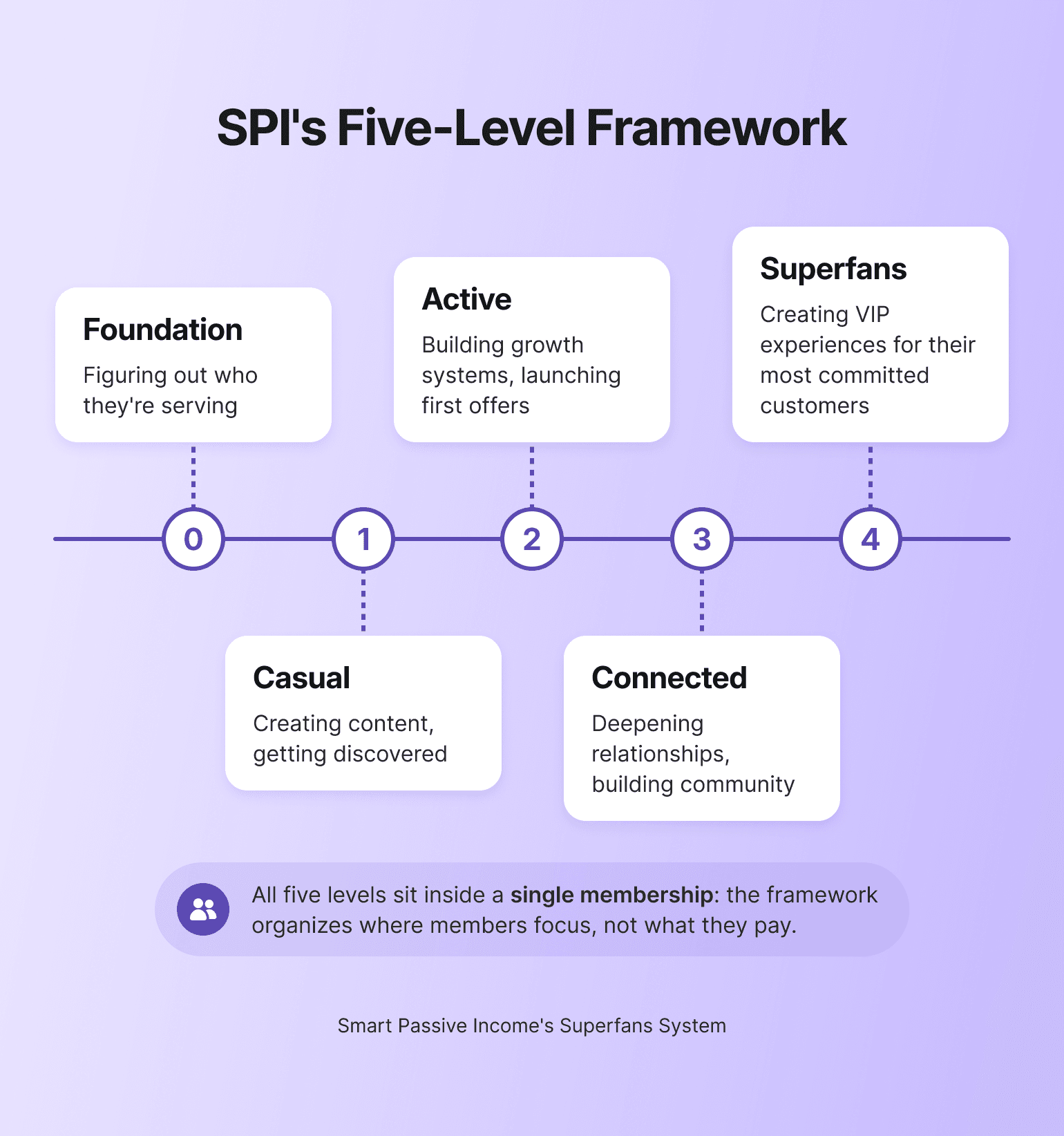
The cleanest way to draw the lines between tiers is to map them to where a member actually is in their journey. Pat Flynn's Smart Passive Income does this explicitly — not through pricing tiers, but through a five-level learning framework built around a single question: where is this member in their relationship with their audience?
The five levels — Foundation, Casual, Active, Connected, and Superfans — each correspond to a distinct creator stage. Someone at Foundation is still figuring out who they're serving. Someone at Active is building repeatable growth systems and launching first products. Someone at Superfans is building VIP experiences for their most committed customers. Same community, five clear entry points, each one self-evident to the member it's for.
The reason stage-based logic works — whether you apply it to learning levels or pricing tiers — is that a member's stage is something they already know about themselves. Nobody has to read a comparison table to figure out whether they're "just starting" or "scaling." That self-awareness does your sales work for you.
A note on SPI's evolution
SPI used to run three distinct pricing tiers — Start, Accelerate, and Thrive — each with different price points and access levels to Pat and to live programming. It worked well. But as the community matured, Pat consolidated everything into a single flat membership with a five-level learning framework organizing where members focus, not what they pay.
That's not a reason to skip tiers — it's a reason to treat them as a tool, not a rule. For most communities, especially those still building toward critical mass, two or three tiers remain the right structure: they capture more willingness to pay, give members a natural upgrade path, and make the pricing decision easier, not harder. SPI's current model works because of the scale and trust Pat has built over 17 years. Most communities get there by starting with clear tiers first.
Start with the right tier
Stage-based tiers work best when most members land in the right one on day one, rather than counting on them to trade up later. "They'll start cheap and upgrade when they're ready" is a fine bonus, but a shaky foundation: plenty of members settle into whatever tier they first joined and never revisit the decision. So you design for correct placement first, make the entry point clear enough that a first-time visitor picks the tier that fits them without asking you, and then build real upgrade paths for the members who are genuinely ready to move up. Getting both right is the difference between a pricing page that sorts people and one that just lists options.
That clarity is also what makes acquiring members easier down the line, because every new signup arrives already sorted into the right tier instead of needing to be moved later.
What goes in each tier
Pricing the tiers is the easy part. The hard part is deciding what actually lives inside each one, because that's what makes the difference between a member who upgrades on their own and a member who churns wondering what they were paying for.
Align price, access, and transformation
Before you decide what's in any tier, write down four things for each one: who it's for (the specific buyer, not "everyone"), what they pay, what they get access to, and what changes for them in 90 days because they joined. If you can't answer the last one without hedging, the tier isn't ready yet.
A useful gut-check: read those four lines back and ask whether a member could pick the right tier from them alone, without a comparison table. The test is whether each line names a specific outcome or just a category. "$39, monthly training block plus weekly form-check on your lifts, so you stop second-guessing your programming" tells a member in three seconds whether that's them. "$39, community access, premium content" tells them nothing, so they guess, and guessing is what closes the tab. The winning version always names the thing that changes for the member; the losing version lists what they unlock as if the member already knows why it matters.
| Entry Tier | Middle Tier | Premium Tier | |
|---|---|---|---|
| Who it's for | Curious newcomers, first-time buyers | Committed members ready to go deeper | High-investment buyers who want direct access |
| What they pay | Low enough to join on impulse | Reflects meaningful added value | Reflects scarcity of your time |
| What they get | Community access, core content, onboarding | Everything in entry + live programming, small group access | Everything in middle + direct access to you |
| What changes in 90 days | They've experienced the community and seen early wins | They've made real progress with accountability | They've received direct feedback on their specific situation |

The next tier is just one click away.
Entry tier: make joining easy
The entry tier has one job: make "yes" the path of least resistance. Price it low enough that a curious lurker can join on impulse, but high enough that the people who join are actually planning to show up.
Tom Ross built Learn.Community on Circle as a side hustle while running Design Cuts, his design marketplace and community of more than 1M creatives. With a full-time CEO job and a baby on the way, his time was the scarce resource, so the entry price had to do two jobs at once: pull people in, but filter for members who'd actually show up rather than tire-kickers who'd eat his attention for free. He set it at $49 a month or $490 a year and grew to around 200 members, a $50K membership community that has since grown.
What that $49 is doing: it's cheap enough that a community-building creator can expense it without a conversation, and expensive enough that nobody signs up "just to lurk." In most paid communities, very low or free entry points attract people who joined out of curiosity and never show up; a real price tag, even a modest one, filters for intent before anyone posts their first message.
Middle tier: build for balance
The middle tier is the one most worth getting right, because it's where most buyers land. The instinct is to build it as a fancier version of entry — more posts, more templates, a second webinar. That's the wrong frame. The middle tier should be the cheapest way to get something the entry tier can't give them at all.
For a writing coach, that might be a weekly small-group hot-seat where six writers get their actual drafts read live. Not more content — a different kind of access. That gap is what makes people pick it over the entry tier, and what makes the premium tier feel like a natural step up rather than an arbitrary price jump.
Mark it as your recommended option on the pricing page, and use the membership name and description to signal who it's for. The middle tier should read like the obvious answer for the member who already knows they're serious.
Premium tier: sell access only you can give
The top tier sells the one thing you can't scale: you. A bigger content library at the top tier doesn't move anyone, because content is something the entry-tier member already feels they're getting plenty of. What moves a premium buyer is direct access to your judgment on their specific situation.
The cleanest builds: monthly 1:1 with you, a small private cohort that runs quarterly, async portfolio or business reviews where you record a Loom on their work. A career coach might add a single 45-minute strategy call per month. A startup advisor might add async chat with 24-hour response time on real decisions. None of those require building a new product; all of them are sold on the strength of your name on the call.
One rule: deliver premium perks outside the main community (a private Space, separate calls) so the existence of a high tier never makes your regular members feel like the cheap seats. If middle-tier members can see the premium-only channel in their sidebar, you've just created a class divide inside your own community.
Use outcome-based tier names
The names carry the same logic into one word. "Bronze, Silver, Gold" ranks the tiers without telling a member which one is theirs. Names tied to a stage or identity do: "Fundamentals, Performance, Elite Athlete" lets a member point at the version of themselves they're buying.
SPI's current framework is worth studying as a naming model. The five levels — Foundation, Casual, Active, Connected, Superfans — don't describe what's inside each stage. They describe who the member is at that point in their creator journey. A brand-new creator recognizes themselves in Foundation immediately. Someone already building an audience self-places at Active. Superfans implies you're building for your most loyal customers — the name tells you exactly who belongs there before a single line of copy does. That's the job a tier name should do: pre-qualify the buyer so they arrive already knowing which door is theirs.
 A few patterns that work for the audience this guide is for:
- A fitness creator using "Train / Compete / Coach"
- A writing community using "Drafting / Shipping / Building a Body of Work"
- A freelance coach using "Find Clients / Raise Rates / Build the Agency"
Each name is the outcome the member is reaching for, not a rank.
Once the names describe progression, pressure-test the numbers behind them. The pricing strategy guide goes deeper on what to charge at each level, and the 55-example pricing reference linked earlier is worth keeping open in another tab while you decide.
Make upgrading effortless
Upgrading and member retention run on the same engine. The weekly habits, milestones, and visible wins that keep a member renewing are also some of what creates the moment they're ready to pay for more, so you build both with one system. Three things make that moment convert:
- Tie the offer to progress. When a member hits a milestone, recognize the win and surface the next tier in the same beat, rather than waiting for them to come asking.
- Time it after value, not before. Offer the bigger commitment once a member has felt the payoff. Strong member onboarding gets them to that payoff early, which makes the later upgrade an easy yes.
- Remove the friction of the jump itself. Don't make members email you to move up; that gap between intent and action is where revenue dies. With Circle's subscription groups, members switch to a higher tier from their billing settings, no support ticket required.
Get this right and renewal stops being a save and starts being the natural result of continued progress. For the full lifecycle playbook, the guide on how to keep members longer covers it in detail.
Build tiers that grow with your members
Communities making real money map each tier to a real buyer, make the entry point an easy yes, and build an engagement system that earns the upgrade. Two or three tiers, each meaningfully more valuable than the last, paired with onboarding and repeatable programming that keep delivering new outcomes.
Circle is built to run exactly that structure. Subscription and access groups let members upgrade themselves from their billing settings the moment they're ready — no support ticket, no friction between intent and action. And now, Circle AI can build all of that with you in a simple conversation. Because community activity, course progress, and payment status all live in one member record, you can see exactly who's ready for the next tier and surface the offer at the right moment, rather than guessing from a spreadsheet.
Your best members are ready to pay for more.
Membership tiers FAQ
How many membership tiers should I start with?
Two or three. One tier leaves your highest-value members with nowhere to go, and four or more can make the buying decision feel harder. Start with two or three clearly differentiated options and make one the obvious recommended choice.
Should I offer a free tier?
For most paid memberships, a low-priced paid entry tier often serves the same access goal without filling the community with people who have no real reason to engage. Keep the entry point easy, but make it intentional.
How much should the price jump between tiers be?
Enough that the value difference is obvious. In practice, real communities run anywhere from $27 entry programs to $9,000 annual masterminds, so there's no single multiple that fits everyone. Aim for clear steps where each tier includes a distinctly more valuable level of access or transformation, and anchor the actual numbers against the 55 real builder examples referenced earlier in this guide.
Why does the middle tier matter most?
The middle tier is where value and commitment usually feel most balanced. That makes your mid tier the primary revenue engine, and your premium tier helps define the high end of the offer.
What's the easiest way to build a premium tier?
Add coaching or 1:1 access, which creates a higher-value offer without requiring a completely new product. Deliver those perks outside the main community so the high tier never alienates your regular members.
Community Content Marketer
Arina is Circle’s community content marketer, sharing insights on community growth, GTM strategy, and storytelling for solopreneurs.