How to run a community challenge — ideas and examples
TL;DR
- The format is the easy part. What keeps members showing up past day three is the scaffolding — visibility systems, reminders, and mid-challenge recognition — that most operators skip.
- A challenge works when it has a specific, measurable goal and a fixed window, so members always know what to do and when they've won.
- Engagement fades in a predictable pattern, and recognition systems and reminders matter as much as the idea itself.
Imagine this: You launched a 7-day "move every day" challenge on Monday for your strength training community for women over 40. (Specificity, remember?)
- Monday's kickoff post has 73 reactions and a thread of intros you stayed up replying to.
- Tuesday's check-in has 22.
- Wednesday has 7.
- Today there's one post, from the same member who comments on everything you publish.
The challenge still has four days left to run, and you're already drafting the apology email in your head, wondering if the prompt was wrong, the timing was wrong, or your members just don't want this anymore.
That fade comes from design, and you can fix it. A well-built community challenge gives people a shared goal and a reason to show up and respond instead of consuming alone. Get the structure right and a challenge can become a reliable engagement tool. Build one that holds up past day two by choosing the right format and adding the systems that keep the energy alive.
What makes a challenge work, and what quietly kills it
Most challenges don't fail because the idea was bad. They fail in four predictable places: the goal is too fuzzy to act on, the daily ask is too big to sustain, participation isn't visible enough to build momentum, or nobody planned for the mid-challenge dip. Fix those four, in that order, and the rest of the design gets easier.
Define the finish line
If a member can't tell whether they've done the thing today, they haven't. "Get healthier this month" is a wish. "Walk 30 minutes a day for 5 days, post a photo when you're done" is a challenge. The test is simple: can a member open the Space, look at their own activity, and know within five seconds whether they're on track? If yes, you've got a finish line. If not, you've got a vibe, and vibes don't drive check-ins.
Keep tasks small
The number most community builders underestimate is how long their members will spend on a daily prompt. Assume two to five minutes, max. If your daily task takes longer than the gap between two real things your member already has to do today, you're competing for focused time — and you'll lose.The fastest way to test this: do the task yourself, on your phone, the morning of, between two real meetings. If it feels like a chore to you, it'll feel like homework to them. And homework is what people skip the day they're tired, which is usually day three.
Build proof and accountability
Completion without proof barely counts. Not because you don't trust members, but because nobody else can see it. Make the proof part of the task itself, matched to what members are doing:
- A movement challenge: a photo of the trail, the watch screen, or the post-workout face
- A writing sprint: the finished paragraph or the published link pasted straight into the thread
- A skill-application challenge: a one-line "here's what I tried and what happened"
- A habit challenge: a quick check-in comment, even just a "done, day 3"
Anything that turns "I did it" into something other members can react to is what makes a challenge feel alive instead of empty. When ten people post their morning walk in the same Space, the eleventh person feels pulled in. When ten people do their walk silently, the eleventh person assumes they're the only one still trying. The difference between those two communities is visibility, not effort. If you're already wrestling with the day-to-day work of keeping people engaged, this is usually the lever to pull first.
Plan for decay
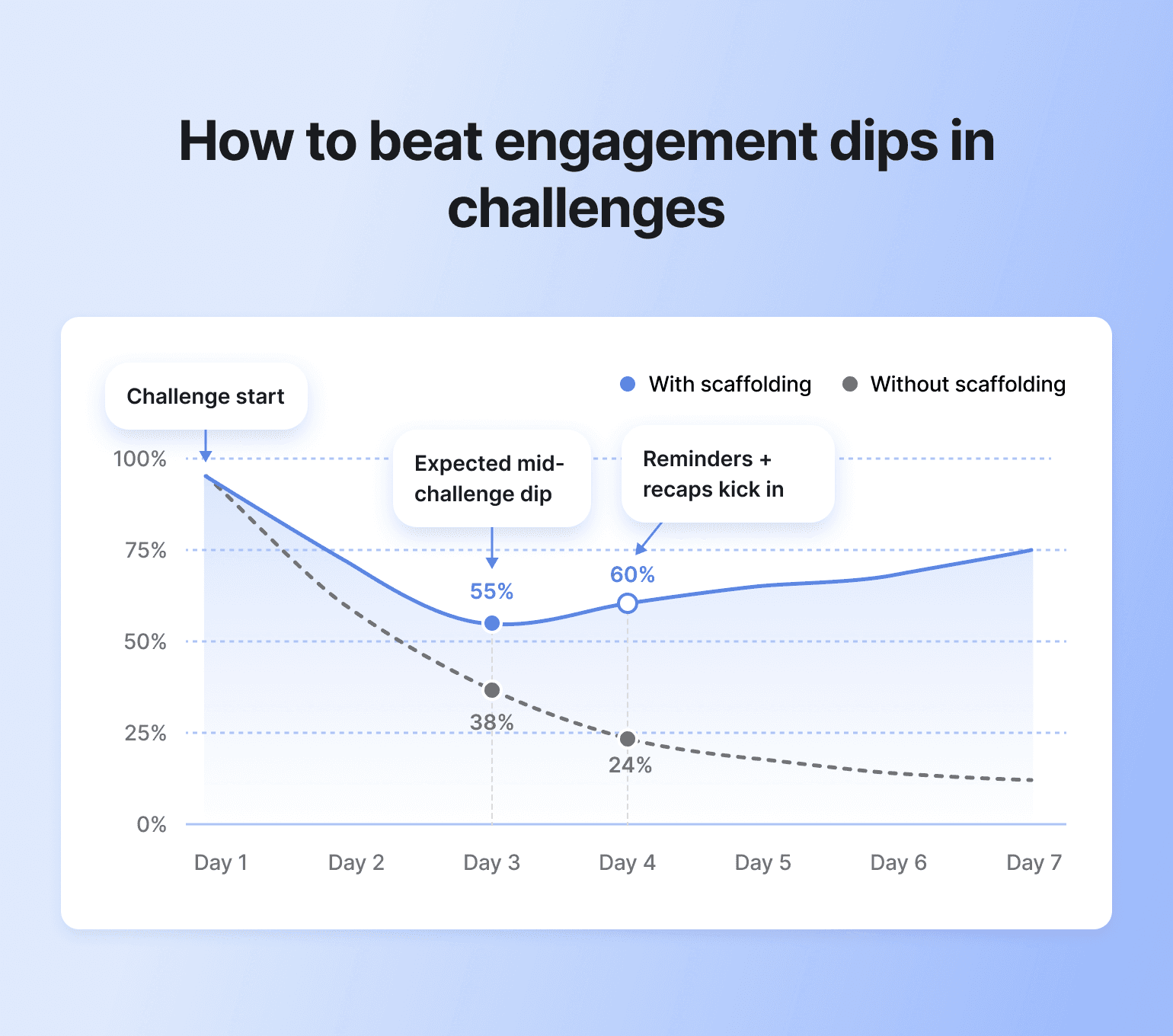
The middle of a challenge is where the design either holds or doesn't. Day one is easy: novelty does the work. Days three through five are when participation drops, and that's where most operators get caught flat-footed because they spent all their prep on the kickoff. Build something specifically for the middle: a midweek check-in post, a spotlight on a member who almost quit but didn't, a reminder that ties back to why they signed up. If you want a wider menu of activation tactics beyond challenges, our engagement ideas guide has more, with one rule worth keeping front of mind: restraint. Two well-run things beat five half-run things, every time.
If you're building your first challenge from scratch, Rachel Starr's Challenge Creator Starter Kit walks through challenge type selection, topic positioning, and a 7-day promotion sequence. It's free and includes a Notion planning template.
Challenge ideas worth running
Match the format to the gap you're trying to close. A challenge that fixes silent onboarding looks nothing like one that fixes low course completion.
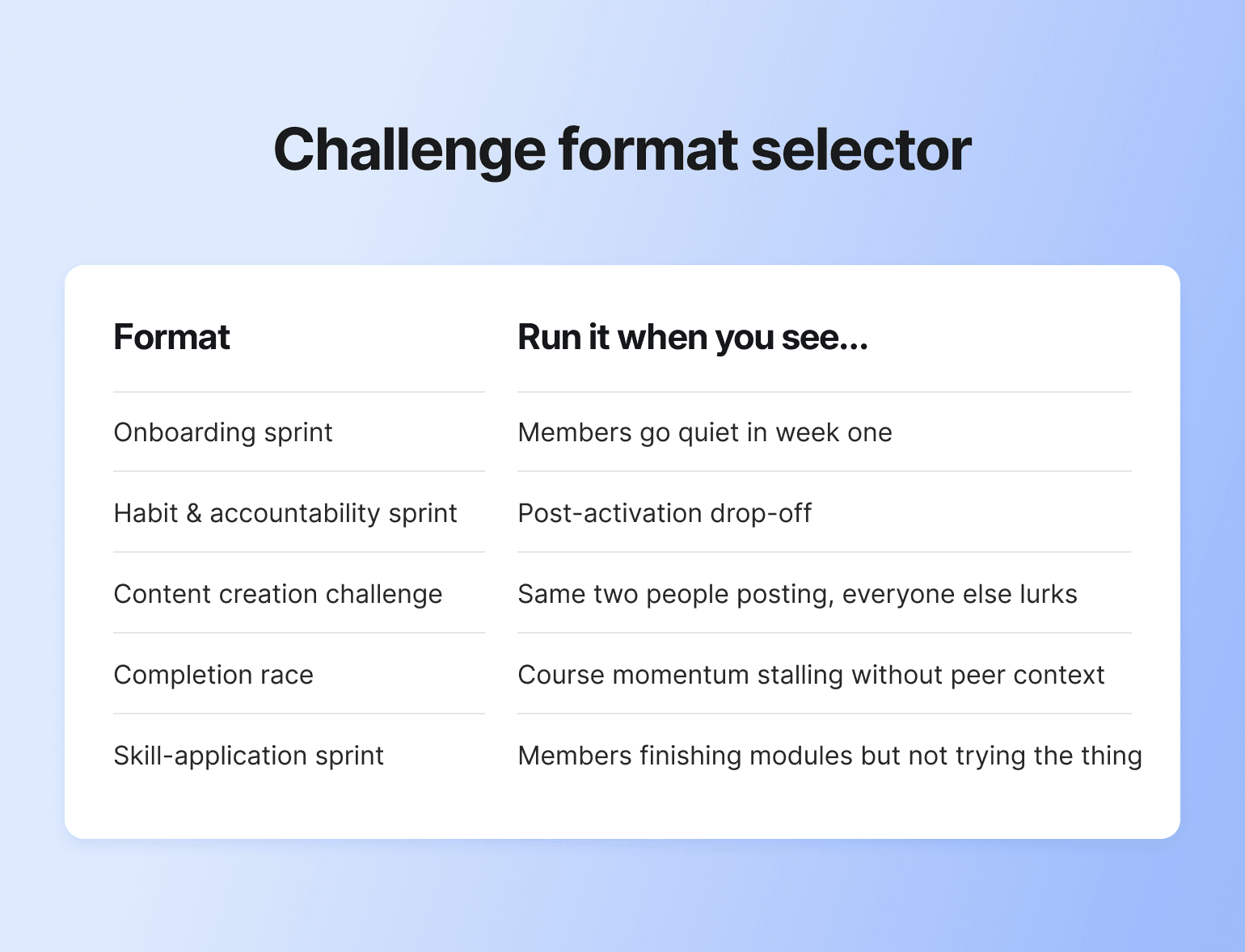
Onboarding sprints — for members who go quiet in week one
Members who don't engage in their first week rarely come back. An onboarding sprint closes that new-member cliff by giving new members one small action a day, each one designed to earn a reply or a reaction, so their first few days feel like a series of quick wins instead of a wall of features to figure out alone. The point isn't to teach them everything. It's to get them posting, get them a response, and get them back tomorrow. That structure matters most when you can't greet every new member yourself.
English Like A Native, Anna Tyrie's language-learning community, solved this by building the onboarding into the platform itself. On Circle, course purchases auto-enroll students into dedicated Spaces organized by course and language level — a Welcome Space, a video walkthrough, and a "what to do first" checklist give every new member a clear first move on day one, no personal outreach required. The result: a community that's scaled past 1,000 members while sustaining more than 650 events and 2,700 posts — volume that's only possible when the first-week experience runs without the founder in the room.

Check out the setup that scaled this.
Habit and accountability sprints — for post-activation drop-off
Habit and accountability sprints solve the post-activation drop-off, the slump where members who joined excited stop logging in a few weeks later. Say you run a membership for early-stage founders. Instead of a vague "stay consistent this month," you launch a two-week sprint with one daily ask: post the single most important thing you shipped today, in one line. That's it. Members drop a comment in the sprint Space, you award a point for each day they show up, and a running tally shows who's kept the streak alive. The bar stays deliberately low, because the goal isn't output, it's the return visit: a founder who writes "fixed the signup bug" in ten seconds is back in the community, sees three other people's wins, and replies to one. Keep the daily action under a minute, and start with a short sprint you can extend once members are hooked on the rhythm.
Musical Nest, a Circle community for music educators and parents, ran a 30-day practice challenge in January specifically timed to ride New Year motivation. Even a thumbs up or a like counted toward completion — deliberately low bar to keep busy parents in the game. They gave out sticker packs and tote bags as prizes; three total winners, chosen by random drawing, kept costs manageable.
Content creation challenges — for communities with an empty feed
Content creation challenges solve the empty-feed problem, where the same two members post and everyone else lurks. The fix is a prompt concrete enough that nobody stares at a blank box.
Make the daily ask tiny and specific. A writing community might run a 5-day flash-fiction sprint: one prompt word each morning, a 200-word cap, every entry posted in the same Space. A design community might run a week of daily redesigns, one real-world screenshot reworked per day. The job of the structure is to be short enough to finish in one sitting and public enough that finishing is visible.
That visibility is the engine. Each entry is one more example that makes the next member think "I could do that," so a week later the feed is full of member work instead of a prompt nobody answered.
Shannon Huffman, who runs Authors Only Collective, a writing community on Circle, built this exact mechanic into a weekly contest. Every Friday a prompt goes up with a deadline: 200 words, posted by Monday. Members drop their entries in the same Space, solicit feedback, and the community votes on a top three. The winner becomes the judge for the next round and picks the next prompt — which means every week someone new has ownership over part of the community. The whole thing runs on 15–20 minutes of admin. Friday through the weekend went from his lowest-engagement window to his highest, not because he changed his content, but because he engineered a reason for people to show up at the same time.
Completion races — for course communities that lose momentum
Completion races solve the problem where course participation can stall when people learn alone. Self-paced courses often lose momentum when members have no fixed deadline or peer context, while cohort-based courses create more urgency through discussion, start dates, end dates, and shared progress. SPI replaced isolated self-paced courses with cohort-based accelerators on Circle, giving members a shared window and a group to move through the material with. Completion rates now run 2.5x to 3x higher than the old self-paced model, and the community drives 58% of SPI's revenue.
Skill-application sprints — for closing the gap between learning and doing
Skill-application sprints close the gap between consuming content and using it, the gap where someone finishes your module, nods along, and never tries the thing. Where habit sprints track repetition, these put one specific lesson into practice. Pick the single most important skill you teach and build a week around applying it.
- A sales coach might run "one cold outreach a day, paste the message you sent and what came back."
- A copywriting community might run "rewrite one headline you wrote this week, post both versions."
Members commit publicly in a daily check-in Space and report what happened, not whether they read the lesson. That public report is the lever: a member who has told the room they'll try something is far more likely to follow through, and the ones reading along get a live feed of the skill working on real problems, which is the moment internal motivation usually drops.
Challenges work best on top of a community that's already set up well. If you're starting from scratch, our guide to build a community covers the groundwork, and the community engagement playbook walks through how the pieces fit together. Challenges are the programming layer that keeps that foundation active.
Keep the energy up between kickoff and finish
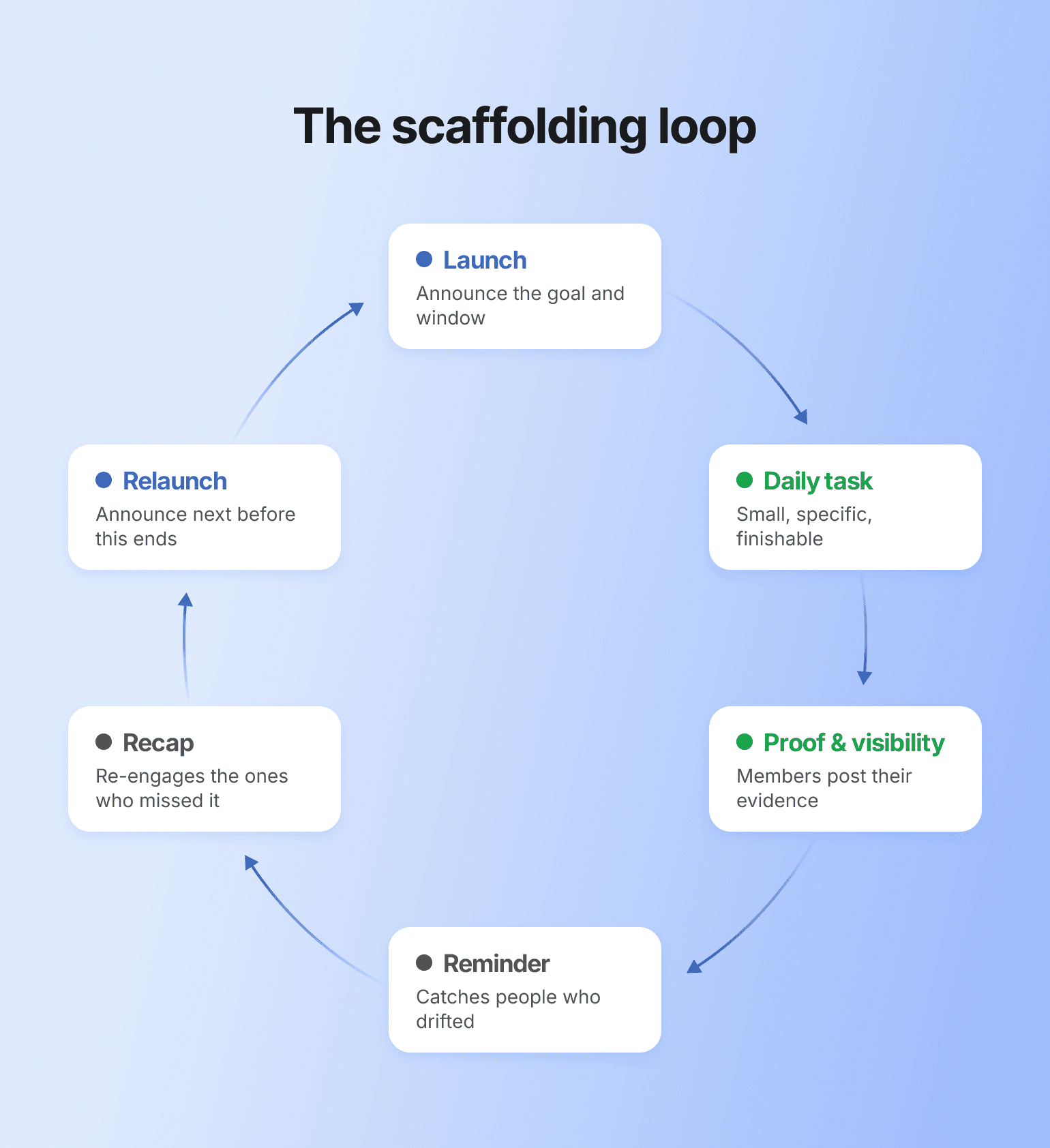
The idea is the small part. Most of the work is the scaffolding that nudges people back when motivation dips, and three mechanics carry most of the load:
| Mechanic | What it does | How to run it |
|---|---|---|
| Leaderboards | Rewards the right behavior — not the loudest voices | Give points for the actions you want more of (posts, replies, check-ins), not raw activity. In Circle, any workflow trigger can award points, so the top of the board reflects real contribution, not noise. |
| Reminders | Catches the people who almost forgot | A visible streak gives members something they don't want to break. Set reminders to send automatically and segment them — active members get fewer pings; quieter members get one weekly summary instead of a daily prompt. |
| Recaps | Re-engages the people who missed it | Someone who skipped the live session won't watch a 45-minute replay, but they'll read three bullets: the best moments, the members behind them, and links to threads they can still join. An AI summary can turn a week of activity into that recap in minutes. |
Skip these and you're relying on willpower, the least reliable engine in any community.
Make the challenge recurring programming
One challenge is an event. A series of them is a reason to stick around, and that shift from "we ran a thing once" to "we always run a thing" is where engagement turns into member retention.
The move that makes it work is repetition with a predictable shape: same format, fresh content, announced before the current challenge ends while energy is still high. Members renew not because last month was great, but because they can already picture next month and want to be there for it, which is why theming a forward calendar (January is planning, February is shipping) is one of the few free retention levers a monthly membership has.
Miro Heroes shows the compounding version at scale: the team pulled their advocate, consultant, and creator programs under one umbrella with space groups, surfaced top contributors with activity scores, and segmented by role and geography, and over two years the community grew 2x, member comments grew 3.5x, and social mentions from advocates climbed 90% annually.
The revenue case is just as direct. Alex Barker, a pharmacist-turned-career-coach, ran a free 4-day live challenge for his community on Circle (The Happy PharmD) — 350 sign-ups, 180 attended day one. By day three he was pitching his coaching program from the stage. The challenge generated $1,863 in VIP ticket sales and $36,000 in coaching contracts from 8 new clients. His most useful lesson: topic selection determines almost everything. A follow-up challenge on a different subject got a third of the registrations and zero coaching sales. The challenge format held — the audience fit didn't.
The challenge is the rhythm
A challenge that lands has a specific goal, a fixed window, small daily wins, and a set of energy systems built to survive the decay curve, repeated until it becomes the rhythm members renew for. Get that loop right and you can run programming that retains — and the next time you open that Space on a Thursday morning, it won't be to count how many people went quiet. It'll be to see who showed up.
Built for the whole challenge loop.
Community challenge FAQ
How long should a community challenge be?
Start short, often around five days, because it's long enough to create momentum and short enough to keep daily participation focused. Habit-building sprints can run longer, and themed accountability challenges can stretch to 30 days if each daily task stays small.
What's a good participation rate for a challenge?
A good participation rate depends on how active your community already is, how specific the challenge is, and how closely it connects to the reason members joined. Measure against your own baseline first: if a normal post gets a handful of replies and a challenge gets sustained check-ins from committed members, that's a useful result.
Should I charge for a challenge or run it free?
Both work, for different goals. A free challenge is a strong top-of-funnel acquisition tool, especially when the challenge is closely aligned with the paid offer that follows. A paid challenge filters for committed members. The price tag itself becomes a filter for who shows up.
What gamification mechanics work best in a challenge?
Combining mechanics often gives members more ways to participate than relying on one element alone. A leaderboard can create comparison, while badges and streaks add recognition and return visits.
Can AI run my challenge for me?
AI handles the operational layer — drafting reminders, summarizing long threads, surfacing which members have gone quiet — so you don't lose a week to manual admin. The relationship work stays with you, including encouragement and judgment calls on who wins. AI scales your reach while the connection members pay for stays with you.
Community Content Marketer
Arina is Circle’s community content marketer, sharing insights on community growth, GTM strategy, and storytelling for solopreneurs.