TikTok has been having a moment for a while now, and creators have been riding the wave.
Some—posting casually. Others—using the platform to attract clients, land brand work, or grow an audience they monetize elsewhere. Many do both at the same time.
While TikTok does offer built-in monetization, it’s not as reliable as many might think. In fact, most real income comes from what happens beyond the feed—UGC deals, sponsorships, affiliates, courses, and communities.
In this guide, we’ll break down how much TikTokers make in 2026, what TikTok actually pays per view, and how creators can turn attention into income off the platform.
How much do TikTokers really make in 2026?
TikTok typically pays anywhere from $20 to $400 per million views, with rare cases reaching $1,000+ per million views under specific conditions. Most creators fall on the lower end of that range, and many earn nothing at all from views alone. The wide variation comes down to eligibility, video length, viewer location, engagement, and whether views qualify under TikTok’s monetization programs.
RPM on TikTok stands for Revenue Per Mille (mille meaning thousand). It's the estimated revenue a creator earns per 1,000 video views. It's calculated as:
RPM = (Total Earnings / Total Views) × 1,000
Why TikTok’s payouts are lower than most creators expect
TikTok was designed around short-form, high-volume content that prioritizes reach and engagement. As a result, videos are only a few seconds long, leaving limited opportunities to serve longer, higher-quality ads. Then there are factors like paying creators only for qualified views, as views under 6 seconds don’t count, and a bunch of other criteria.
Compared to long-form platforms like YouTube, TikTok has fewer ad placements per video and less time to generate revenue from each viewer. Advertisers pay less per impression, which limits how much revenue can be shared with creators.
Why TikTok income depends on diversification, not views
On TikTok, views alone rarely translate into meaningful income. That’s simply the reality of the platform’s monetization model.
However, you can use TikTok effectively to capture attention and generate interest. The key is to then direct your audience toward paid offers elsewhere, such as affiliate links, digital products, courses, or paid communities.
Members only
One issue, five minutes, every Tuesday. Read by +14,200 creators.
The main ways TikTokers make money in 2026
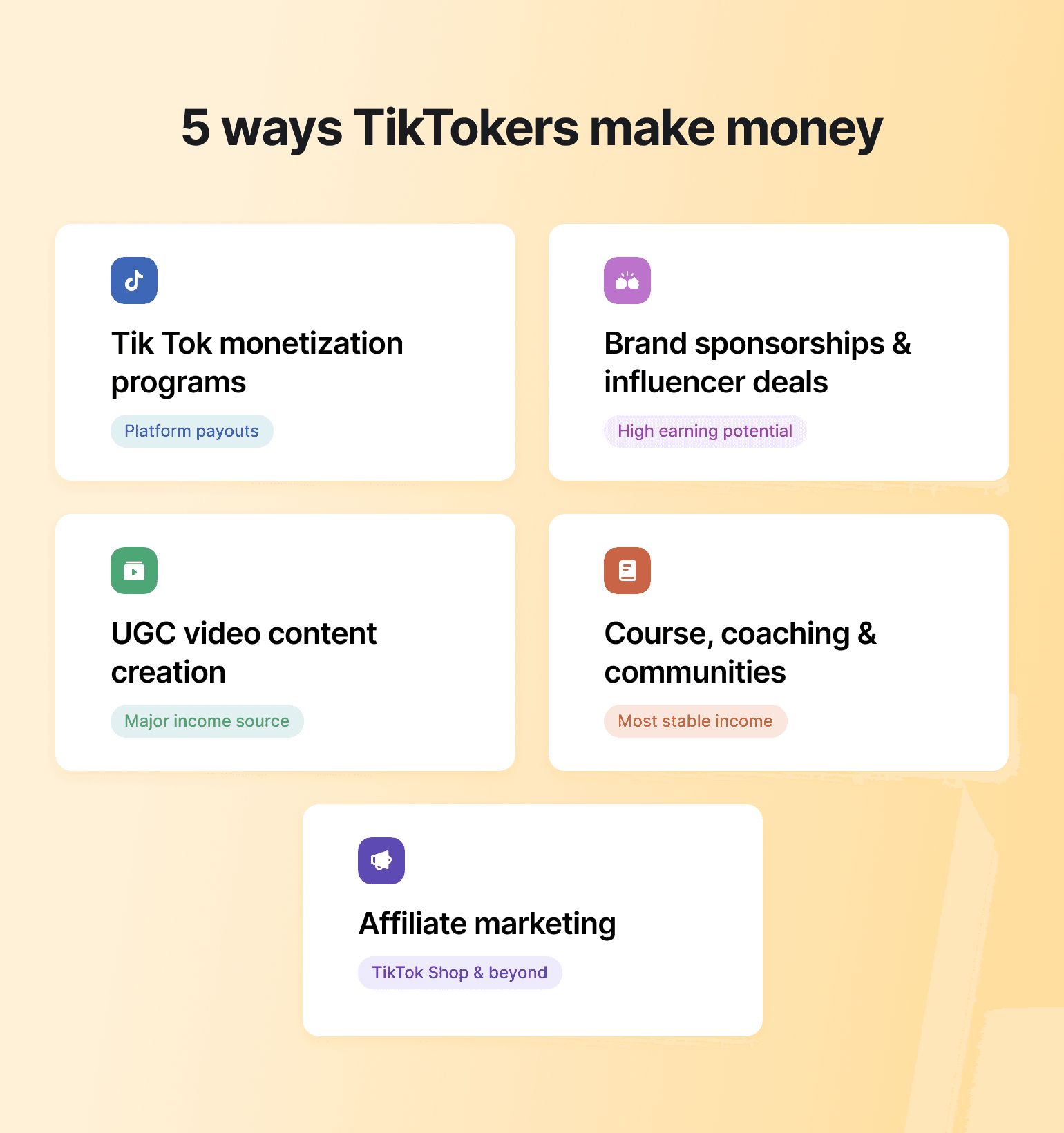
If TikTok payouts alone don’t tell the full story, the next question is where creator income actually comes from. In practice, most TikTokers rely on a mix of revenue streams.
TikTok’s own monetization programs
TikTok offers several monetization options. These are:
- TikTok One: A collaboration platform that connects creators with brands and advertisers for paid partnerships negotiated outside the feed.
- Creator Rewards Program: Pays eligible creators for high-quality, original videos based on qualified views and engagement, with payouts varying widely by performance and eligibility.
- TikTok LIVE: Enables creators to earn through virtual Gifts, subscriptions, and tips from viewers during live streams, depending on audience size and engagement.
Brand sponsorships & influencer deals
Brand deals are one of the most common ways TikTokers earn real money. Creators are paid to feature products, tell stories, or promote services in a way that fits their content style. Rates, however, vary widely depending on niche, audience trust, and consistency.
UGC content creation (a major income source)
UGC, or user-generated content, is one of the biggest income streams for TikTok creators. Instead of posting to your own audience, you get paid by brands to create short-form videos that the brand then uses in ads or on its own social channels.
Because payment is based on content creation rather than views or virality, many people earn a steady income through UGC without ever going viral. This makes it a popular path for solopreneurs and newer creators.
Affiliate marketing (TikTok Shop & beyond)
Affiliate income lets you earn a commission when viewers buy products through your links. TikTok Shop has made this easier by integrating products directly into videos, but you can also earn through external platforms and brand programs. This model is popular among product-heavy niches, though income often fluctuates with trends and demand.
Courses, coaching, communities, and digital products
Some of the most stable TikTok income comes from things you do and sell off the platform.
If you’re a niche creator or have a skill to teach, you can use TikTok as a discovery channel, then move those people off the platform into offers you control (like courses,coaching, or a paid community) where income is more predictable and sustainable.
How TikTok’s native monetization works (And what it really pays)
TikTok’s built-in monetization options can be appealing, especially for new creators. But they’re often misunderstood. While these programs do pay creators, earnings look very different from the headlines.
What TikTok Pulse really pays in 2026
TikTok Pulse is an ad revenue–sharing program that places ads next to the platform’s most premium, brand-safe content. Only videos that rank in the top 4% of content on TikTok, based on TikTok’s internal Pulse Score, are eligible.
When ads run next to a qualifying video, creators earn a 50/50 share of the ad revenue. Not every view qualifies, and ads don’t run on every impression, which means earnings can vary widely.
Why the Creator Rewards Program earnings are misleading
The Creator Rewards Program pays creators for original videos over one minute long that meet TikTok’s quality and eligibility requirements. Rewards are based on qualified views, not total views, which means factors like watch time, viewer location, and engagement all matter.
Only creators who meet minimum thresholds, such as follower count, recent views, account standing, and country eligibility, can participate.
The catch? Your actual earnings can be confusing because not all views qualify for payment, and eligibility rules, regions, and watch-time thresholds exclude a large portion of traffic. On top of that, payout formulas change and vary by video, making income inconsistent and difficult to predict from one post—or month—to the next.
TikTok LIVE gifting and virtual tips
TikTok LIVE lets creators earn money directly from viewers through Gifts, tips, and subscriptions during live streams, as well as Video Gifts on eligible posts. When viewers send Gifts, creators receive Diamonds, which can be converted into cash. To qualify, creators must meet age, follower, account, and location requirements, and not all content is eligible.
How much TikTokers earn by views & followers
To move past payout myths and TikTok “money calculators,” it helps to look at what creators actually report earning. We reviewed recent Reddit threads where creators openly shared view counts, RPMs, and payouts. The results show just how inconsistent TikTok monetization really is.
What TikTok actually pays per 1,000 views
On average, TikTok’s direct payouts land at a few cents to a few dollars per 1,000 qualified views, depending on the program, video eligibility, and audience factors like location and watch time. Many views don’t qualify at all, which is why two videos with similar reach can earn very different amounts—or nothing.
In a discussion about TikTok payouts, one user on r/TikTokLounge broke down how earnings typically work on a per-1,000-views basis:
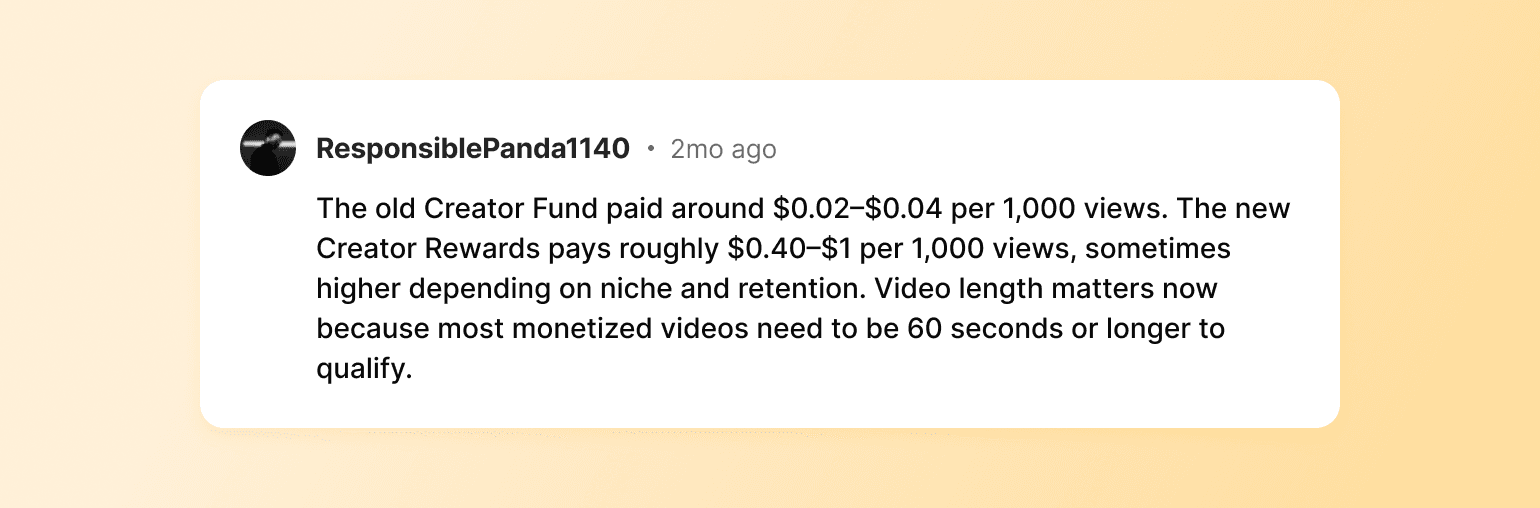
It’s definitely not a lot!
Earnings per 1 million views
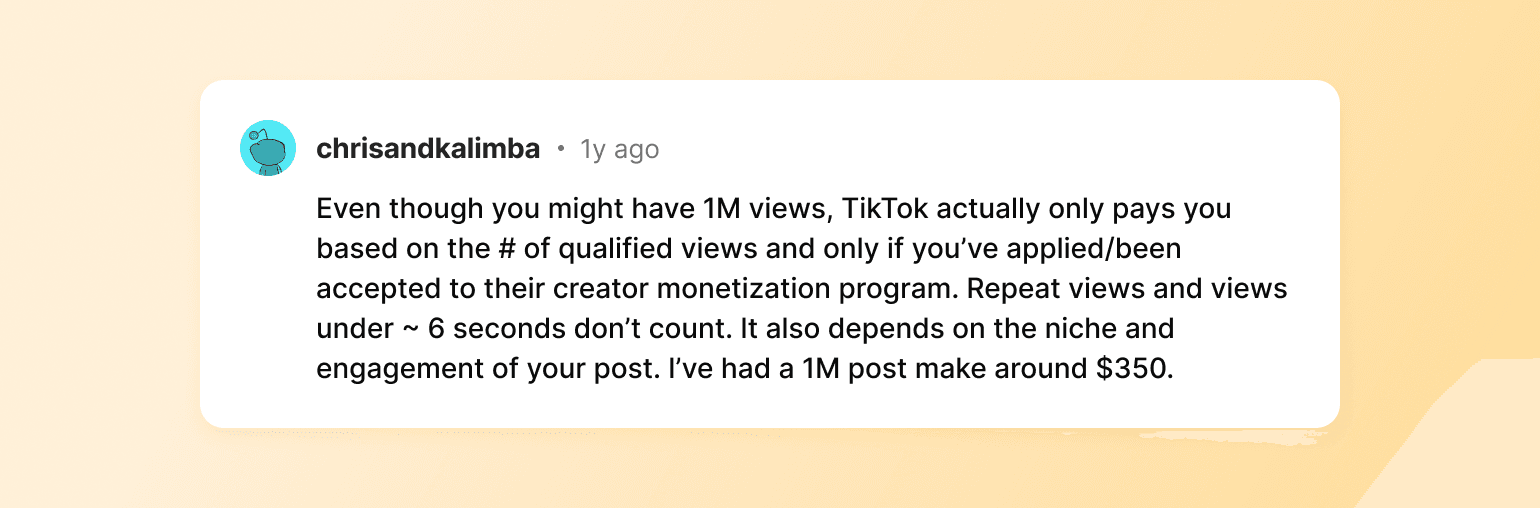
Even at the 1-million-views mark, payouts vary far more than most creators expect. Several creators in another Reddit thread shared wildly different outcomes for similar view counts.
One creator made $350 for 1 million views:
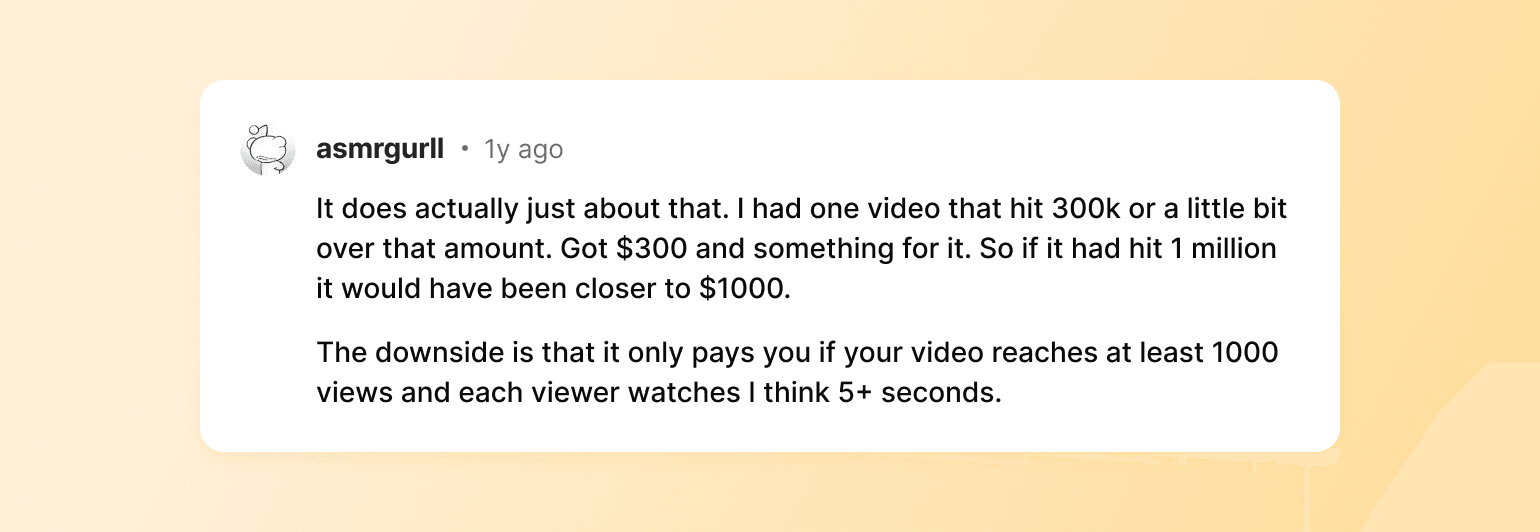
Another user claims she made $300 for a video that reached 300,000 views, which would have been close to $1,000 if it had reached 1 million views.
How much creators earn with 10k, 50k, 100k, and 1M followers
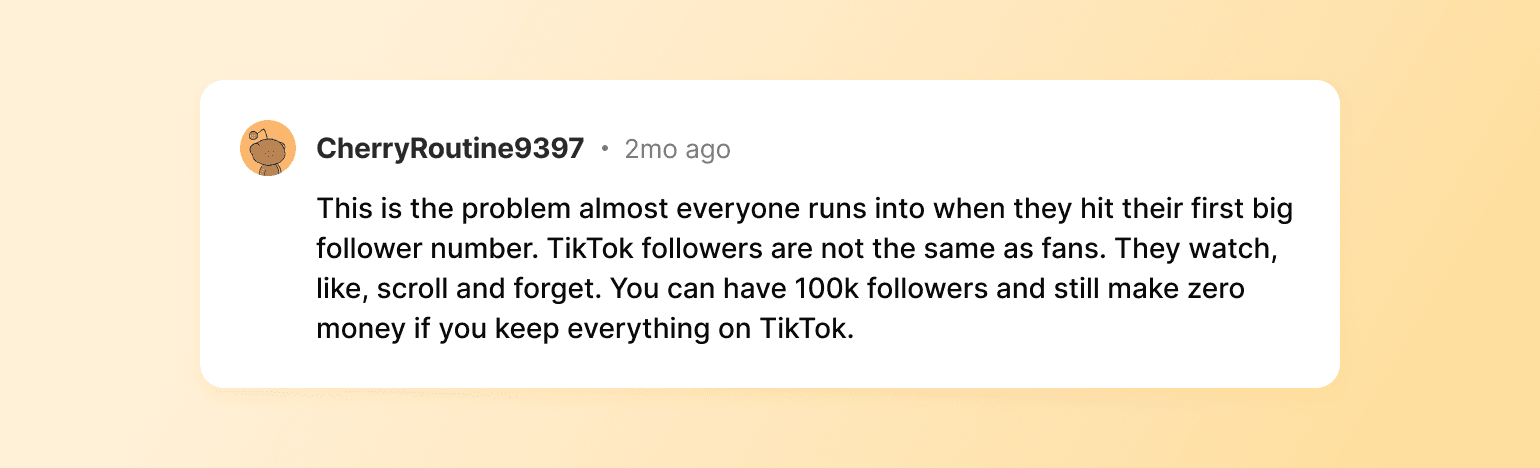
Follower count doesn’t translate directly into income. Some creators with a large following earn consistently through UGC or affiliates, while others with hundreds of thousands earn very little from views alone.
Followers help with credibility and deal flow, but income depends far more on how a creator monetizes than on how large their audience is. This user on r/advice thread said it best:
Why “per view” payout charts are misleading
Most charts assume every view is paid, every creator is eligible, and payouts are stable. None of that reflects reality.
TikTok rewards performance unevenly, changes rules frequently, and pays based on qualified engagement. As a result, views are a weak predictor of income unless they’re connected to a broader monetization strategy.
UGC & sponsorship income: Where most TikTok money really comes from
Let’s talk about UGC content and brand deals in a bit more detail because that’s where money is. According to the 2025 Creator Earnings Report, brand deals remain the single largest revenue source for creators, with nearly half earning most of their income from them.
What brands pay for UGC (beginner → advanced)
If you decide to go down the UGC creator route, expect your earnings to vary based on a few key factors:
- Your experience and proof of performance
- Brand that’s contracting your services
- Usage rights
- Niche and expertise
- Video volume
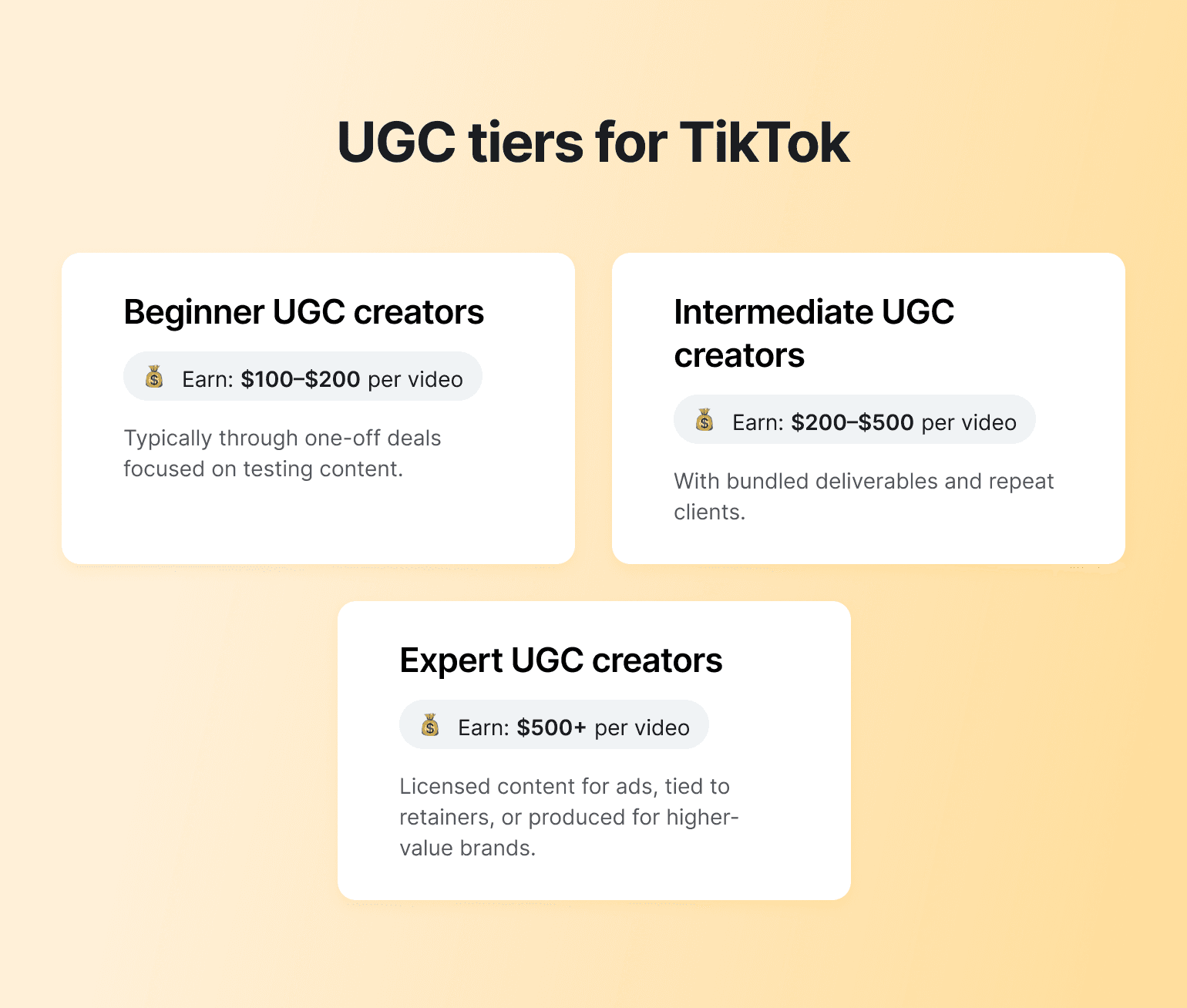
That said, creators tend to fall into a few rough earning tiers:
- Beginner UGC creators can typically expect to earn $100–$200 per video, often through one-off deals focused on testing content.
- Intermediate UGC creators often earn $200–$500 per video, with bundled deliverables and repeat clients.
- Expert UGC creators can charge $500+ per video, especially when content is licensed for ads, tied to retainers, or produced for higher-value brands.
Niches that command higher rates
Not all TikTok niches earn the same. Some attract higher-paying brands, stronger demand for UGC, and more consistent deal flow, while others struggle to monetize at all. Here are some of the most profitable ones:
- Personal finance & fintech
- Beauty & skincare
- Health, fitness & wellness
- Tech, apps & AI tools
- E-commerce & TikTok Shop products
- Education & skill-based content
- Home, lifestyle & organization
- Travel & experiences
👉 A side note: If you aren’t into any of these niches, don’t force yourself to create content around topics that are supposedly easier to monetize—you won’t build a sustainable business like that! Instead, look for the overlap between what you genuinely enjoy talking about, what you’re useful at (or actively learning), and problems people already pay to solve.
How UGC rates compare to typical TikTok payouts
UGC rates operate on a fundamentally different economic model than TikTok’s platform payouts. With UGC, brands pay creators directly for content production (usually a fixed fee per asset or package) based on creative skill, niche relevance, and usage rights.
TikTok payouts, by contrast, are variable and performance-based. Earnings depend on qualified views, watch time, geography, and shifting monetization rules, which makes revenue volatile and difficult to scale predictably.
In practice, a single UGC deliverable can generate the same income as what you can earn from millions of views through TikTok’s native programs.
Why TikTok alone can’t pay the bills
While becoming a UGC creator may sound good, the problem remains: TikTok’s payouts for views just aren’t that good. And there are a few reasons for that:
- You can make more on long-form platforms like YouTube. YouTube benefits from longer watch time, multiple ad placements, and higher advertiser intent, which allows creators to earn steadily from evergreen content. TikTok’s short-form, swipe-heavy format limits ad exposure, resulting in relatively small payouts.
- Social reach is volatile. According to Circle’s 2026 Community Trends Report, 32% of creators are already experiencing declining reach, despite posting consistently. Algorithm changes, audience fatigue, and platform saturation mean that earnings can fluctuate a lot on social media.
- There’s also a human factor. You’re probably going into TikTok alone, trying to earn a living off it by yourself—and that comes at a cost. As per Circle’s data, 25.8% of creators report burnout, driven by constant posting pressure (and yes, you need to post a lot on TikTok!), unstable reach, and the feeling that you can’t step away without losing momentum.
Taken together, there’s a massive platform risk—low payouts, volatile reach, and a constant grind just to make a few dollars from views. Is there a silver lining? Enter the TikTok → Email → Community monetization funnel.
The TikTok → Email → Community monetization funnel
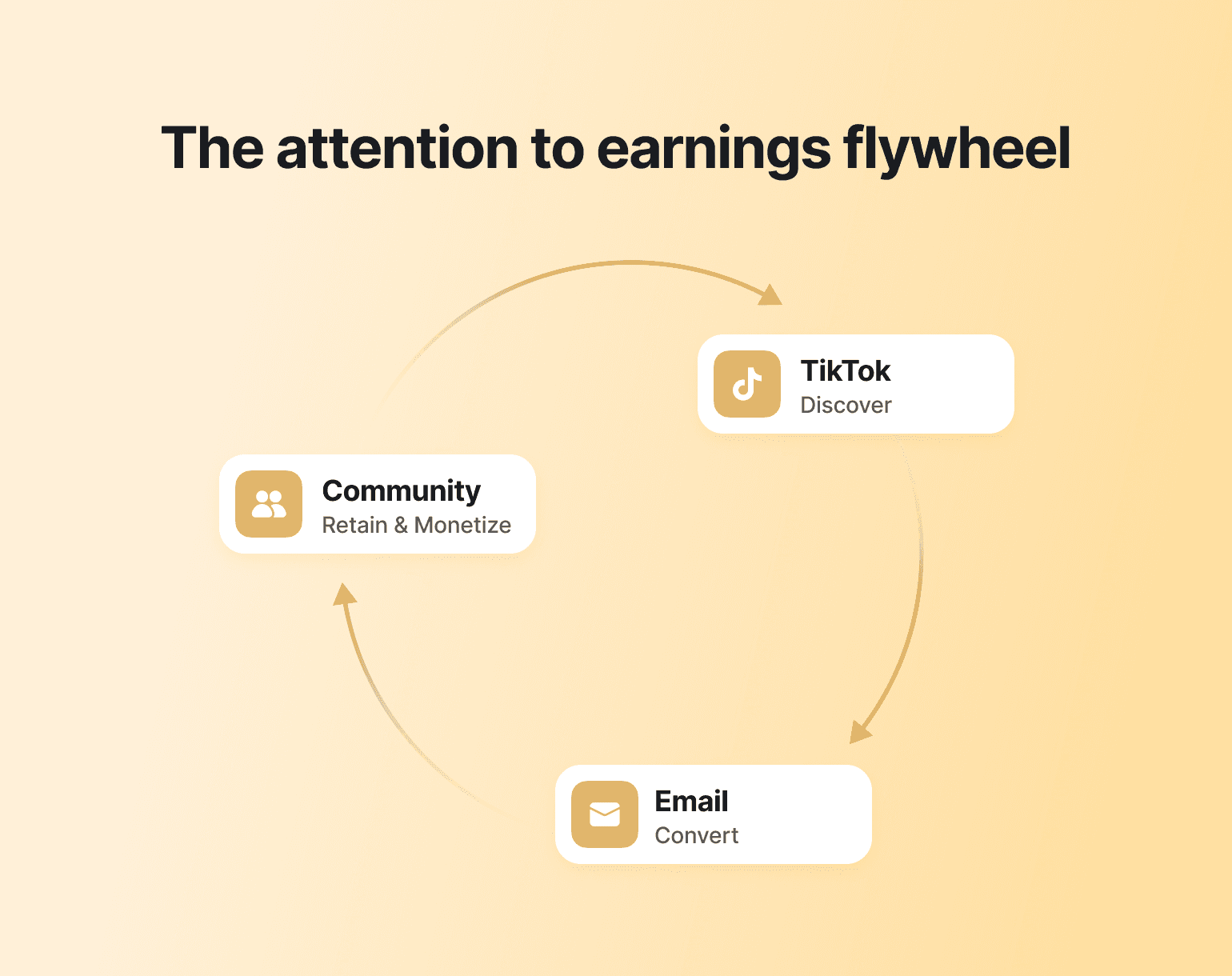
Something we can all agree on is that TikTok is powerful for reach, discovery, and momentum. Was it designed to be a stable income engine on its own? Not really. 🤷♀️ Can you still make money from it? Absolutely—but you have to approach it with a different mindset.
Why TikTok is top-of-funnel, not the destination
TikTok excels at putting your content in front of new people fast. But reach is rented, not owned. The best way to treat TikTok? As a top-of-funnel channel, meaning using it for what it does best: attention and discovery, while accepting that long-term revenue has to live elsewhere.
Capturing your best viewers with email
Once you achieve the main goal of TikTok (which is generating interest), you have to take your audience elsewhere. The most logical and easiest method? An email list.
Email gives you a direct line to your most engaged followers, without relying on algorithms or fluctuating reach. It also lets you nurture trust over time and introduce offers, like courses, communities, or coaching, on your own terms.
Converting fans into members, students, or coaching clients
Once you’ve captured attention and trust, the next step is giving your audience a place to go deeper. This is where memberships, courses, and coaching naturally fit—especially when they live in a space you control.
Building your community on a dedicated platform like Circle makes that transition smoother. Instead of monetizing attention one TikTok video at a time, Circle lets creators package knowledge, access, and connection into memberships, courses, and programs—under their own brand. Community discussions, structured learning, events, and content all live in one place, making it easier to increase lifetime value rather than chase the next spike in views.
The key distinction between TikTok-only revenue streams vs. community is that you have control. TikTok monetization is transactional and externally governed; owned communities are relationship-based and creator-governed.
Circle Partner and a community coach, Rachel Starr, after a TikTok ban scare, said it best:
If you’re not building a community you control, you’re playing a dangerous game.
And that pretty much means—stop treating social platforms like TikTok as the place where your business lives. Because one day, it can just be taken away from you!
Want to hear Rachel’s full take on this? Check out her video below👇
Earnings scenarios for different types of TikTok creators
So what does making money outside of TikTok actually look like in practice? Let’s take a look at a few scenarios.
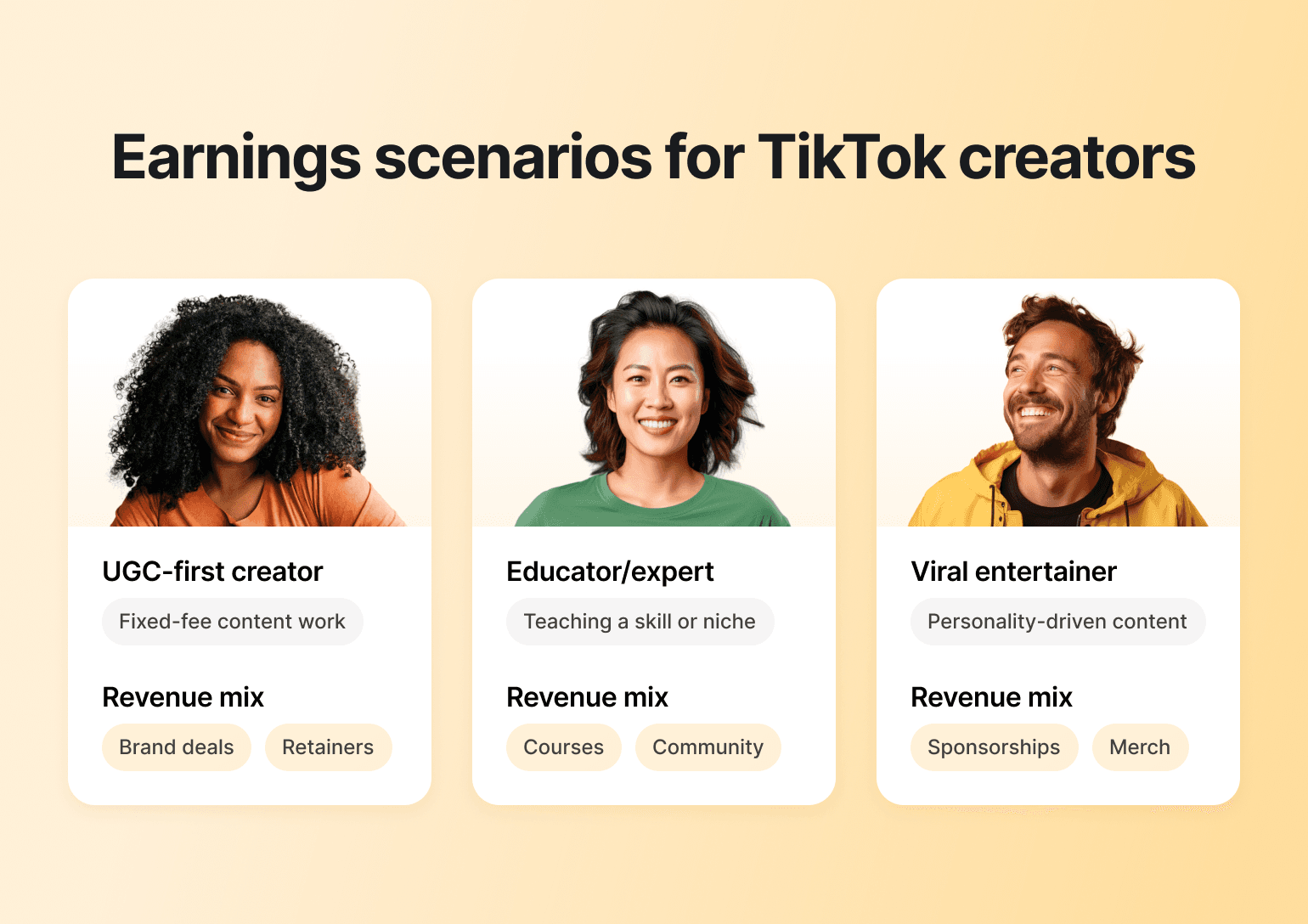
The UGC-first creator
If you want to become a UGC creator, most of your income would come directly from brands in the form of fixed payments for agreed deliverables.
That means your earnings would be driven by:
- Client type (one-off vs. recurring)
- Deal quality (scope, rates, and usage terms)
- Brand maturity (experienced brands vs. first-time UGC buyers)
- Contract structure (project-based vs. retainers)
- Lifetime value of a client (repeat work plus upsells)
You can earn a solid income from UGC content creation. However, you can’t fully control how frequently brands book you or how consistently you attract higher-paying opportunities.
The educator/expert
If you’re a niche creator with something to teach, income would primarily come from courses and a paid community. TikTok is where people would discover your ideas; revenue would be generated after viewers move off-platform into spaces you own.
Courses allow you to generate upfront revenue, while a community adds predictable, recurring income.
The viral entertainer
For entertainers, the most logical path to monetization is selling merchandise that reflects your personality or what your account is about, or doing sponsorship deals where you feature a product or service in your videos for an agreed fee.
How to choose your revenue mix as a TikToker
The question is really simple: how hands-on do you want to be? If not much, low-effort monetization strategies like affiliate links make the most sense. If you have more time and want long-term stability, building a course or starting a community is a far better move.
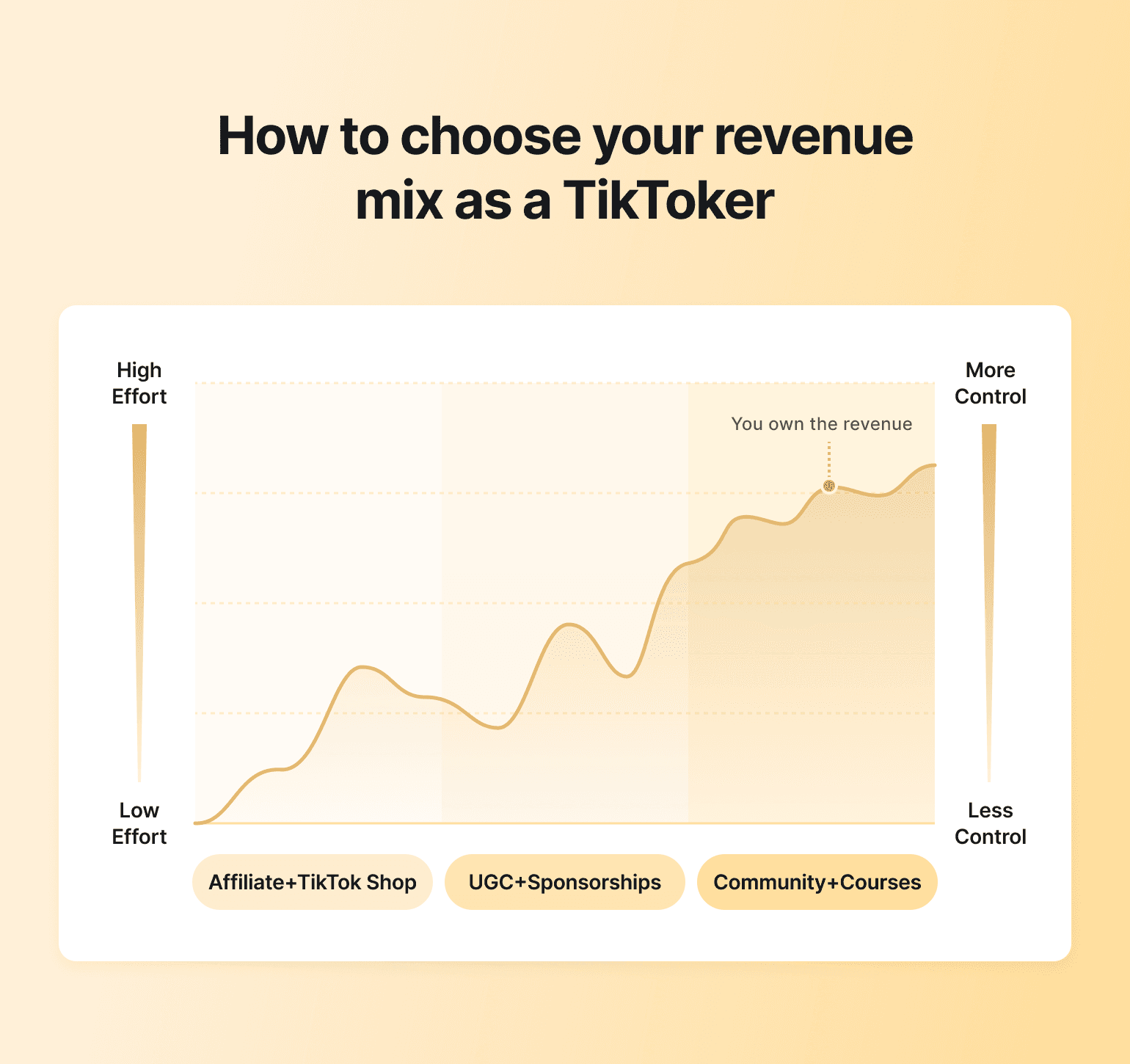
Low-effort monetization (affiliate links, TikTok Shop)
This works best if you:
- Don’t want to build products or services
- Are comfortable promoting existing offers
- Prefer speed over control
The downside? Earnings fluctuate with reach, trends, and platform changes.
Mid-effort monetization (UGC, sponsorships)
This is a step up in effort and income potential. You’re paid directly by brands for content, regardless of views.
This works best if you:
- Are strong on camera or creatively skilled
- Want higher payouts per project
- Don’t mind client work and negotiations
Income can be solid, but it’s still tied to deal flow and availability.
High-leverage monetization (paid community + courses)
If you want to monetize your knowledge or a unique skill that you have, this is the most durable model for you. It works best if you:
- Have a niche, skill, or framework to teach
- Want recurring or scalable income
- Prefer owning the relationship with your audience
Courses create upfront revenue. Communities create ongoing income. Together, they reduce reliance on algorithms and posting volume.
What TikTok creators can realistically expect to earn in 2026
If you rely on TikTok alone, expectations need to stay modest. Platform payouts are low and inconsistent, with most creators earning anywhere from $20 to $400 per million views, and many earning nothing at all.
If you diversify beyond the platform, earnings can certainly improve. Creators who add UGC work, brand deals, affiliates, or sponsorships can earn anywhere from a few thousand dollars a year to a full-time income, depending on niche, deal flow, and client quality.
If you build an owned audience ecosystem, the ceiling changes entirely. As per Circle’s research, 31% of creators running paid communities earn between $10,000 and $250,000 annually, which is by far better than relying on views or brand deals alone.
Next steps
If you’re ready to take the leap into monetizing your TikTok audience in a more sustainable way, now is the best time to do it. Circle is built specifically for creators who want to turn attention into ownership—by launching paid communities, hosting courses, and building recurring revenue without relying on algorithms.
Stop chasing views and virality! Instead, build a space you control, deepen relationships with your audience, and monetize in ways that compound over time.
Try Circle for free for 14 days!
FAQs
Can you make a living off TikTok?
Yes—but for most creators, not from TikTok alone. Platform payouts from views are low and inconsistent, so relying solely on the app makes earning a full-time income difficult. Creators who do make a living typically diversify with brand deals, UGC work, affiliates, products, or by monetizing audiences off-platform through courses or communities.
Does TikTok pay monthly?
Yes, TikTok generally pays creators on a monthly basis, but only if certain requirements are met. Earnings are calculated over a monthly period and paid out after the month ends, as long as you've completed the required setup (such as linking a payment method), meet the minimum payout threshold, and your account remains eligible. If any of these conditions aren't met, payments may be delayed or held until they are.
Who is the highest-paid TikToker?
As of 2025, it is estimated that the top three highest-paid TikTokers are:
- Charli D'Amelio – ~$17.5 million
- Dixie D'Amelio – ~$10 million
- Addison Rae – ~$8.5 million
Their income comes largely from brand deals, businesses, media projects, and careers built beyond TikTok itself.
Contributing Writer
Paulina Major writes about online courses, freelancing, and growth. She helps creators build, launch, and grow educational communities that thrive.