TL;DR
- Just like people don't quit bad jobs, they quit bad managers — members don't quit over bad content. They quit over non-engaging spaces.
- AI can’t help re-engage members it can’t see—so it needs to be native to the platform to see who finished the course, who skipped events, and who stopped posting.
- Circle is the strongest all-in-one pick because its engagement AI acts on what members really do, not a stale copy synced from another tool.
You didn't have an engagement problem on day one. The first cohort was loud — intros flying, every post pulling a string of replies, events filling up the moment you announced them. Then it settled. The same ten people carry every conversation, RSVPs slid from forty to twelve, and the member who used to post weekly hasn't opened the app since the last billing cycle. You can feel people drifting before the cancellation emails pile up.
Keeping the members you already have engaged — and keeping the community healthy enough to grow — is a whole skillset on its own, separate from the day-to-day of moderation and onboarding. Some tools are built for that ongoing work; most just aren't.
The real question is whether a platform's AI can act on the signals already sitting in your data — who finished the module, who skipped the last two events, who used to post and stopped — or whether it's a generic chatbot stapled to a feed. Here's how the seven tools creators evaluate stack up.
Overview: best AI tools for improving engagement
| Platform | Getting new members to post | Re-engaging members who go quiet | Driving event turnout | Spreading participation past the regulars | Best for |
|---|---|---|---|---|---|
| Circle | Circle AI builds and executes from a single conversation; AI Agents greet and guide in DMs with profile context | Activity Scores flag at-risk members; Circle AI surfaces and re-engages from admin chat; behavior-triggered Workflows act without manual steps | Native events with AI Workflows for targeted invites and reminders; Circle AI can build the whole sequence | Member directory + 'Near me' + Gamification; Circle AI can configure points, badges, and leaderboards in plain language | Creator-led communities needing end-to-end AI from onboarding to re-engagement |
| Kajabi | Expert Agents answer in courses and DMs; Cofounder helps admin build onboarding flows but no in-community AI greeter | Email automations trigger on behavior; no in-community re-engagement AI; no Activity Score equivalent | Events via Meetups; no AI-assisted invite targeting | Gamification (leaderboard, points) now available; no member-matching or directory | Course creators who want AI for building and selling, less so for sustaining community |
| Skool | No native AI; manual welcome | None native | Calendar tab, no AI programming help | Points/leaderboard only | Simple communities where gamification is enough to drive participation |
| Mighty Networks | Member-matching AI ("Similarities") | Re-engagement suggestions for the admin | AI suggests themes; admin executes | "Similarities" surfaces shared interests | Communities where member-matching and AI content planning matter more than execution |
| Hivebrite | AI member matching (institutional) | AI matching, no behavior triggers | Event tooling for chapters/networks | Directory/matching, association-style | Alumni networks, associations, and large institutional member orgs |
| Higher Logic | AI-suggested answers, no chat agent | Smart Campaigns nudge via email | Forum events, admin-driven | Forum and email, not in-community | Enterprise associations running forum-based communities with email re-engagement |
| Disco | Ask AI for learners; no community greeter | Smart nudges, but cohort-bound | Cohort scheduling, not community events | Ends when the program ends | Training businesses and corporate L&D running structured cohort programs |
1. Circle — best all-in-one, AI-native platform for community engagement
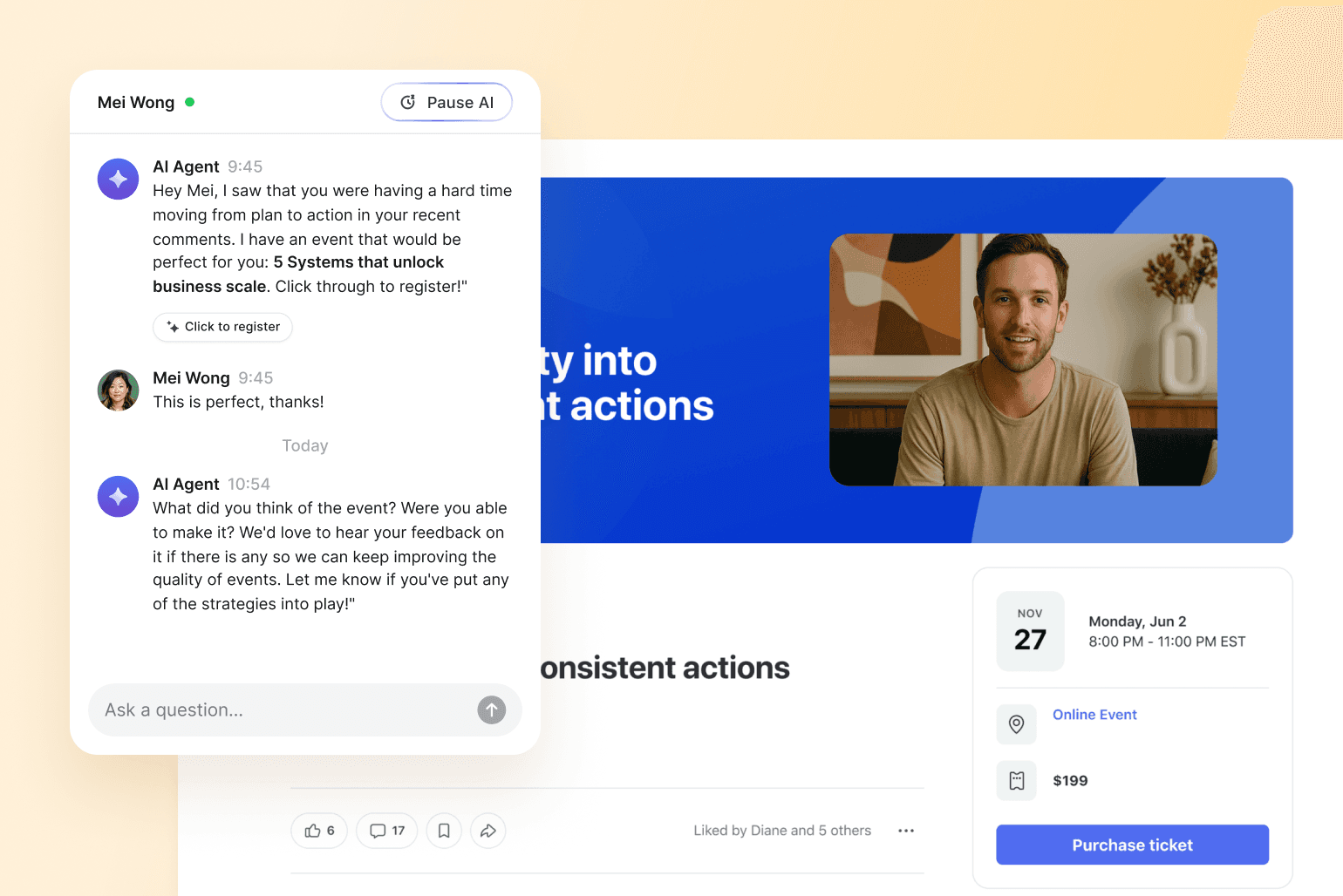
Circle is the all-in-one community platform built for creators, coaches, and brands running community-led businesses. Discussions, courses, events, email, payments, a website builder, and a CRM all live under one roof. In June 2026, Circle became the first platform in this space to go genuinely AI-native — not by bolting a chatbot onto a feed, but by rebuilding the admin experience around a conversational AI partner that knows your entire community and can take action on your behalf.
The engagement AI works inside that shared record, so when it reaches out to a member, it already knows what they paid for, what they finished, and when they last showed up.
How Circle keeps members engaged
Circle's engagement AI runs on two distinct layers. The first is Circle AI — a conversational workspace for admins, built directly into the platform, that can build, manage, and operate your entire community from a single chat interface. Describe what you want in plain language and it figures out what needs to happen, shows you the plan, and executes it in real time. It launches with 50+ specialized skills across domains including member management, content creation, analytics, and engagement — and because it has full context of your community (every member, every space, every conversation, every payment), its suggestions and actions are grounded in what's actually happening, not generic advice.
The second layer is what your members experience directly:
- Turning signups into first posts: AI Agents trained on your Spaces, courses, and content greet new members in DMs and walk them to their first action — personalized to their profile, including role, goals, and any custom fields you've set. The guided onboarding runs without you sending a single welcome message.
- Building the early-weeks habit: AI Workflows fire on real behavior — a stalled course, a missed event, two weeks of silence — and trigger a DM, a post, or a re-invite. From the admin side, you can build and adjust these workflows in plain language through Circle AI rather than navigating a visual editor.
- Spreading participation past the regulars: A searchable member directory with a 'Near me' filter helps members find relevant peers, and gamification with points and leaderboards rewards real contribution to pull quieter members in.
- Boosting event RSVPs: Native event tools send targeted invites by Space, profile, or tag, with automated reminders and Workflow-driven follow-ups splitting attendee and no-show paths.
- Catching members before they churn: Activity Scores give every member a 1–10 score over a rolling 30-day window. A drop typically shows up before they leave, and Circle AI can surface at-risk members and suggest — or execute — the right re-engagement action directly.
What ties all of this together is one record. Because Circle AI has full admin context and AI Agents are trained on your actual content, neither layer is guessing. The Entreprenista League put an AI Agent to work surfacing answers, pointing members to the right events, and handling navigation for nearly 3,000 founders — which cut the load on its five-person community team while keeping the relationship-building firmly with the humans.

20K+ digital businesses live on Circle
2. Kajabi — built for selling courses, not sustaining participation
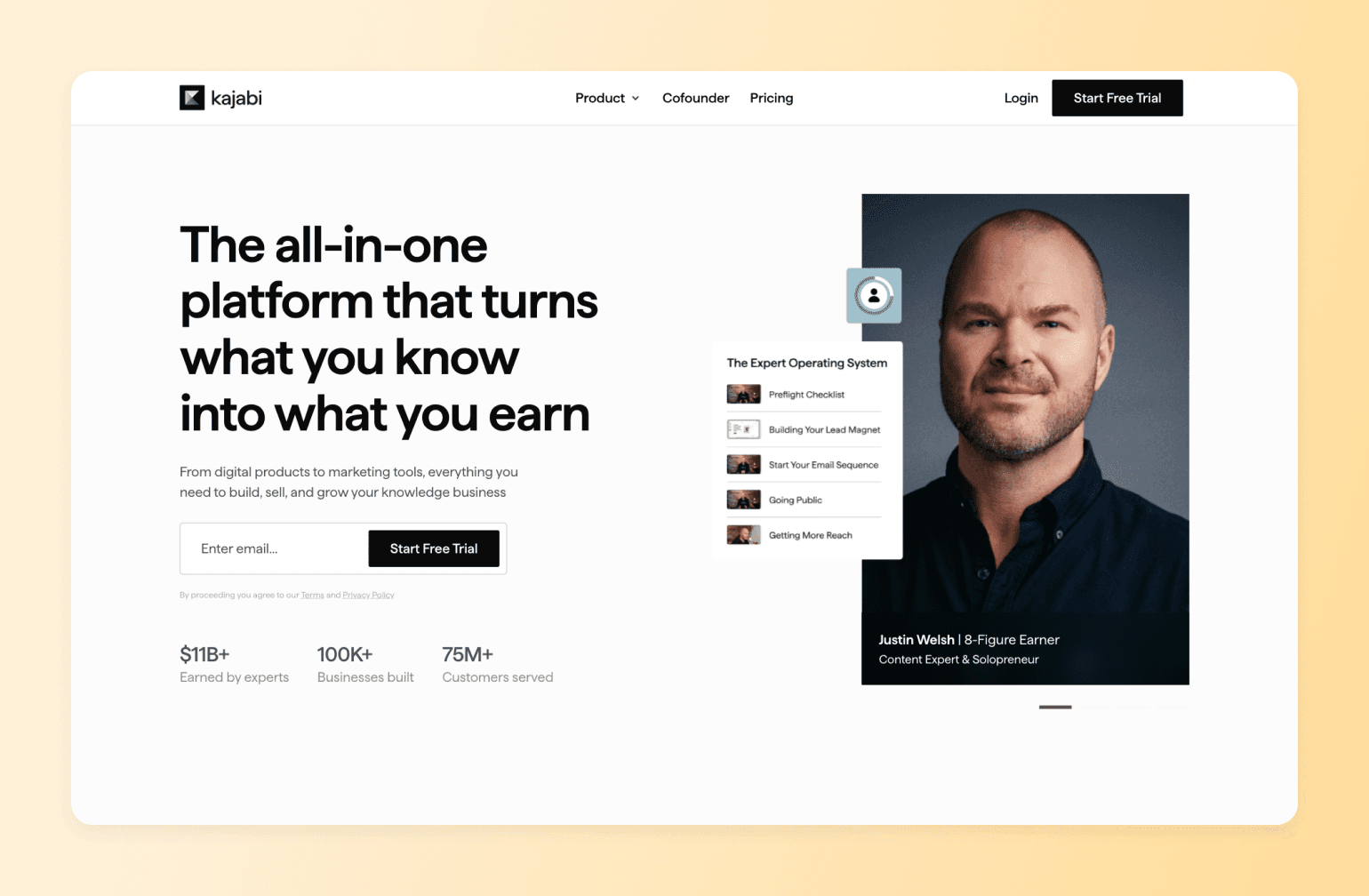
Kajabi's roots are in course sales and marketing funnels, and that still shows up in where its AI investment lands. Cofounder helps you figure out what to build, how to price it, and how to write about it. Backstage gives coaching clients personalized portals with AI session summaries. Both are genuinely useful. Neither watches who's drifting in your community or does anything to bring them back.
Where Kajabi falls short on engagement
- Cofounder helps the admin, not the member. Kajabi's most prominent AI product — available on every plan — thinks with you, plans with you, and helps you build a business that matches your expertise: drafting copy, pricing offers, and suggesting what to build next. It's a powerful tool for a creator running a business. But it doesn't greet new members, watch who's going quiet, or trigger re-engagement. The admin gets an AI partner; the member still gets a feed.
- Backstage is 1:1 coaching, not community engagement. Backstage turns existing content into a personalized program for each client, with a private portal, AI session summaries, and transcribed voice memos. Genuinely useful for coaches working with individual clients. It doesn't address the problem this article is about: keeping a community of dozens or hundreds of members engaged with each other over time.
- No behavior-triggered in-community re-engagement. Kajabi's automations trigger based on real behavior — joining, engaging, or going quiet — and keep messaging personal and timely. But those automations run over email. There's no AI watching who hasn't posted in three weeks and nudging them back into the conversation inside the community itself. The moment a member drifts, Kajabi's response is an email campaign — which is exactly what a member who's already disengaging is least likely to open.
Kajabi is a genuine all-in-one platform for experts, and its recent releases show real ambition. But its AI investment is concentrated where Kajabi has always been strongest — helping the creator build and sell — not on keeping a community of members active once they've joined. Circle's AI acts on that second problem directly: Activity Scores surface the drifting member, and behavior-triggered Workflows reach them inside the community, not in their inbox.
Read the full Kajabi vs. Circle comparison.
3. Skool — simple to start, no engagement AI
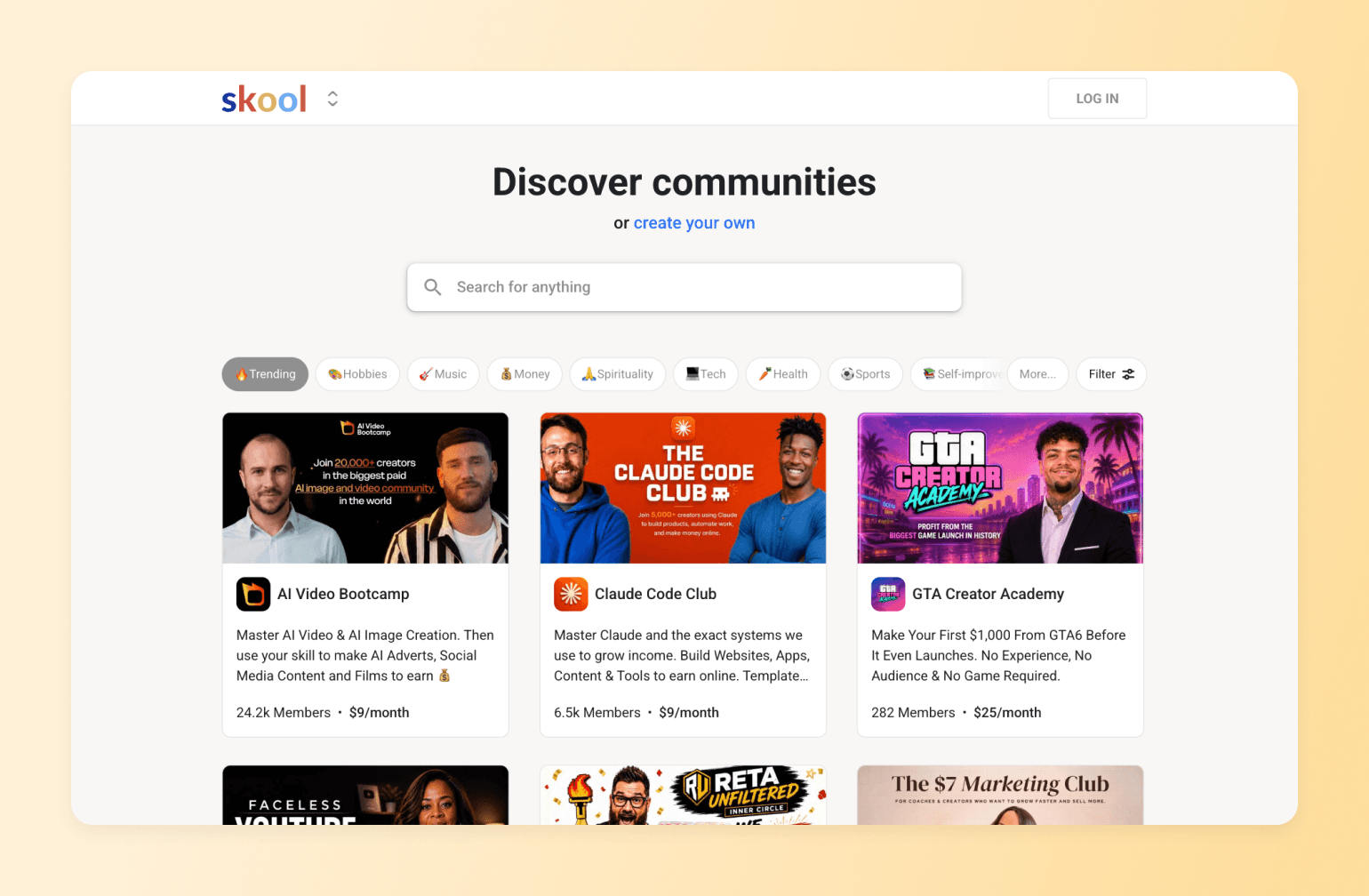
Skool is a paid community platform built around a single forum feed, a course player, and gamification, kept deliberately minimal. The simplicity gets members posting fast, but its only real engagement lever is a points-and-leaderboard system — there's no AI underneath it.
Where Skool falls short on engagement
- Gamification is the only lever: Members earn points for likes and climb levels to unlock content. It moves surface activity, but there's no behavioral scoring to catch a member going quiet and no workflow to act on it.
- No AI for re-engagement or programming: Skool has left AI out of scope, so spotting the at-risk member, drafting the prompt that restarts a thread, and matching members are all yours to do by hand.
- Limited room to grow programming: The three-tab structure (community, classroom, calendar) keeps things clean but leaves little room for the varied programming rhythm a maturing community leans on to keep people coming back.
Skool's points and leaderboards are enough to spark early activity, but they only register surface actions — a like, a post — not the member quietly drifting toward cancellation. There's no scoring to flag them and no workflow to act. Circle reads the deeper signal: Activity Scores surface the member whose participation is dropping, and behavior-triggered Workflows re-engage them before they're gone.
Read the full Skool vs. Circle comparison.
4. Mighty Networks — AI for planning engagement, not running it
Mighty Networks built its AI around community strategy and content prompts for the host. It helps you plan and draft engagement, but it doesn't act on members on its own — so executing the plan still lands on you.
Where Mighty falls short on engagement
- The AI advises; it doesn't act: Mighty Co-Host generates monthly themes, conversation starters, and re-engagement messages for the host. The member matching ("Similarities," which surfaces shared interests) can help with participation breadth. But the re-engagement feature works by drafting a message you then send yourself — the AI hands you the nudge rather than delivering it.
- Data sits in silos: Native community features exist, but engagement AI works best on a complete member picture — and when community activity isn't connected to email and payments, personalized re-engagement at scale gets messy.
- Thin analytics on what matters most: Membership reporting has documented gaps: there are no video retention graphs, watch time data, or drop-off tracking on any plan, and analytics aren't available at all on the entry-level tier. Operators who need a clear picture of churn or revenue trends often find themselves piecing it together from outside the platform.
- Depth scales with price: Automation and engagement depth increase on higher tiers, and a fully branded app sits on a separate, higher pricing plan.
Mighty's AI can help you plan engagement — themes, prompts, member matches — but the execution still lands on you, because it drafts the message and leaves you to send it. Circle's AI Agents close that loop: they reach members directly in DMs to onboard, answer, and nudge, and because community activity, email, and payments share one record, the re-engagement fires on a member's real behavior instead of a suggestion you have to action by hand.
Read the full Mighty vs. Circle comparison.
5. Hivebrite — engagement AI built for institutions, not creators
Hivebrite is enterprise software for associations, alumni networks, and large organizations. Its AI routes members to other members — useful for a directory, less so for the day-to-day engagement a creator-led community needs.
Where Hivebrite falls short on engagement
- Matching, not member pull: Hivebrite's AI matching pairs members for 1:1 networking by industry, interests, and experience, and handles the scheduling. That's useful for an alumni or association directory, but it's a one-time introduction — it does nothing to keep a member who's losing interest coming back week to week, which is the work a paid community actually runs on.
- Built for member administration: Directories, job boards, mentorship modules, and chapter management suit alumni and association networks. A creator getting members to show up weekly is solving a different problem than an association administering a roster.
- Enterprise scope and sales cycle: Pricing and implementation are quote-based and institution-scale (often $8K–$10K+/year with a guided rollout), which puts Hivebrite out of reach for most solo creators and small teams.
Hivebrite's matching engine is real, but it's built to introduce alumni for a one-off coffee chat, not to deepen day-to-day participation in a paid community — and it's priced for an institution, not a creator. Circle approaches participation breadth differently: a searchable member directory with a 'Near me' filter lets members find the peers worth talking to, and gamification rewards contribution to draw more of them in — all self-serve on a creator's budget rather than an enterprise procurement cycle.
6. Higher Logic — forum engagement for enterprise, AI on the admin side
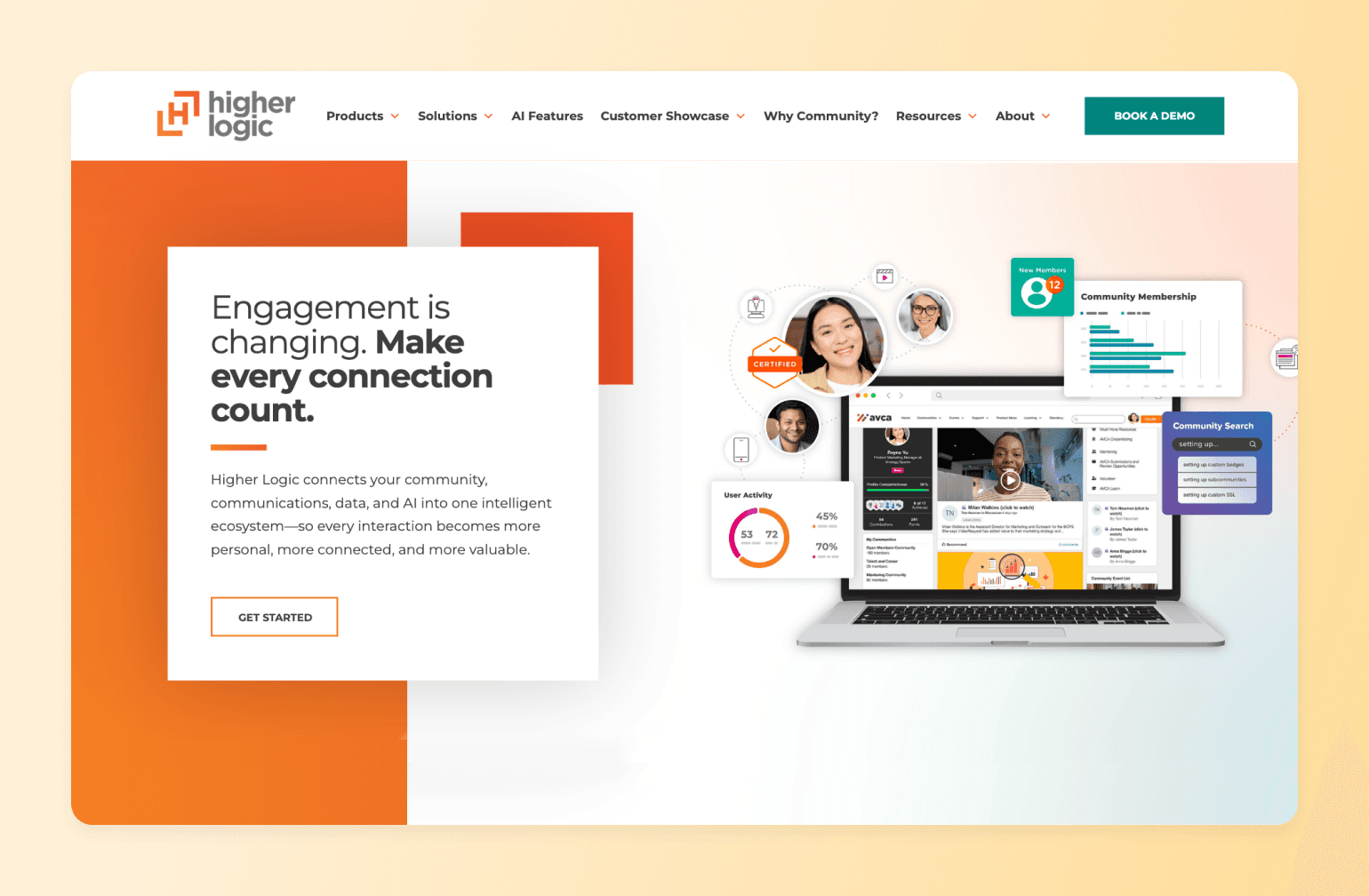
Higher Logic is a long-standing enterprise community provider, with Thrive for associations and Vanilla for customer communities. It's traditional forum software with AI layered onto the admin and content side.
Where Higher Logic falls short on engagement
- Engagement runs on email, not in the community: Higher Logic's Smart Campaigns are pre-built, AI-generated email sequences for common goals — re-engagement, onboarding, driving participation. They deploy fast and require minimal setup. But they're templated: the flows and targeting criteria are fixed, so the re-engagement that fires is the same for every lapsed member, not a response to what that specific member did or stopped doing.
- Forum-first, not relationship-first: Discussion forums and sub-communities are the backbone. Communities that drive engagement through chat, DMs, and structured Spaces operate differently — engagement comes from connection, not thread volume.
- Courses are a third-party add-on: Higher Logic Thrive Learn is a separate add-on powered by third-party partners, so course progress and community engagement don't share one record.
Higher Logic can nudge members and surface content, but it's an association engagement platform — the re-engagement lives in email campaigns an admin builds, and the community itself is a forum. That keeps a forum populated; it doesn't make conversations feel alive. Circle drives engagement through connection instead: chat and DMs, structured spaces, and gamification with points and leaderboards that reward real contribution — so more members talk because they want to, not because a campaign reminded them to log in.
Read the full Higher Logic vs. Circle comparison.
7. Disco — engagement scoped to the cohort, not the community
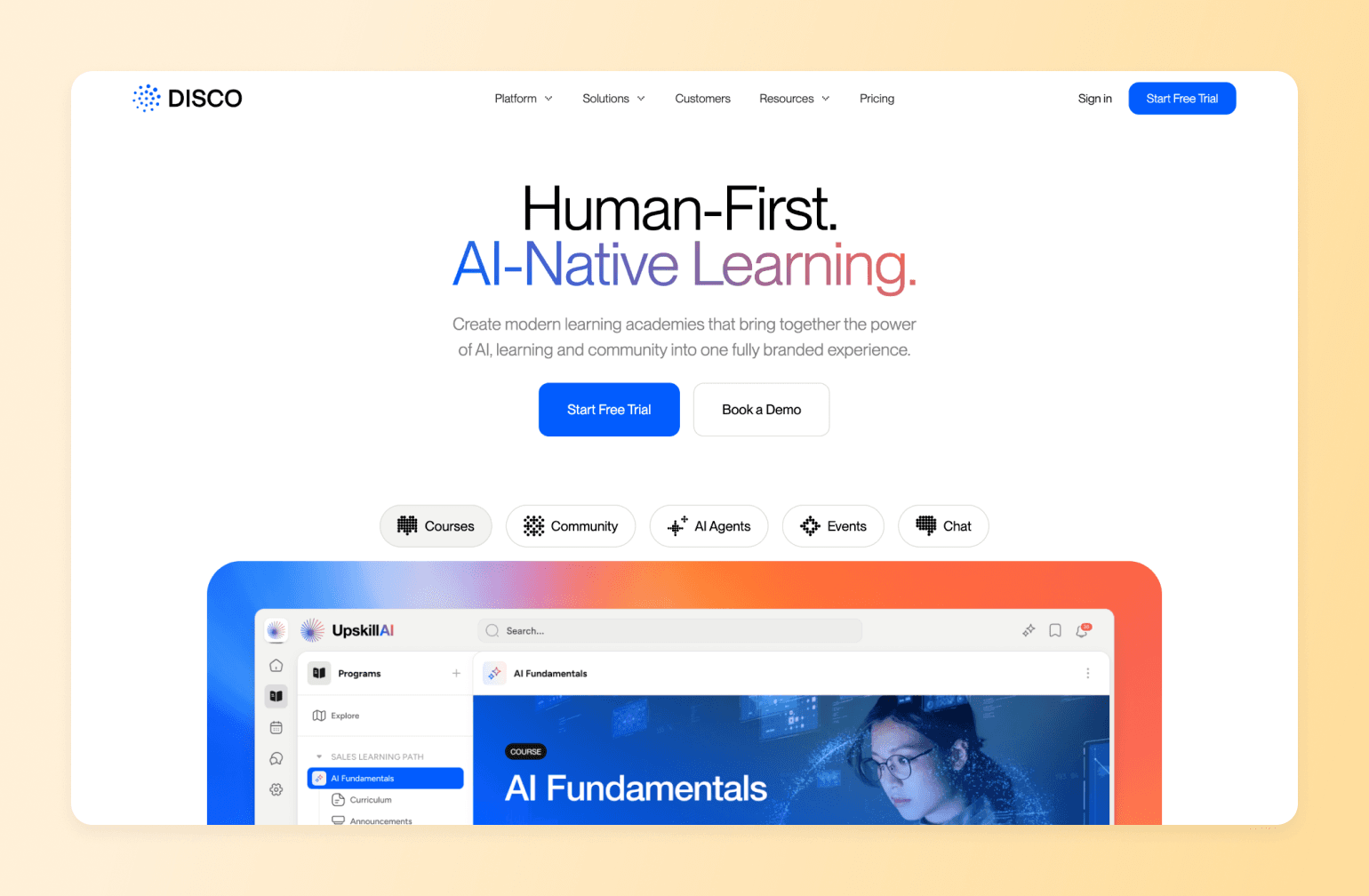
Disco is a learning platform built around cohort-based programs and branded academies, and it markets itself as AI first — the framing you'll most often hear from prospects weighing it. The distinction that matters is what the AI is pointed at: Disco's keeps learners moving through a curriculum, which is engagement of a narrow kind — bounded by the program, not the community.
Where Disco falls short on engagement
- Built for the program, not the membership: Disco's AI generates curriculum, Ask AI answers learner questions, and smart nudges keep people moving through a cohort. That works well while the program is running — but it's organized around a course with a start and end date, not an open-ended community members pay to stay in month after month.
- Engagement ends when the cohort does: Disco's nudges and workflows are built to drive a learner to completion. There's nothing equivalent for the long tail — keeping a member active in the months between programs, when there's no curriculum left to progress through. When a cohort wraps on Disco, the shared timeline and peer accountability that drove engagement disappear with it. What's left is a community channel with no program holding it together — and no AI watching whether anyone comes back to it.
- Academies, not communities: The framing throughout is "learning organization" and "training business." Recurring membership and the day-to-day community life a creator-led business runs on aren't the product's center of gravity.
Circle treats a course as one Space inside a living community, so a finished cohort flows into ongoing discussion rather than a dead end. AI Workflows re-engage members long after any program wraps, and the recurring membership the engagement is meant to protect actually has somewhere to live.
Why Circle is the strongest pick for AI-powered community engagement
Engagement comes down to timing — reaching the right member before they drift. Most platforms can't do that, because their AI can't see what members actually do. A nudge that doesn't know who finished the course or who skipped the last two events is a guess.
Circle is the only platform in this comparison where the engagement AI runs on the same record as your courses, events, email, and payments. That AI operates at two levels: directly in the admin's hands through Circle AI, and directly in members' hands through AI Agents. Most platforms give you a feature. Circle rebuilt the admin experience around it. RSRA's jump to 39% monthly active users and its lowest churn in eight months came from exactly that: onboarding, role-based Spaces, and member-led programming all running on one system.
Want to build an exceptional community? Start your 14-day free trial of Circle now.
AI community engagement tools FAQ
What's the difference between AI for community engagement and AI for community management?
Worth knowing that Circle draws this distinction inside its own product: Circle AI is the admin-facing layer — it helps you build, manage, and run your community through a conversational interface that can actually execute tasks. AI Agents are the member-facing layer — embedded in Spaces, they handle onboarding, answer questions, and nudge members based on content you've trained them on. Management AI takes operational load off you; engagement AI works on the members themselves. A platform can be strong at one and thin at the other, which is why it's worth checking both before you choose.
How does AI actually re-engage a member who's gone quiet?
It watches behavior — posts, logins, course progress, event RSVPs — and acts when the signal drops. Circle's Activity Scores rate each member 1–10 over a rolling 30-day window, and a behavior-triggered workflow can fire a DM or re-invite when someone goes quiet, so you reach them before the cancellation, not after.
Will engagement AI replace the human relationships members signed up for?
No. The AI handles the timing and the repetitive work — the nudge, the prompt, the re-invite — so you have the bandwidth for the conversations that actually keep people. The member-facing agent only steps in to guide and answer; the relationship, the live sessions, and the judgment stay with you.

Head of Product Marketing
JK Sparks is Circle's Head of Product Marketing, shaping the positioning, messaging, and go-to-market strategy behind the company's biggest product launches.