Circle is the first AI-native community platform — here's what that means
TL;DR
- Move over, AI-powered features: Unlike tools that just sprinkle AI on top of old workflows, Circle's new "AI-native" platform (announced at Circle Eclipse, June 16, 2026) completely redesigns how you build a community by letting you shift from clicking settings to directing your vision.
- Think self-driving car, not just a GPS: The fundamental shift here is that the AI doesn't just help you navigate the platform; it acts as an operator, handling the heavy lifting like building structures, configuring paywalls, and seeding initial content based on your instructions.
- "Vibe building" is the new vibe coding: You no longer need to be a tech expert to launch; you simply describe the community you want to build in plain English, and the platform's specialized AI agents handle the technical execution, leaving you free to focus on connection and transformation.
Members only
One issue, five minutes, every Tuesday. Read by +14,200 creators.
Launching a community on Circle used to look like this: you'd start a trial, spend an afternoon clicking through space settings, figure out access groups by trial and error, wire up Stripe, build a landing page, write a welcome post, and then do it all over again every time you wanted to change something. The platform was powerful — but the work was still yours to do.
Now, with the announcements at Circle Eclipse, you type: "I want a paid community for B2B marketers with a discussion space, a resource library, and a monthly live call. The first tier is free, the second is $49/month." Circle AI reads that, builds the structure, configures the access groups, sets up the paywall, and drafts a launch plan. You review it. You approve it. You're live.
That shift — from doing the work to directing the work — is what it means for a platform to be AI-native.
Eclipse is our most ambitious product launch to date. It brings five new products together as a single moment: Circle AI, Circle Discover, Circle Studios, a redesigned, AI-native course builder, and Circle Inbox. This article is about the first of those — and what it signals about where the platform is going.
AI-powered vs. AI-native: the distinction that actually matters
Most software that calls itself "AI" is actually AI-powered because the underlying tool works the same way it always did. AI helps at certain steps — a writing assistant here, a suggested template there. You still need to understand how the product works: what an access group is, what Stripe Connect requires, and how to structure a space hierarchy. AI reduces friction at individual steps, but doesn’t change the job you have to do.
AI-native is different. An AI-native platform doesn't add AI on top of existing workflows. It redesigns the workflows around what AI makes possible. The result is that the nature of the operator's job changes — not just the speed at which they do it.
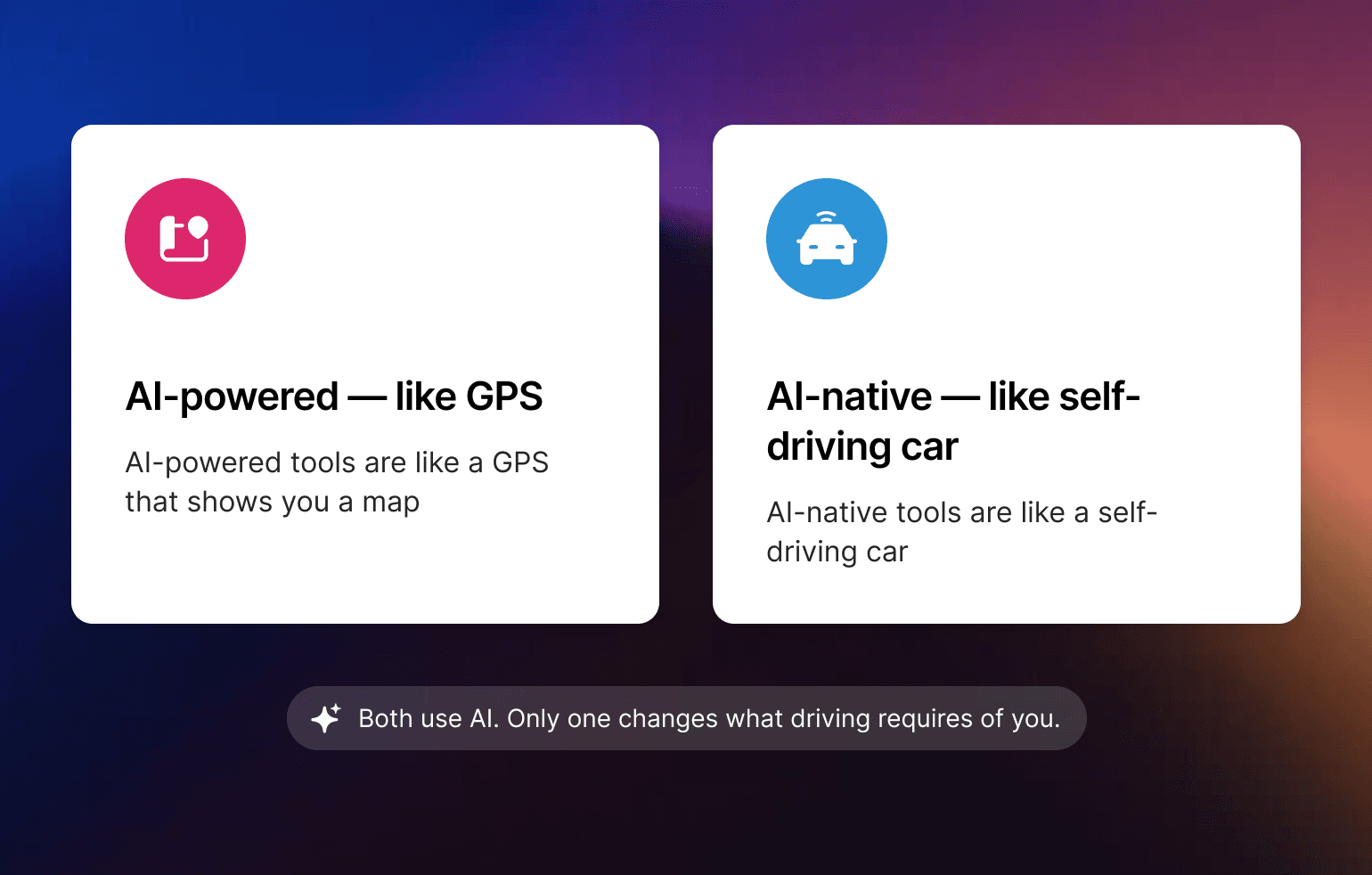
The analogy that keeps coming to mind: AI-powered tools are like a GPS that shows you a map. AI-native tools are like a self-driving car. Both use AI. Only one changes what driving requires of you.
Circle is the first community platform to cross that line. With Eclipse, we announced a fundamental redesign of what it means to build and run a community business.
Not faster setup — different setup. Not better features — a different relationship between you and the platform.
What "AI at the core" is actually built on
"AI-native" is easy to stake a claim in. It's harder to demonstrate. Here's how it actually works inside Circle.
Most AI tools give you guidance — Circle AI gives you execution. When you ask it to "set up a three-tier membership community with a free onboarding space and two paid tiers," it doesn't tell you how to do it. It does it: creates the spaces, configures the access groups, builds the paywalls, and updates the canvas in real time. You can watch it happen.
Circle AI launches with 50+ specialized skills across 12 domains:
- Community setup and build — design space structure, set visual branding, configure access, generate logos and cover images
- Content creation — write and publish posts, build full course curricula from a single sentence, generate email broadcasts, create rich-text content
- Member management — invite members, manage access groups, handle moderation, set up onboarding flows
- Monetization — create and configure paywalls, set up coupons, manage payment settings, build gamification systems (points, badges, leaderboards)
- Growth strategy — business strategy guidance drawing on learnings from 20,000+ Circle communities
- Analytics and insights — surface community analytics, generate reports, answer data questions in plain language
- Workflows and automation — create and manage automated workflows triggered by member behavior
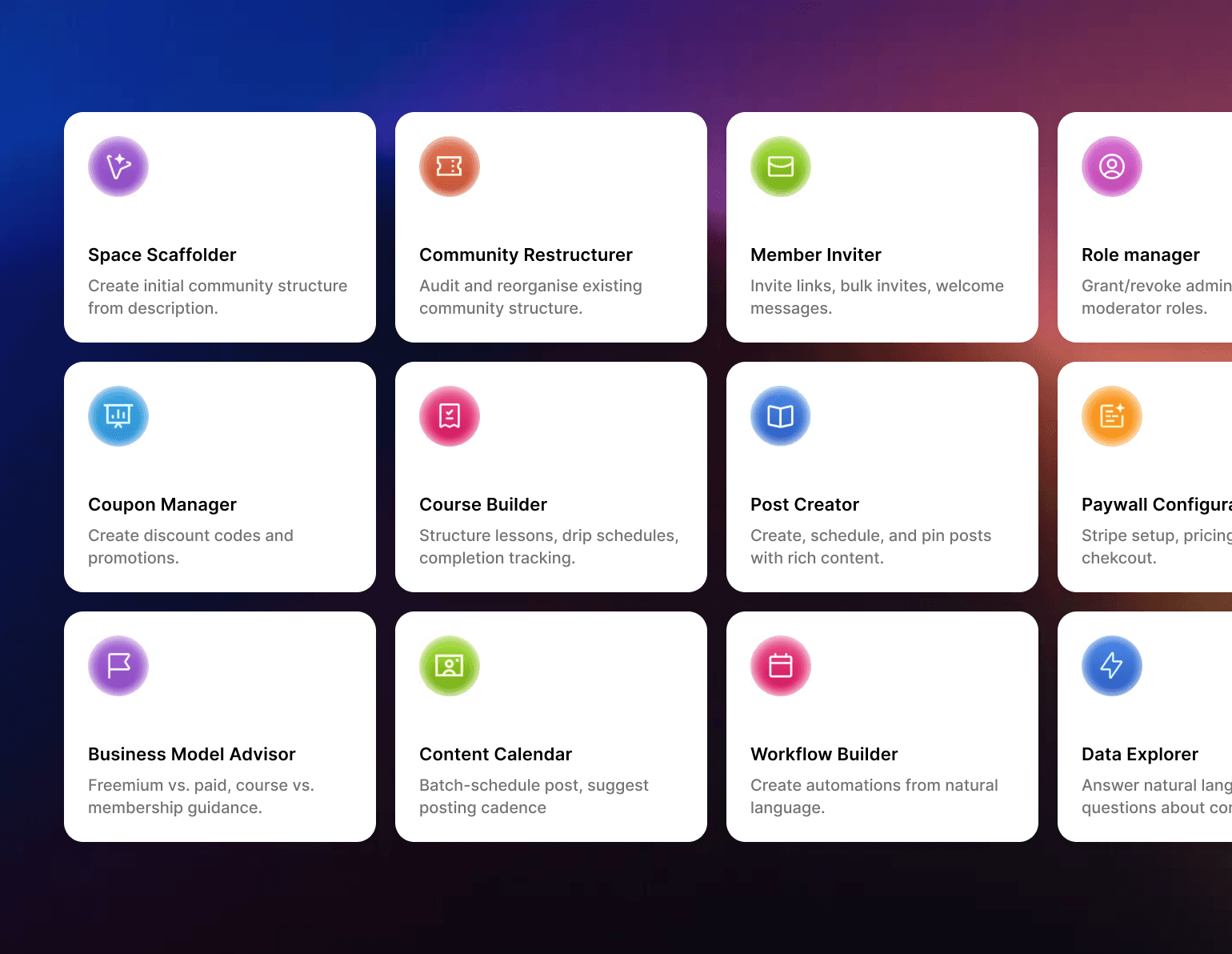
These aren't separate features — they're connected, with context flowing between them. When you've worked through your pricing strategy, the monetization skill already knows what you decided. It doesn't ask you again — it learns with you.
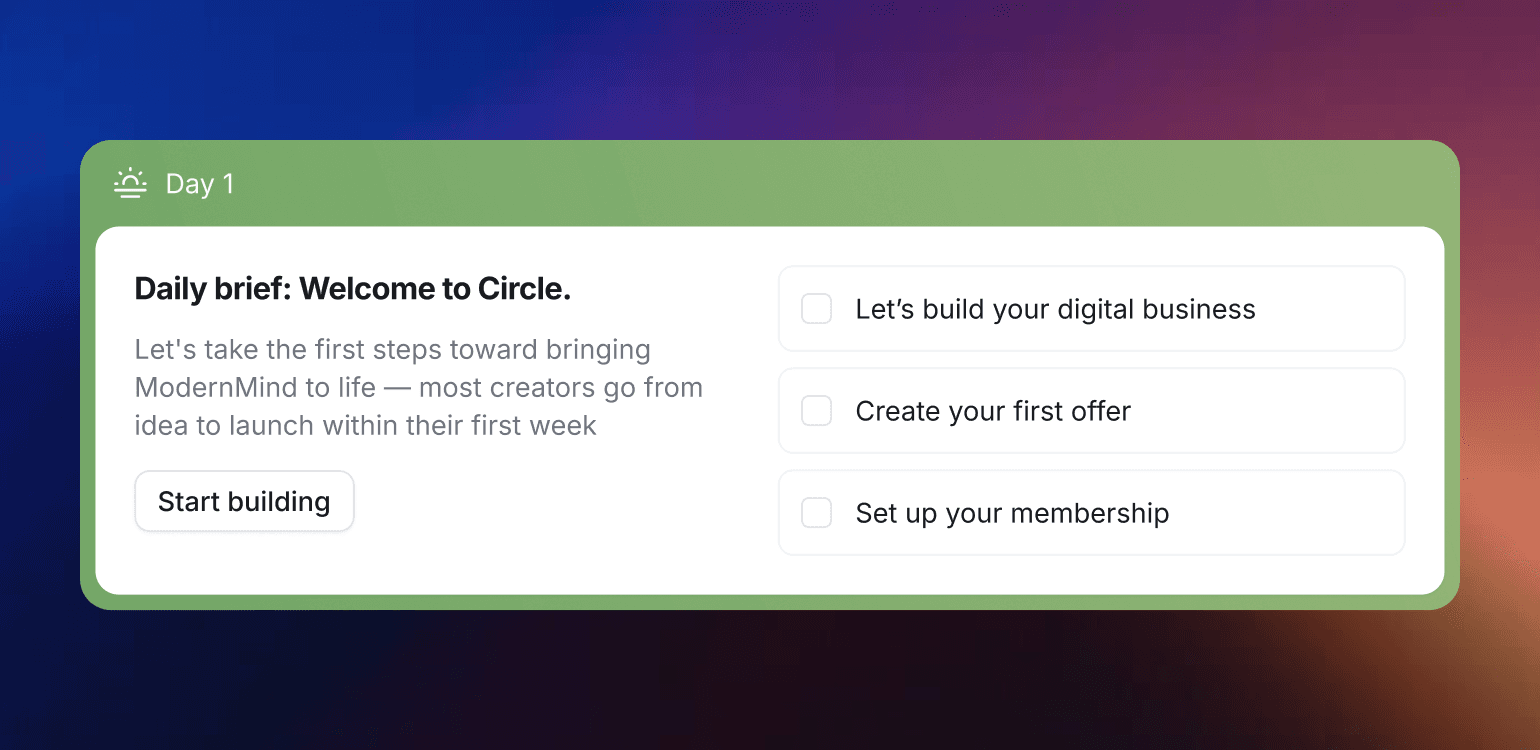
Circle AI is also your everyday partner, not just your setup tool. Each day when you sign in, you're greeted with a daily brief: a pulse of your recent community activity and specific recommendations for what to do today. No more digging through dashboards looking for patterns — the patterns surface to you. And if you have teammates, you can collaborate with Circle AI using Projects, which keep shared conversations and context organized across your team.
It also has web search built in, so it can pull in real-world context — competitor research, niche topic content, recent news — to inform what it builds for you.
That design philosophy — "instruct and influence, don't dictate" — is what separates Circle AI from a chatbot that fills out forms for you. It leaves room for your judgment. It makes you better at running your community, not just faster at clicking through settings.
Where the skills actually came from
These skills weren't built from a community-building framework or a product team's best guesses (though, hey, they’re pretty dang good). They were distilled from three sources of knowledge that no one outside Circle has.
The first is customer success experience. Circle's team has onboarded thousands of operators personally. Every question that surfaced on those calls — about space structure, access group logic, pricing strategy, launch timing — became signal. The business model advisor knows exactly where operators get stuck on pricing because Circle's team answered those questions live, thousands of times.
The second is previous product feedback. Millions of real operator conversations, analyzed for what people actually asked for, where they dropped off, what worked and what didn't. The skills are built from patterns in that data, not assumptions about what operators might need.
The third is cross-community pattern recognition across 20,000+ communities on the platform. Circle has a view no individual operator ever gets: what space structures correlate with better member retention, what pricing tiers tend to reduce churn, what onboarding sequences produce the highest early engagement rates. Those patterns are baked into the skill instructions.
The result is advice that's specific, tested, and grounded in what actually happens inside community businesses — not a recycled startup playbook wrapped in a chat interface.
Vibe building vs. coding
You've probably heard of vibe coding — building software by describing what you want in plain English, without needing to write the code yourself. Developers are using it to ship faster than they ever could before, because they can direct output instead of produce it.
Vibe building is the community equivalent. You describe the community you want to create. Circle AI builds it. You don't need to understand every configuration setting or know what an access group is. You tell Circle what you want — the kind of members you're trying to serve, the transformation you want them to experience, the business model that makes sense for you — and it translates that into the platform.
This isn't a metaphor. It's literally what Circle AI does.
Type: "I want a paid coaching community for fitness coaches, with a private space for my VIP clients, a public discussion forum, and a course section for my onboarding program." Circle AI builds that structure. It's the difference between knowing how to configure a community platform and knowing what kind of community you want to build.
We’re removing the friction of “how” so you can get to your “why I’m building this community” faster and simpler.
The business context: why this matters right now
Content businesses are getting commoditized. Over 40% of videos posted online today are AI-generated — and that number is rising. If your business is built on content delivery, that's a real structural problem. The scarcity of content that powered a decade of creator economics is gone.
What AI can't commoditize is transformation and belonging. People don't just want information anymore — they want to change, to connect with others who are changing, to feel like they're part of something. Community businesses are built on exactly that. They generate recurring revenue. They create compounding retention. They're harder to copy because they're built on relationships, not just output.
Circle today powers over 20,000 community businesses with more than 15 million members. The pattern we see across all of them holds: a content business says "here's what I know, now watch some ads." A community business says "here's what you'll become, and join us on this journey."
But building and running a community business has always been a lot of work. That's the real obstacle. The operators who would benefit most — coaches, educators, creators, B2B companies — often don't have the technical capacity or time to set everything up and keep it running.
Eclipse is the answer to that obstacle. Circle AI is the partner that handles the platform operations, so operators can focus on the transformation side — the part only they can do. That's only possible if the AI is native to the platform — if it can see your members, your spaces, your engagement patterns, your revenue, your content, all in one place, and act on all of it with full context. A bolt-on AI feature can't do that. It only sees the slice of the product it was added to.
A platform gives you tools. After Eclipse, Circle gives you the full ecosystem for your digital business: AI that builds with you, a marketplace that grows for you, and a studio that can do it all for you.
What changes for you, the operator
The creators seeing the most success on Circle have often done it entirely solo — wearing every hat at once: strategist, operator, content creator, community manager, marketer. Some have built multi-million dollar businesses this way. It worked because they were exceptional. Circle AI is what makes that path replicable for people who aren't superhumans.
Concretely, here's what the operator's day looks like differently when your platform is AI-native.
- You don't need to learn platform configuration to launch. The gap between "I have an idea for a community" and "I have a running community" compresses from weeks to hours.
- You don't lose your mind migrating from another platform. Circle AI audits what you have and reorganizes it into something that works — without starting over.
- You don't start with empty spaces. Before your first member joins, there's content, there are prompts, there's something to respond to. Strongmember onboarding is no longer a labor-intensive project — it gets seeded before it needs to happen organically.
- You don't build pricing strategy in isolation. Circle AI has a real conversation with you about what makes sense for your community type. When you're ready to implement, it's already configured.
- You don't start each day digging through dashboards. Your daily brief surfaces what matters — recent activity, what's trending in your community, what to focus on next.
As you use Circle, it accumulates context about your community — who your members are, what they engage with, what's working, what's not. The platform gets more useful the longer you use it. That's what AI-native compounding looks like.
The operator's job shifts. Less execution, more direction. Less configuring, more deciding. You can focus on what you're actually good at — building relationships, creating transformation, growing your audience — and trust that Circle AI handles the platform operations.
This isn't a promise about a future roadmap. These skills are real. You can use them once the waitlist opens.
Join the waitlist for Circle AI.
P.S. If you're already using the Circle MCP to connect your community to external AI tools like Claude, here's how the two fit together.
Frequently asked questions
Is Circle AI just a chatbot?
No. A chatbot answers questions. Circle AI takes actions — it builds spaces, configures access groups, sets up paywalls, creates launch plans, seeds content. The conversational interface is how you direct it, but what it does is execute real work inside your community. The skills architecture underneath is what makes it capable of actually doing things, not just talking about them.
How is this different from the AI features Circle already had?
Previous AI features in Circle were point solutions — an AI writing assistant for posts, AI-generated summaries, that kind of thing. They made individual tasks faster. Circle AI is different in kind, not just degree. It's not a feature. It's a layer of intelligence across the entire platform that can see your full community context and take coordinated action across multiple domains at once.
Do I need to be technical to use Circle AI?
No. That's specifically the point. You need to be clear about what you want. You need to make good strategic decisions about your community. You don't need to know what an access group is, or how Stripe Connect works, or how to structure a space hierarchy. Circle AI handles the translation between your intent and the platform configuration.
What's the difference between Circle AI and Circle MCP?
Circle AI is the AI layer built into Circle itself — it builds, runs, and grows your community from inside the platform. Circle MCP (Model Context Protocol) is for operators who want to connect external AI tools like Claude to their Circle community from outside the platform. They're complementary: Circle AI is for day-to-day platform operations, Circle MCP is for custom workflows in the AI tools you already use. Here's a full breakdown of what the Circle MCP does.
Does this mean Circle is replacing community managers and operators?
No. Circle AI handles configuration, structure, and execution. What it can't do is build relationships with your members, make judgment calls about community culture, or decide what transformation you want your community to deliver. The operators who will benefit most from Circle AI are the ones who are already good at those things — because Circle AI frees up more of their time for exactly that work.
Co-founder and CEO