7 best AI tools for creating online courses in 2026
TL;DR
- Most AI course tools stop at the first draft (outlines, lesson copy, quizzes, sales pages) and leave the harder work of keeping students engaged through the finish line to you.
- The best AI course platforms go further with delivery-side AI that answers student questions 24/7, re-engages stalled learners, and turns one-time course sales into recurring revenue.
- Circle is the strongest all-in-one pick, combining AI course creation with a teaching-assistant layer trained on your curriculum, plus community, payments, and email under one roof.
Picture this: you've spent six weeks building a course. The launch goes well. People buy. And then, around module three, the completion stats start telling a different story. Fewer lessons opened. No questions in the forum. The students who were excited two weeks ago have quietly disappeared. You send a check-in email. Most don't reply.
That's the problem almost no AI course tool is designed to solve. They all crowd around the same stage, getting you to a finished course faster. Outlines, draft lessons, quiz questions, a sales page. Useful, until you realize the hard part was never the building. It's everything after the sale. And the numbers back this up: across the biggest open online platforms, completion sits around 3%, and years of platform updates haven't moved it.
The hard truth? The AI tool that gets you to a finished course fastest isn't necessarily the one that gets your students to lesson ten. (Or to stay. Or re-enroll. Or promote it.)
So before you pick a tool based on which one drafts the prettiest outline, it's worth asking what each tool actually does once your course is live.
The real job runs in three parts: figuring out what to teach and making it good, selling it, and getting people to actually finish. The tools worth paying for help you draft faster, sell more confidently, and keep students engaged through the finish line, then automate the operational work that drains your time and turn one-time buyers into long-term members. Here are the seven tools worth your attention this year, what each one actually does well, and which one fits the way you want to build.
Quick comparison: 7 AI course creation tools at a glance
| Feature | All-in-one platform | AI course creation | Built-in community | White-label branding | Built-in payments |
|---|---|---|---|---|---|
| Circle | Yes: community, courses, events, email, payments, website | Circle AI builds, runs, and grows the business with you: full curriculum from a prompt, course builder now conversational; AI Agents as teaching assistants trained on your content; AI Workflows to boost engagement and completion | Yes: purpose-built with Spaces, chat, DMs, gamification | Yes: removed on Business; full white-label on Circle Plus | Yes: Stripe-powered |
| Mighty Networks | Yes: community, courses, events | AI tools for outlines and engagement prompts; no curriculum-trained teaching assistant | Yes: native community | Yes: custom branding | Yes: Stripe-powered |
| Kajabi | Yes: courses, marketing, website, payments | Cofounder drafts strategy and copy for the creator; Expert Agents (beta) add an in-course teaching assistant trained on your lessons and community | Yes: gamification now available; sits beside courses rather than inside them | Yes: custom branding | Yes: Kajabi Payments |
| Thinkific | Partial: courses, website, payments, app store | AI Course Creator drafts outlines and quizzes; Thinker is a student-facing teaching assistant trained on your content (Plus plans) | Limited: community available, not the product core | Yes: custom site branding | Yes: native payments and checkout |
| Teachable | Partial: courses, payments, basic community | AI Course Starter for outlines, content, sales pages; no AI after launch | Yes: supporting layer, not purpose-built | Limited on lower plans | Yes: teachable:pay |
| LearnWorlds | Yes: courses, site, commerce, community | AI Assistant: outlines, content, assessments, copy, one of the deepest authoring suites; no student-facing AI once live | Yes: community feature alongside courses | Yes: full white-label | Yes: native, per-enrollment fee on entry plan |
| Heights | Yes: courses, community, coaching, website | Heights AI builds course draft, acts as business coach; no student-facing teaching assistant | Yes: community channels and gamification | Yes: full white-label | Yes: zero transaction fees |
1. Circle — best all-in-one platform for AI-powered course creation
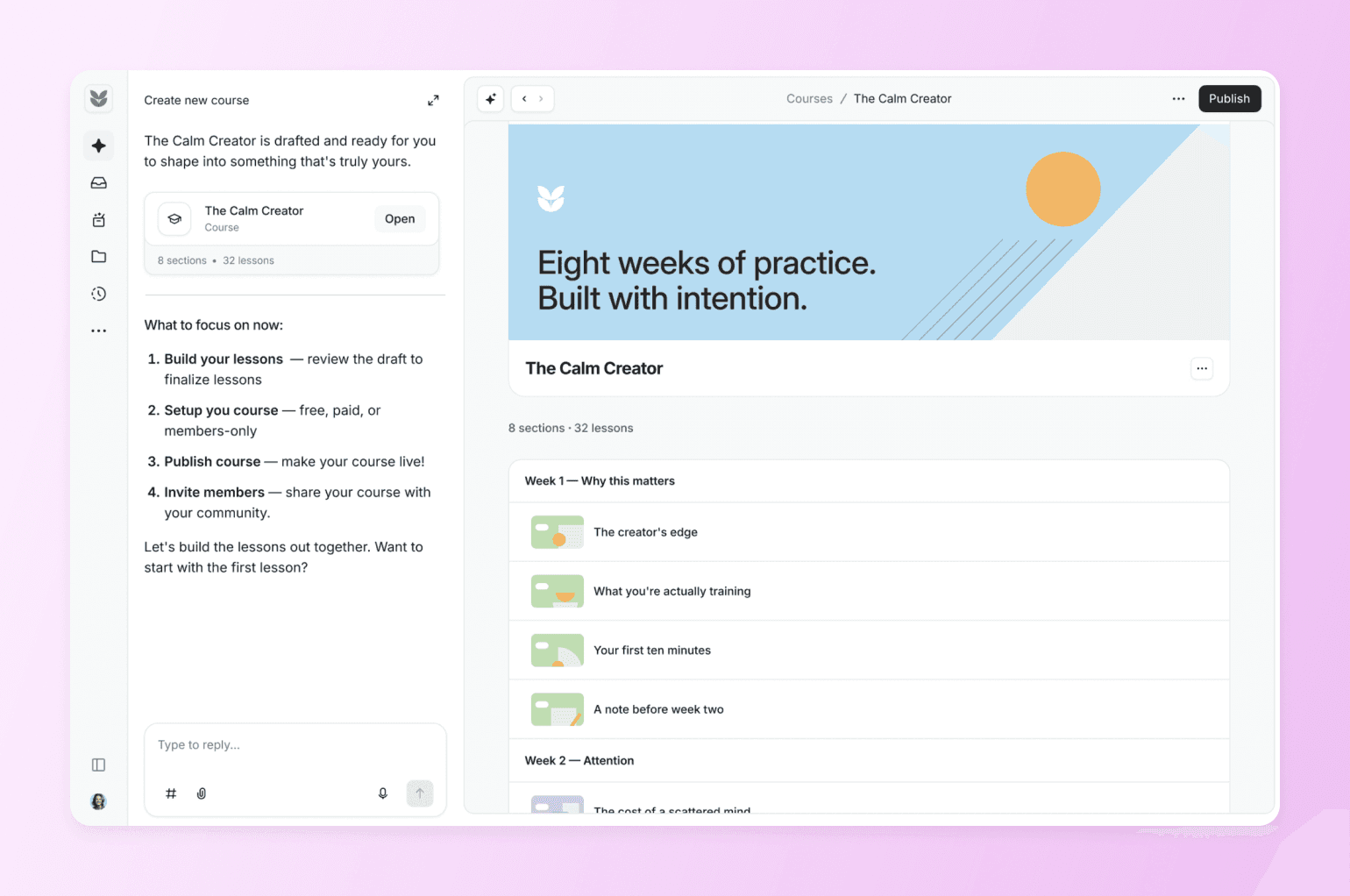
Circle is the all-in-one community platform built for creators, coaches, and educators running course businesses. Courses live inside the community rather than in a separate tab, with cohort enrollment, drip content, and lesson-completion gates built in.
Circle AI is a native AI partner that builds, runs, and grows the business with you. It builds the course and community from a prompt. Once the course is live, AI Agents answer student questions and AI Workflows handle the automated nudges. It works across the whole lifecycle, from the first draft to the last lesson — not just the part before the sale.
Built for
Creators, coaches, and educators who want to build a course business that actually compounds. From your first paid cohort to a full academy, Circle works across categories like business, wellness, and professional development: anyone who wants courses and recurring revenue running from one place.
Circle's AI stack for course creators
Circle AI is native to the platform, so it can see your content, community, members, engagement, and revenue in one place and act on all of it, always with your approval. Nothing gets built until you say so; you stay in control the whole way. For course creators, that shows up across the work you'd rather not do by hand: organizing the course, transcribing video, fielding the same student questions on repeat, nudging stalled learners, and writing the recap nobody has time to write.
- Circle AI to build the course: Describe what you want to teach and Circle AI proposes a full curriculum you shape on a visual canvas, drafting lesson copy, assessment questions, and discussion prompts at the speed of conversation. Drop in an outline and it builds the full course, lesson by lesson, in seconds, then prompts you to layer in video or audio for each lesson.
- Recommendations grounded in real community data: Circle AI is built on 300+ best practices and analysis of 20,000+ communities, so when it proposes pricing, tiers, or a cohort structure, it's drawing on what has actually worked for businesses like yours. Ask it to price a cohort and it lays out a pricing table with projected revenue per cohort, not just a number. That's the part a general-purpose chatbot pointed at your business can't do; it can write a plan, but it can't tell you which plan tends to convert.
- AI Agents as 24/7 teaching assistants: Build up to 10 specialized agents per community, each with its own role, voice, avatar, and trained knowledge from your courses, Spaces, posts, and uploaded files. Every video uploaded directly to Circle is automatically transcribed and indexable by your agents, so answers stay grounded in what you actually taught. (Available on Circle Plus.)
- AI Inbox: Every AI Agent conversation lands in a shared inbox so you can see what your agents are telling students, escalate when a question needs a human, and pause an agent with a keyword whenever you want to step in. It doubles as a research signal, showing you exactly where your curriculum is unclear.
- AI Workflows: Combined with behavioral triggers (course purchase, lesson completion, course completion), the student journey runs on its own: a progress-triggered DM when a learner stalls in module three, an onboarding sequence that kicks off at enrollment, and auto-comments that keep new posts from sitting unanswered. (Available on Circle Plus.)
Why it stands out for course creators
Circle’s AI is part of a real course platform, and that's the difference. Courses live inside the community, not in a sidebar tab. Students don't finish a lesson and vanish into another app; they land in a space where their cohort is already discussing the material.
The edge isn't any single feature, since every tool here can draft a course. It's two things working together.
- First, Circle AI carries you across the whole lifecycle: building the curriculum from a prompt, pricing and promoting it against patterns that have actually worked, then answering student questions and re-engaging stalled learners after the sale.
- Second, it all runs on one system, where the course, the community, the payments, and the email share the same data. So a course sale grants access, kicks off onboarding, and starts the membership clock without a Zapier chain in the middle.
Monetization is built in too, with branded checkout supporting one-time purchases, subscriptions, installment plans, free trials, and access groups that grant or revoke course content automatically based on payment status. You're running a business, not stitching one together.

Stop losing students after module three.
2. Mighty Networks — best for non-technical creators launching quickly
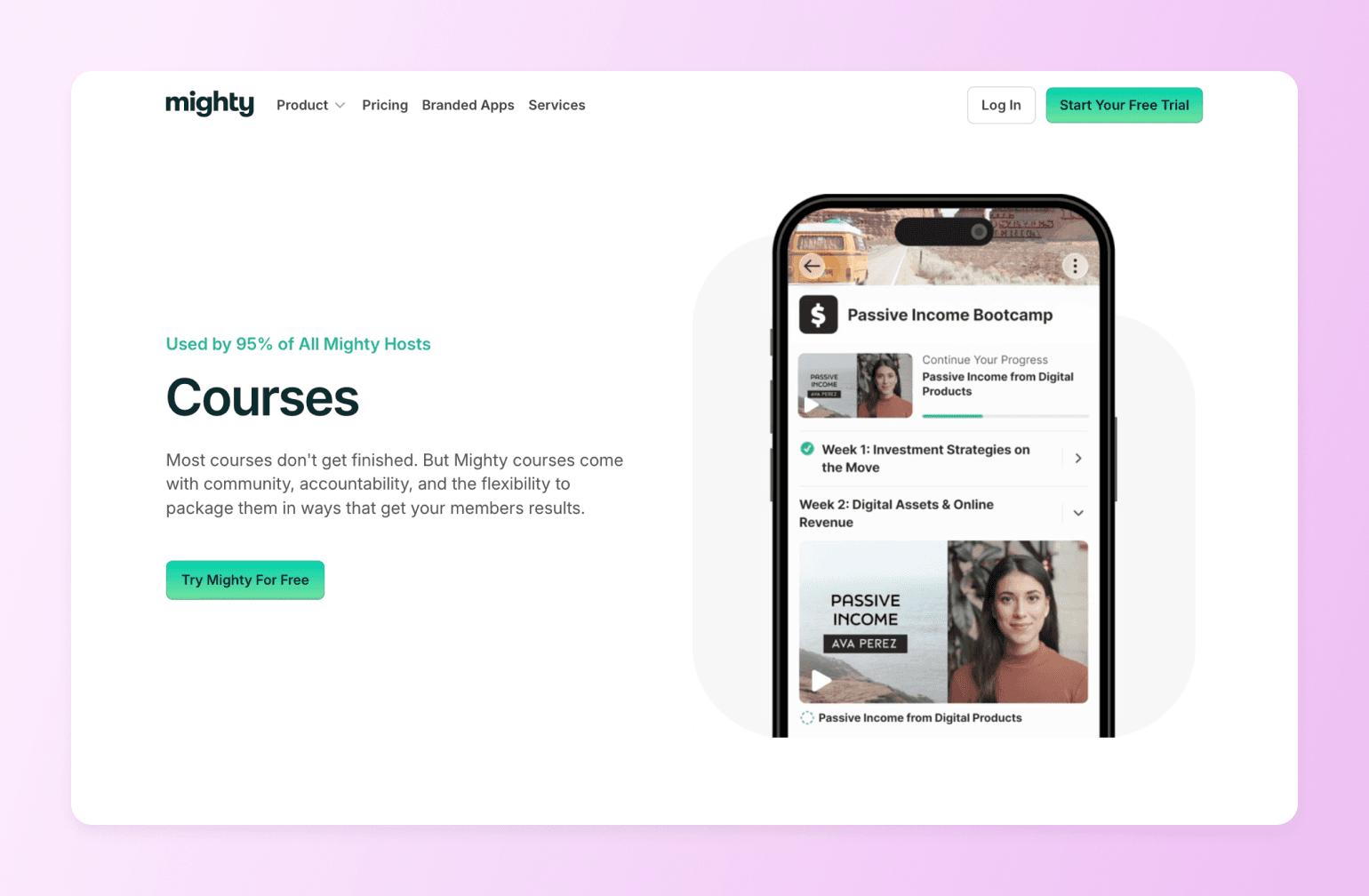
Mighty Networks is a community-and-course platform. The AI is primarily admin-facing and engagement-prompting: useful for drafting and nudging activity, but not a full teaching assistant deeply trained on your curriculum.
Built for
Non-technical creators who want to launch a branded community with on-demand or cohort-based courses quickly, using AI-assisted setup to draft outlines, branding, and templates before launch.
Where it's a fit, and where Mighty runs short
Mighty Co-Host helps admins draft course outlines, community plans, polls, and engagement prompts, and can suggest discussion prompts or assist with member-facing nudges and Q&A facilitation. For early-stage creators, that's a solid starting point. Where it falls short:
- AI for planning and prompting, not curriculum-trained teaching: What's missing is a teaching assistant trained deeply on your specific course content, the kind of AI that can field "where is module 4," "what's the prerequisite for this lesson," or "can you explain this concept again" with answers grounded in your actual curriculum, not a generic knowledge base.
- "All-in-one" with seams between the tools: Native community, courses, and events are in the box, but the underlying data is siloed. Email marketing leans on third-party tools, and stitching course progress to email or payments gets messy fast.
- Friction when upgrading members between tiers: Moving members from free previews into paid cohorts is a workflow creators flag as clunkier than it should be, a problem you'll feel the moment you try to convert free students into a paid program.
For a first community, Mighty is capable. For a course business you're planning to compound, the seams start to show.
Read the full Mighty vs. Circle comparison.
3. Kajabi — best for selling courses through email funnels

Kajabi's roots are in course sales and marketing funnels, and that still shows up in where its AI investment lands. Cofounder, its most prominent new AI product, helps you figure out what to build, how to price it, and how to write about it. Backstage gives coaching clients personalized portals with AI session summaries. Both are genuinely useful. Neither watches who's drifting in your community or does anything to bring them back.
Built for
Selling digital products through sales funnels, email sequences, and landing pages, with courses delivered alongside marketing infrastructure rather than alongside community.
Where it's a fit, and where Kajabi falls short
Kajabi has made moves in 2026: Cofounder, Backstage, MCP support, and gamification now available in its community product. It's a more capable platform than it was a year ago. The engagement gaps that matter for this comparison, however, are still there:
- The teaching-assistant gap has mostly closed: Kajabi's Expert Agents (in beta) now add an in-course teaching assistant trained on your lessons and community posts, so student Q&A after the sale is covered. Cofounder still points at the creator, planning, pricing, and drafting.
- Community sits beside the course, not inside it: When a student finishes a lesson, there's no discussion thread attached to it. They have to leave the course, switch to the community tab, and hunt for the right space to ask a question. Most never bother. The learning environment and the conversation environment aren't the same place, which is exactly what kills momentum.
- No behavior-triggered in-community re-engagement: Kajabi's automations trigger on behavior (joining, engaging, going quiet), but they run over email. There's no AI watching who hasn't opened a lesson in three weeks and nudging them back inside the course. The moment a student drifts, Kajabi's response lands in an inbox they're already ignoring.
Kajabi is a genuine all-in-one platform for course sellers, and its 2026 releases show real ambition. But its pieces sit side by side rather than in one system: the community beside the course, the automations running over email. Circle wires them together, so a sale, the onboarding that follows, and the nudge when someone stalls all fire off the same member data, no email-only guesswork and no Zapier in the middle.
Read the full Kajabi vs. Circle comparison.
4. Thinkific — best for standalone course sales with basic community
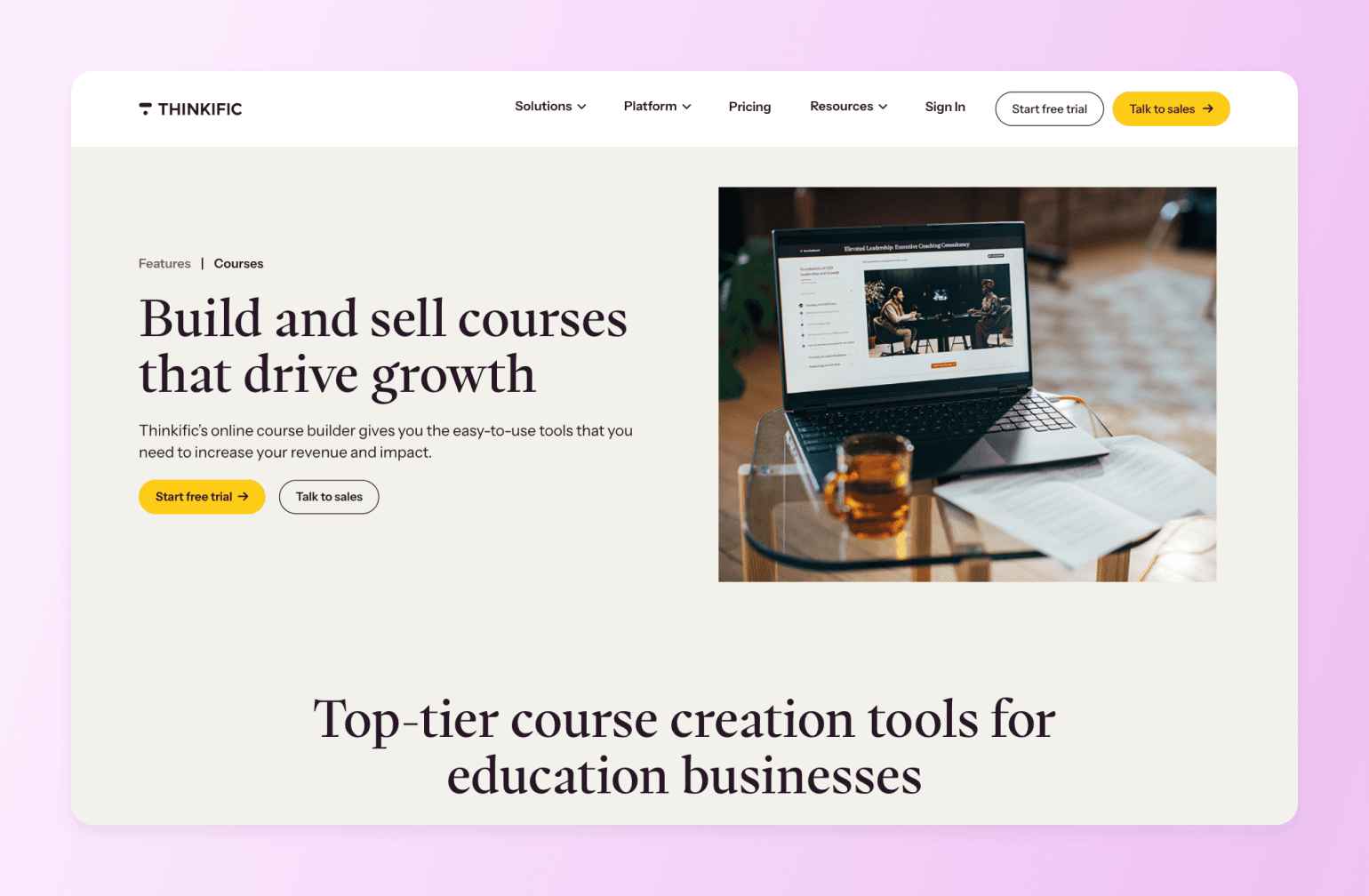
Thinkific is a course-selling platform whose AI now spans both building (AI Course Creator) and delivery (Thinker, a student-facing teaching assistant). Courses come first, with site, payments, and community features added around them.
Built for
Creators whose main need is building and selling standalone courses, with AI for both drafting and student support, and limited community on top.
Where it's a fit, and where Thinkific falls short
Thinkific is genuinely easy to use and a reasonable starting point if your immediate goal is building and selling a single course. Its AI Course Creator drafts outlines and quizzes, and Thinker (on Plus plans) adds a student-facing teaching assistant that answers learner questions from your content. The platform is stable with a low learning curve. Where it falls short:
- Delivery AI, but only the reactive half: Thinker answers student questions well, but it's reactive Q&A gated to Plus plans. What's missing is the proactive side: an AI that watches who has stalled and pulls them back in, wired to workflows that fire on real behavior rather than waiting for a learner to ask.
- Course platform first, engagement second: Community and engagement are layered on around the courses rather than built into the core. For creators building a business around discussion, cohort momentum, and ongoing membership, that ordering means the engagement layer often feels like an afterthought.
- More moving parts as the business compounds: If your model grows from selling one course into running cohorts, memberships, and deeper engagement, the stack tends to fragment across add-ons and integrations.
Thinkific earns its reputation as an easy-to-use course platform, and its AI now reaches into delivery. The trade-off is that community isn't at the center, so the engagement and re-engagement layer that keeps cohorts moving isn't the product's strength.
Read the full Thinkific vs. Circle comparison.
5. Teachable — best for getting a first course live fast
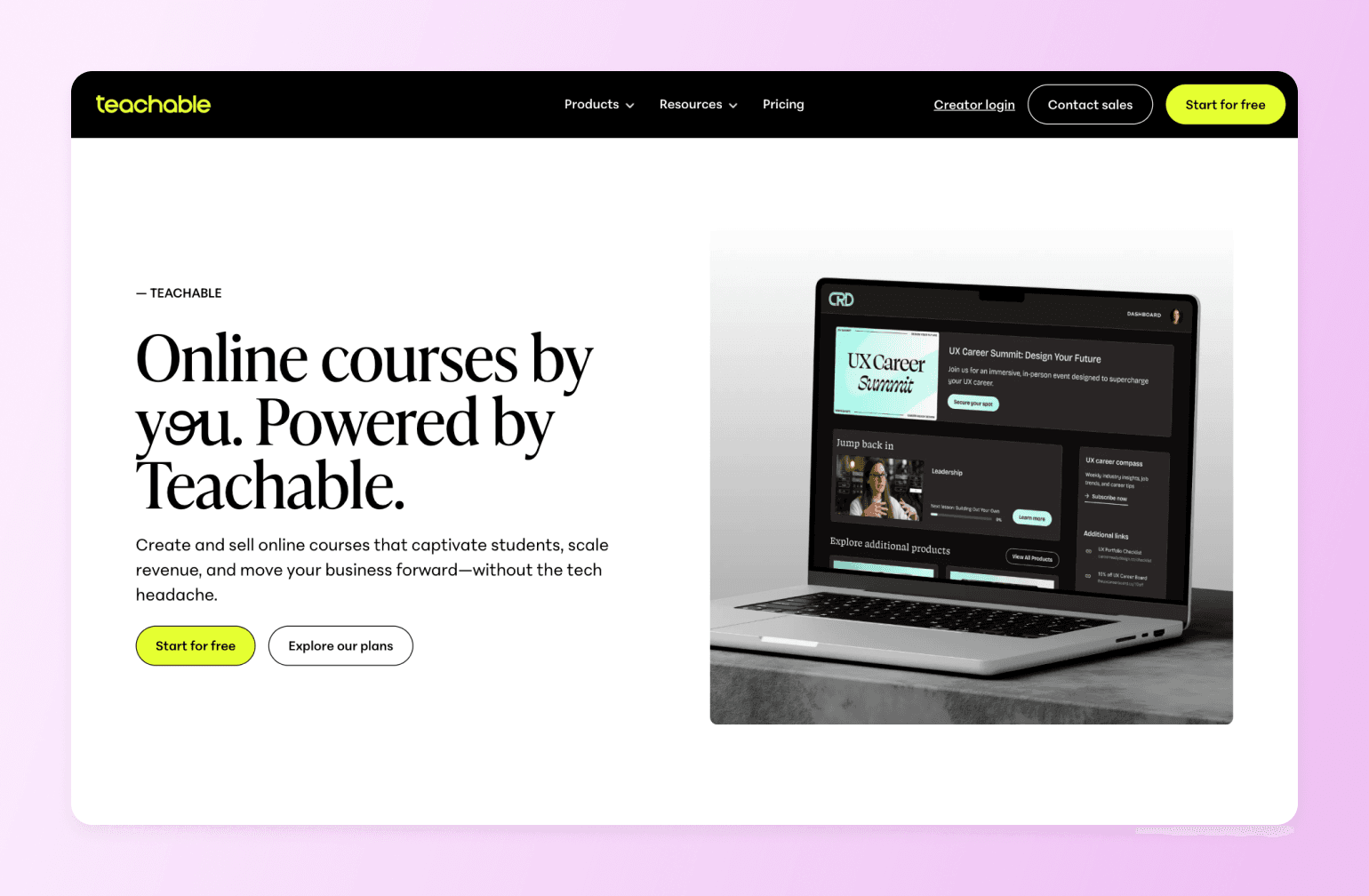
Teachable is a course-selling platform that pairs a beginner-friendly course builder with native payment processing and an AI Course Starter that drafts curriculum and sales pages in one workflow. Strong for launch, thin on everything that comes after.
Built for
First-time course creators who want to go from idea to published course as quickly as possible, with built-in payment processing and basic AI assistance for the initial draft.
Where it's a fit, and where Teachable falls short
AI Course Starter drafts curriculum, lesson content, and sales pages. For a creator who needs to get something live quickly, that matters; it compresses real work. The core course tools (certificates, drip content, quizzes) are solid too. Where it falls short:
- AI for the first draft, not for delivery: Once the course is live, there's no student-facing AI teaching assistant trained on your curriculum, no AI re-engagement for stalled learners, and no behavioral workflows. The operational layer after launch is yours to run manually.
- Community is the thin layer: No Spaces-style architecture, no native chat or DMs, no gamification. For a course business that runs on engagement and recurring revenue, that's the layer that caps your growth.
- Frequent plan and pricing changes are a risk to watch: Teachable has changed its plans and fees repeatedly, including a June 2025 overhaul that retired old plan names, introduced product and student limits, and revised transaction fees. If you're building a business that needs predictable economics and a clear path from a first course to a multi-course academy, a moving target on pricing is worth accounting for before you build on top of it.
Teachable is quick to launch on, but the community is thin and the AI stops once the course is built, leaving the day-to-day of running the course to you.
Read the full Teachable vs. Circle comparison.
6. LearnWorlds — best for full LMS depth with a broad AI authoring suite
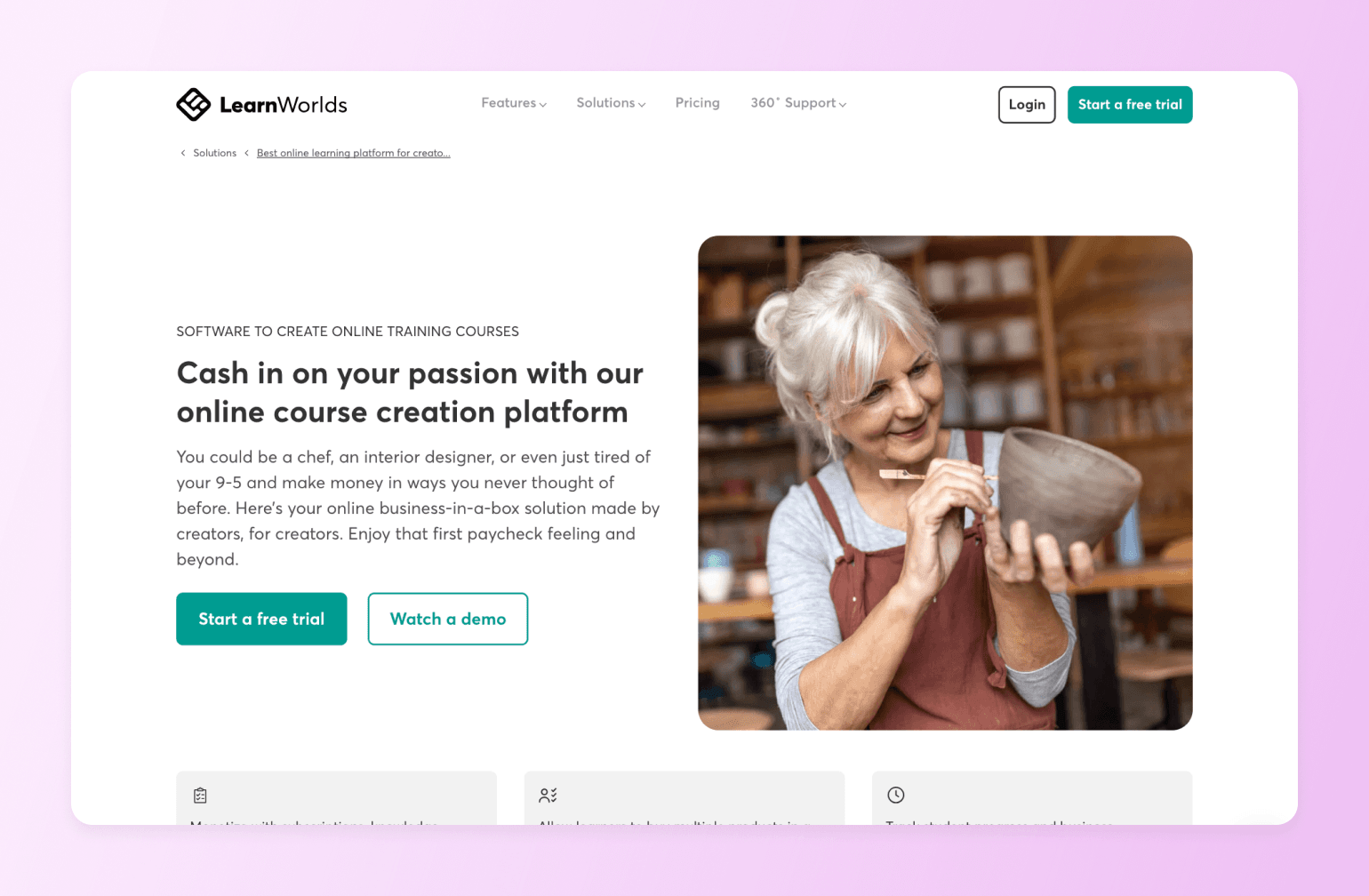
LearnWorlds is a learning management system for course businesses that need structured delivery: graded assessments, certificates, and detailed reporting. It also carries one of the deeper AI toolkits in this list, though that AI is aimed at building and marketing the course, not at supporting students inside it once it's live.
Built for
Course creators, training companies, and educators who need a full LMS (assessments, certificates, interactive video, ebooks) with AI to speed up the building and selling, and the operational depth to scale into a larger academy.
Where it's a fit, and where LearnWorlds falls short
LearnWorlds' AI Assistant spans course outlines, lesson content, assessments, landing page copy, email copy, and even ebooks and interactive-video questions. It's one of the most complete authoring-AI toolkits in this category, and the LMS depth is real. Where it falls short:
- A broad AI suite, all on the build-and-market side: The AI doesn't extend into delivery; there's no member-facing assistant trained on your curriculum that answers student questions inside the course once it's live. Once a student is enrolled, support is on you.
- Built for the solo learner, not the group: LearnWorlds is built to move one student through a structured course well. What it isn't built for is members learning together. There's no real discussion home, so the peer interaction that keeps people enrolled month after month has nowhere to happen.
- Complexity and pricing climb as you scale: Reviewers consistently note a learning curve, and pricing progresses steadily as you move up tiers and add learners.
LearnWorlds is a strong pick if LMS depth is the priority. The trade-off is that all of that AI points at producing and selling the course; the ongoing student support and engagement is yours to manage.
7. Heights Platform — best for solo creators who want an AI business co-pilot
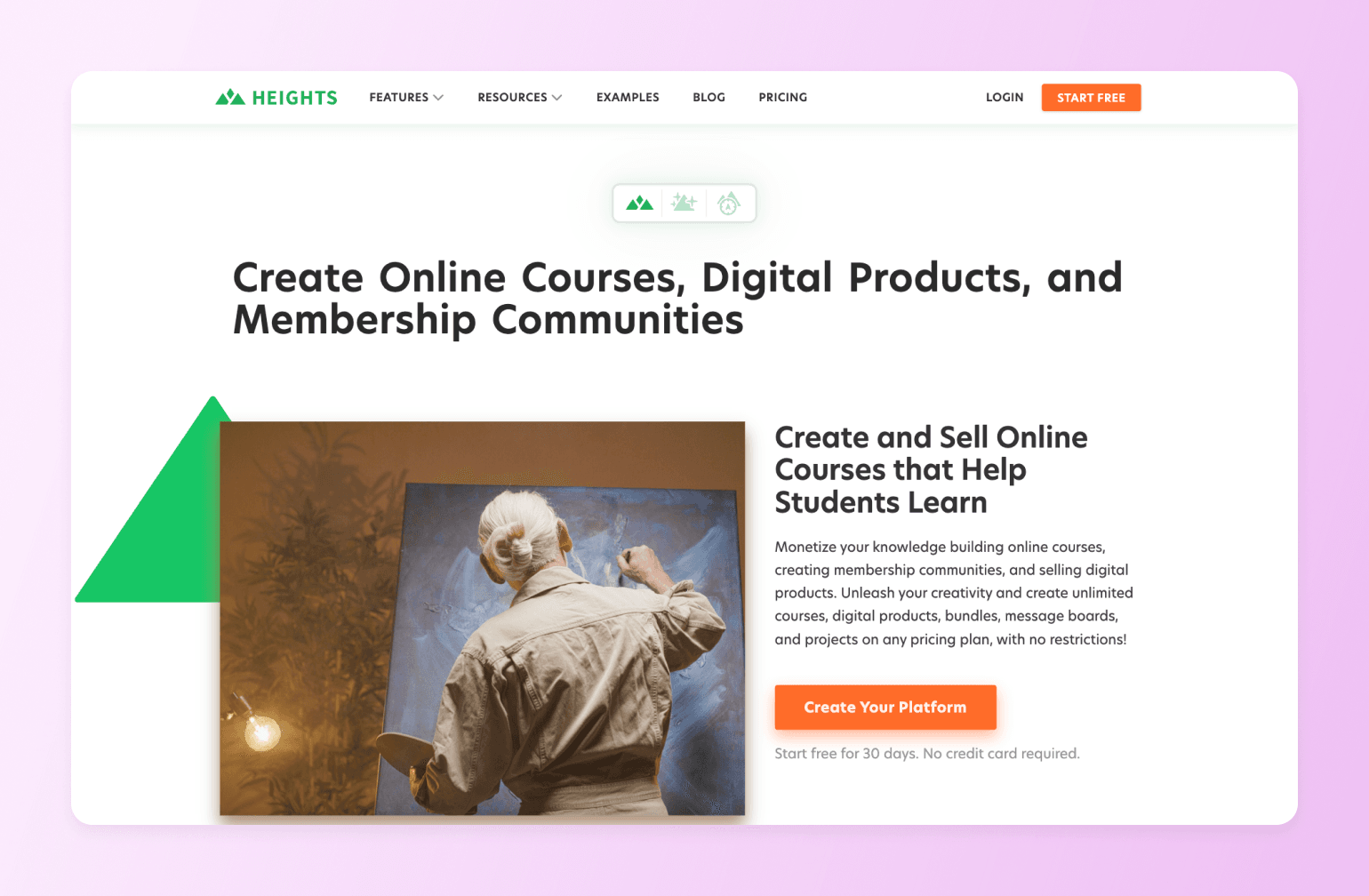
Heights Platform is an all-in-one course, community, and coaching tool whose AI leans into guiding the creator: it drafts your course, coaches you on the business, and can edit your products on command.
Built for
Solo creators and coaches who want an AI co-pilot that takes them from idea to launched course and then offers business coaching along the way.
Where it's a fit, and where it runs short
Heights AI builds your course draft from a title, acts as a business coach with weekly action steps, and edits products when you describe the change. For a solo creator who wants a tool that actively coaches them through building and growing, and charges no transaction fees, that's a real differentiator. Where it falls short:
- AI co-pilots the creator, not the student: Heights AI is pointed at helping you build and grow. It's not a member-facing teaching assistant trained on your curriculum that answers student questions inside the course after the sale.
- Lighter on structured delivery and reach: Heights covers courses, community, and coaching, but runs lighter on advanced assessment and engagement tooling than platforms built around delivery and retention, and lacks a dedicated mobile app.
- AI guidance is general, not grounded in your community's data: The AI coach is trained on Heights' own course-creation playbook rather than on your members' behavior, so the guidance is solid but generic, not driven by what's actually happening in your community.
Heights is a capable creator-first all-in-one. But its AI is pointed at helping you build and grow, not at supporting students after the sale.
Others worth knowing
The platforms above cover the heart of the category, but a few lighter, more specialized AI tools come up often enough to be worth knowing, especially if course creation is only one piece of what you do:
- Mini Course Generator turns a prompt into a short, interactive micro-course or lead magnet, useful for bite-sized or top-of-funnel content rather than a full program.
- Gamma converts text prompts into polished, presentation-style modules, handy for visual lessons and decks, though it's a content tool rather than a course platform.
- Canva has a free AI course creator that formats simple visual mini-courses inside its editor, a fit for educators who already live in Canva.
These are worth a look for specific jobs, but none of them runs the full lifecycle: selling the course, hosting the community, processing payments, and keeping students engaged to the end. That's the gap a platform like Circle is built to close.
Why Circle is the strongest pick for AI-powered course creation in 2026
Every platform here has its niche. But course creation is only the beginning of running a course business, and that's where the gaps in this list start to show. The real question isn't which tool drafts the best lesson outline. It's which platform handles the full lifecycle: course sale, onboarding, engagement, completion, and turning that one-time buyer into a recurring member.
That's the gap Circle is built to close. Circle AI is a partner that builds, runs, and grows the business with you: it builds the course from a prompt (drop in an outline and it can produce the full set of lessons in seconds), prices it against patterns drawn from 20,000+ communities, then runs the operational work after launch. The course and community are one branded space, so finishing a lesson leads into the cohort rather than a logout. AI Agents trained on your curriculum answer student questions 24/7 in DMs and threads. AI Workflows re-engage learners who stall in module three before they quietly disappear. Payments, email, and access control are wired together natively, so a course sale automatically grants access, kicks off onboarding, and starts the membership clock, with no Zapier required. And with Circle Discover, there's now a marketplace that routes high-intent members toward your community as you grow.
The result across Circle customers: less tool fragmentation and a cleaner path from one-time course sale to recurring membership revenue.
The tool that builds the course isn't the one that finishes it.
AI tools for creating online courses FAQ
How much of an online course can AI actually build for me?
AI is great for the heavy lifting at the start: outlines, first-draft lesson copy, quiz questions, video transcripts, and sales pages. With Circle AI, you can hand it an outline and get the full set of lessons built out in seconds. It's not great at replacing your point of view, your stories, or the specific results you've gotten clients. Treat AI as your production assistant: it gets you to a draft faster, then your expertise is what makes the course worth paying for.
What's the difference between Circle AI and Circle's AI Agents?
Circle AI is the admin-side partner: it builds your course and community from a prompt, runs the operational work, and suggests what to do next, always with your approval. AI Agents are the member-facing layer: assistants you train on your curriculum that answer student questions 24/7 in DMs and threads. One helps you run the business; the other supports your students.
Will AI Agents replace the human relationship my students signed up for?
No, and that's the wrong question to ask of them. Circle's AI Agents handle the repeatable layer: how to reset a password, where a resource lives, which lesson to start with after onboarding. That frees you up for the conversations that actually drive results: feedback on a student's work, live coaching, cohort facilitation. Every AI conversation is visible in the shared AI Inbox, you can pause an agent with a keyword, and agents never speak unless a student asks first.
Can AI help me improve a course that's already live?
Yes, and this is where most creators underestimate AI. Circle's AI Inbox shows you exactly what students are asking your agents, which surfaces the lessons where your curriculum is unclear, the modules where learners get stuck, and the questions worth turning into new content. It's a continuous feedback loop on your course quality that no static authoring tool can give you.
How do AI Agents stay accurate to what I actually teach?
Circle's AI Agents are trained on the content you give them: your Spaces, courses, posts, uploaded files, and automatic video transcripts. Not a generic internet model pretending to know your method. You can also tier agents by membership level so free students can't surface answers reserved for your paid cohort. The result is AI that sounds like your school, not a generic chatbot.
What happens to my course business when I outgrow a beginner tool like Teachable?
Migration is the moment most creators feel the cost of choosing on speed instead of stack. Moving live students, course content, payment history, and an email list off a beginner platform is painful and almost always loses you revenue along the way. If you can already see yourself running cohorts, building a community, or adding recurring revenue, starting on a platform built for that (like Circle) saves a future migration you don't want to do twice.

Head of Performance Marketing
Marcus is the Head of Performance Marketing at Circle—and Circle's main demand gen nerd.