The complete beginner's guide to starting your first newsletter
TL;DR
- A newsletter is a direct line to your audience that no algorithm can take away from you.
- What you write about and how reliably you send it matter far more than your design.
- A newsletter grows into a real business when it feeds a community readers can pay to join.
Members only
One issue, five minutes, every Tuesday. Read by +14,200 creators.
Here's the thing nobody tells you when you're staring at a blank screen wondering if you should even bother: starting a newsletter feels weirdly intimidating for something that's basically just writing an email. You think you need a big audience first. Or a clever name. You don't, at least not yet.
What you actually need is something to say and a few people who want to hear it. That's it. A newsletter is the rare corner of the internet where no algorithm gets a vote, no platform can bury your work, and no ranking system decides which of your readers gets to see it. Everyone who subscribed gets what you send. You hit publish, and it lands in their inboxes—not in a feed that may or may not surface it.
For coaches, creators, and educators building a business on trust, that direct connection is the whole game. And you can start today, from scratch. This guide covers how to pick a topic that won't run dry, how to pick the right tool and get your first subscribers, and how to keep sending once the initial excitement wears off.
Why start a newsletter now
What makes a newsletter different from everything else you do online is that you own the relationship. On social, the feed decides who sees you, and the rules change without warning. Email doesn't work that way: you're writing to people who asked to hear from you. For a coach, creator, or educator whose work runs on trust, that direct line is hard to beat.
The economics work in your favor too. A small, engaged list often out-earns a big one full of people who barely remember signing up. For anyone who goes deep on a specific topic for a specific group, depth beats reach almost every time—and once you're ready, there are several ways to earn from even a modest list.
And the timing is good. As privacy changes make third-party data less useful, the audience you build directly is worth more than ever. Your subscriber list is yours. Your follower count belongs to whoever runs the app this week.
How to start a newsletter in 5 steps
Knowing why to start is the easy part. The harder part is the blank screen in front of you right now. Here's the process, broken into five steps you can work through one at a time.
Step 1: Pick your topic and decide who it's for
Every newsletter needs a clear topic at its center. The best ones live at the intersection of two things: something you know well enough to keep writing about, and something a specific group of people genuinely want to read about (or pay to learn).
Start with whether your topic is specific enough to grab someone. Try the "dinner party test": if a stranger asked what your newsletter was about, would your answer make them lean in or politely change the subject? "I write about leadership" makes eyes glaze over. "I write for new managers who got promoted without any training and are quietly terrified of their first one-on-ones" gets a reaction. Specific wins.
Then check whether it's broad enough to last. Can you produce a long runway of distinct issues without repeating yourself? A coach writing about a narrow test-prep angle will run out of material by month three. A coach writing about leadership without burnout has territory for years. Try sketching out 25 issue ideas in one sitting. If you stall at issue eight, the topic is too narrow. If you keep going past 30, you're in good shape.
A useful filter for evaluating your topic:
- Do you have real skills and experience here?
- Is the audience large enough and growing?
- Are there advertising opportunities in this space?
- Does this audience have buying power?
If your topic clears most of these, it's worth committing to from a business perspective.
Once you have a topic, get weirdly specific about who you're writing for. Not "entrepreneurs"—picture Sarah, 38, left a marketing director job six months ago, has two clients, scared the well will run dry by Q4. Every time you're choosing between two versions of a sentence, you ask: which one would Sarah actually want to read on a Tuesday morning?
A few imaginative ways to land on a topic worth committing to:
- The "questions I keep getting" list. Open your DMs, your email, your client intake notes. The questions that show up over and over are pre-validated newsletter topics. People are already telling you what they want to read.
- The "thing you can't stop researching" angle. What rabbit hole do you go down for fun, on a Saturday, when nobody's paying you? That obsession usually translates into the most readable newsletters because the energy is real.
- The "boring industry, fresh voice" play. Some of the most successful niche newsletters are about topics that sound dry on paper—tax law for freelancers, fermentation, school board politics—written by someone with a strong point of view. Boring topic + interesting person = loyal audience.
- The "two worlds collide" combo. Pick two things you know and smash them together. A therapist who writes about money. A chef who writes about restaurant economics. An ex-teacher who writes about parenting. Combinations are easier to own than single categories.
Before you fully commit, validate demand the cheap way. Post short content on three or four candidate angles across your social channels over a couple of weeks and watch what hits. Not just likes—look for the post that makes people reply with stories, send it to a friend, or DM you a question. That's the topic with oxygen in it. Launch around the signals, not the guesses.
Step 2: Choose your newsletter tool
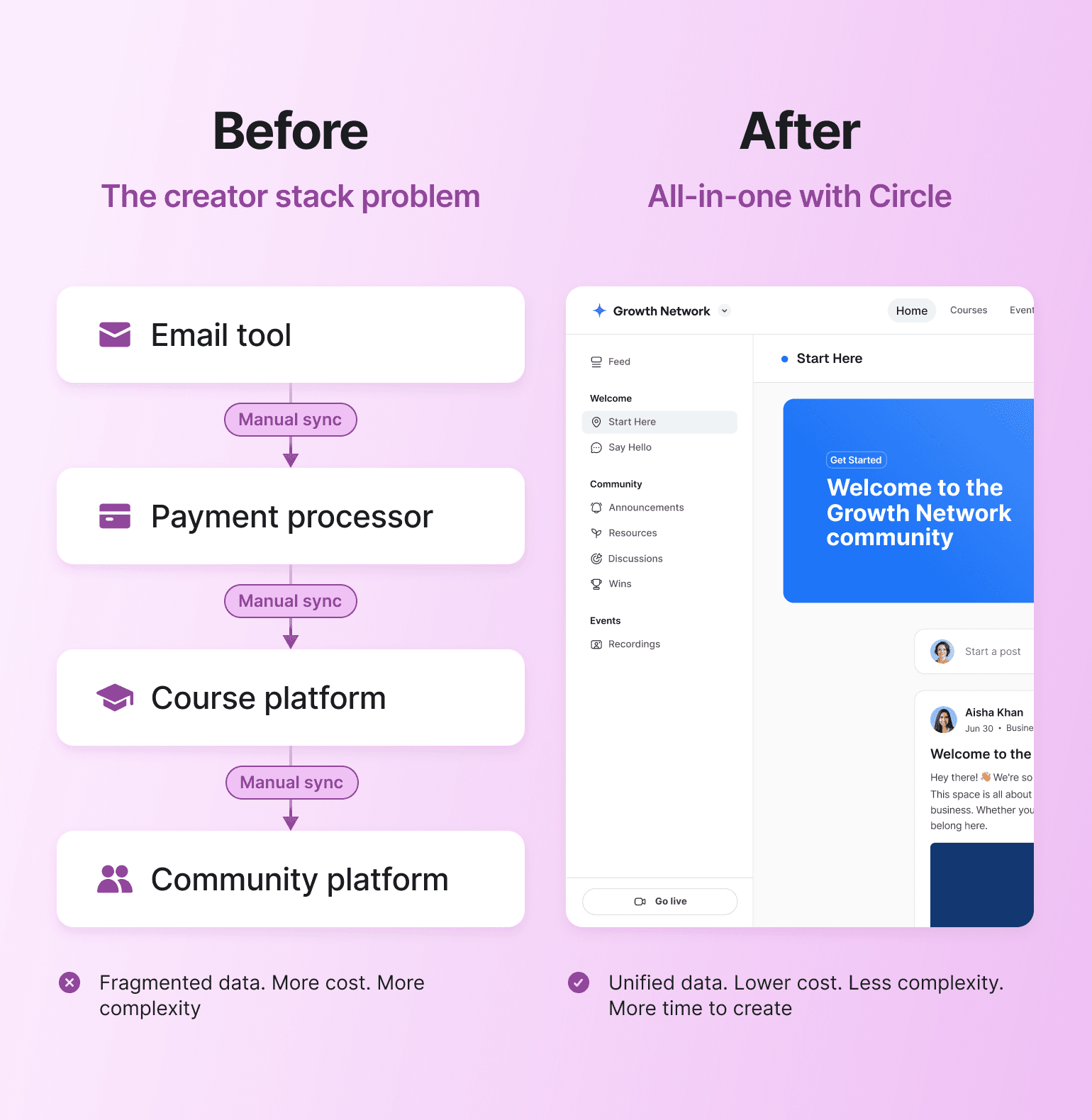
Most creators start by choosing a standalone newsletter tool. You set up an email tool, build your list, and start sending. Then you add a payment processor. Then a course tool. Then a community platform. Before long, you're managing a stack of logins, syncing data between systems that don't talk to each other, and spending more time on operations than on the work your audience actually pays for.
If you're a coach, creator, or educator who plans to build a community, sell courses, or run any kind of membership alongside your newsletter, Circle lets you skip that fragmentation entirely. Email Hub, Circle's built-in email marketing system, lets you send your newsletter from the same platform where your community, courses, events, and payments already live. One login, one CRM, one place to see who's subscribed and who's engaged.
TroopHR started as a one-way email newsletter, with founder Tracy Avin answering every question herself. When she moved onto Circle, the newsletter became the front door to a community where members connect directly and every issue, recap, and thread lives on as searchable content instead of disappearing into inboxes. Today TroopHR holds an 80%+ annual retention rate, with 60% of members joining through referrals. The newsletter sits in the same place as the events, discussions, and payments instead of in a separate tool to sync.
Step 3: Build your signup form and get your first subscribers
Your signup form should be simple. The fewer fields you ask people to complete, the less friction you create at the moment of signup.
Pair that form with a dedicated landing page. A focused landing page can work better than spreading signup opportunities across lots of competing pages and links. Your landing page needs a benefits-first headline written in clear, easy-to-scan language, one clear call to action, no competing navigation links, and some form of social proof.
If you don't have a large subscriber count to display yet, use what you do have: a short testimonial from someone who's read your work, a line about your own background and why you're worth reading, or a specific result you've helped someone get. Honest proof beats borrowed credibility.
Circle's Email Hub includes branded signup forms that sync instantly to member profiles. You can embed these forms on external websites, inside your Circle community, or on landing pages you build with Circle's Website Builder. Subscribers and community members can be managed together in Circle's audience tools. That cuts down on CSV exports between separate systems.
Two things make those first subscribers easier to win:
- Offer a lead magnet: build it around what your audience actually wants to receive. A mini email course works particularly well because it builds trust across several touchpoints before the subscriber has even seen a full issue.
- Start with people who already know you: your email contacts, social followers, coaching clients, and course alumni. If you're a coach, add a newsletter opt-in to your scheduling flow so everyone who books a call becomes a potential subscriber.
Step 4: Write and send your first issue
Your first issue isn't a thesis statement—it's a handshake. The reader is wondering one thing: was signing up for this a good idea? Your only job is to make the answer yes.
A useful frame: write the first issue as if a friend just gave a stranger your email address and said "you'll like her stuff." What would you send that person to make them glad the introduction happened?
A few things that tend to work in a first issue:
- Open like a human, not a brand. Skip the "Welcome to [Newsletter Name]!" banner energy. Try the opening line you'd actually use if this person walked into your studio or office: "Hey — glad you're here. Quick note before the real stuff starts."
- Remind them what they signed up for. People sign up, get distracted by lunch, and forget you exist by the time your email lands. One line referencing the post, lead magnet, or page that brought them in is enough to bring them back into context.
- Tell them who you are in the most disarming way possible. Not a bio. A reason to trust you, told like a story. "I spent eight years as a litigator and burned out spectacularly. This newsletter is what I wish someone had sent me in year three" beats any credential list.
- Set the rhythm. Tell them when to expect you, roughly how long issues will be, and what kind of stuff is coming. Predictability is underrated—it's what turns "another email" into "yay, it's Thursday."
- Deliver one thing worth their time, today. A tactic, a reframe, a story, a single link to your best existing piece. One. Resist the urge to dump your greatest hits. You want them finishing the email, not bookmarking it.
- Ask one real question. Not "what do you want to learn about?"—that's too broad to answer. Try "what's the one thing you're stuck on right now with [topic]?" The replies you get back become a goldmine for future issues and, frankly, future clients.
That last one is the secret weapon. Most subscribers will never reply to anything, ever. But the ones who do are telling you exactly what to write next, and often exactly what to sell them next.
One last thing, and this is the trap to avoid at all costs: don't launch a format more elaborate than you can repeat. A six-section magazine-style issue with original illustrations and three interviews is impressive on day one and a quiet shame spiral by week six. Pick the smallest format you can imagine still being proud of, then send it. You can always add—it's much harder to subtract.
Step 5: Stay consistent and grow
Consistency matters more than almost anything else at this stage—more than design, more than your subject lines, more than how fast the list grows. Pick a frequency you can sustain on your worst week, not your best one. If weekly feels too aggressive, go slower and build a cadence you can actually hold. Reliability is what turns a list into a habit.
Once you're shipping issues reliably, growth becomes the focus. Contribute to niche online communities where your audience already hangs out. Post consistently on your social channels. Turn newsletter content into threads and short posts. Cross-promotions with other newsletter creators can also become an effective growth channel over time.
As your newsletter grows, Circle's Workflows let you automate the operational layer using your community, course, email, and payment data in one system. Set up an automated welcome sequence that introduces new subscribers to your community. Trigger re-engagement emails to subscribers who haven't opened recent issues. Send course reminders based on where members are in a program. These automations can act on a complete member picture while you focus on the content only you can create.
Pat Flynn's Smart Passive Income community shows what happens when a newsletter is wired into a real membership business instead of sitting beside one. After consolidating courses, community, and three membership tiers onto Circle, SPI generated more than $700K in membership revenue in 2024—58% of total revenue, with 191% growth over three years. Each newsletter issue points readers somewhere they can actually do something: a discussion, a cohort, an event. Passive readers become active members. That's the system worth building.
Your newsletter compounds like a business asset
A newsletter you own and send consistently is one of the few marketing channels where the value compounds over time. Every subscriber is someone who chose to hear from you. Every issue is a chance to deepen that trust. And when your newsletter connects directly to a community where subscribers can become members, take courses, and pay for deeper access, the whole system reinforces itself.
Circle brings that system together: your newsletter, your community, your courses, your events, and your payments in one place, with one CRM and one login. No duct tape required.
Want to build an exceptional community? Start your 14-day free trial of Circle now.
How to start a newsletter FAQ
How much does it cost to start a newsletter?
Less than most people expect—your real starting cost is time, not money. The expense that creeps up later is paying for several disconnected tools at once: a separate email tool, course platform, and payment processor that all bill you and don't talk to each other. That's why creators planning to build a community often start on a single platform from day one.
How long should a newsletter issue be?
Aim for something a reader can finish quickly. Many readers open newsletters on mobile, where long, dense paragraphs hurt readability. One clear insight, delivered well, beats a sprawling essay every time.
Should I start with a free or paid newsletter?
Start free. Build trust, find your voice, and grow your subscriber base first. Audience first, monetize second. Once you have consistent engagement and a clear understanding of what your readers value most, you can introduce a paid tier.
How often should I send a newsletter?
Pick the cadence you can hold on a busy week, not your best one. Weekly is a common starting point, but a reliable monthly issue beats a weekly one you abandon by month two. Consistency builds the habit on the reader's side—they start expecting you—so choose a rhythm you can keep and only speed up once it feels easy.
Can I use my newsletter to grow a community?
Yes. Newsletters are especially powerful for coaches and educators because they build trust with a broad audience. Your community converts the most engaged readers into members. Link each issue to a specific discussion thread, course module, or live event inside your community. Readers who participate can be more likely to convert into paying members.
Community Content Marketer
Arina is Circle’s community content marketer, sharing insights on community growth, GTM strategy, and storytelling for solopreneurs.