Do newsletter referral programs drive growth?
TL;DR
- A newsletter referral program gives subscribers a unique link and rewards them for bringing in new readers—a version of newsletter gamification
- The best rewards for coaches cost nothing to fulfill: gated community access, bonus content, free course modules, or 1-1 coaching.
- You're ready to launch a referral program when you have enough subscribers, healthy open rates, a zero-cost reward, and other growth channels.
Members only
One issue, five minutes, every Tuesday. Read by +14,200 creators.
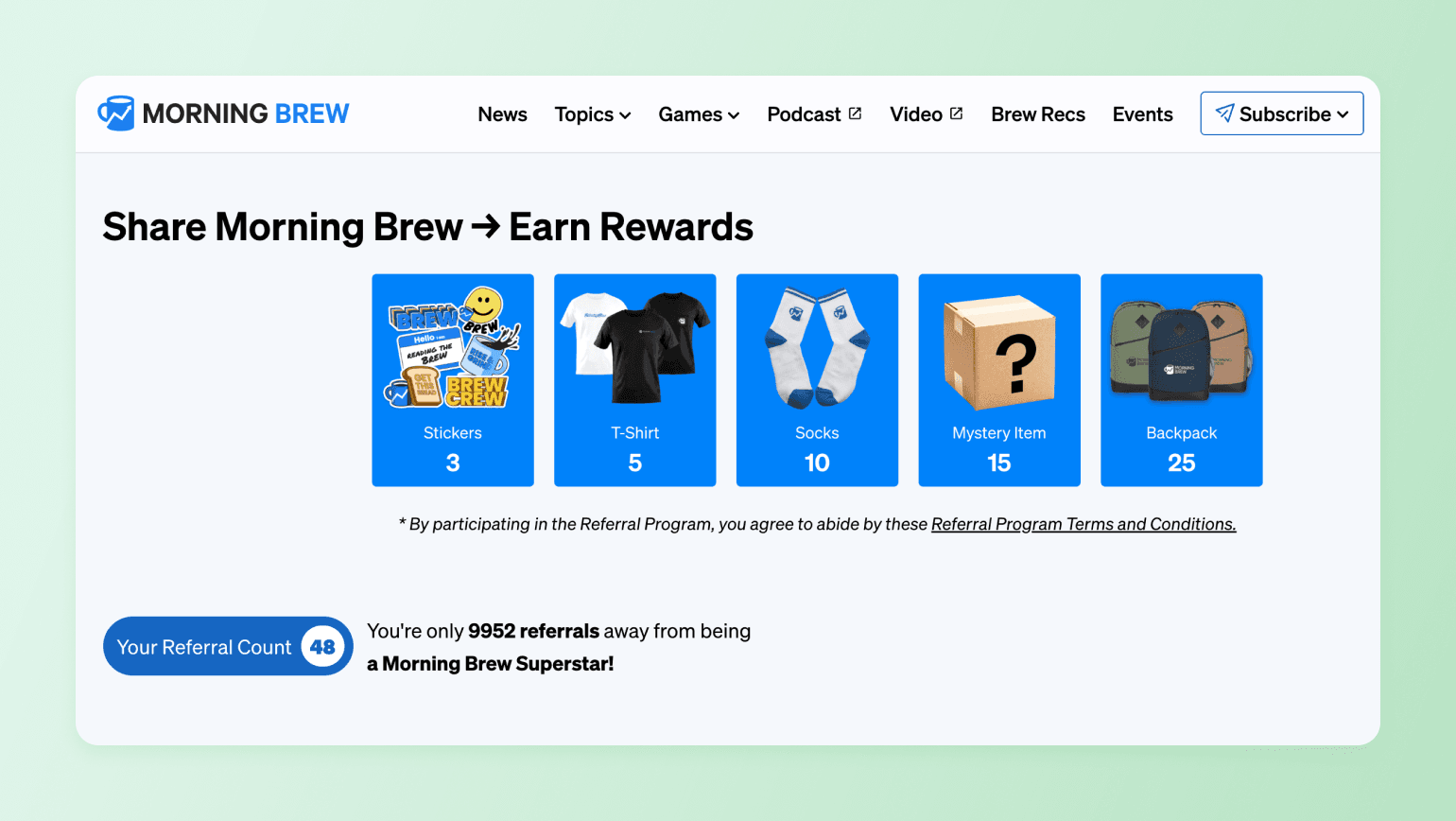
You've seen the excitement around Morning Brew's growth. You drooled over their subscriber numbers and their take-home math. So you decided to try to motivate your subscribers and set up a program for yourself. Except instead of a shout of glee at a swag bag for every five referrals, you watched the crickets chirp on the dashboard and wondered: What went wrong?!
That's because newsletter referral programs amplify growth—they don’t create it from scratch. For creators and coaches building a community-based business, they only pay off when a few specific things are already in place.
I’ll share how to tell if you're ready to set up a referral program of your own, how to set one up without overcomplicating it, and which rewards actually move people to share.
What a newsletter referral program is and how it works
A newsletter referral program is a structured word-of-mouth system that gives each subscriber a unique tracking link and rewards them when new readers sign up through it. When someone new subscribes through the link, the original subscriber gets credit. Stack enough credits, and they earn a reward.
A simple process would be:
- A subscriber gets their unique link, usually something like circlenewsletter.com/subscribe?ref=creator1.
- They share it with friends, colleagues, or their social audience.
- The system tracks clicks and conversions.
- When the subscriber reaches a defined milestone, a reward is automatically delivered.
Most programs tier rewards: a small reward at an early milestone, a better one at later milestones, and a high-value reward for true advocates who refer the most.
The blocker for a creator is whether your newsletter is positioned to make any of it work.
Signs you're ready for a referral program
Four signals suggest the timing is right to launch your newsletter referral program: enough subscribers to see results, healthy open rates with unprompted replies, a low-effort reward your audience actually wants, and other growth channels that are already producing.
You have enough subscribers to see results
Subscriber thresholds vary by audience, engagement, and incentive structure. If your list is still small, say like under 1,000, your energy is often better spent on other growth channels like guest posting, community courses, podcast appearances, and social media first.
Your open rates are healthy, and people reply without prompting
Good open rates combined with unprompted replies and forwards mean your audience is already engaged, and primed to share. A formal program provides structure to behavior that's already happening. But be careful: if subscribers won't share your newsletter without an incentive, the program may attract lower-quality subscribers who don't engage. Take that as a signal to strengthen the newsletter itself first—improve the content, sharpen the niche, and build genuine engagement before layering on referral mechanics.
You can name a low-effort reward your audience actually wants
If you can immediately think of a digital reward your subscribers would value—a PDF framework, a gated community, a bonus course module, or a 1-on-1 call—the economics will work in your favor.
Your other growth channels are already producing
A referral program works best as a supplement to existing channels like cross-promotions, content marketing, and SEO. If you're still figuring out your primary acquisition channel, start there, because referrals work better once your newsletter already has a reliable way to bring in and engage new subscribers.
If most of those boxes check out, the setup itself is the easy part.
How a simple referral setup works
A simple referral setup has three parts: a personal link, basic tracking, and one clear call to action per issue. You don't need a complex program to start.
The personal link
Each subscriber gets a unique URL when they join, auto-generated by your newsletter platform or referral tool. The link maps directly to their account, so when someone subscribes through it, the system credits the right person.
Basic tracking
Your platform tracks three things: link clicks, completed subscriptions, and milestone progress per subscriber. You don't need to build dashboards from scratch—many email (or newsletter) tools or add-on referral tools can handle this.
One clear call-to-action
The best place for a newsletter referral CTA is in your welcome email. Then, add it to the footer of every issue. Since email is often a strong referral channel, give subscribers a way to forward a pre-written email to a specific person rather than relying solely on social share buttons. Try to keep it to one CTA per issue.
If you have other offers to promote, keep them visually separate from the referral CTA—save them for a different section of the email (like a dedicated P.S.) so the referral ask stays the clear primary action wherever it appears.
Once you’ve set up the mechanism, it’s the reward offers that will determine whether anyone actually shares.
5 reward ideas that cost you (almost) nothing
The best referral rewards are digital, automated, and tied to your area of expertise. Here are five that cost almost nothing to deliver.
1. A gated PDF or resource guide
Repurpose a methodology guide, framework document, or resource list you've already created. A PDF download is a simple reward with fully automated delivery.
2. Exclusive content archive access
Lock your best evergreen issues, deep-dive posts, or resource libraries behind a referral milestone. Exclusive newsletter content is a low- or zero-marginal-cost reward.
3. Access to a private community
Create a referrer-only area in your community. This works particularly well because the reward itself increases engagement: referrers get access to peers and direct access to you, and you get a concentrated group of your most advocacy-oriented members.
If you're running your community on Circle, this means creating a gated space and granting access via member tags—your referral tool can trigger the tag once a subscriber hits the milestone.
4. A free course module or mini-course
If you already have a paid course, unlocking a single module or smaller course costs you nothing in time or money for the additional access. The content exists, but is given new life as a bonus.
5. A 1-on-1 coaching call
Reserve this for your highest-threshold tier and cap the number of redeemable calls in a given period to prevent over-commitment. A direct call with you is high-value and needs to be genuinely earned. This tier identifies your most active advocates, who often become some of your most engaged community members.
The common thread: every reward here is either fully automated or requires minimal time from you—no shipping, inventory, or recurring fulfillment costs.
When you pick the right rewards, you’ll notice that the program will start producing the growth signals you need.
What "growth" means here
Growth for your newsletter referral program should mean three things working together: more of the right subscribers, more community members, and better retention.
More subscribers (and the right ones)
Track your subscriber growth rate lift by comparing growth before and after launching the program. Results vary widely with audience size and engagement, so also monitor your referral conversion rate (new subscribers from referral links divided by total referral-link clicks) to gauge how well the program converts.
More community members
What percentage of referral-acquired subscribers convert into community members or paid tiers? No universal benchmark exists, so set your own baseline early and tag subscribers by acquisition source to measure this downstream.
Tip: A great way to do that if you don’t have an advanced tracking setup is a quick HDYHAU: How Did You Hear About Us? on a submission form.
Better retention
Segment your referred subscribers separately from organic ones and compare open rates, click rates, and unsubscribe rates over time. If referred subscribers are disengaging faster, the program may be attracting people who want the reward but don't care about your content. Watch unsubscribe rates closely to protect deliverability.
Even with the right metrics in place, plenty of newsletter referral programs still stall, usually for the same handful of reasons.
4 ways referral programs flop
Most referral programs that underperform fail for one of four reasons: the wrong rewards, launching too early, poor visibility, or overcomplicated rules.
Rewards that attract the wrong people
Offering a reward that doesn't match your audience attracts subscribers who want the incentive but don't care about your content. Those subscribers may mark emails as spam (or simply never open them), hurting your deliverability for everyone else. Referral programs can look efficient on a cost-per-subscriber basis, but that advantage can disappear if referred subscribers disengage.
Launching before the content is ready
If your newsletter hasn't proven its value yet, adding referral mechanics just accelerates mediocre results. You end up with a bigger list of people who don't engage, which makes future growth harder—and a larger unengaged list can quietly erode the economics of everything downstream, from open rates to paid conversions.
Before layering on referrals, get clear on what an engaged subscriber is actually worth to you. Circle's Community ROI Calculator can help you model that: plug in your audience size and pricing to see what realistic conversion rates from subscriber to paying member look like, so you know whether the foundation is strong enough to amplify.
Leaving the program invisible
Setting up a referral program but forgetting to embed it in every issue is more common than you'd expect. In some setups, the referral widget doesn't appear automatically. If subscribers never see the program, they can't participate—so include it in your welcome email and in every issue.
Confusing rules or too many tiers
Overcomplicating the structure creates confusion. Start with one or two reward tiers; you can always add more later. If a subscriber can't understand how the program works within seconds of seeing it, simplify.
What ties all of these failure modes together is the same thing: the program was built before the underlying experience was ready. So focus on perfecting your newsletter, your engagement, and your niche before bringing more people into your world.
Build the foundation first, then add referrals
A referral program captures word-of-mouth that's already happening. The newsletter has to be worth forwarding, and the community on the other side of the signup has to be worth joining. Get those two right, and the referral mechanics become the easy part.
That's where Circle comes in. It's the all-in-one home for the experience your referrals lead to: gated spaces for members-only rewards, courses and workshops for your deeper offering, and a community that turns curious subscribers into the kind of advocates who refer you without being asked.
Build the newsletter and community your subscribers actually want to refer to. Start your 14-day free trial of Circle now.
Newsletter referral FAQ
How many subscribers do I need before launching a newsletter referral program?
Many operators find that referral programs become more worthwhile once they already have a meaningful, engaged subscriber base. If you're still well below that kind of threshold, your time is likely better spent on content quality and other growth channels first.
What's a good referral conversion rate for a newsletter?
Referral participation is often modest, so even a small group of active advocates can still matter. The most useful benchmark is your own baseline: track how many subscribers share, how many clicks those shares generate, and how many of those clicks convert.
Should I use physical merchandise as referral rewards?
For most coaches and educators, no. Physical rewards scale linearly with volume and add shipping complexity. Digital rewards like gated content, community access, or free course modules cost nothing to fulfill at scale and connect more directly to your expertise.
How do I know if my referral program is attracting low-quality subscribers?
Segment your referred subscribers separately and compare their open rates, click rates, and unsubscribe rates against your organic subscribers over time. If referred subscribers disengage faster, your reward structure may be attracting people who wanted the incentive but don't value your content.
Community Content Marketer
Arina is Circle’s community content marketer, sharing insights on community growth, GTM strategy, and storytelling for solopreneurs.