Steal these 3, million-dollar playbooks

Oct 13, 2026 6 mins read
The one-man, million-dollar business
On two speeds, and the creators who cracked both.

You've seen the screenshot. A revenue chart going up and to the right, a caption about one person and no employees, and zero context. It's the gym selfie of business: great lighting, no information about the six months before it.
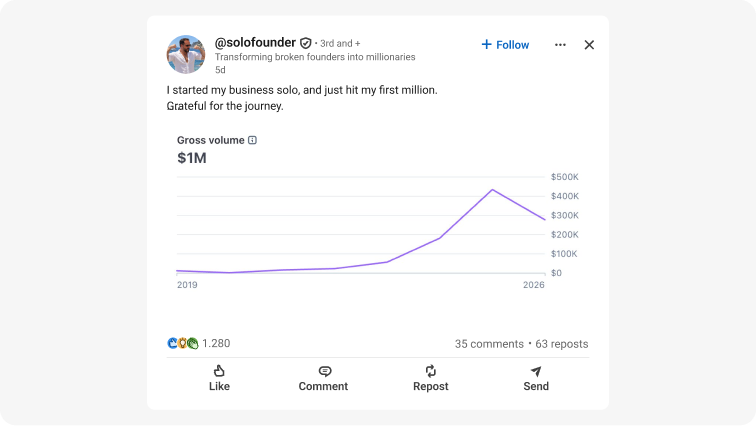
In the 2010s, "ditch the 9-to-5" was the calling card for leaving corporate behind. Freelance, laptop, work from anywhere. The new milestone is the million-dollar, one-person business.
At Anthropic's first developer conference, Dario Amodei predicted the first billion-dollar company with just one human employee would show up by 2026. (It's October, so the clock is ticking.) The most talked-about attempt this year is Medvi, a telehealth company profiled as two brothers and $401 million in sales. Even in the flattering version, there were contractors and account managers behind the curtain. "One person" usually comes with an asterisk.
So I went looking for people who'd show me what a million dollars actually looks like, asterisks included. I went in skeptical, as I usually do.
Is the one-person million-dollar business a real thing? Yes. Just at two different speeds, depending on where you start.
Speed one: slow and recurring
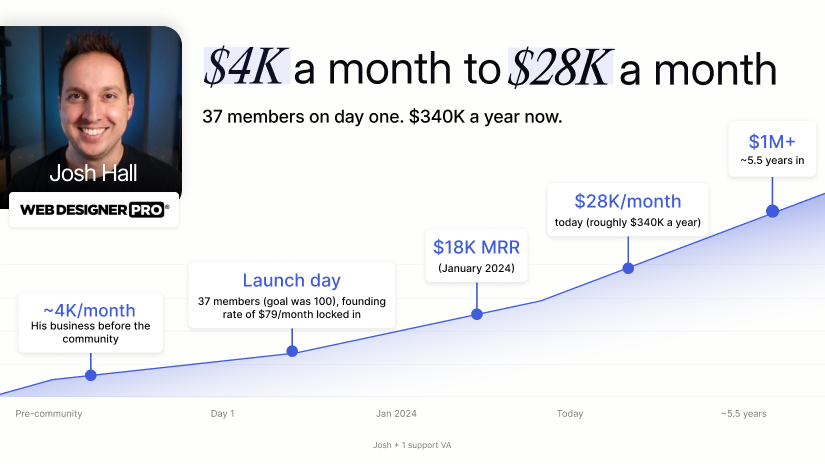
Josh Hall runs Web Designer Pro, a membership for web designers. He only figured out how close he was to $1M when someone asked how much the community had made. His reaction: "I haven't even looked." It's now past $1M in lifetime revenue, about 5.5 years in.
He opened his talk with a joke that he was calling in from his yacht. Then he took it back: "I'm not on a yacht. I've got 3 kids. I've got a mortgage, and we pay taxes too."
The growth was gradual. Before the community, his business made about $4K a month. By January 2024 the membership hit $18K MRR. Today it's around $28K a month, roughly $340K a year. It's Josh and one VA.
He didn't start from zero. He already had 1,000+ course students, a 25K-subscriber YouTube channel, and a podcast. His goal for launch day was 100 members. He got 37. "I was really discouraged at first." But those 37 got a founding rate of $79/month locked in for as long as they stay, and he figures 30 to 40% of them are still around. Every new member also gets a personal welcome video, and people still mention it five years later.
Speed two: fast and live
Matt McGarry's story starts with an email. January 2024, about 4,000 subscribers, announcing his first live cohort. Thirty days later it had done $100K.
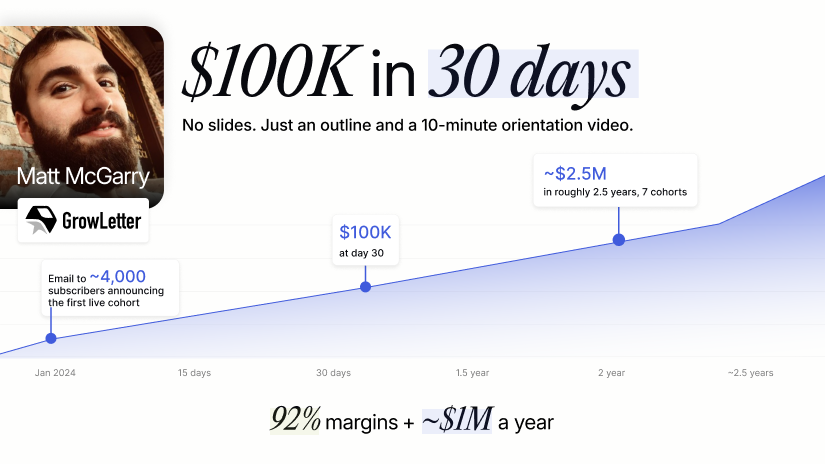
No slides. No finished course. Just an outline and a ten-minute orientation video. In his words: "I didn't have any slides. All I had was an orientation video about how to get started after they bought." He built each session the day before he taught it.
Seven cohorts later, he says he's brought in about $2.5M in roughly 2.5 years at 92% margins (!!!!). His rules for a first cohort: four weeks, tops. Two live sessions a week, max. And one result you can almost touch, like "get your first 1,000 newsletter subscribers" or "run a 5K in 30 days."
And then there's the one who ran both
Hoon Lee was 23 when he uploaded a Korean teaching video that blew up. His first year in business, 2019, brought in $6,500. Last year it was $1.1M. (Revenue, not profit, and he's not technically solo: three teachers, himself included, plus one support person.)
Here's the number I like better than the million, though. Everyday Korean has had 4,000+ students over the years, but roughly 880 are actively paying today. For his first five or six years he sold lifetime access, so that 4,000 stacked up over time. Then he moved to monthly and six-month plans, because lifetime access made it easy to coast. With a subscription, he says, "we have a mindset to provide better value every single month."
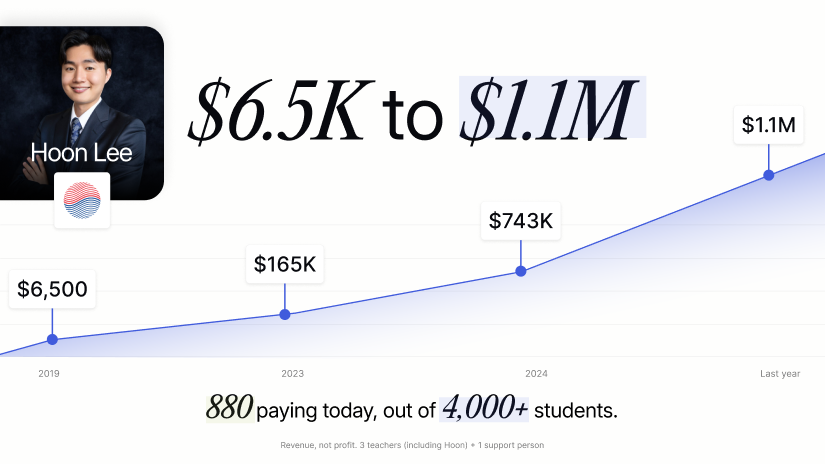
The real jump came from a free workshop. Revenue went from $165K in 2023 to $743K in 2024. The setup is simple: Meta ads promote a free Sunday workshop, people drop in an email and name, get a reminder, show up, and at the end he makes the offer. His numbers: about $4 a lead, 40% show up, roughly 8% convert. Then he cut the teaching part from 50 minutes to 25, and conversion stayed about the same, maybe slightly better. "It's not always that the longer is better."
He also tried high-ticket sales calls. He closed most of them, and found it exhausting, so he stopped. Prices run $50 to $200, partly by choice: "I have money guilt. So it was hard for me to charge 2K or 3K for learning Korean."
What they have in common
All three started with some kind of audience. Josh had 1,000 course students. Matt had a 4,000-person email list. Hoon had one video that blew up. And none of them were just selling information. Josh says members "came for the courses… but they stayed for the community." Matt says the same material sells as a $27 ebook or a $2,000+ cohort. Hoon wanted "the transformation of the people, not just a couple of seconds of fun."
So which speed sounds more like you? The slow build, the 30-day sprint, or a bit of both? Hit reply and tell me. I read every one.
The data desk
What's growing on Circle right now, straight from September.
Who's earning more. Of the 40 Circles that added the most revenue last month, about a third were course and skills academies: language, design, music, DJing, interview prep, photography. Next came money and property communities (investing clubs, trading, tax, real estate), then career and business coaching, then wellness and family. And roughly one in five run in a language other than English. (French, Czech, and Spanish showed up a lot.)
What they're using. Conversation still wins on volume. Comments, DMs, and posts lead, same as always. The growth is somewhere else. Automations had the biggest jump, then email broadcasts, then live video. Basically: the tools that do the repeat work so the person running the community doesn't have to.
Who jumped. Several Circles more than tripled their August earnings. A UK property community. A French real estate consultancy. A Czech course creator. (Some were mid-launch, so that's part of the story.) What they share, if you squint: they teach one specific thing and charge for the result.
Sincerely London, in four questions
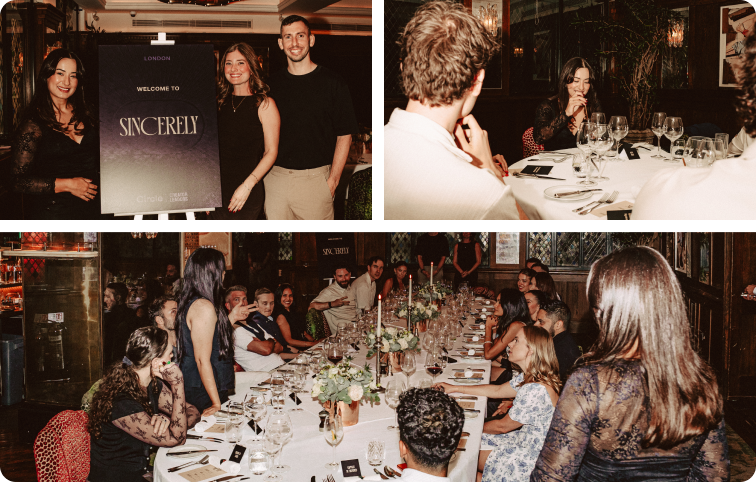
In August, we hosted our first exclusive Sincerely dinner in London with our friends at Creator Leaders: 25 creators, a poet writing a custom poem for every guest (their parting gift), and servers in white gloves bringing out a new question with each course. Madison, who ran the night, says the questions got deeper as the meal went on. Here they are, if you want to steal them:
- If you could uninvent one thing, what would it be?
- What has left the biggest impression on you in your life or your career this year?
- What does sincerity mean to you?
- What are you most curious about right now?
For the last one, everyone stood up and answered out loud. Madison asked the room to skip the obvious answer (AI, obviously) and go one level deeper. It worked. All night, people kept finding each other over drinks to say "wait, I want to talk about that too."
Next Issue: The money gap between business niches is huge. Health, finance, and legal (the YMYL crowd) play by different rules than everyone else. So what does that gap look like for creators? I got the data behind our pricing calculator, which splits what people charge by niche. Some niches are charging way more than I expected. Others are leaving money on the table.
Hit reply with your niche and what you charge right now. I'm curious where you land.
|

P.S. The three founders featured in this edition used Circle to build, launch, and scale their digital businesses. Want to see what you can bring to life?
 Arina,


