9 lessons from our first mastermind 🧠

Read time: 4 minutes
Hey,
One of my favorite things about online businesses is the hunt for authority. Some people have massive brands with very little pudding as proof. Others have fledgling businesses built on decades of niche experience.
So… how do both prosper?
You need the confidence, and the generosity, to be one step ahead of someone else, publicly.
This works in a community context too — and is often how masterminds come to life. Here’s our version of it.
The setup:
-
Circle's customer community: 20,000+ business owners, every stage, age, and niche.
- Past a certain size, communities do one of two things — fragment into smaller circles, or go quiet. (Read about Dunbar's number if you want to nerd out.)
- Ours is our lifeblood. Quiet isn't an option.
- Across customer calls, founder conversations, and the community itself, we kept hearing the same thing: "Between the choice of software, and a connection with one founder earning what I'm earning… I'll take the founder."
That's not a knock on the product (we know we can’t solve everything with tech!) It’s the whole thesis of community, said out loud. So this year, our community programming manager, Trisha, made a bet: build and run an extraordinary mastermind for founders moving from $400k to $1M.
The Founders Table ✨
At first, she was terrified about not being qualified to run a small intimate room for founders, when she'd never built a company herself. Will this be valuable? Will they come back for session two? Will there be a repeatable structure or are we going to have to constantly change it?
Here's the playbook she actually ran & 9 things she learned from round one:
- She didn't guess who belonged in the room. She pulled real community data — revenue, tenure, persona — and landed on a specific target: founders sitting around $400k, heading toward $1M.
- She kept it small and made it a real commitment: seven people, invite-only, say you'll show up to most of the six sessions or don't apply. In a room that small, one person skipping three sessions sets the tone for everyone else, real fast. Two dropped out the day before it started anyway, so the takeaway for her? Always over-recruit.
- Before anyone met as a group, she met every single one of them, 1:1, to find out where they actually were and what they wanted. That's where most of the real work lived — to build rapport, dig into their hopes, and understand their personal goals so she could better coordinate the group.
- She pre-introduced attendees. Full bios on every founder, sent out ahead of session one — so nobody showed up not knowing who else was in it. (I’ve seen our Studios founders do this for an community event roadshow, and it was SO exciting knowing who’s coming.)
- She resisted the urge to teach. "This isn't for me to do the talking," she told them. "I'm here to bring you together. You have to participate." Guest speakers came in as open conversations, not panels. The final session was a founder spotlight — five prompts, no exceptions: advice to your past self, something you're proud of, a belief you've changed your mind on, two predictions, and "borrow my brain."
- Busy founders don't want less structure. They want more context for how they're about to invest their time. The one week Trisha showed up with nothing prepared, people questioned whether they should even come — not because they didn't like the group, but because they didn't know what they'd get out of it. The fix was small: one thing to react to before each session — their own data, a prompt — not a full syllabus, but something to think about in advance.
- The room started setting its own agenda. In one session, a founder volunteered on the spot to go find out what was working on a shared challenge with their own team, and report back at the next one. Nobody assigned that. The room set its own homework.
- The clearest "it worked" moment: one founder shared their actual win-back policy — cancel, and you can't rejoin for a year. Prices go up every year. An automated message fires the second someone hits cancel. Three others asked for the exact wording on the spot. That's not something you find on YouTube.
- Here's what she got wrong, by her own account: she went in wanting to move these seven people toward $1M in six sessions. Partway through, she had to admit that six biweekly calls can't engineer a revenue outcome — different businesses, different paths, no single formula. What she could actually build was the room & organize the people working towards the same goals.
If you run a community: would you ever build something this small, this deliberately exclusive, on purpose? Hit reply and let me know.
Don’t miss the Build Summit | Aug. 25 & 26
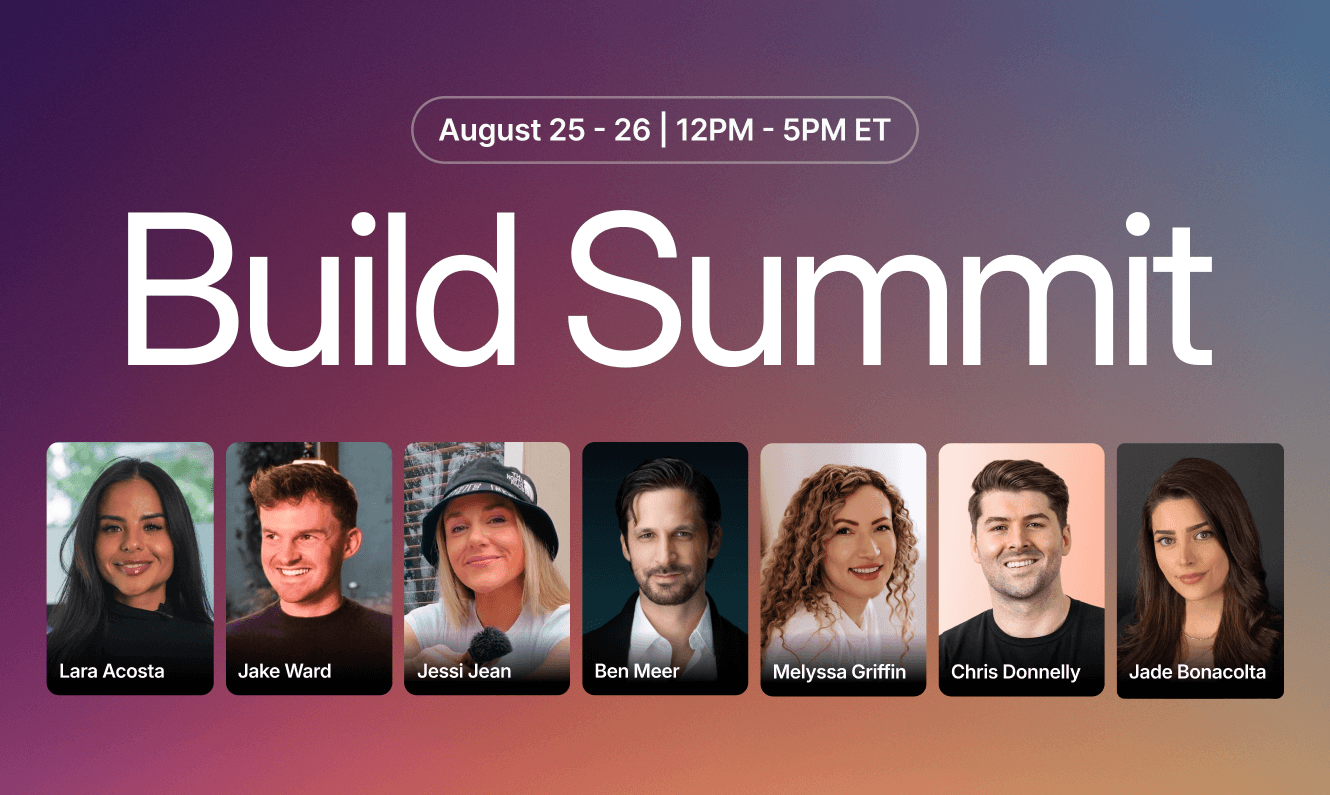
We’re no strangers to doing summits at Circle (say that 5x fast, I dare you), but man, is this one going to be a doozy.
Not only do you get the inspo on day one from folks like Melyssa Griffin, Chris Donnelly, Jade Bonacolta and Ben Meer, Jessi Jean, Lara Acosta and Jake Ward… about how to build a profitable, sustainable digital business.
But on day two, we turn everything you’ve been hoping, planning, and putting off… into actual, functional businesses… together. Everything from discussion and cohort spaces, to community branding, to courses, events, and payments gets built with Circle AI and real humans from our team in the room to unstick you.
My hot tip? Attend live. Not only is the chat to die for, but you get bonus AI credits when you commit to showing up for yourself and your future.
3 crazy cool communities
Why am I highlighting these? Because a lot of people think they need to be experts to build something real. The truth (see above) is that you just need to be one step ahead of someone else, doing something you love & believe in. Here are 3 examples to steal confidence from.
- Archaix Underground — A private research hub for people convinced our timeline isn't what it looks like: ancient chronology, predictive historical cycles, simulation theory, taken completely seriously. Who it's for: researchers of alternative history, chronology nerds, and — per their own site — "seekers exploring reality simulation theories."
- Tomlin Harmonica School — One teacher, one instrument, a full structured path from your first clean note to real improvisation, built by a guy in Edinburgh who taught himself blues harmonica and turned it into a curriculum. Who it's for: beginners who want structure, intermediate players sharpening technique, anyone tired of noodling with no plan.
- Whimsy Forge — Fantasy cosplay and real strength training, on purpose, at the same time: Dragon Rider Training, guilds, quests, book clubs, zero shame-based fitness content anywhere in sight. Who it's for: fantasy-loving makers, cosplayers, and women who want their warrior side and their maker side in the same room.
Coming up: London Writers' Salon runs a free writing ritual four times a day, every day, and it's turned into a $500K community business with 1,800 paying members. Founder Matt Trinetti's whole philosophy comes down to one line — people show up "when they feel a sense of ownership about the place."
See y’all soon.
Arina Kharlamova
Lead Editor, Circle Newsletter
P.S. Do you like free things? If you sign up and attend the Build Summit, you’ll get 2,500 free AI credits to build your dream digital business.
 Arina,


