The most unexpected acquirable asset

Read time: 4 minutes
Hey,
I don’t know about you, but I’m no stranger to venture capital news or startup-land hype. While these massive acquisitions are now par for the course, what I just witnessed was awe-inspiring in a more personal way.
Last month, Gesche Haas sold Dreamers & Doers — the women's founder community she'd spent more than 12+ years building — for seven figures.
What’s even more incredible? Her community business:
- Was completely bootstrapped
- Saw 10+ years of up-and-to-the-right, seven-figure ARR (annual recurring revenue)
- Had ~600 paying members (and still sold for million(s))
- Sold to one of its oldest members, kept Gesche on-board, and didn’t eliminate any roles on the team or “clean house”
It leads me to wonder: what kind of startups can claim these sort of stats & pair it with this level of care?

Photo: Christina Salerno, new owner and CEO of Dreamers & Doers, Gesche Haas, former CEO and owner, and Taylor Harrington, Head of Community.
The best buyer might be one of your members
Gesche said that she “never built it to sell it” but as a way to combat her own loneliness at being a first-time founder. She poured her heart and soul (and, obviously, dreams) into the business, which is why it mattered who she sold the business to.
When she thought about a steward for D&D, Christina Salerno was the only name that popped to mind. She was a member for over ten years, a seasoned operator and community strategist, and had stepped in to help Gesche hire the best people for the community, pro bono, because the community itself had helped her so much over the years.
In short, Christina became the “CEO whisperer” — and the only person Gesche trusted to not break the thing she had spent the past decade building.
A win-win-win acquisition
Neither woman had bought or sold a business before, so this didn’t look like your typical Patagonia-vest acquisition. They didn’t write a letter of intent, draft the purchase agreement until financing was locked, or reach out to lawyers until the very end.
They came to their “win-win-win” (for the seller, buyer, and the community itself) through "mutual care, respect, and what's best for the business" — not around who could squeeze whom.
This is the quote that I keep thinking about, though:
"So many acquisitions are really about acquiring a customer base or a sales channel. This one just isn't."
What this means for you
And here's the part I can tell you that you won't read in Forbes: Gesche isn't a one-off.
We watch community businesses change hands semi-regularly (there’s at least one more massive one coming this year 👀), and the pattern rhymes almost every time. The best buyer is a member who already loves the place.
So here’s a little wake-up call: your community is a real, financial asset.
Those members you’ve painstakingly won over to your little corner of the internet? They’re invested in your success, and they will match your energy — if not even surpass it.
So if you have a life change (Gesche is trying for a baby!), a desire to step away from the day-to-day work, or an intentional pivot towards a different business: don’t think about the community as a monthly revenue line.
Start thinking about it as an asset — something with real value that you build, protect, and one day hand to someone who'll love it as much as you did. (Maybe someone who’s already in there, that echoes your values, thoughts, and goals.)
Because nobody acquires a feed. But they will invest in a room full of people who'd notice if it disappeared.
Glad you're in ours.
The numbers (an acquirer cares about)
What an acquirer cares about — whether they’re a member, a teammate, or an outside company — isn't just your signup count (though that helps them model out future cashflows for the business). It's whether people stay (retention), how much they’re worth (member LTV), and finally, your profit margins. For community businesses, margins are much higher than the typical 5-10% — though we’ll explore this deeper in a later issue.
A big chunk of Dreamers & Doers members have been around five-plus years — and that longevity is a massive part of the valuation.
Try this: stop leading with total members and start watching your 12-month retention & growth trends. Those are the numbers that quietly turn a community into an asset — worth obsessing over even if you never plan to sell.
1 follow | 1 read | 1 listen — all joy
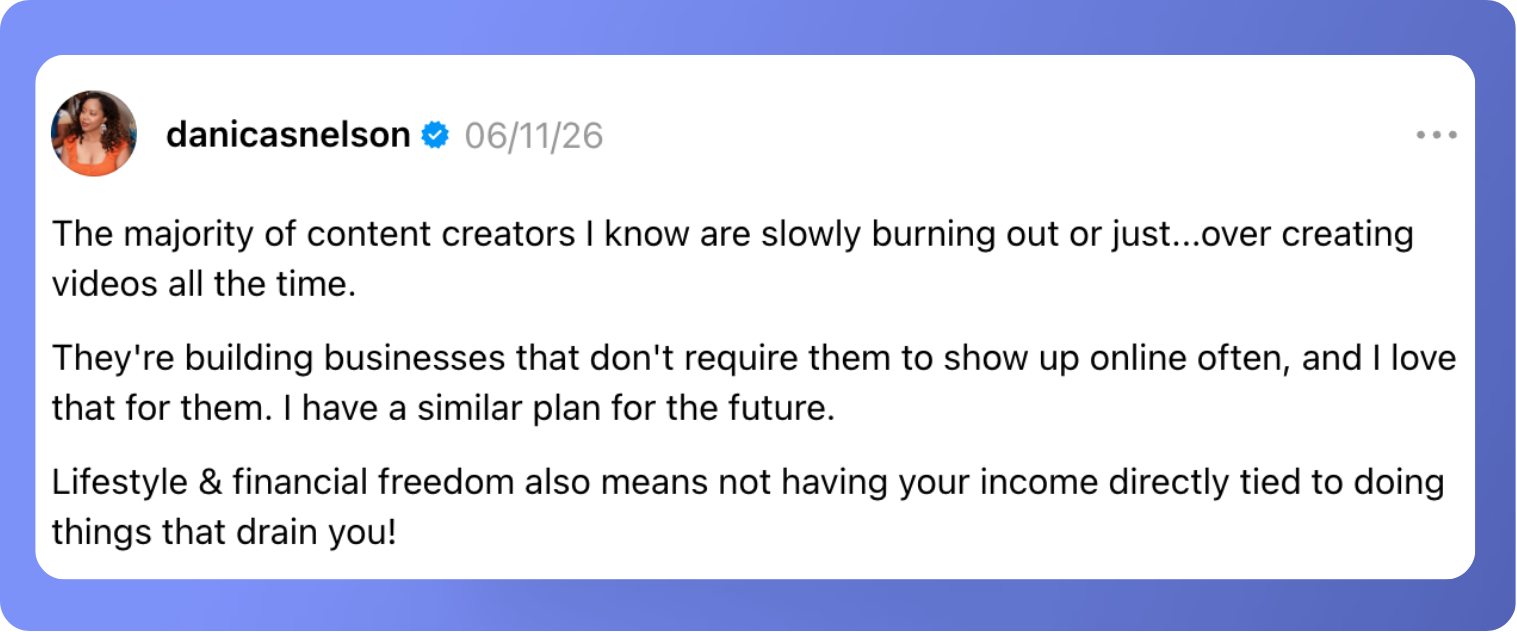
- Danica took an extended sabbatical after being burned out by her 9-5 hustle in tech marketing. It was so transformative, she coined it a “liberty leave”. Now? She built a community to help women to take liberty leaves of their own. A true testament to how your own transformation can trickle down and uplift your community.
- Why does this brand-new local event keep selling out? As someone who has participated in, organized, and supported local arts events, community strategist Becky Pierson’s insight hits it right on the nose.
- Your new binge-listen about the inner workings of communities. Take this on your next long walk via Spotify and Apple podcasts. (Yes, we’re very excited.)
Next issue: how do you market the “je ne sais quoi” of the magical transformations happening inside your community? I spoke with Will Mannon, Head of Circle Studios, about the sacred value of communities, and how you can test yours with the airplane test. We're getting into the value members feel but never see advertised, and why it's the whole game.
What's one member you'd genuinely miss if your community disappeared tomorrow? Hit reply and tell me about them. I read every response.
Arina Kharlamova
Lead Editor, Circle Newsletter
P.S. Circle AI is now available to all to test drive with a free trialllllll, baby. Get building. You can literally just tell it your idea, and it'll start creating for you.
 Arina,


