7 Hivebrite alternatives for organizations where members actually show up
Hivebrite checks all the right boxes on paper for alumni networks, professional associations, and member organizations. It offers member directories, CRM features, and event tools.
But many organizations run into the same pattern after launch. Members sign up, take a look around, and then gradually stop coming back. Why? Well, it could be lots of reasons, but the most obvious one is that the platform doesn’t have the best tools to support ongoing member engagement.
At the same time, community managers often find the platform overly complex and slower to work with, which doesn’t align with modern, member-friendly expectations. Add to that the platform’s price that can quickly climb into the thousands per year, and it’s no surprise that many organizations begin looking for alternatives that feel more modern, flexible, and better suited for engagement.
If you have been having similar feelings, here are 7 of the best Hivebrite alternatives that may be better suited to your needs. For each, we’ll look at:
- Its best use case
- Key features
- Pricing
- Pros and cons
- User reviews
Why organizations are looking for Hivebrite alternatives
Hivebrite positions itself as an all-in-one, highly customizable platform where everything lives in one place, from member directories to events to content. In theory, that should make it easier to bring your community together and manage everything from a single hub.
But in practice, many organizations find that having everything in one place doesn’t automatically lead to an active, engaged community. Here are the most common reasons teams start exploring alternatives:
- Engagement gap: Even though Hivebrite includes engagement features, they aren’t always central to the experience. The platform leans more toward organizing information than sparking interaction. As a result, members often consume passively instead of participating.
- Onboarding and registration leaks: The platform is designed to be flexible and customizable, which can make onboarding less intuitive out of the box. Without a clear, guided first experience, new members may not immediately see value. And they may even drop off before any meaningful engagement begins.
- Fragmented experience despite “all-in-one” positioning: While Hivebrite brings many tools together, they don’t always feel tightly connected. Members often have to navigate between different sections for events, discussions, and resources. And that’s not ideal if you’re trying to create a seamless community experience.
- Enterprise cost and operational weight: Hivebrite is built with enterprise organizations in mind, which shows in both pricing and complexity. For many teams, this means longer setup times, ongoing management overhead, and costs that quickly scale into the thousands per year.
- Data portability and long-term flexibility: As communities grow, teams start thinking about control and future-proofing. Questions around exporting data, migrating platforms, or adapting the setup become more important. When flexibility feels limited, it can create hesitation about long-term commitment.
How to choose the right Hivebrite alternative
Choosing a Hivebrite alternative isn’t just about finding more features (although yes, that matters too 😅). You’re better off choosing a platform that supports the kind of community you actually want to build.
So before comparing tools, start here: what do you want your members to do once they join?
Most platforms fall into one of three categories:
Directory-first platforms (management-focused)
Directory-first platforms are built to organize members, not necessarily to engage them. They’re a strong fit for organizations that need structured data, like alumni networks, associations, or groups managing large member databases. If your priority is tracking relationships, profiles, and services, this model works well.
💪 What they do well:
- Member profiles and search
- Structured data and segmentation
- Administrative control
📉 Where they fall short:
- They make it easy to find people, but aren’t designed for engagement
- Activity tends to be passive rather than ongoing
2. Engagement-first platforms (interaction-focused)
Engagement-first platforms are designed to get members to participate and come back regularly. They work best for communities that rely on conversations, events, and ongoing interaction to deliver value. If retention and activity are your main goals, go for platforms that support that.
💪 What they do well:
- Discussions, spaces, and conversations
- Events and real-time interaction
- Notifications and engagement loops
📉 Where they fall short:
- Limited support for complex member databases and structured records
3. Learning-first platforms (content-focused)
Learning-first platforms center the experience around content, courses, and structured programs. They’re ideal for organizations running cohort-based learning, paid memberships, or educational communities. In these setups, content is the primary driver of value, with community playing a supporting role.
💪 What they do well:
- Courses and learning paths
- Content delivery and progress tracking
📉 Where they fall short:
- Community interaction is often secondary to content consumption
Once you know which model fits your needs, it becomes much easier to evaluate your options.
7 Best Hivebrite alternatives in 2026: A quick snapshot
Before we dive into each tool, here’s how the top Hivebrite competitors stack up at a glance:👇🏻
| Tool | Best for | Key features | Starting price |
|---|---|---|---|
| Circle | Organizations that want real member engagement | Structured spaces, events, courses, AI, workflows, gamification | $89/month |
| Mighty Networks | Social-style community apps | Activity feeds, courses, live streaming, mobile apps | $79/month |
| Higher Logic (Vanilla) | Enterprise customer & association communities | Forums, knowledge base, automation, CRM integrations, SSO | Custom pricing |
| Bettermode | Embedded product communities | Customizable UI, integrations, widgets | $399/month |
| Disciple | Branded mobile community apps | White-label apps, live streaming, groups, subscriptions | $399/month |
| Tradewing | Professional associations | Member directory, events, sponsorship tools, analytics | Custom pricing |
| Slack | Lightweight professional networking | Channels, messaging, integrations, simple onboarding | Free |
1. Circle — best Hivebrite alternative for organizations that want real member engagement
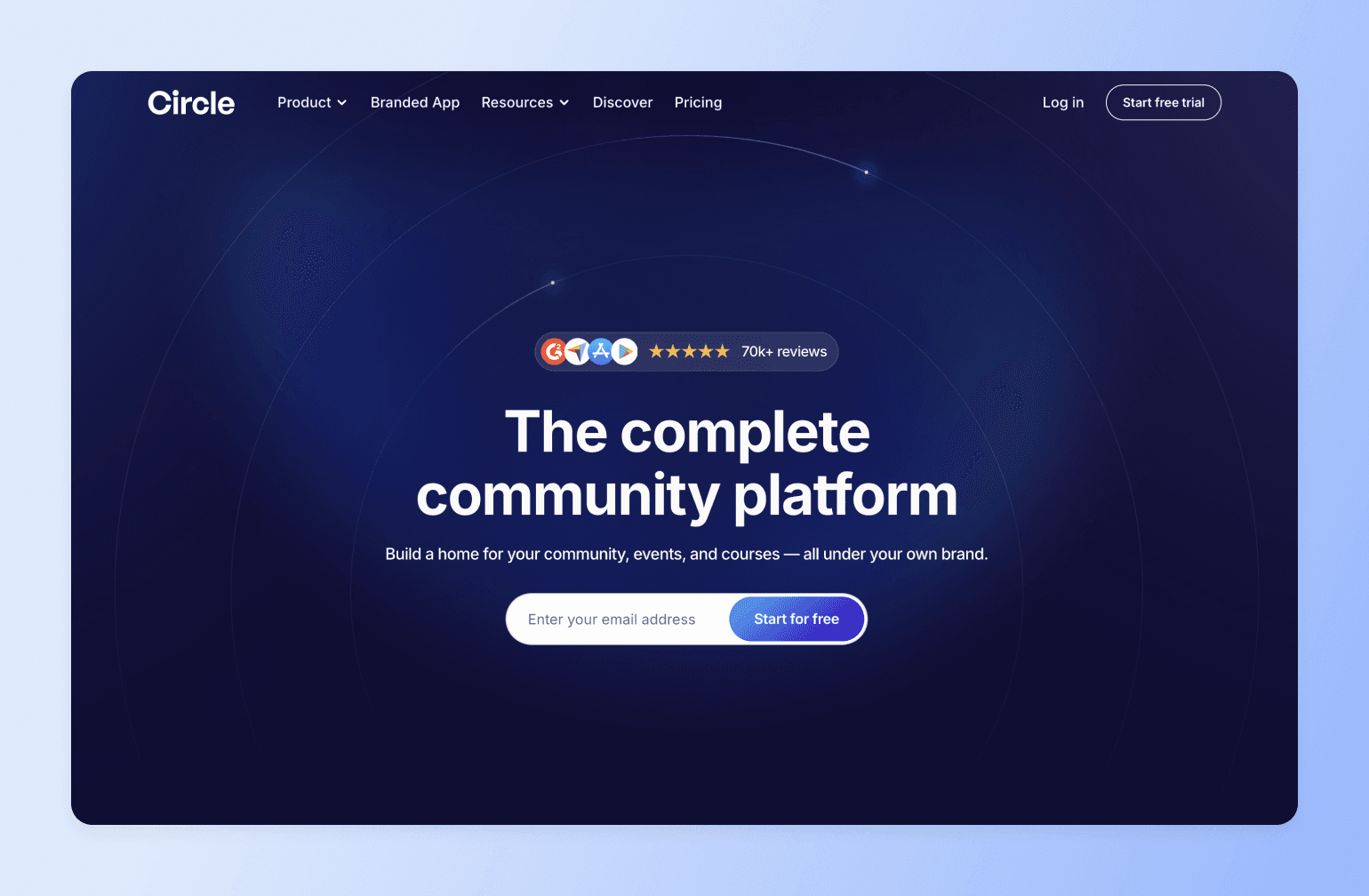
Yes, this is us. And yes, we do think Circle is one of the strongest Hivebrite alternatives, especially if engagement has been a challenge.
More specifically, Circle is built to solve the problem many teams run into with Hivebrite: members join, browse, and never come back. Instead of a directory-first experience, Circle is designed around interaction, with structured spaces, conversations, events, and content all working together to give members a reason to return.
It also replaces the fragmented feel many teams experience with Hivebrite. Community, events, and learning live in one cohesive platform, supported by features like gamification, AI agents, and native live experiences. Combined with transparent pricing and faster product iteration, Circle offers a more modern, engagement-first alternative without the typical enterprise overhead.
Key features:
- Built-in course builder with modules, drip scheduling, and cohort-based experiences.
- Native events and live streaming for workshops, Q&As, and virtual sessions.
- Flexible monetization across memberships, subscriptions, and courses.
- Rich engagement tools, including DMs, group chats, gamification, and activity tracking.
- Branded experience with a customizable community website and optional white-label mobile apps.
- AI-powered workflows and agents to automate moderation, onboarding, and engagement tasks.
- Advanced analytics tracking engagement, retention, and revenue across the full member journey.
- Integrations and API access for connecting tools like Zapier, Google Analytics, Loom, and more.
- Enterprise-ready infrastructure with role-based permissions, secure payments, and scalable performance.
Pricing:
A free 14-day trial available. Plans start at $89/month.
Ideal for:
Organizations that want to increase member engagement, retention, and participation without the complexity of enterprise platforms.
| Pros | Cons |
|---|---|
| Designed specifically to drive engagement and retention. | No native job board or fundraising tools. |
| Intuitive onboarding and user experience. | Feature depth can feel overwhelming at first, but that flexibility allows you to support different community models. |
| Fast product development and regular updates. | |
| Migration support and full data export if you decide to switch to us. |
Users say:
👍🏼 "Circle is a well-designed platform for building and managing online communities. The interface is clean, intuitive, and makes it easy to organize discussions, events, and content in structured spaces. Features such as member management, notifications, and integrations make it a strong solution for organizations looking to create an engaged digital community." - Verified review from G2
🤔 "While the platform offers comprehensive settings, the current long-form list makes locating specific options challenging." - Verified review from G2
Circle vs. Hivebrite: A quick comparison
| Capability | Circle | Hivebrite |
|---|---|---|
| Community engagement | Structured spaces, threads, DMs, chat, AI agents | Directory model, members browse rather than engage |
| Member onboarding | Automated workflows and guided setup | Registration flow can feel unclear |
| Live events & streaming | Native live events (100–200 attendees) | Event management is registration-focused |
| Gamification | Points, leaderboards, badges | Not available |
| Courses | Built-in course builder | Not supported |
| Member directory | Searchable with filters and discovery features | Strong directory with CRM |
| Job board | Not native | Built-in |
| Fundraising | Not native | Built-in |
| SSO | Available on Business/Enterprise plans | Included |
| Custom branding | Full white-label and branded apps | Custom branding |
| Pricing transparency | Public pricing from $89/month | Pricing available upon request |
| Data export & portability | Full export and open API | Some concerns reported |
| Product velocity | Frequent updates and releases | Slower enterprise release cycles |
👉 For a detailed breakdown, check out the Circle vs. Hivebrite comparison.

20K+ digital businesses live on Circle
2. Mighty Networks — best Hivebrite alternative for social-network-style communities
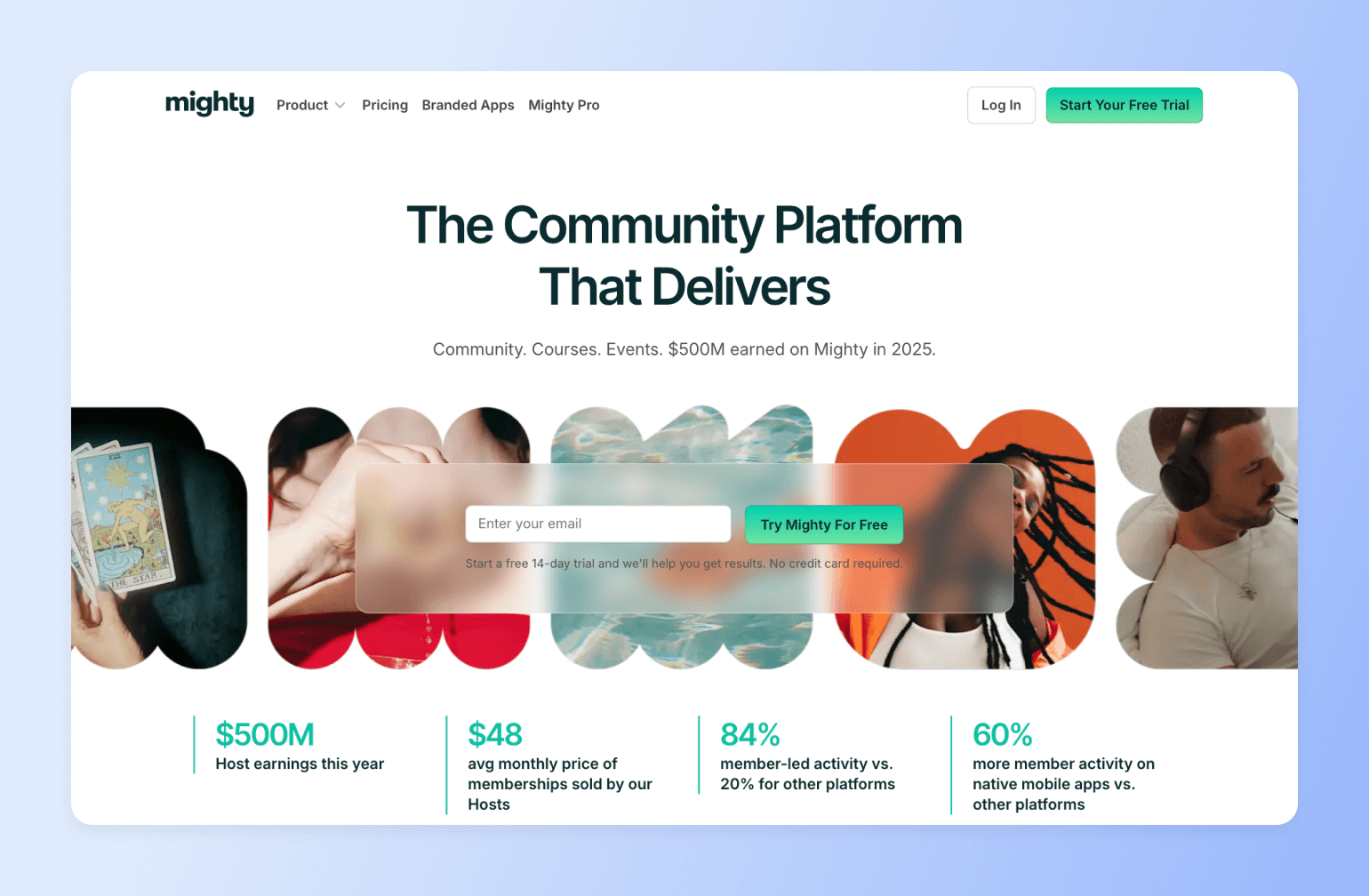
If you're looking for a community platform that centers around social interaction and recurring engagement, Mighty Networks is a strong pick. Unlike Hivebrite, it uses activity feeds, challenges, and memberships to give members reasons to come back regularly. However, the feed-based structure can feel less organized at scale, especially for organizations that need more structured experiences.
Key features:
- Activity feed with posts, comments, and reactions.
- Built-in courses, challenges, and memberships.
- AI “Cohost” for community and content setup.
- Automations and member segmentation.
Pricing:
Starts at $79/month, with a free 14-day trial available.
Ideal for:
Brands that want to build a social-style community.
| Pros | Cons |
|---|---|
| Strong mobile experience with native apps. | Feed-based structure can feel unorganized at scale. |
| Designed to encourage frequent member activity. | Advanced features require higher-tier plans. |
| Relatively easy to launch without a heavy technical setup. |
Users say:
👍🏼 "It makes it possible to build community on your own terms, free from the noise and algorithms that dominate most online spaces. You can design the experience around real connection: meaningful conversation, learning, and shared purpose. The customer support is outstanding, quick, thoughtful, and genuinely invested in helping creators build great communities" - Verified review from G2
🤔 "Impromptu changes to where things are and how to get to them! There is no notification or warning of changes, and one has to waste a lot of time to find them." - Verified review from G2
3. Higher Logic (Vanilla) — best Hivebrite alternative for enterprise support/customer communities
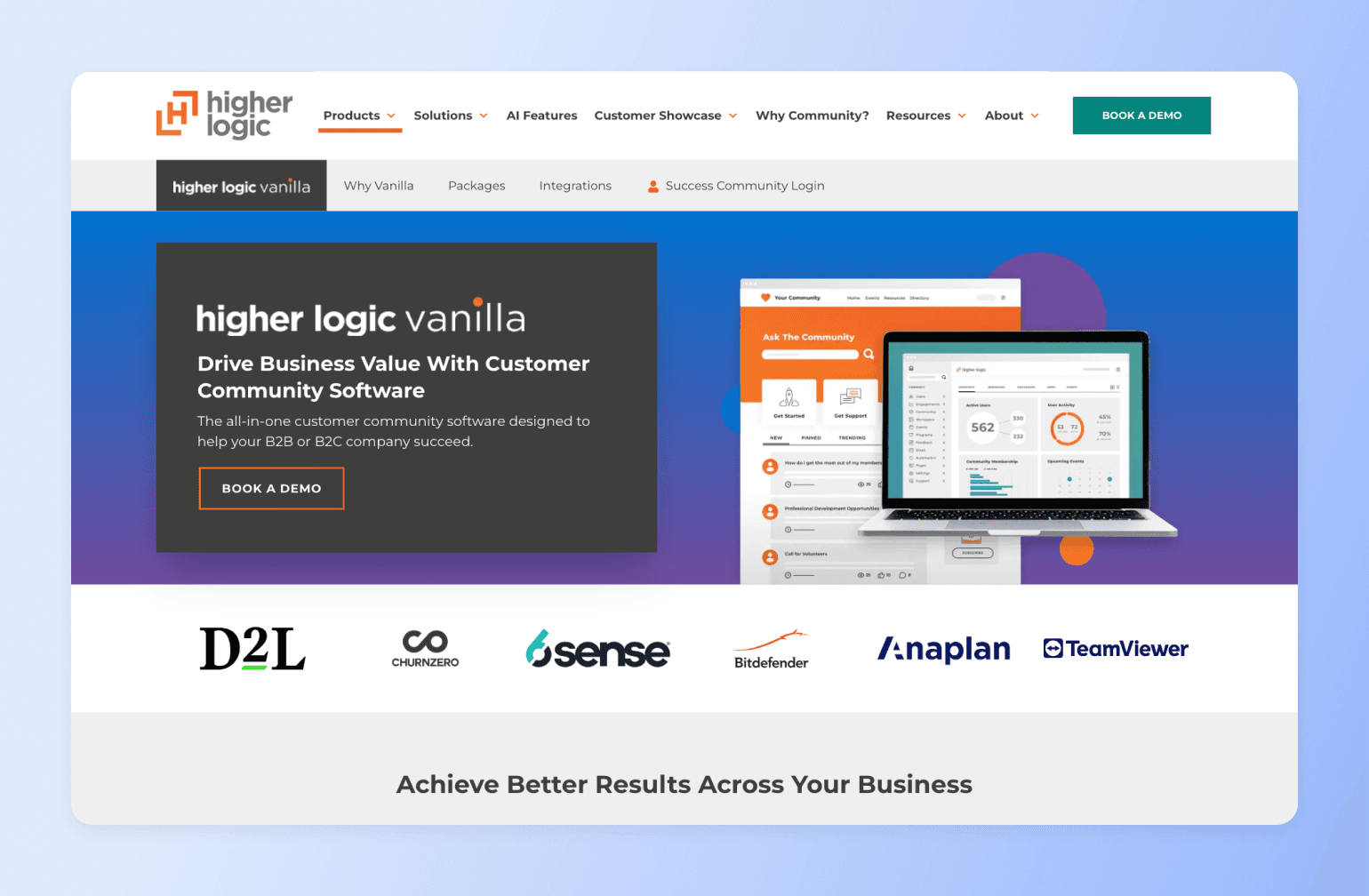
If you're looking for a platform specifically built for customer support and enterprise community use cases, look no further than Higher Logic Vanilla. It offers a similar foundation to Hivebrite with SSO and integrations, but goes deeper into areas like knowledge bases, peer-to-peer support, and federated search.
Key features:
- Q&A forums and discussion threads for peer-to-peer support.
- Knowledge base and self-service support tools.
- Federated search across multiple platforms.
Pricing:
Custom pricing available upon request.
Ideal for:
Enterprise organizations that want to build customer support communities with deep integrations and advanced moderation.
| Pros | Cons |
|---|---|
| Deep integration capabilities with enterprise systems. | The knowledge base can be buggy. |
| Flexible customization with widgets and layout controls. | Less intuitive user experience compared to modern community platforms. |
| Robust analytics and reporting for large teams. |
Users say:
👍🏼 "It is easy for our customers to engage with. Setup is straightforward and supported throughout the process by their team." - Verified review from G2
🤔 "The knowledge base is terribly buggy and has been for years now, with little improvement. It's not their primary focus, and you can tell. The search is also not very friendly and works pretty poorly for our users." - Verified review from G2
4. Bettermode — best Hivebrite alternative for embedded product communities
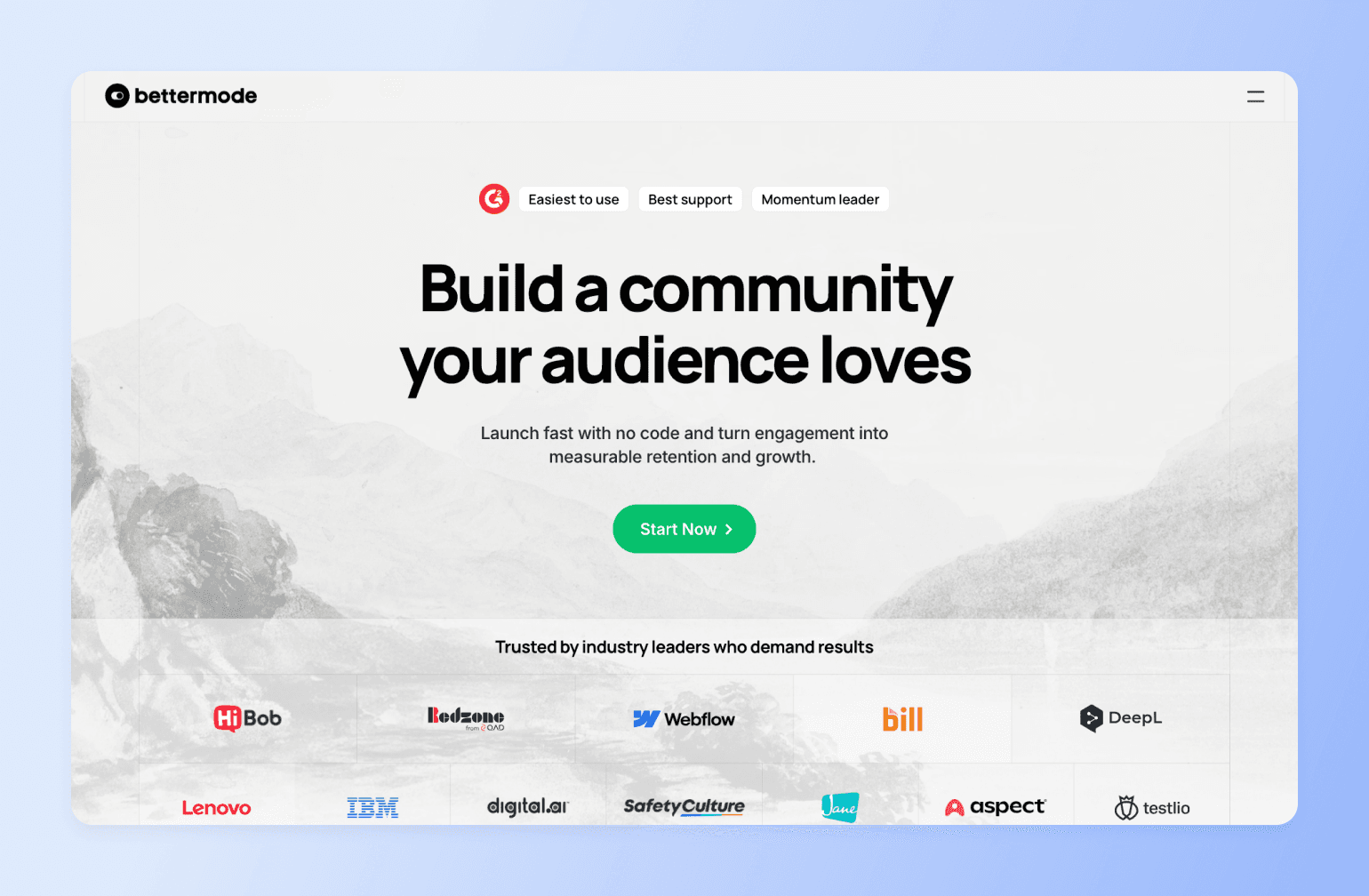
If Hivebrite feels a bit too rigid, Bettermode is what happens when you give a community platform a design team and a developer-friendly mindset. It’s built to be flexible, letting you mix and match features like discussions, knowledge bases, and events into something that actually fits your product or brand. Unlike Hivebrite’s more fixed structure, Bettermode gives you room to build, tweak, and experiment.
Key features:
- Modular community spaces like discussions, Q&A, events, and knowledge bases.
- Built-in engagement tools like reactions, polls, and leaderboards.
- Private messaging and group chat.
Pricing:
Starts at $399/month.
Ideal for:
Companies that want a highly customizable, branded community integrated into their product or customer experience.
| Pros | Cons |
|---|---|
| Highly flexible and customizable platform. | Higher starting price compared to many alternatives. |
| Good balance of engagement features and structure. | The system can be a bit slow at times. |
| Modern user interface compared to traditional enterprise tools. |
Users say:
👍🏼 "It's easy to set up and to maintain, anyone can get started without code. It took a while for me to understand the concept of building CMSs that are then applied to spaces/pages, but after I figured it out, it worked like a charm. Overall, there's minimal time spent on setting up the platform, so you can spend more time on creating content." - Verified review from G2
🤔 "The system is sluggish more frequently than I would like, but the features more than make up for this at the moment." - Verified review from G2
5. Disciple — best Hivebrite alternative for white-label branded apps
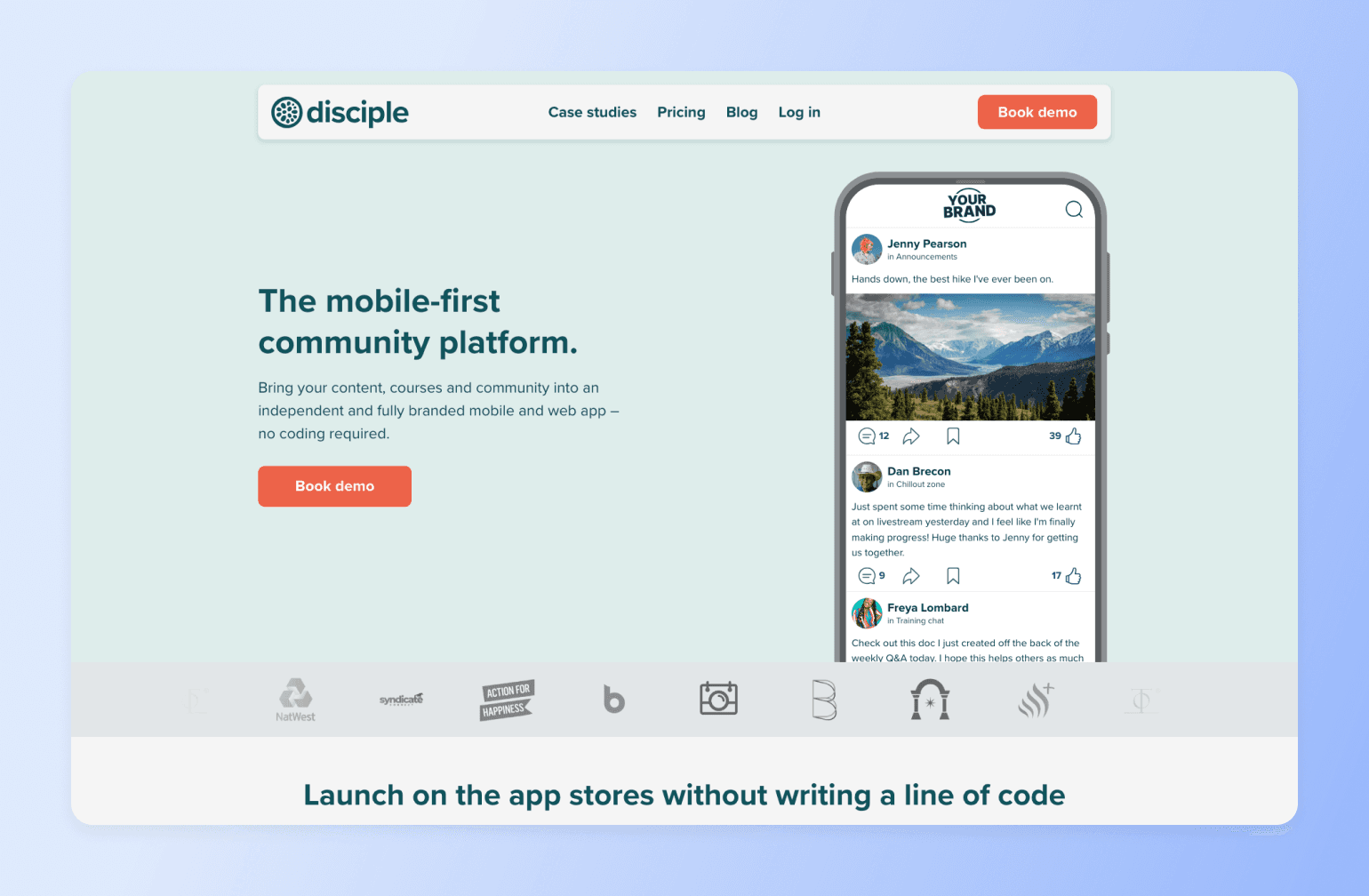
If your goal is to get your community into your members’ pockets, Disciple is built for that. Unlike Hivebrite’s web-first, directory-driven experience, Disciple is mobile-first and centered around branded apps, giving you your own space in the App Store without needing a developer. It’s a strong option for organizations that care about brand and mobile engagement, though it is less focused on structured discussions or complex community workflows.
Key features:
- Fully branded iOS and Android apps.
- Activity feeds, groups, and community discussions.
- Member directory and direct messaging.
Pricing:
Starts at $399/month.
Ideal for:
Organizations that want a fully branded, mobile-first community experience with strong control over their app and member experience.
| Pros | Cons |
|---|---|
| No-code setup for launching apps. | High starting price compared to web-first platforms. |
| Combines community, content, and monetization. | Less structured for discussions compared to forum-style tools. |
| Strong engagement through push notifications. |
Users say:
👍🏼 "One aspect I really appreciate about Disciple is the ease of community management. The platform's intuitive interface and customization options make it simple to create and manage my online community. I also find the engagement features, such as discussions and event organization, to be effective in fostering interaction among community members. Overall, Disciple has helped me build a thriving community and enhance the overall user experience." - Verified review from Capterra
🤔 "It's a little pricey in comparison to other platforms. However, it offers several features that other platforms lack, creating a unique experience." - Verified review from Capterra
6. Tradewing — best Hivebrite alternative for professional associations
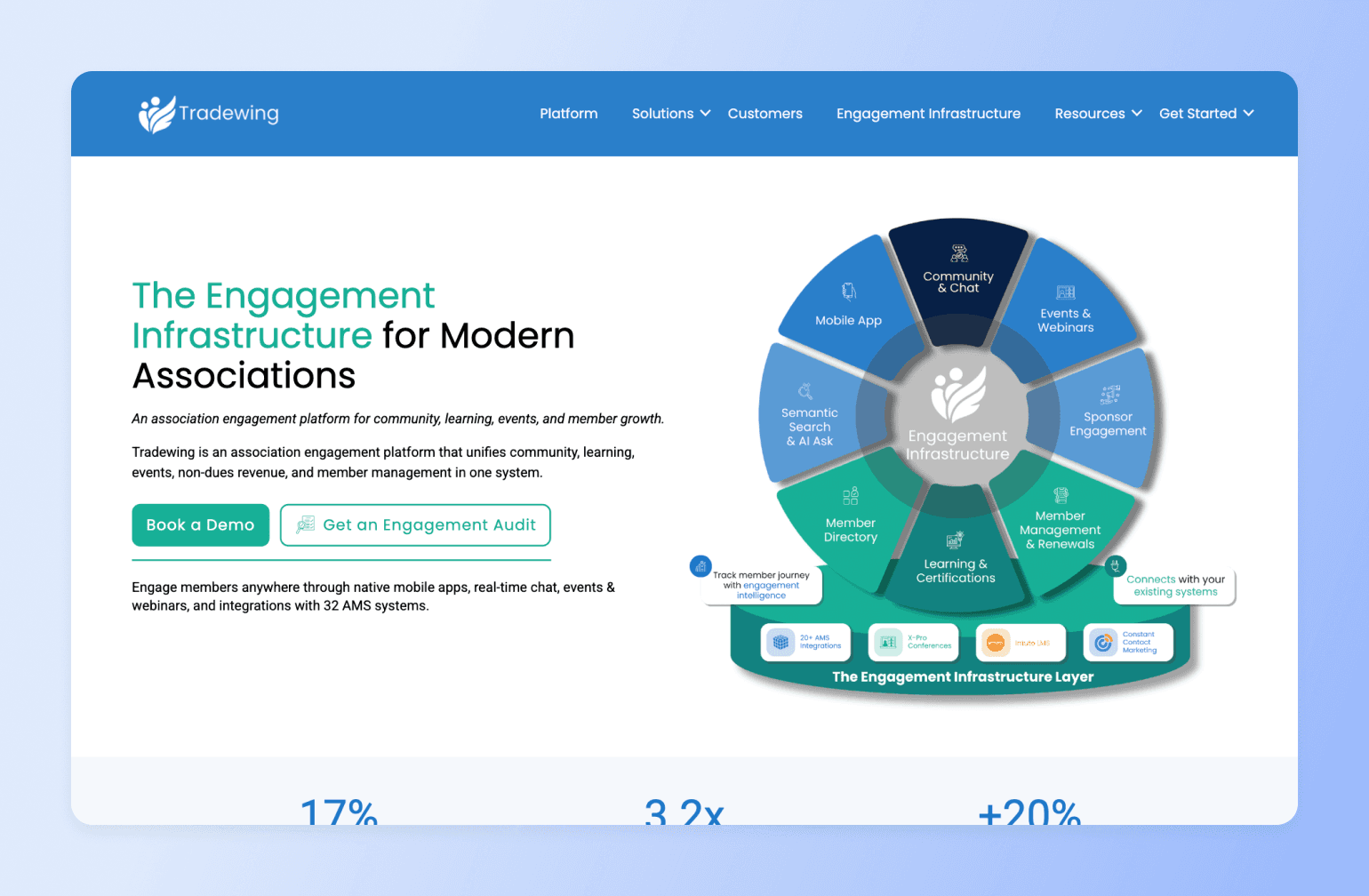
Next up, we have Tradewing. It’s built specifically for trade and professional associations, bringing member management, events, content, and communication into one centralized hub. Similar to Hivebrite, it covers the operational side of running a community, but places more emphasis on engagement through real-time discussions, resource libraries, and integrated event experiences that support member growth and retention.
Key features:
- Virtual, in-person, and hybrid event hosting.
- Resource libraries for content and knowledge sharing.
- Real-time discussions and peer-to-peer interaction.
Pricing:
Custom pricing available upon request.
Ideal for:
Professional associations that want a purpose-built platform for member engagement, events, and retention.
| Pros | Cons |
|---|---|
| Combines content, communication, and engagement in one platform. | Limited flexibility outside of association use cases. |
| Sponsorship and monetization tools. | Less customizable than other tools on the market. |
| Built-in analytics and reporting. |
Users say:
👍🏼 “Tradewing offers our association members a great way to communicate and stay connected outside of our live events. It's also a great way for us to make announcements, as opposed to email.” - Verified review from Capterra
🤔 “The sales experience proceeded well. We had a team vetting the product, which can become overwhelming, but the salesperson was focused and professional. The build, too, went well. Where it went downhill was once the final product was unveiled. While the member backend functioned as promised, the public-facing website "design" was so simplistic that it looked unfinished and unprofessional.” - Verified review from Capterra
7. Slack — best Hivebrite alternative for lightweight professional networking
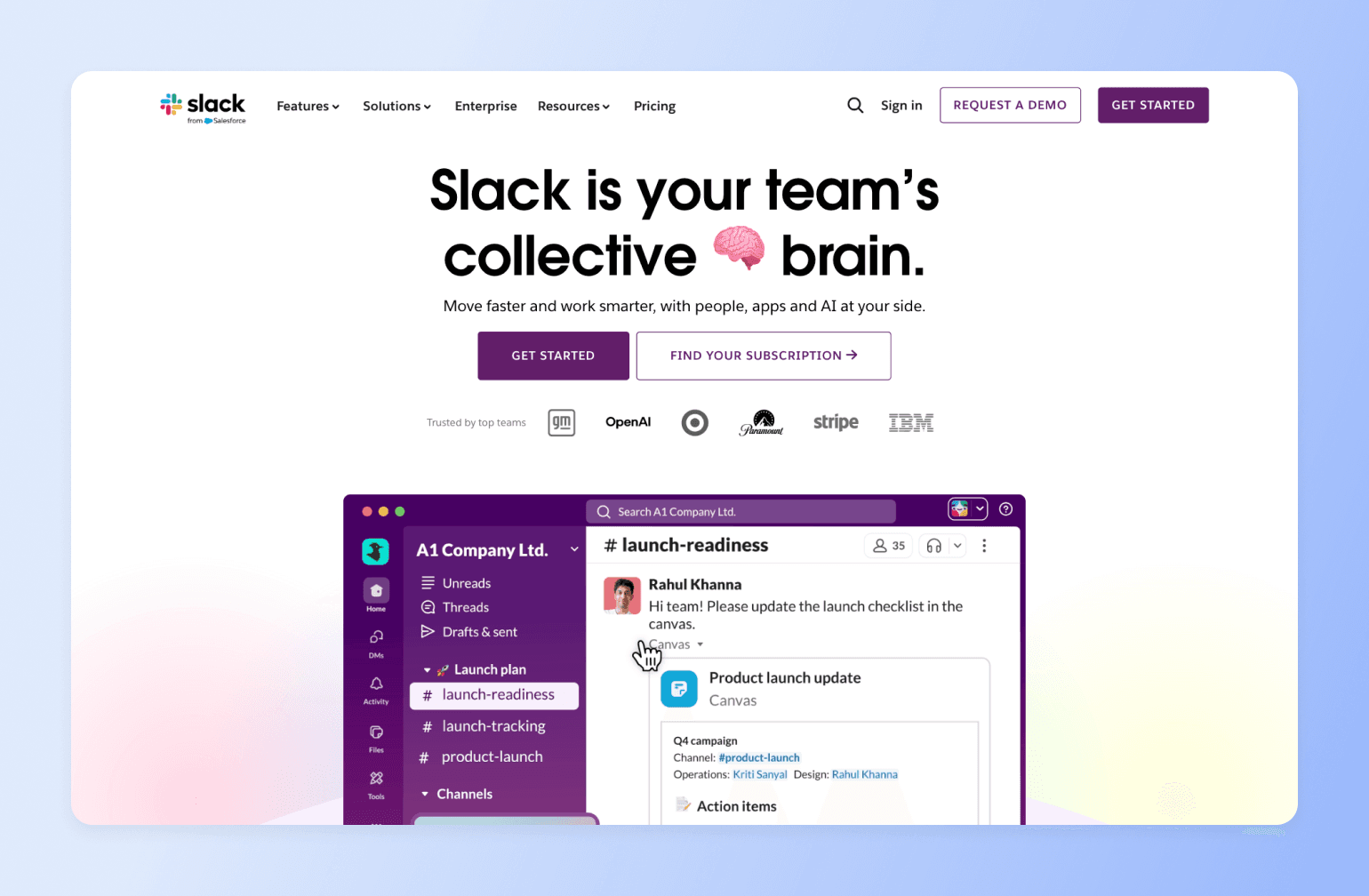
You probably know Slack as a real-time business communication app. However, it can double as a lightweight community platform for quick conversations and informal networking. Compared to Hivebrite, it’s much easier to get started with, but lacks the structure needed to support long-term engagement or larger member organizations.
Key features:
- Channels for topic-based conversations.
- Threaded replies to organize discussions.
- File sharing and searchable message history.
Pricing:
A free basic plan available. Entry-level paid plan costs $7.25 per user per month when billed annually.
Ideal for:
Teams and small communities that want a simple, real-time communication tool without complex setup.
| Pros | Cons |
|---|---|
| Extremely easy to set up and use. | Not really a community platform. |
| Large ecosystem of integrations. | Weak member management and segmentation capabilities. |
| Voice and video huddles. | Messages are deleted after 90 days on the free plan, which can lead to loss of valuable community knowledge. |
Users say:
👍🏼 “It is an easy tool to use for business requirements as well as for tech communities for event announcements or to host some challenges for the users.” - Verified review from G2
🤔 “While the reviewer notes that the 90 days of history provide "plenty of runway for a community to thrive" and help new members catch up on recent conversations, this limitation means that any message or file shared just over three months ago becomes inaccessible and unsearchable unless the user upgrades to a paid plan.” - Verified review from G2
Which Hivebrite alternative is right for you?
So which platform should you actually choose? Different tools are built for different outcomes, so you need to focus on what matters most for your community.
- Want an engagement-first platform that drives participation and retention? → Circle
- Looking for a social-style community with strong mobile engagement? → Mighty Networks
- Need enterprise-level structure or association-focused tools? → Higher Logic (Vanilla)/Tradewing
- Want flexibility and customization for a product or branded experience? → Bettermode/Disciple
- Just need something simple for communication? → Slack
The bottom line
What matters most is not where members sign up, but where they stay active. Many Hivebrite communities see members drop off after that first visit. And that’s the engagement problem!
Luckily, there are solid alternatives on this list depending on what you need. But if you’re looking for a modern, engagement-first platform that’s easier to run, more flexible, and built for how communities operate today, Circle is the one to consider.
👉 Start your free 14-day trial of Circle.
FAQs
What is similar to Hivebrite but more engaging?
Platforms like Circle and Mighty Networks offer similar core functionality to Hivebrite, but are designed to actively drive participation rather than just organize members.
Circle, in particular, focuses on engagement through structured spaces, discussions, direct messages, and group chats that make it easy for members to interact. It also includes native events and live streaming, built-in courses, and gamification features like points, badges, and leaderboards that give members reasons to return. On top of that, AI-powered agents, automated workflows, and personalized notifications help keep the community active without adding manual work.
How much does Hivebrite cost?
Hivebrite does not publicly list its pricing. Most organizations need to contact sales for a custom quote. Based on available estimates, pricing typically ranges from $5,000 to $15,000+ per year, depending on community size and features. This enterprise pricing model is one of the main reasons organizations explore Hivebrite alternatives, especially if they want more flexibility or transparency.
Can Circle replace Hivebrite for an alumni network?
Yes, Circle can replace Hivebrite for many alumni networks, especially those focused on engagement and connection. While Hivebrite offers strong directory and CRM features, Circle provides a more interactive experience with discussions, events, and content all in one place. Many alumni communities find that this leads to higher participation and stronger relationships over time. If your priority is networking, learning, and ongoing engagement, Circle is often a better fit.
Does Circle support SSO and enterprise security?
Yes, Circle supports SSO and enterprise-grade security, with more advanced capabilities available on higher-tier plans.
Custom single sign-on (SSO) is available on the Circle Plus plan, along with features like advanced analytics, dedicated infrastructure, and priority support. Circle also supports integrations with common identity providers and tools such as Auth0, Memberstack, and others across plans.
In addition, Circle is SOC 2 certified and compliant with GDPR, CCPA, and PCI standards. Combined with role-based permissions and secure payments, it provides the level of security and scalability most organizations need.
How do I migrate from Hivebrite?
Migrating from Hivebrite typically involves exporting your member data, content, and payments, then importing them into your new platform. At Circle, we offer Concierge Migrationsupport, meaning our team helps handle key parts of the process for you, including memberships, subscriptions, courses, and email lists. It costs you nothing, and you get to switch faster and get your community up and running with minimal disruption.
Is Circle better for associations than Hivebrite?
It depends on what your association prioritizes. Hivebrite is a strong fit for associations that need deep member management features like directories, job boards, and fundraising tools. Circle, on the other hand, is better suited for associations that want to drive engagement through discussions, events, and ongoing participation.
If your goal is to create a more active, connected community rather than just manage members, go for Circle.

Head of Performance Marketing
Marcus is the Head of Performance Marketing at Circle—and Circle's main demand gen nerd.