9 profitable online course ideas for 2026
TL;DR
- The course topics that pay in 2026 all promise one thing: a tangible result the student can point to.
- Picking a hot topic is the easy part. What you sell it as, a video pack or a cohort, is what decides whether you make only $99 or $99 a month.
- A community doesn't just improve completion rates — it turns the course into something people renew for, which is where the real revenue is.
You've spent a decade getting genuinely good at your work — whether that's small business acquisition strategies, the science behind speaking on stage, or money mindset for creators. Your colleagues come to you for help, your manager routes the hard problems your way, and the new hires get told to go ask you. And in the last year, you've watched at least two people from your industry leave to teach what they know online. You've started sketching out your own course ideas between meetings, wondering which topic is actually worth building a business around, and whether you can replace your salary with a little bit of freedom that you own.
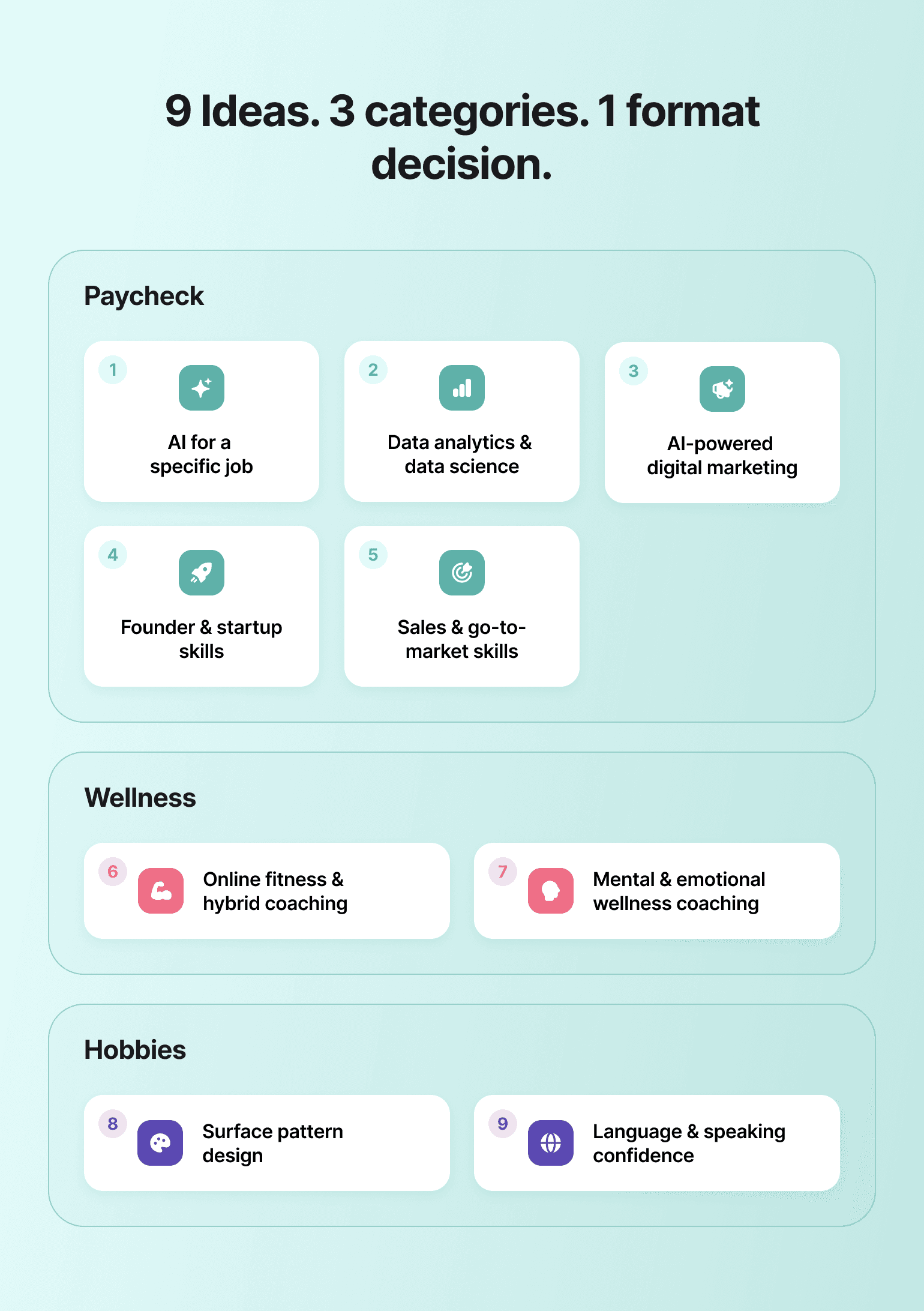
The topics below are the ones that sell in 2026, grouped by the transformation people are paying for: a bigger paycheck, a healthier life, or a new hobby. But the topic is only half the answer. Sell the same expertise as a one-off video pack and it earns $99 once; wrap it in a cohort or community and it earns $99 a month. That's why each idea below comes with the format that makes it pay.
| # | Course idea | Best for | Recommended format |
|---|---|---|---|
| 1 | AI for a specific job | Professionals in a saturated "AI for X" niche who need to differentiate | Self-paced prompt/template library, wrapped in a membership |
| 2 | Data analytics and data science | People breaking into or upskilling in data roles | 4–8 week cohort built around real deliverables |
| 3 | AI-powered digital marketing | Marketers who want a repeatable AI workflow, not more prompts | Membership: template vault + monthly teardown calls |
| 4 | Founder and startup skills | First-time founders fixing one specific mistake | Fixed-window cohort sprint (4 weeks–90 days) |
| 5 | Sales and go-to-market skills | Founders/reps closing a specific stage of the pipeline | Cohort with live deal/call reviews |
| 6 | Online fitness and hybrid coaching | Personal trainers moving past 1:1 hours-for-dollars | Hybrid: short course + community + weekly live call |
| 7 | Mental and emotional wellness coaching | Life/wellness coaches building recurring support | Tiered membership |
| 8 | Surface pattern design | Working artists building a licensing business | Community + course, portfolio reviews |
| 9 | Language and speaking confidence | Language tutors/creators with an existing audience | Course + community (conversation clubs) |
Skills that grow a paycheck or a client list
These are the courses people buy because they can point at a number: a raise, a promotion, a first client, a closed deal. The payoff is money and the buyer can see the return before they enroll, so price resistance mostly disappears when your curriculum gets close to that outcome. Some of these skills help someone earn more in the job they already have; others help them win customers for a business of their own.
1. AI for a specific job
AI and big data rank as the fastest-growing skill cluster in the World Economic Forum's Future of Jobs Report 2025, which makes it the most crowded course topic of the year. "AI for marketers" and "AI for real estate agents" are already saturated, sold by dozens of people and sliding toward free.
Niching by audience isn't enough anymore. You have to niche by the specific job they're trying to get done. Not "AI for real estate agents" but "the listing-description system that gets your homes seen," the exact prompts, the MLS-compliant templates, the before-and-after that closes faster. Not "AI for photographers" but "cut your culling time in half by Friday." When the promise is a specific outcome your student can feel in their week, you're no longer the cheapest "AI for X" course they're weighing. The comparison shifts from your price to the hours you give them back.
Keep the course and modules themselves short. Build it around one workflow your students run live: the prompt set, the templates, and a weekly thread where they post the output they made for a real client or project. They're not studying AI in the abstract. They're shipping the thing their job needs by Friday.
Sell it as a self-paced prompt-and-template library wrapped in a membership, not a one-off download. The tools shift every few weeks, so the reason to keep paying is that you keep it current.
2. Data analytics and data science
Demand here is real and rising: the Bureau of Labor Statistics projects data scientist roles to grow 34% by 2034, more than ten times the 3% growth expected across all jobs. What makes data different from most topics is that the work produces something you can hold up. So build the whole course around the deliverable.
They don't have time for a 40-hour video library; they need a focused 4-to-8-week cohort built around three or four real artifacts: a dashboard they ship, a report they automate, a query library they reuse. Run office hours in your community so they can bring real work problems to the group. The finished dashboard is the proof of value, and that proof is what keeps them in the community once the cohort wraps.
3. AI-powered digital marketing
Marketers don't need more prompts. They have access to every AI tool already; what they're missing is a system that ties the tools together into something repeatable. So sell the system, not the prompts. Instead of "10 prompts for marketers," teach the full content repurposing workflow that turns one podcast episode into eight LinkedIn posts, four reels, and a newsletter.
The part students pay to keep isn't the lessons. It's the ongoing operating system around them:
- A template vault: the actual prompts, content briefs, and repurposing chains they copy and run, updated as the tools change.
- A monthly teardown call where members drop in their real content calendar and you fix what's not landing.
- A swipe channel where members post the best AI-assisted posts they've seen that week, so the whole group's reference library compounds.
- A "what's working now" thread, because the tools shift every quarter and last month's winning workflow quietly stops performing.
The course gets them started. The system and communal learning is what they renew for.
Exit Five shows how far this goes. Dave Gerhardt, a former B2B CMO, started a community for marketers who wanted something better than scattered LinkedIn advice, then moved it to Circle in 2022 and built a branded app, annual pricing tiers, and subgroups for specialties like Marketing Ops. It now serves 6,000+ members with 43% year-over-year revenue growth, proof that teaching marketers, done as a real community, is a business in its own right.
4. Founder and startup skills
Roughly half of new businesses are gone within five years, according to the Bureau of Labor Statistics, and most don't fail because the founder lacked talent. They fail because they spent it on the wrong problems. First-time founders overbuild before they have customers, hire too early, price too low out of fear, and burn six months on a website when they should be sending cold emails. A course that fixes one of those mistakes pays for itself many times over.
So name the exact problem you fix, not "how to start a business," which is a Google search. The programs that sell promise one specific result in a fixed window:
- First Customer 30 — a four-week sprint to land a pre-launch founder's first 10 paying customers, with daily outreach targets and a shared tracker.
- Pricing for service businesses — a one-month program where each member raises their rates on a live client by the end, with you reviewing the conversation.
- The 90-day product launch — templates, swipe copy, and a Friday call where members report the week's numbers to the group.
Each one names a result and a deadline, which is what lets you charge for it. Founder topics work because the audience is already paying for help, often badly: they've burned $5K on a course that sat in a Google Drive, or hired a coach who gave generic advice. Show up with a cohort that has real check-ins, real assignments, and people in the exact same boat, and a premium price gets easy. "Helped me find my first 10 customers" is worth $2,000. "Helped me understand startup theory" is worth $99 and a refund request.
5. Sales and go-to-market skills
Sales courses can hold a $3,000 price because a single extra deal closed makes the cost trivial. What separates a $3,000 sales course from a $99 one is whether you fix a named stage of the pipeline. A few angles that are working right now:
- Cold outbound for founders who hate selling. Templates, sequences, a real-time chat space where members post their best replies of the week.
- Discovery calls that close. Teardown sessions where members upload call recordings and the cohort breaks them down together.
- Pricing and negotiation for service businesses. A four-week sprint where everyone goes into a real negotiation that month and reports back.
What makes any of these stick is a cohort-based format where members bring real deals to the group. The lesson is the warmup; the deal review is the product. High-ticket buyers pay to be in a room with someone who'll watch them sell and tell them what to fix.

More topics like this, monthly.
Wellness courses that improve people's lives
Wellness is a $6.8 trillion economy that surpasses global sports, tourism, and IT, with mental wellness the fastest-growing segment from 2019 to 2024 at 12.4% annual growth. Big numbers, but the only one that matters for your business is whether the person who paid you in January is still showing up in June.
That's the whole challenge in this category. Nobody finishes a wellness program alone on the couch, so the results your students are paying for depend on whether they keep showing up. A community gives them a reason to, which is why wrapping a course in one tends to hold members longer than selling the same material as a standalone video pack.
6. Online fitness and hybrid coaching
If you're a personal trainer trading hours for dollars, the move is to stop selling 60-minute sessions and start selling a 12-week program members run on their own time. Here's why the math works.
One-to-one, twelve clients at $150 an hour earns you $1,800 a week, and that's the ceiling: more income means more hours, and you're out of hours. A program is different because the value isn't your live time, it's the plan, the community, and the weekly check-ins. Price it at $100 a month, less than a single session, so it's an easy yes. A hundred members is $10,000 a month, and supporting a hundred takes barely more of your week than supporting twenty. Every member you add after that is almost pure upside.
Here's what the best hybrid programs actually look like, beat by beat:
- A short structured course (4 to 6 weeks) that teaches the system: how to warm up, how to progress weights, how to eat for the goal.
- A community space where members post weekly check-ins. Photos, lifts, what they ate, what went sideways.
- One live group call a week where you give feedback on form videos members upload ahead of time.
- A "stuck this week?" thread you run on Mondays. People who would have ghosted post instead.
7. Mental and emotional wellness coaching
Emotional fitness is the angle that's working right now. The Global Wellness Summit's 2026 trends report points to a shift toward nervous-system regulation and emotional resilience as a mainstream focus, which is exactly the territory a course can own. Less "fix what's broken," more "build the habits that keep you steady." Think nervous system regulation, boundary-setting practice, daily journaling prompts, weekly group reflections, where someone can post "I had the hard conversation with my mom and here's how it went" and get real responses from people doing the same work.
In life coaching, subscriptions already command 45% of revenue and are growing at 10.9% a year. Your clients want a place to keep showing up, not a one-time program that ends. A few things that make this model click:
- Tiered access (a $29/month tier with course access and community, a $149/month tier with monthly group coaching, a $497/month tier with 1:1) so members can move up as they get more committed.
- A daily prompt or check-in space, because emotional work is daily.
- Privacy that feels real. Vulnerable conversations don't happen in public Facebook groups.
If members are meant to show up every day, the community has to live where they already are: on their phones. Circle's branded app builder is how communities like Fifty410, a telehealth GLP-1 clinic, run patient care: 40,000+ members, 80%+ of engagement happening on mobile, and a branded app that members open the way they open Instagram. If you're building anything wellness-related, that's the bar.
Unique hobbies and skills worth learning
Creative learners need two things that solo video courses can't give them: feedback on their actual work and a reason to believe a real business is possible. The community is where both of those happen.
8. Surface pattern design and the creative-to-business path
The reason a technique course on a marketplace sells for the price of a dinner while a "turn your art into a licensing business" program runs into four figures is that the second one promises an income path. Students aren't buying technique; they're buying the bridge from hobby to business. That's the gap your course fills: portfolio reviews, pitch letter templates, real conversations with members who've landed their first licensing deal, a community where someone posts "I just got my first $500 royalty check" and twenty people lose their minds.
Bonnie Christine's story is the one to study. In 2012 she and her husband were living at the poverty line, and she wanted predictable income instead of living launch-to-launch. So she set up a PayPal recurring link and wrote a blog post about it. 200 members joined opening weekend, creating $1,000/month in recurring revenue for the first time in her business, enough to buy groceries the night the payments hit. That recurring layer became the backbone for a surface pattern design business that has graduated more than 15,000 designers since.
The point isn't the PayPal link. It's that recurring access to her community was worth more than any one-time download. Students wanted to keep growing alongside people doing the same work, and she built a structure that let them pay for that instead of paying once and leaving.
9. Language and speaking confidence
Language courses fail in a predictable way: students watch the lessons, never speak out loud, then quit because they don't feel like they're getting better. The fix isn't more grammar videos. It's a place to talk.
That's why language is one of the cleanest community-first plays in this list. The course teaches vocab, structure, and confidence frameworks. The community is where members actually open their mouths:
- Weekly conversation clubs grouped by level, so beginners aren't intimidated and advanced speakers aren't bored.
- Voice-note threads where someone posts a one-minute clip and three classmates reply with their own.
- Partner matching for accountability calls between sessions.
- Themed events that give people a reason to show up: movie nights, cooking, debates.
None of this works as a video library. It only works when there are other people on the other end.
Anna Tyrie's English Like A Native is doing exactly this. She has 1.1 million YouTube subscribers and wanted a way to add courses without becoming a one-to-one tutor for every student. On Circle she runs a Conversation Club and dedicated Spaces by language level, with a video library that serves members across every time zone. The English Like A Native community has now hosted more than 650 events with 1,000+ members and 2,700+ posts, all without 1:1 effort on every student.
Match the format to the topic
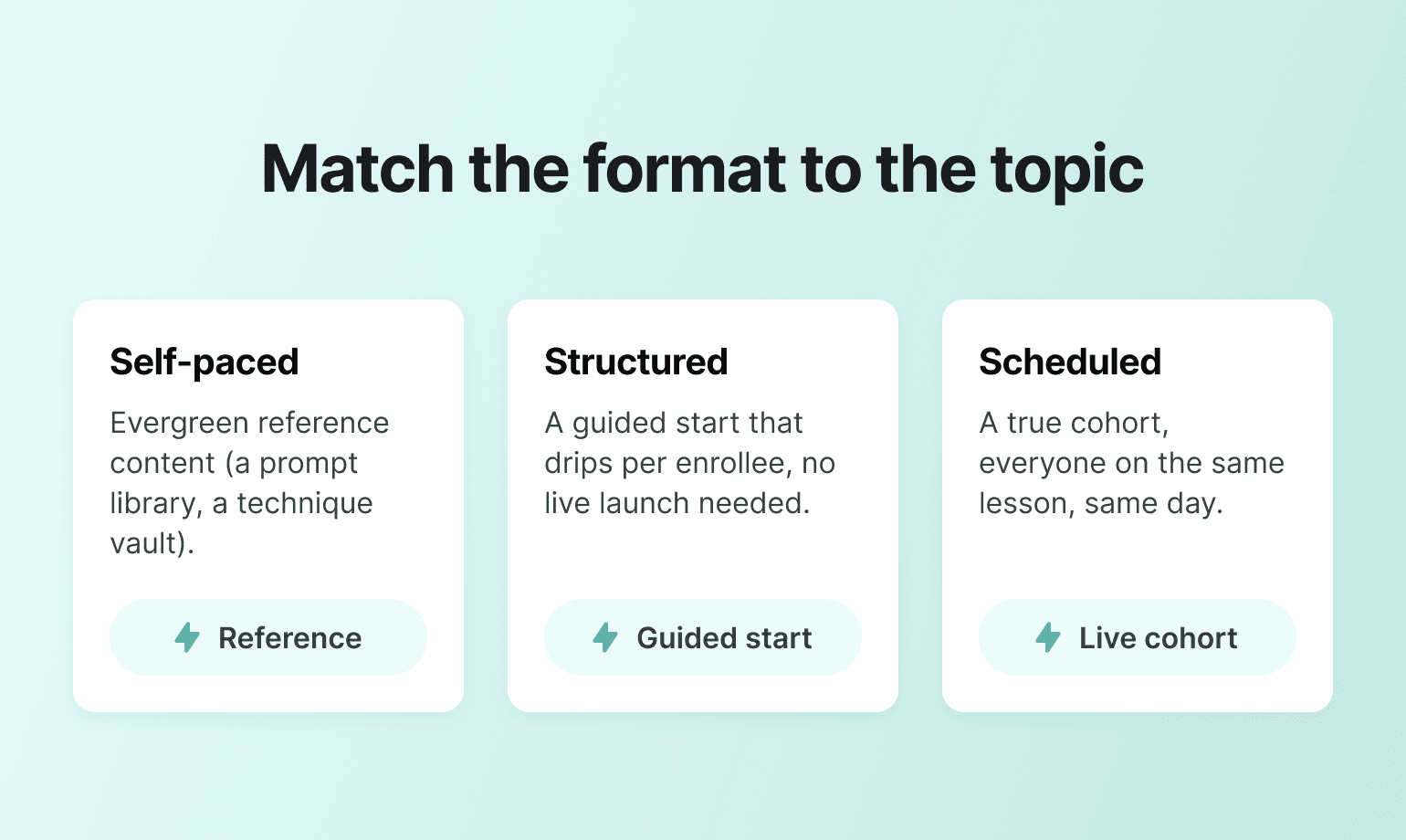
The format you build a topic in decides what you can charge for it. On Circle that's a choice between three course types, each suited to a different kind of topic:
| Format | Best for | Example from this piece |
|---|---|---|
| Self-paced | Evergreen reference content people return to | The AI-for-a-job prompt/template vault |
| Structured | A guided start that drips per enrollee, no live launch needed | Founder sprint programs (First Customer 30, 90-day launch) |
| Scheduled | A true cohort — everyone on the same lesson, same day, live discussion | The data analytics 4–8 week cohort, sales deal-review cohorts |
If you want to create an online course people actually finish, the type you pick is part of the design, not a settings page you skip past.
How to turn a topic into recurring revenue
Most of the work of running a course business isn't teaching, and it isn't even choosing the delivery model. It's the duct tape: a course tool, a chat tool, Zoom, Stripe, Zapier holding it together, and a spreadsheet you keep meaning to update. When every member sits in five tools that don't talk to each other, you can't see who's slipping until they've already gone. Put everything in one place and you can. You spot the member who hasn't logged in for ten days, send a DM about the lesson they got stuck on, and pull them back before they cancel.
Circle's Courses are built for exactly this. Lessons and discussion sit side by side. Progress data sits next to payment status. The conversation about Module 3 happens right under Module 3. That's how completion rates climb, and how one-time buyers become members who renew.
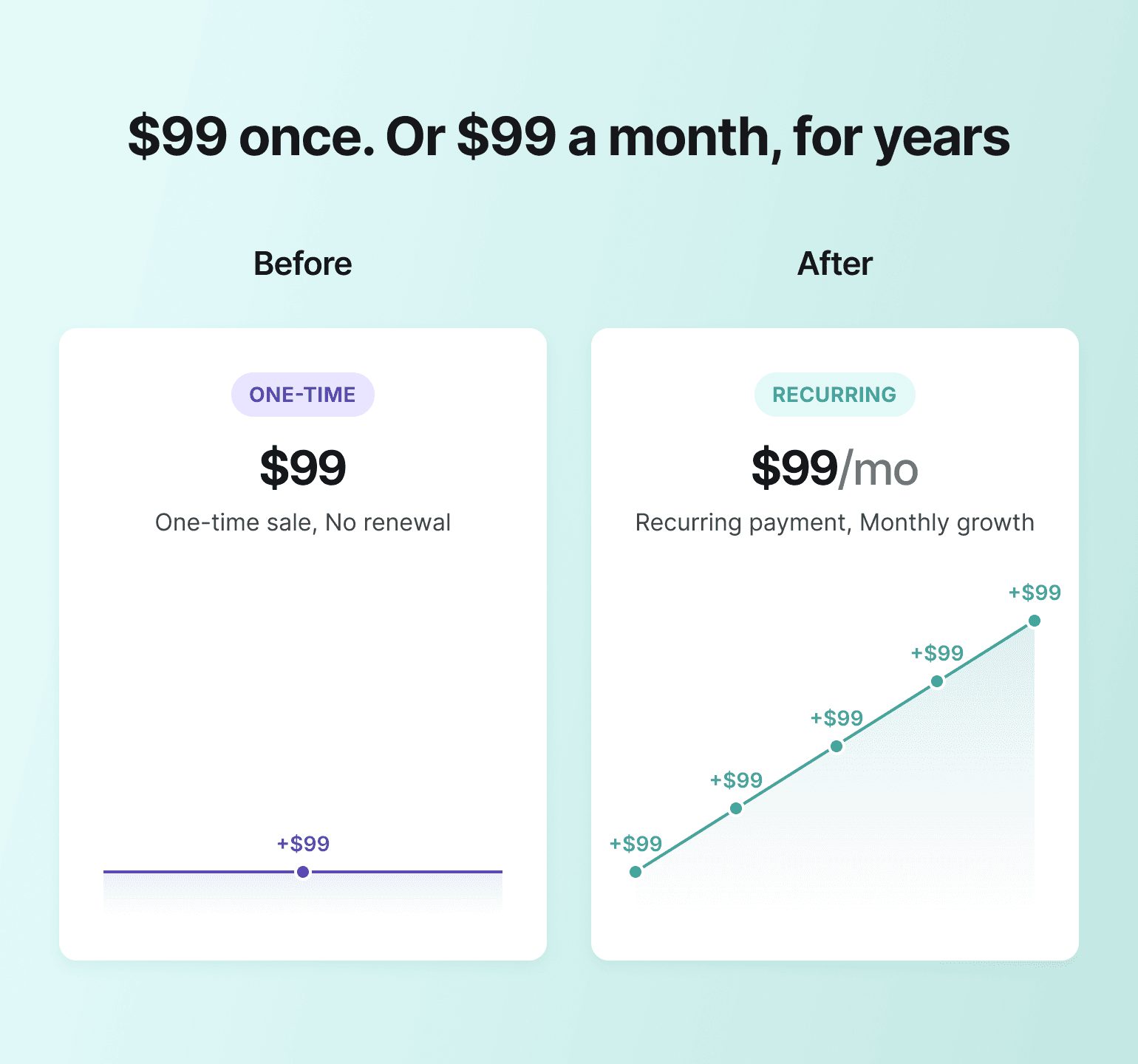
The nine ideas here are profitable because demand is real and members can point at the result. But a course on its own is a thing people buy and forget. A course inside a community is a thing they keep showing up for, which is what turns one-time buyers into members who renew. That's the whole game: the community is what makes the course finish, and the course is what gives the community a reason to exist.
$99 once. Or every month.
Profitable online course ideas FAQ
What is the most profitable type of online course in 2026?
Courses with a community or coaching layer, because more members finish, more renew, and they refer friends. A $497 course you sell once will lose to a $49/month community offering the same material in under a year, and the gap widens after that.
Do cohort-based courses really complete better than self-paced ones?
By a significant margin. A cohort gives people a deadline, classmates who notice if they go quiet, and live calls they paid to attend — all the things a video library asks them to supply on their own.
How much should I charge for a community-backed course?
Price reflects the transformation, not the hours of video. A self-paced course sits at $99 to $299, the same material delivered as a cohort with weekly calls usually lands at $500 to $1,500, and ongoing access with group coaching runs $97 to $497 a month. Our guide to pricing a course walks through the logic. The more access you include, the more you can charge.
Can I make recurring revenue from a course?
That's where the real business is. Sell the course once, then offer ongoing access to a community, monthly group calls, or a "graduates' lounge" for alumni. Members keep paying for the room and the relationships, not the original lessons.
Community Content Marketer
Arina is Circle’s community content marketer, sharing insights on community growth, GTM strategy, and storytelling for solopreneurs.