How to structure an online course people finish
TL;DR
- Start from one result a learner can show you, and cut anything that doesn't move them toward it.
- Match access rules, release timing, and discussion placement to your delivery model.
- Design week one before you polish module six.
You launched the course your audience kept asking for, and the first week delivered. Members introduced themselves in the discussion space, lesson one racked up views, the welcome thread had a pulse. By week three, it's gone quiet—the assignment queue sits empty, discussion has flatlined, and the members still around are DMing you asking where they're supposed to go next.
That drop-off almost always traces back to structure, not content, and it's far cheaper to fix on the outline than after launch. Ashley Gore, who used to be the Community Experience Manager at Smart Passive Income (SPI), puts it plainly: only 5 to 15% of people who start a paid online course finish it, and her latest cohort, which ran asynchronously, reached 37%. Course structure decides what belongs in the course, what order it follows, and which parts need a deadline, a discussion, or live practice. Build backward from one observable final project and adapt it to your delivery model, and more learners finish than when you arrange the same material topic-first and ship it in one shape for every format.
Community tip: If you're starting from scratch and haven't nailed down the topic yet, work through the course creation process first.
What's changed about online learning (and why structure matters more than it used to)
The version of the online course that dominated in 2018—40 hours of talking-head video, a private Facebook group tacked on the side, an evergreen sales page—doesn't hold learners the way it used to. A few shifts stacked on top of each other:
- Learners have ChatGPT open in the next tab. They can get a decent explanation of any concept in ten seconds. What they can't get is your judgment calls, your redlines on their actual work, and a group of peers stuck on the same problem.
- Attention is mobile and short. A course opened on a phone during a commute won't tolerate a 45-minute monologue. It will tolerate a six-minute lesson with one clear action.
- Cohorts came back. After the self-paced boom hit its completion ceiling, creators started shipping cohort-based programs because a shared start date and live feedback actually get people over the line.
- Buyers ask for proof, not hours. "27 modules, 60+ videos, 12 workbooks" doesn't land anymore. "Here's what a graduate can do at the end" does.
- Community is the retention layer. The course is the reason a member joins; the community is the reason they stay past month three.
- AI has flooded every niche with content. Proof of lived experience, not more content, is what buyers actually pay for now.
- Courses are graded like software, not textbooks. Buyers expect versioning and updates as the field moves, not a static one-time purchase.
None of this makes structure optional—it makes structure the main lever you have left. Content used to be enough of a differentiator on its own; now everyone can generate competent content, so structure is what decides whether a course actually works. A course that survives this environment is one where every module has a job, learners always know what to do next, and the discussion happens next to the lesson instead of in some other tool.
What a course people actually finish looks like
Every course that reliably graduates learners has the same underlying architecture, regardless of topic, price, or format. Six decisions do the heavy lifting—miss one and learners quietly drop off exactly where you skipped:
1. Design backward from the final proof
It's tempting to start a course draft with the topic and hope structure emerges as you go. Backward design flips that order: name the result first, decide what would prove a learner reached it, then plan the lessons. Every module you're tempted to include now faces one test—does it move a learner toward the proof, or does it just sit near the topic?
Write one observable course outcome
"Client communication" is a topic. Conducting a difficult client conversation and leaving with a documented agreement is a result.
Write the result as one sentence a learner (and you) can check, using this pattern: "By course end, learners will be able to [measurable verb] [specific skill or deliverable] under [real working condition]." For a course called Confident Client Communication for Independent Consultants, that reads: "By course end, learners will be able to conduct a difficult client conversation about scope creep or missed deadlines that preserves the relationship and produces a documented agreement."
The verb decides whether the outcome can be tested. "Conduct," "ship," and "send" describe something you can watch someone do and judge for yourself. "Understand," "know," and "appreciate" don't, because there's no way to see whether someone understands client psychology or appreciates good design. If your draft outcome uses a vaguer verb, swap in something observable: conduct, produce, analyze, evaluate. Here's how that plays out across different types of courses:
| Niche | Testable outcome |
|---|---|
| Coaching | Learners run a 45-minute discovery call that ends with a signed proposal or a clean no. |
| Fitness and wellness | Learners design and complete a 4-week strength program built around their own equipment and schedule. |
| Marketing and creator education | Learners write, schedule, and send a 5-email nurture sequence that opens with a hook their audience responds to. |
| Consulting and B2B services | Learners deliver a client discovery workshop and walk out with a one-page scope both sides have signed off on. |
| Design and creative skills | Learners take a brand brief and ship a logo, color system, and one-page style guide a client can approve. |
| Software and technical training | Learners build and deploy a working three-page app using the stack the course covers. |
| Nonprofit and community leadership | Learners plan a 90-day member engagement calendar and run the first month of it. |
Design the final proof before the lessons
Once the outcome is testable, design the artifact that proves it. For the consultant course, that's a recorded 10-minute role-play with a peer, submitted alongside a written summary of the agreement. You grade it on four checks: they named the issue, proposed a workable solution, confirmed the agreement out loud, and kept a professional tone. That checklist is your rubric—the specific criteria you'll score every submission against, and the thing the rest of the course structure gets built around.
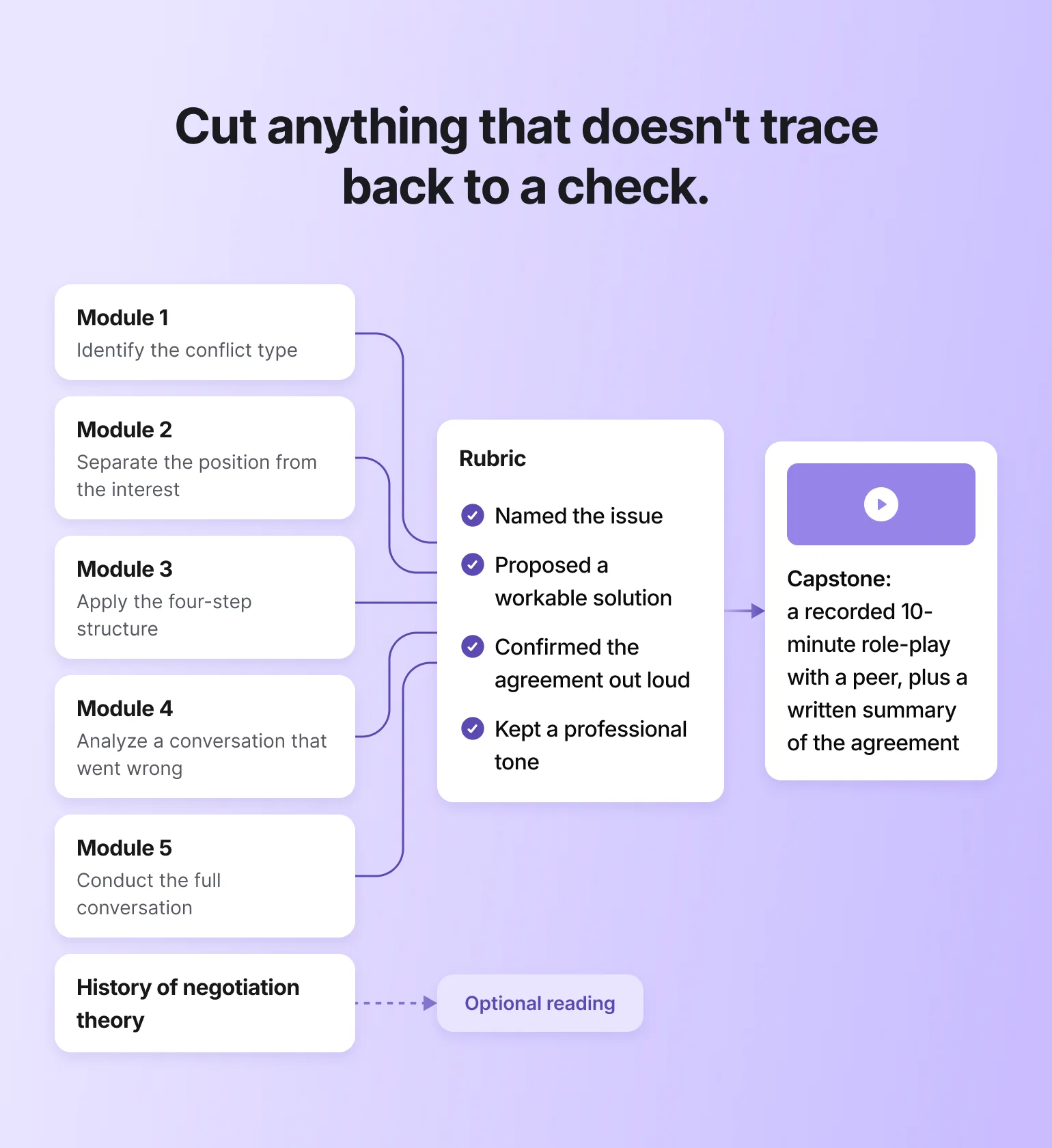
Write that brief before you draft a single lesson, because it becomes your cutting tool. A module on the history of negotiation theory might be fascinating—unless a learner uses it inside that 10-minute recording, it improves none of the four checks, so it moves to optional reading or out of the course entirely.
This isn't improvised. Grant Wiggins and Jay McTighe, the education researchers behind the backward-design framework widely taught in K-12 and higher-ed curriculum design, formalized the same three-stage sequence: "Plan with the end in mind by first clarifying the learning you seek—the learning results (Stage 1). Then, think about the assessment evidence needed to show that students have achieved that desired learning (Stage 2). Finally, plan the means to the end—the teaching and learning activities and resources to help them achieve the goals (Stage 3)." With the role-play and its rubric on the page, you know exactly what capabilities a learner needs to walk in with.
Turn past grading into a written rubric
If you've taught a version of this course before, AI can help turn your own grading instincts into that rubric. Gather a handful of submissions you've marked up in the past—the student's original attempt, and the corrected version you sent back—and feed both to AI. Ask it to compare them and describe what separated the passing attempts from the failing ones. That gives you a first draft of your rubric, built from patterns you were already grading by without ever writing them down. Edit it before you use it: AI's version is a starting point, not the final checklist.
2. Figure out your modules
This step answers one question: what modules does the course need? The goal is a dependency map, an ordered list of modules where each one teaches exactly one capability the learner needs in order to pass your rubric.
Build it by working backward from the rubric. For each check you're grading against, ask what someone would need to be able to do first in order to clear that check. Each answer becomes a module. If something doesn't trace back to one of the checks, even if it's a subject you know a lot about, it doesn't belong in the course. Move it to a resource library, or cut it. Here's how that plays out for the consulting course:
Dependency Map for Consulting Course
- Module 1: Identify the conflict type. Scope creep, a missed deadline, and a late invoice each open differently, so naming the wrong one sends the whole conversation off track.
- Module 2: Separate the position from the interest. A client asking for a discount may really be protecting a budget. Learners solve for the interest, not the ask.
- Module 3: Apply the four-step structure. Name the issue, surface the interest, propose a solution, confirm the agreement, practiced first on a sample email.
- Module 4: Analyze a conversation that went wrong. Learners review a transcript and find the moment the tone turned defensive.
- Module 5: Conduct the full conversation. A 10-minute role-play, scored against the same checks practiced in Modules 1 through 4.
Transcripts of coaching calls, workshops, and client sessions are the highest-value input for this step. Feed AI a batch of them and have it pull out recurring questions and the moments a session unlocked something for someone. Those patterns are candidate modules, not just the topics you happen to know well.
Circle AI can do the same sorting on a program that already exists. Laura Guilmain's 120-day program hadn't been recorded since 2023, so she had Circle AI use her program data to separate core content from bonuses and deep dives, then remap 34 worksheets plus audios, meditations, and activations to the emotional moments they served. It's the same cut the rubric makes. "All of it reads and feels like me. Nothing got flattened."
Decide what actually needs to be locked
Notice the climb from Module 1 to Module 5: identify, explain, apply, analyze, evaluate. That's the Revised Bloom's Taxonomy at work, Anderson and Krathwohl's well-established framework for ordering how people build up a skill — from just recognizing something to being able to judge and create with it. You don't need to know the theory to use it. Just check that each module asks for a harder kind of thinking than the one before it.
Lock a module into the sequence only when a learner genuinely can't do it without the one before. Test every transition with one question: could someone complete this module without the one before it? A reference lesson on contract templates passes that test, so leave it unlocked and let learners grab it whenever they need it. And get the hierarchy right before you touch sequencing: modules hold lessons, not the other way around.
3. Give every module the same working rhythm
A dependency map tells you which module comes next. A working rhythm tells learners what to do once they're inside one. Every module should contain the same six parts, in the same order:
- A goal
- A short core lesson
- An applied task
- A specific discussion prompt
- A knowledge check
- A link to the next module
Because every module follows that same shape, a learner never has to relearn how the course works. They already know where the discussion lives and what's expected of them, so their attention goes toward the actual work instead of the format.
Community tip: Put the discussion prompt as the last line of the applied-task lesson, and collect responses in the connected discussion Space. Ask for one specific detail rather than "Any questions?" so a stalled learner has something small to post.
The rhythm is also the easiest part of an existing course to standardize with AI. Xhico of Studio Xhico used Circle AI to bring consistent lesson descriptions and structure to a Brand Foundations course that was already live. "I was able to update an entire existing course in a way that would have been a pretty tedious project to tackle lesson by lesson on my own." Treat any AI output here as a draft to edit, not a lesson to ship as-is.
What still varies is how and when learners move through that rhythm, and that's a delivery-model choice.
4. Choose the right delivery model
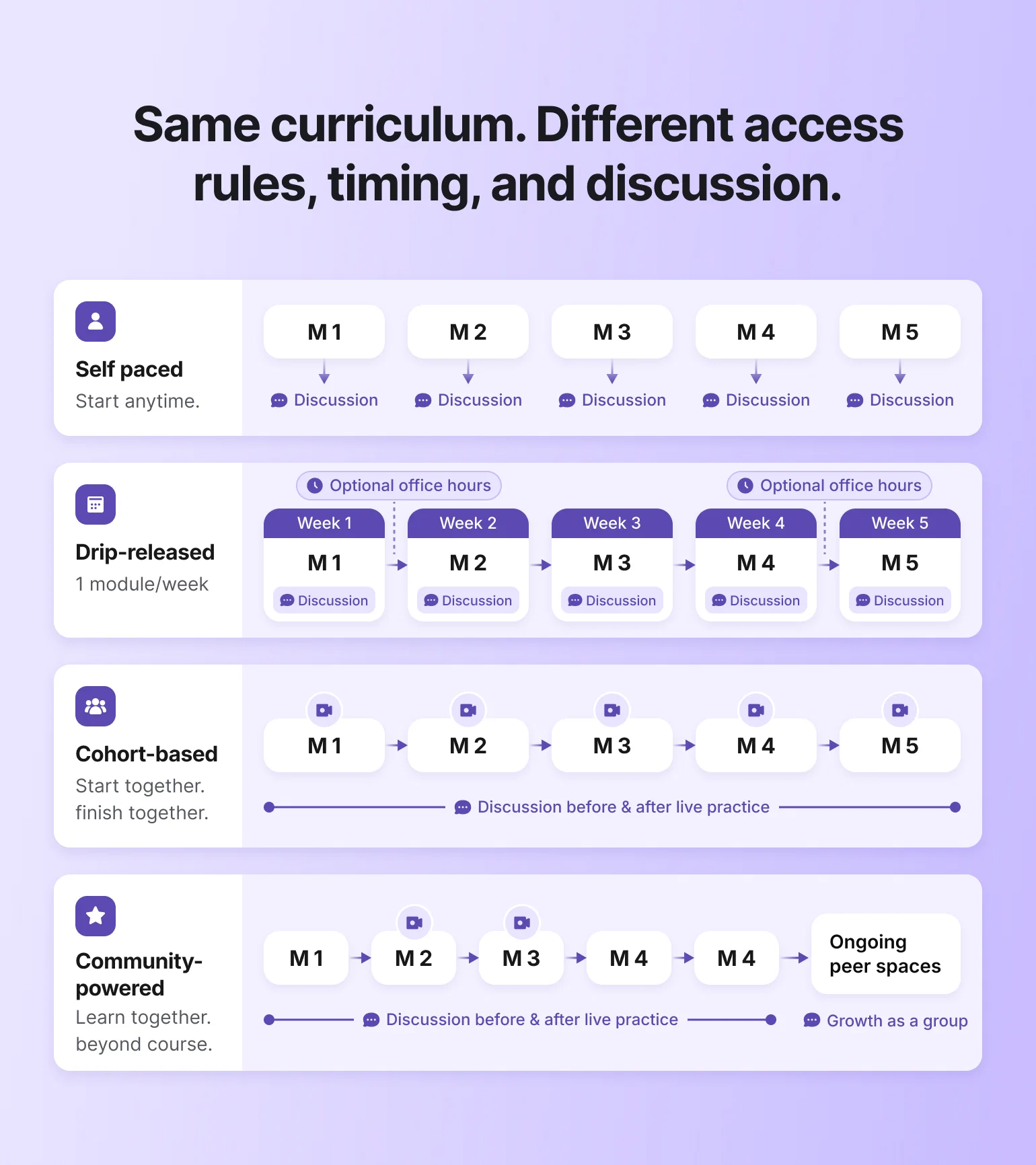
The delivery model decides when learners complete your course and whether there's a live human in the room. Four models are worth knowing: solo (self-paced and drip) and social (cohort and community-powered).
| Model | Access rule | Live cadence | Discussion placement | Best fit |
|---|---|---|---|---|
| Self-paced | Every module opens at enrollment; reference lessons stay open | None required | Beneath each applied task | Independent learners and reference use |
| Drip-released | One module released per week; references open from day one | Optional office hours | With each released task | Skills that need practice attempts between lessons |
| Cohort-based | Shared start and end dates | One focused session a week | Before and after live practice | Feedback-heavy skills |
| Community-powered | Course plus ongoing peer Spaces after the cohort ends | Events as needed | Attached to specific work | Programs where peers give feedback on application |
If you're leaning toward the cohort row, this guide to cohort-based courses covers how to design and launch one in full.
5. Design the first week before polishing later modules
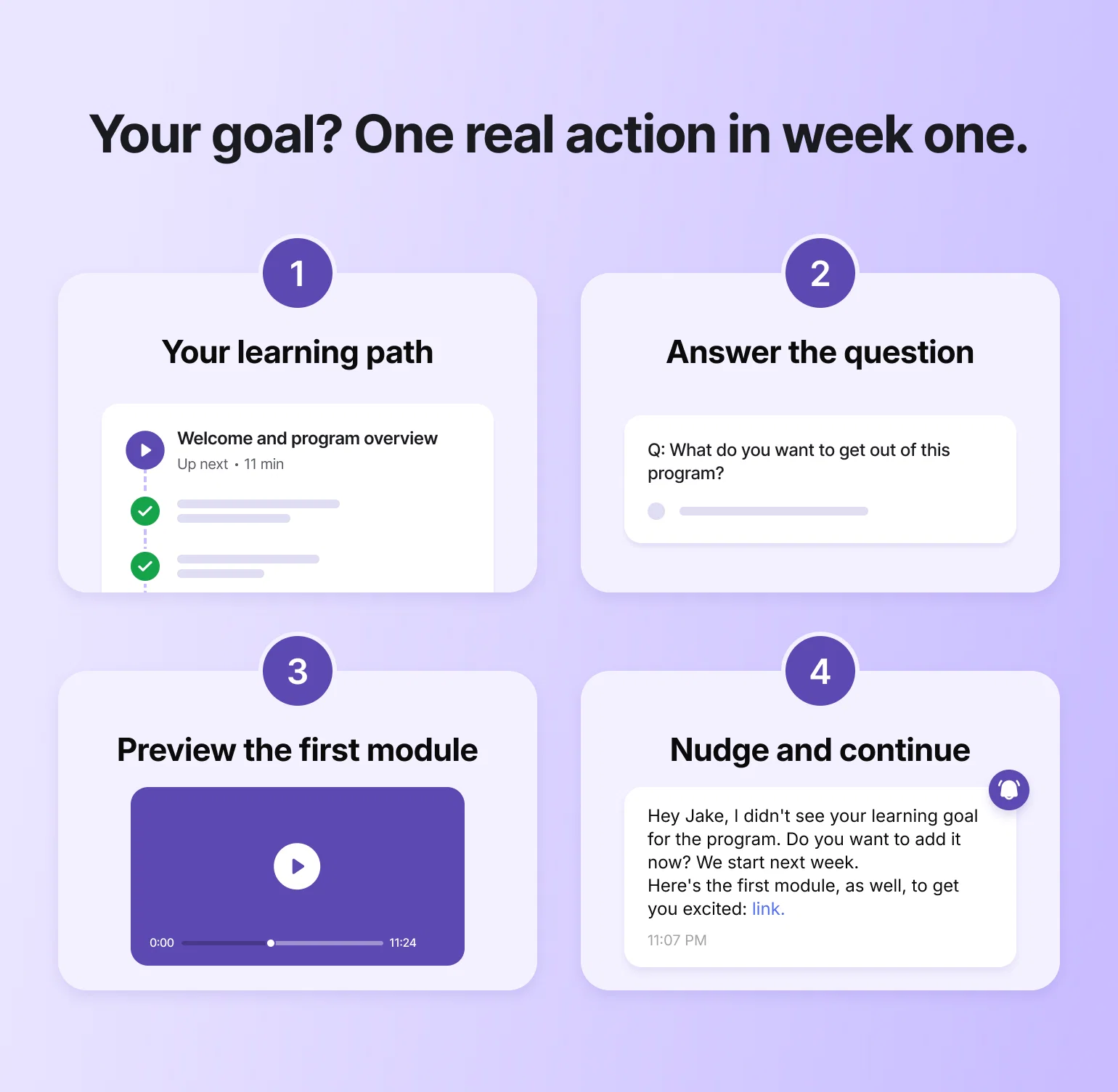
Week one decides who reaches Module 4. If a learner doesn't take a real action in the first few days, the odds they reach the capstone drop off a cliff—so treat Week 1 engagement as an explicit design goal. The path has four parts:
- A welcome page that states the final capstone and shows the module path.
- One prompt, answered in under 15 minutes: what real issue will you bring to this course, and what outcome do you want from it?
- A visible next step: open the first module and see how that issue fits.
- A short follow-up a few days later, sent only to whoever hasn't answered the prompt yet, linking straight to it
The issue a learner picks in that first action isn't throwaway. It carries through every later module and becomes their capstone material. Add one more intervention, and only one: a midpoint reflection partway through the course that reviews progress toward the goal, names the biggest obstacle, and asks the learner to choose one adjustment.
How big is the gap you're designing against? Vojtěch Kašpárek asked Circle AI to analyze his member data, numbers only and no advice, and found that 86% of his roughly 205 members had never posted or commented. Dana Malstaff of BossMom went after the same problem with a bingo-style onboarding card: 12 actions to complete in the first two weeks, with points feeding her existing leaderboard.
The wider welcome sequence around all of this is community onboarding. If the course lives inside a larger membership, that sequence wraps around the course path rather than replacing it.
Your DMs and support inbox are a shortcut for building this path. The questions members ask you over and over, sorted by how often they come up, are your onboarding lessons and your Start Here FAQ waiting to be written. Feed AI the thread and have it group the recurring questions for you.
Community tip: On Business and above plans, you can use Circle community workflows to send the follow-up as a 1:1 DM when member progress hits the trigger you set. It reads as you because you wrote it; you just set the recipients and timing.
All of that only holds up if the environment holds it together, which is the next call.
6. Build the outline in Circle without splitting the experience
A course works best if the discussions live right next to it. The moment a learner has to log into a second tool to post a reply, they stop posting.
Here's the build: create a course space and add five modules, each with a core lesson, an applied-task lesson, and a quiz. Quizzes handle the multiple-choice knowledge checks; anything else, like a role-play recording, comes back to you directly for review. Then pick your access model: Self-paced opens everything at enrollment, Structured releases modules on a fixed schedule (say, every 7 days), and Scheduled runs a cohort on set calendar dates.
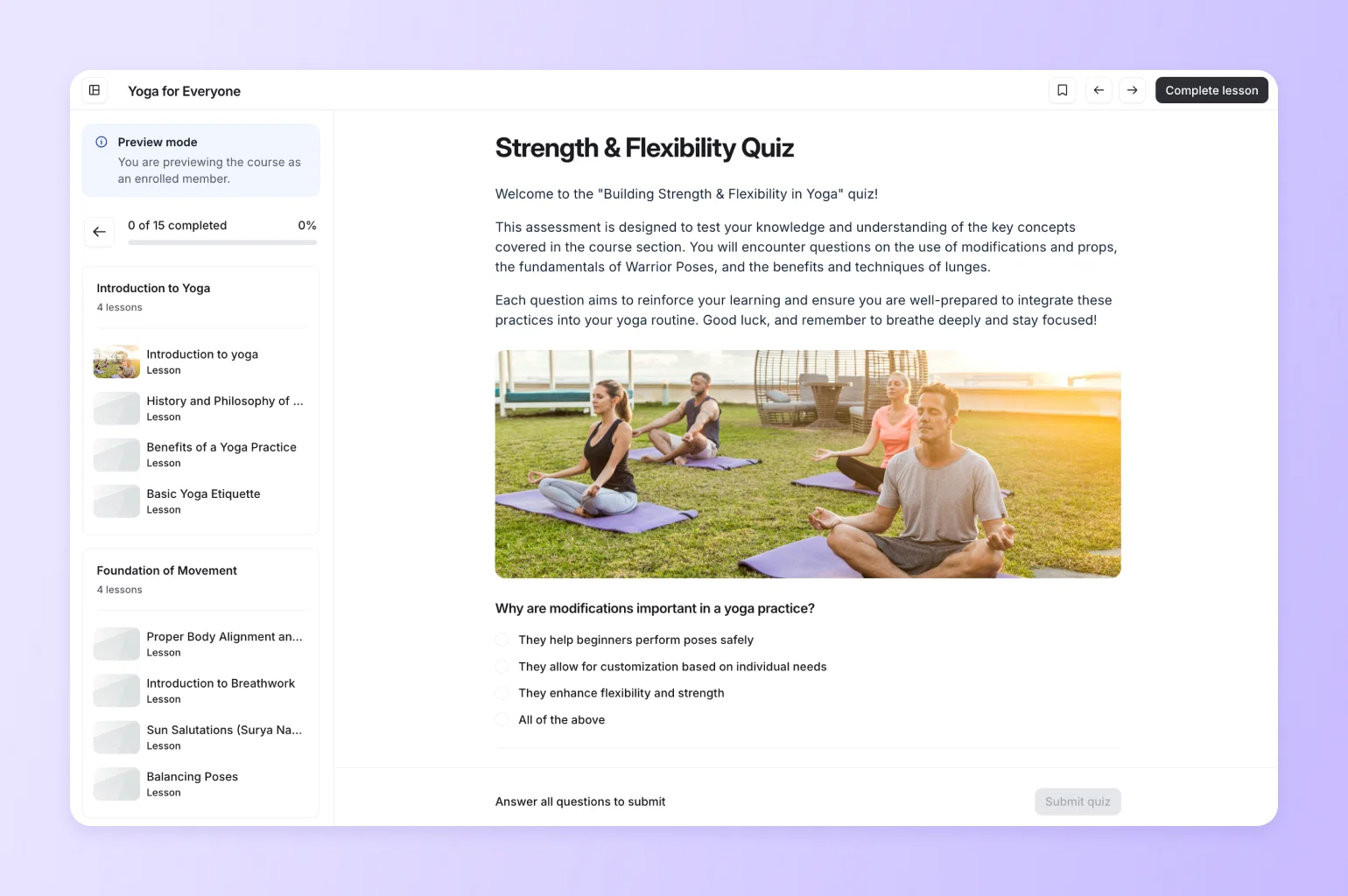
Drip schedules and quizzes are table stakes, since most platforms have them. What decides whether this works is simpler: does the course share a login with its discussions, or not? One login means a learner never leaves to do the work. Two logins means you're reconciling progress across systems while learners try to remember which tool holds which part of the program.
If you already have the outline, you don't have to click it together by hand. Philip Putnam and Holly of The Cooking Family pasted their outline into Circle AI as one long prompt and ended up with a 36-lesson, 9-module homeschool course: modules unlocking on set Sundays, quizzes, badges, a paywall with three payment plans, coupons, and access rules. "Getting it set up inside Circle was the part I kept putting off."
Start smaller: one course and one discussion Space. Add the weekly event when the cohort needs live practice, and the community paywall when you're ready to charge.

Build the whole thing in one place.
How the structure flexes by niche
The framework above holds across fields, but the shape it takes doesn't. If you're still choosing a field, start with these profitable online course ideas. Here's how it shifts across the most common niches, starting with three Circle customers.
| Niche | How the structure shifts |
|---|---|
| Parenting and family education | Sensitive-topic, high-trust content, where a lesson has to feel like a private conversation, not a broadcast. The Good Inside membership runs large workshops alongside intimate coach-led sessions, so members get both the scale content and a room that feels safe enough for vulnerable questions. Structured or self-paced works for the core lessons; live sessions are where you reserve what nobody wants to ask in a group feed. |
| Real estate and sales training | Roleplay is the entire capstone, because a scripted pitch falls apart the moment a real client goes off-script. Most real estate training teaches the same handful of scripts under different branding, so Agent on Tube Academy sidesteps that by leaning on community proof: client wins are visible inside the community before a prospect ever books a call. |
| Craft and hobby education | Physical materials mean solving logistics before teaching anything, since a learner missing the right yarn or loom can't follow along. Weaving Space runs five-to-six-week cohorts with detailed pre-course prep, so students arrive with the right materials and equipment sorted instead of losing the first two weeks to logistics. |
| Coaching (business, life, executive) | Fewer, denser modules, often three or four. Discussion happens in small pods rather than a group feed, and cohort or community-powered formats almost always beat self-paced. Capstone: a live call the learner records with a real client, reviewed against a rubric by you or a peer coach. |
| Fitness, wellness, and health | Cyclical rather than linear: a 4- or 8-week program a learner can run again with heavier weights or a new goal. Modules become weeks, lessons become sessions, and discussion lives in a habit-tracking Space. Capstone: a check-in video paired with data such as before/after lifts, run times, sleep, or macros. |
| B2B, consulting, and agency training | Deliverable-first: every module ships a template (discovery doc, scope, pricing model, proposal) the learner fills in against their own client. Live cadence is optional, but a monthly critique session lifts completion. Capstone: the stack of filled-in templates for one real engagement. |
| Design and creative craft | Portfolio-driven: modules end in artifacts (moodboard, first draft, revised draft, shipped piece). Peer critique is load-bearing, and cohorts work because critique needs synchronous eyes. Capstone: one piece a learner would put in a portfolio. |
| Software and technical training | Lab-based: each lesson pairs a short concept video with a working environment the learner ships code into. A passing build matters more than any knowledge check, and the discussion Space doubles as a debugging channel. Capstone: a deployed project. |
| Nonprofit and community leadership | Longer arcs, three to six months, because the work being learned is the work being done. Cohorts of practitioners from similar-sized organizations beat isolated self-paced. Capstone: a live plan they've already started executing. |
| Language and skill acquisition | Repetition-heavy, spaced practice: short daily lessons and weekly live conversation practice instead of one-and-done modules. Capstone: a real interaction, such as a 10-minute conversation or a written piece a native speaker reviews. |
The pattern underneath all of these: the more feedback the skill needs, the more your structure has to make room for a human—yours, a peer's, or both. A skill you can grade against a rubric handles self-paced. A skill that needs someone to say "try it this way" needs a cohort or a community.
A strong course structure leaves the important work to you
Zoom out on every decision in this article and there's one throughline: each one hands the operational load to Circle or the drafting load to AI. That frees your time for the work only you can do, which is your point of view, the stories buyers are actually paying for, and the judgment calls no rubric can make.
That's also why the raw material you feed AI matters. Hand it your actual discovery-call transcripts, your redlined submissions, and your real DM threads, not a cleaned-up summary of them. A summary strips out exactly the detail that made the story worth telling. If you don't have that material yet, start recording it now. Six months from now, it's what a whole module gets built from.
Augment Business School learned the cost of a split experience the hard way. Two years of running courses on one platform and community on another quietly undercut a premium brand pitched as the alternative to a traditional MBA. Consolidating both onto Circle in early 2025 doubled its student base from 3,000 to 6,000 in four months, at a 61% monthly active rate.
The course is ready to open when every module maps to at least one rubric check, and your capstone module requires all of them. If either isn't true yet, fix that before you ship. Once both are true, plan the launch around participation, not just sales. The launch-to-movement playbook shows how Jessi Jean ran a launch that kept buyers posting instead of just purchasing.
Every module needs a job.
Online course structure FAQ
How long should each video lesson be?
Long enough to finish an idea, short enough that a learner doesn't tap away. A study of 6.9 million video sessions across MIT and edX courses found median engagement peaked at around six minutes, but those were free learners, not paying members, so treat it as a directional data point rather than a rule. The better cut is behavioral: split a lesson wherever the learner's task, decision, or idea changes. When a focused demonstration only makes sense watched end to end, keep the ten or twelve minutes intact.
Community Content Marketer
Arina is Circle’s community content marketer, sharing insights on community growth, GTM strategy, and storytelling for solopreneurs.