How to build a paid media strategy your membership can afford
TL;DR
- A low cost per lead can hide a high cost per member. The real test is what each person still subscribed after three months actually cost you.
- Before launching, work out what a member is worth to you and cap what you'll pay to win one at about a third of that.
- Prove the offer sells to your own audience, try a single channel, and grow the budget only while you stay under that cap.
Hoon Lee teaches Korean through Everyday Korean, a paid membership that made $1.1 million last year. His growth runs through one funnel: paid Instagram and Facebook ads send people to a free live workshop, where he teaches a Korean speaking lesson and then invites attendees to join. In a single year, that funnel took his revenue from $165,000 to $743,000.
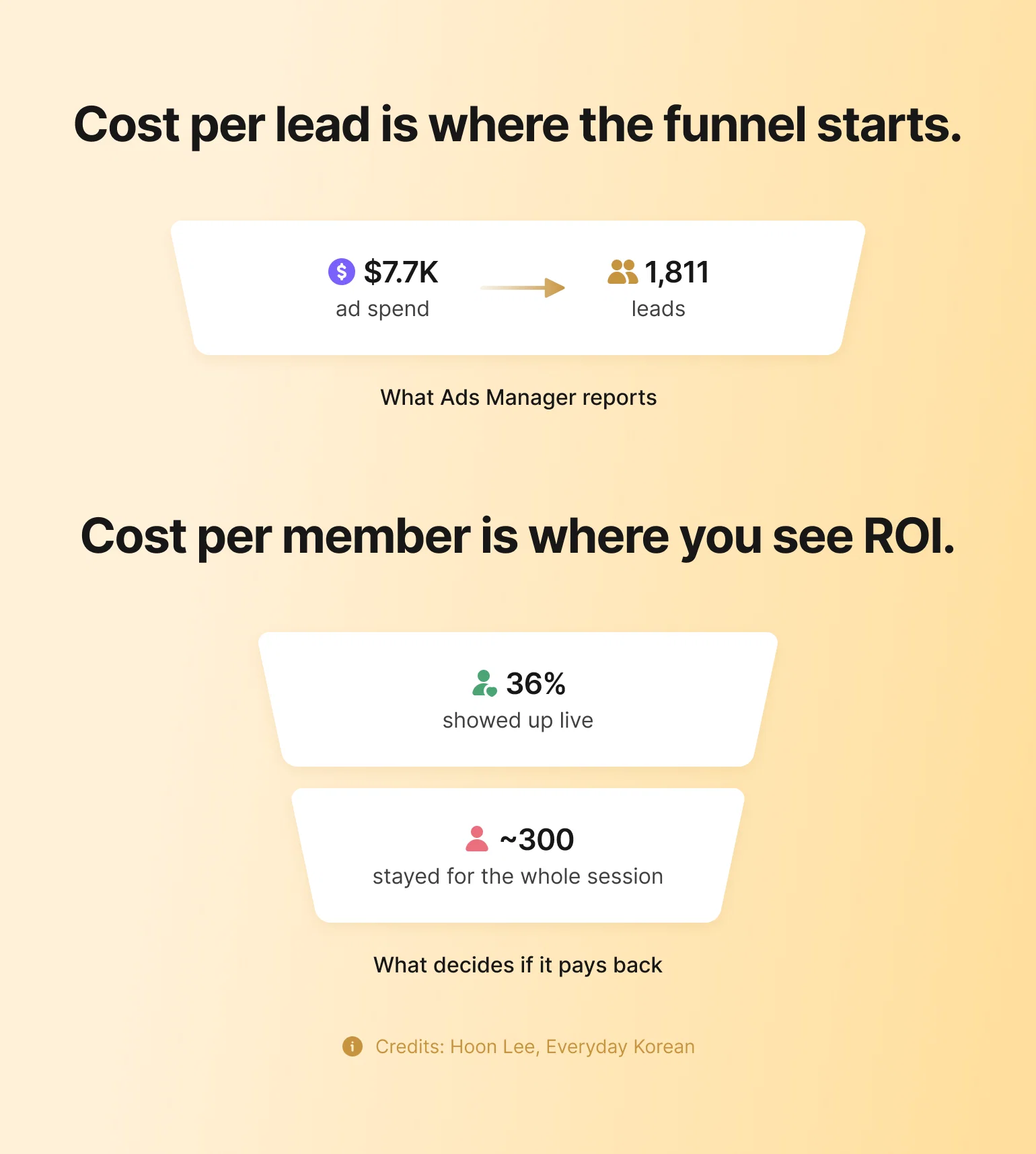
One workshop shows how the numbers stack up. Hoon spent $7.7K filling it and got 1,811 leads. Of those, 36% showed up, and roughly 300 stayed for the whole session. Every week, he checks three numbers to know whether the funnel is working: cost per lead, show-up rate, and conversion rate. Ads Manager reports the first one. The other two happen after the click, in your workshop and at your checkout, and they decide whether a lead becomes a member who pays back what you spent to find them.
Before you spend, work out what one member is worth and the most you can afford to pay for them. That ceiling tells you whether to test now or fix the funnel first. Here's how to set it and build a paid media strategy around it.
What are paid channels?
Paid channels are the places you pay to put your offer in front of people who don't follow you yet. That's what separates them from organic posts. Organic content can reach new people too, through recommendations, search, and shares, but the platform decides who sees it and when. With an ad, you choose the audience, the budget, and where people land after the click.
For a membership business, paid channels fall into five groups:
| Channel | What you're paying for | Works best when |
|---|---|---|
| Paid social (Instagram, Facebook, TikTok) | A spot in the feeds of people who match your targeting | Your message comes across in a short video and you have an easy first step, like a free workshop |
| Paid search (Google) | A spot at the top of results for the words people type | People already search for the problem you solve by name |
| Video ads (YouTube) | Ads that play before or alongside YouTube videos | Seeing how you solve the problem is your strongest proof |
| Sponsorships | A mention in someone else's newsletter, podcast, or channel | Another creator's audience overlaps with yours and trusts their picks |
| Retargeting | Ads shown to people who already visited your site or engaged with your content | People find you but leave before they buy |
Krista Ripma, founder of Authentic Audience, an agency that runs paid ads for community-led brands, and of The Authentic Business Club, a Circle community, shared her advice on where to advertise in a Circle workshop on scaling a community with paid ads. Krista’s numbers in this guide are rules of thumb from running ads for community-led brands, not studies.
She recommends starting with one channel. Each channel charges differently, and the unit you’re buying shapes your budget. On Meta (Instagram and Facebook), you typically pay per impression to show your offer to people who don’t know you yet but resemble your best members. On Google, you pay per click from people already searching for what you offer, which means higher intent and, she expects, somewhat higher costs. Her order: Meta first, then Google once people are actively searching for your solution, and expand beyond those two only when your funnel, creative, and tracking are working. Other channels charge per view, per conversion, or a flat fee, so the math changes the moment you leave clicks and impressions behind.
Hoon's funnel runs on one of these, paid social, and starting with a single channel is the approach the rest of this guide builds on.
What a paid media strategy has to coordinate
A paid media strategy is a plan for using paid channels to reach a defined audience, move them toward a specific offer, and measure whether the customers you get are worth what you paid. It ties together goals, audience, channel, creative, budget, funnel, and measurement so each campaign has one job. A campaign feels unpredictable when only two or three of those pieces get decided before launch and the rest get improvised once leads arrive.
Write the one-page brief
Before any money moves, put the plan on one page so every decision has a test to pass. Here's the brief for a $49-a-month membership that teaches conversational Spanish to adult beginners:
| Brief field | What to write |
|---|---|
| Objective | Members still active at month three |
| Audience | Adult beginners learning Spanish for travel or family |
| Entry offer | A free 60-minute workshop |
| First channel | Meta (Instagram and Facebook) |
| Campaign goal | Workshop registrations rather than purchases |
| Budget | A fixed amount for a seven-day test that you can afford to lose; your acquisition ceiling decides whether you scale it |
| Creative's job | Get adult beginners to register for the workshop |
| Decision metric | Cost per member still active at month three, compared against your ceiling: the most you can afford to pay |
| Gate | No second channel until the first brings in a three-month cohort at or below your ceiling |
Where paid, owned, and earned media fit
Your Meta ads put the workshop in front of Spanish learners who've never heard of you. After someone clicks, your owned media takes over: the registration page captures the opt-in, the email sequence sends reminders and the replay, and checkout takes payment. Earned media comes from current members—referrals, reviews, and word of mouth—and it supplies the trust an ad can't. If earned media is weak, your ads have to build all of that trust on their own, which gets expensive. The free channels in this guide to membership growth can build it first.
Build the business on what you own. Ad prices and algorithms can change overnight, but your email list, your community, and your checkout stay yours when they do.
Check whether your offer can carry paid traffic
Paid traffic amplifies an offer that already sells, which makes it an expensive way to find out whether anyone wants the offer at all. Before you spend, check three things: the offer, the funnel, and your ability to deliver and track.
Proof the offer sells
You have offer proof when all three of these are true:
- People already pay for the membership without ads, whether they find it through your email list, referrals, or your own posts.
- You can name specific results members have gotten, the kind you could put in an ad.
- New members keep giving you the same reason for joining, which tells you what your ads should say.
If your proof is likes, waitlist sign-ups, or warm replies, people are interested but haven't paid yet. Sell the offer to your existing audience first, then buy traffic for it.
Proof the funnel converts
Track six steps, in order:
- Landing-page visits: everyone who clicked an ad and saw the page.
- Opt-ins: visitors who registered for the workshop or downloaded your free resource.
- Attendance or engagement: registrants who showed up, watched the replay, or opened your follow-up emails.
- Purchases: people who joined the membership.
- Onboarding completion: new members who finished your welcome steps.
- First member outcome: members who reached the first result your membership promises.
For each pair of neighboring steps, check what share of people made it from one to the next. That shows you exactly where the funnel loses people.
Attendance is where many funnels leak. In Hoon’s workshop, 36% of registrants showed up live, so nearly two-thirds never saw the session as it happened. That’s why the replay email matters: it gives everyone who missed it a second chance to watch. Track your show-up rate alongside replay views, and once you know how many attendees buy, you can calculate your cost per member and set a budget.
The step that matters most before you spend is the one between a cold visitor and a purchase. Krista’s rule of thumb is that your sales page should turn at least 3% of cold website visitors into buyers before you point paid traffic at it. If clicks are cheap but sales aren’t coming, she says the problem is usually the page, the messaging, or the positioning rather than the ads, so fix those first. That applies to ads that send people straight to a sales page. Workshop funnels have six steps above.
Proof you can deliver and track
Ads can bring in a batch of new members at once, so check two things before you spend: that you can give all of them a good first week, and that you can follow each one from ad click to renewal.
Start with delivery. If 30 people join in the same week, can your community onboarding welcome each of them, answer their questions, and get them to a first win? If your onboarding depends on you personally greeting every new member, a paid campaign can overwhelm it.
Then check tracking. To know your cost per member who stays, you need to connect each person's ad click to their purchase, any refund, and their renewal three months later. When that data is split across a form builder, a payment processor, and an email tool, you end up matching names across spreadsheets, and the numbers stop adding up. Before you raise spend, run one test purchase and one test refund, then confirm you can pull up that test member's full history in one place.
If you can't connect those records yet, put the next dollar into community marketing with the members you already have. It grows the membership without depending on tracking every ad click.

Track your ad funnel on Circle
Work backward from what a member is worth
Ads Manager asks for a budget before it shows you a single result, so work out your ceiling first: the most you can spend to get one member who stays. It takes three numbers: how long the average member stays, what you keep from each payment, and how much of that you're willing to spend.
Find your ceiling
Here's the math for the $49-a-month Spanish membership:
| Step | Math | Result |
|---|---|---|
| How long the average member stays | From your own membership data | 10 months |
| What you keep each month | $49 minus about $9 in costs | $40 |
| What one member is worth | $40 × 10 months | $400 |
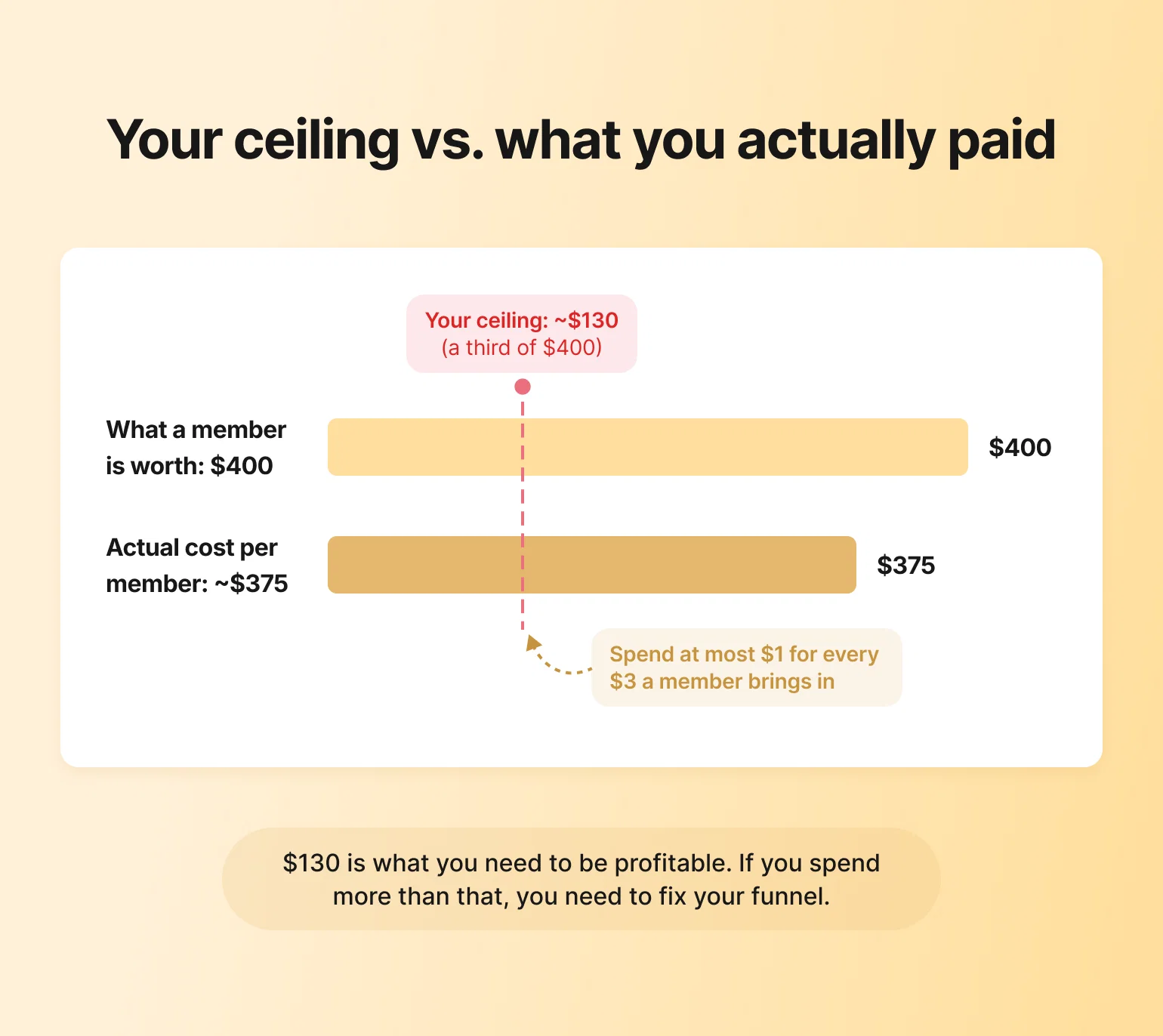
| Your ceiling: the most to spend to get one member | A third of what a member is worth: $400 ÷ 3 | About $130 |
For the first row, check what share of last month's paying members cancelled: if it was about 1 in 10, members stay around 10 months.
Two other rows need a closer look. The first is what you keep each month. Base it on what's left after costs, not the full $49, because software, payment fees, your time on calls, and guest experts all come out of each payment. The more live calls you run, the bigger that cut gets. If it leaves you too little, revisit your price. See how 55 paid communities price theirs, or compare seven pricing models.
The second is the ceiling itself: the most you'll pay in ads to get one member who stays. To set it, decide how much of that member's $400 you're willing to spend winning them. A common rule of thumb is a 3:1 ratio: spend at most a third, or $1 for every $3 a member brings in. That leaves room for members to leave sooner or ad costs to rise. If you want more cushion, spend a quarter instead.
With a ceiling of about $130, you have a number to hold every campaign against. Say you spend $1,500 on a test, and four of the people it brings in are still paying at month three. That’s $375 per member, nearly three times your ceiling, so the campaign isn’t ready to scale.
Your ceiling is the most you can spend, and your target should sit well under it. Krista’s rule of thumb is that a membership is scalable when winning a member costs about one to two months of your membership price. On a $49 membership, that’s roughly $49 to $98, comfortably under the $130 ceiling above. It measures the cost to win a member, not the cost per member still paying at month three, so run your own three-month review before you adopt it.
How long until you earn it back
The ceiling tells you how much you can spend on one member. Payback tells you how long that money is gone before it comes back. The two are different because ad spend leaves your account right away, while a monthly member repays it a little at a time.
At the ceiling, you'd spend about $130 to win a member who pays you $40 a month, so you'd get that money back after a little over three months. Every new batch of members you buy starts that wait over again, which means you need enough cash to keep running ads while earlier members are still paying you back. An annual plan shortens the wait, because the full year arrives at checkout.
Krista counts payback on gross revenue, which looks faster, so plan your cash on the net number. Before you raise your ad spend, check both numbers:
- Cost per member: are you paying at or below your ceiling? If not, too much of each member's value goes to winning them, and a small rise in ad costs or cancellations can tip you into a loss.
- Payback time: can you cover about three months of ad spend before it comes back to you? If not, the campaign can drain your cash even though it pays off eventually.
If either answer is no, pause and fix the funnel or the budget before you spend more.
Keeping members longer raises the ceiling. If the average member stays 20 months instead of 10, they're worth $800, and your ceiling roughly doubles to about $270. That's why the retention best practices that keep members longer also raise what you can afford to spend on each new one.
Plug your own numbers into the table above to find your ceiling.
Choose the shortest funnel your offer can support
How many steps your funnel needs depends on how much a buyer has to trust you before they pay. A low-priced offer can sometimes sell straight from an ad. A high-priced one needs more proof first, and every extra step—a workshop, a free community, a sales call—is one more stage your ad spend has to carry people through. Your ceiling decides how many of those steps you can afford.
If you’re still deciding which to build, our guide to coaching sales funnels compares them in more depth.
Sabby Bagga shows what a strong trust step looks like at the high end. His program costs $10K-plus, so prospects need real proof before they buy. He let them into a Circle community where they could see client wins and ask members questions before booking a sales call. Sabby Bagga added $60K in new business within three months that way, plus 200+ members, and prospects now arrive at calls already convinced. For paid traffic, the takeaway is to point your ads at a step that builds that kind of trust, rather than at a checkout buyers aren't ready for.
Lead-magnet funnel
A lead magnet is a free resource, like a guide or a mini-course, that people get in exchange for their email address, and your emails do the selling from there. It fits when people need a few weeks of hearing from you before they buy.
Krista names quizzes and seven-day challenges among the lead magnets that work best. A quiz that sorts people into a type and points them to a matching part of your membership gives you a reason to follow up.
The catch is that free resources are easy to say yes to, so you pay for plenty of leads who never buy, and only the ones who join and stay count toward your cost per member. If that cost climbs past your ceiling, improve your emails or your offer before you spend more on ads.
Webinar or challenge funnel
A live workshop or challenge fits when people need to see your expertise, or get a taste of your community, before they'll commit. They spend time with you live, and then you invite them to join.
Story School hit $100K in under a year this way. Its paid challenge costs $20 to $67 to join, each round brings in 50 to 80 people, and 10% to 15% of them buy the full membership, which now has 720 active members.
This format pairs well with ads for two reasons. The ticket covers part of your ad spend, and because the challenge runs again and again, new members arrive on a steady schedule instead of all at once during a yearly launch. When you calculate cost per member, count only the people who buy the membership, not everyone who bought a ticket.
Krista calls this the experience-led path: let people feel the value in a live session before you ask them to pay. Hoon’s 40/20/30 split, below, is that principle in practice.
Community tip: Hoon runs each Everyday Korean workshop in three parts: 40 minutes teaching Korean, 20 minutes presenting the membership, and 30 minutes of Q&A. By the time he makes the offer, attendees have already learned something useful from him.
Direct-to-offer funnel
Sometimes you can skip the trust step and send ads straight to your sales page. That only works when all three of these are true:
- People already know what kind of offer this is, so it doesn't need explaining.
- The price is low enough that someone can decide on the spot.
- Your sales page has already turned visitors into buyers.
If your sales page hasn't been tested yet, start with creating a landing page. If the price is high or the membership is something people haven't seen before, add a trust step like a workshop or a free community first. This guide to membership funnel strategy covers how to build one.
Krista’s version of this path pairs an easy first commitment, like a free trial, a $1 trial, a free first month, or a founding-member offer, with proof. The ad format that has converted best for her agency is the founder telling their own story on camera: why they started the community. If you don’t have that video pinned to your profile, she says to record it, because people follow people.
Run one test campaign and count the members it brings in
Once your funnel is ready, run one small test. Keep it simple: one campaign, one group of ads aimed at one audience, and three to six different ads, running for seven days. In Meta, that group of ads is called an ad set. Then judge the test on how many paying members it brings in, not how many leads.
Set up tracking before you spend
Tracking tells Meta which ads lead to sales, so it can show your ads to more people like your buyers. Set it up before your campaign goes live.
Meta can receive a sale two ways: from the browser with the Meta Pixel, or from a server with the Conversions API. Circle’s conversion tracking sends your sales through the Conversions API, so you don’t need a browser Pixel for purchases.
Circle now sends your sales to Meta for you. Connect your Pixel once in your paywall settings, and every purchase flows back to Meta through the Conversions API, so Meta learns which ads bring in paying members. It’s part of the October 2026 release.
- Create your Pixel. In Meta Events Manager, create a Meta Pixel and copy its ID.
- Generate an access token. In the same Pixel’s settings, create a Conversions API access token.
- Connect Circle. Go to Settings > Payments > Conversion tracking and paste in the Pixel ID and token.
- Test with a coupon purchase. Buy your own offer with a coupon code, then check that the sale shows up in Meta’s Test Events tool. (link: Test Events doc)
Optional: if you also want Meta to see page views and other browser activity, add your Pixel under Website > Code snippets. Paste the JavaScript into the JavaScript code snippets field without script tags, because Circle adds them. If your browser Pixel also fires a purchase event, give both versions of each sale the same event name and event ID, such as your order ID, so Meta counts it once.
Keep it to one ad set
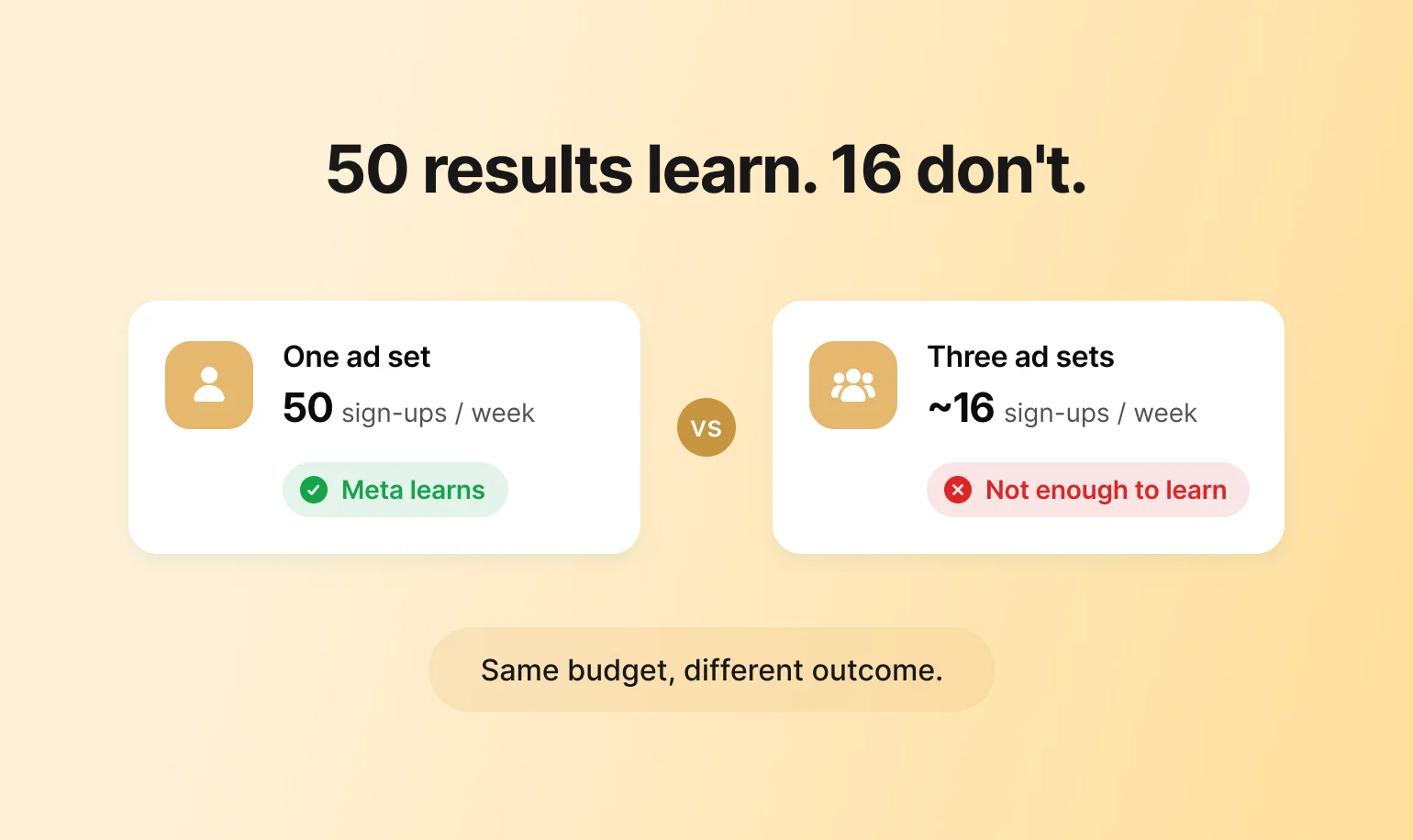
Meta learns who to show your ads to by watching who responds. It needs about 50 results, like 50 workshop sign-ups, in a week before it gets good at finding more of those people.
That's why splitting a small budget backfires. Say your budget gets you about 50 sign-ups a week. In one ad set, Meta sees all 50 and learns. Split that budget across three ad sets aimed at three audiences, and each one sees only around 16, so none of them learn.
The same goes for changes. A big budget change, or a new audience, ad, or goal, sends Meta back to the start. Once the test is running, leave it alone for the week.
Make each ad answer five questions
Before an ad goes live, Krista checks that it answers five questions:
- Who is this for?
- Why now?
- What changes when they join?
- Why should they trust you?
- What do they do next?
Then match the angle to the goal: “Get the free template…” for a list build, “Come to one free class…” for an experience, “Try the community free…” for a conversion, or “Stop building alone.” for belonging. For this guide’s seven-day test, the goal is workshop registrations, so the angle is experience-first.
Review the members at three months
Three months after the test, look at everyone who joined from the campaign as one group, and compare two numbers:
- What you paid per purchase: your ad spend divided by everyone who bought.
- What you paid per member who stayed: your ad spend divided by the people still paying at month three.
The second number is always higher, because some people cancel or get refunds along the way. It's also the one that matters. If it's under your ceiling, you can spend more. If it's over, fix the funnel first.
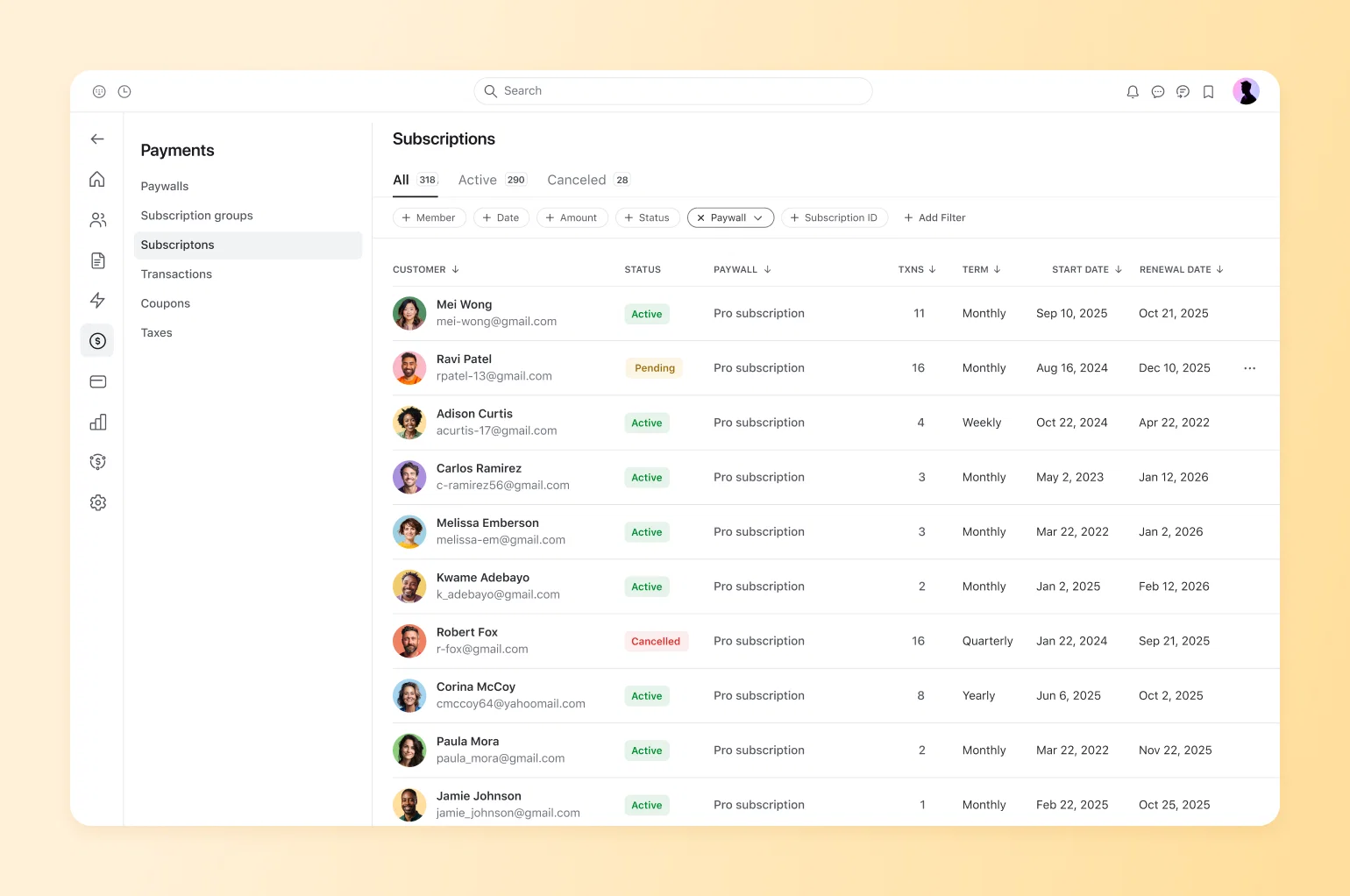
Community tip: To find that group later, give each campaign its own coupon code, like a small discount for workshop attendees. In Circle's Subscriptions dashboard, you can filter by coupon to see exactly which subscriptions came from that campaign.
Retention decides whether paid growth lasts
Every number in this guide depends on how long members stay. Your ceiling, your payback time, and whether a test campaign passes all come from it. So one of the best ways to afford more ads is to keep the members you've already paid for.
That starts in the first week. Someone who joined from an ad doesn't know you the way a referred member does, so give them the same quick first win, and a reason to stay past month one.
A community where members help each other does two jobs at once. TroopHR moved from a founder-led newsletter to a Circle community where members answer each other's questions. TroopHR holds 80%+ retention year over year, and 60% of its members now join through referrals. That kind of member advocacy brings in new members without ad spend, which lowers what you pay per member overall.
Krista puts it this way: ads are the front door, and the community is where people stay and belong.
Make paid media earn its place
Hoon Lee checks three numbers every week to know whether his workshop funnel is working. The same habit makes paid media affordable for any membership: know what a member is worth, know what you can pay to get one, and check whether each campaign brings in members who stay.
Start with what you already have. Prove the offer sells to your own audience, work out your ceiling, and run one seven-day test on one channel. Three months later, count who's still paying. If you paid less than your ceiling per member, spend more. If you paid more, fix the funnel before the next dollar goes in. Krista’s closing advice runs along the same lines: run the ads, build the list, own the relationship, and give people a reason to stay.
Your ceiling, your payback time, and your three-month review all depend on connecting an ad click to a purchase and a renewal. Circle’s conversion tracking sends each sale to Meta, and your community, checkout, and payments stay in one place, so you can see what a campaign cost per member who stayed instead of stitching together exports from three tools. Track your ad funnel on Circle.
Scale on one platform.
Paid media strategy FAQ
How much should you spend on your first test?
Enough for Meta to learn in seven days, and no more than you'd be comfortable losing. To size it, multiply what you expect to pay per registration by 50, since Meta needs about 50 results in a week to learn who to show your ads to. At $15 a registration, that's about $750 for the week.
How long should you wait before judging a test?
Judge it in two stages. After seven days, you can see which ads bring in registrations most cheaply and drop the weakest. Wait until month three to judge the campaign itself, because only then do you know who stayed. If Meta labels the ad set "Learning limited," it isn't getting enough results to learn; combine ad sets or switch the campaign goal to registrations, which happen more often than purchases.
Should you hire an agency or run ads yourself?
Run them yourself if you can set up tracking, make a few ads, and check your numbers each week. If you hire help, add the agency's fees to your ad spend before you work out cost per member. An agency charging $1,500 a month on a campaign that brings in ten members a month adds $150 per member, which is already more than the $130 ceiling in this guide's Spanish membership example before you've paid for a single ad.
What ad rules should membership creators watch for?
Meta's personal attributes policy bars ads that imply you know something personal about the viewer. "Are you struggling with anxiety?" gets flagged because it implies a health condition, while "Learn a weekly reflection practice" describes what's inside. Google's unreliable claims policy bars promises of big financial returns with little effort or investment. Describe what members do and get, and if you share a standout member result, say it's a standout.
Which paid channel should you start with?
Start where your audience already responds to your organic posts, because content that works there needs the least reworking to become an ad. Then check that the channel suits your entry offer. A free workshop needs a channel that can show a slice of what members get in a quick scroll, while a search ad needs a landing page that answers exactly what someon
Community Content Marketer
Arina is Circle’s community content marketer, sharing insights on community growth, GTM strategy, and storytelling for solopreneurs.